
 Worksheets
Labaids/Sepup Review
Total questions: 71
Worksheet time: 48mins
Select all that are raw materials for Photosynthesis.
Water
Carbon Dioxide
Oxygen
Sunlight (Light Energy)
Glucose (Sugar/food)
Select all that are products of Photosynthesis.
Water
Carbon Dioxide
Oxygen
Sunlight (Light Energy)
Glucose (Sugar/food)
What are the products of cellular respiration?
6 molecules of H2O and ATP
6 molecules of CO2, 6 molecules of H2O and ATP
1 molecule of glucose
1 molecule of glucose and 6 molecules of O2
Organisms that can produce their own glucose are known as
herbivores
heterotrophs
monotrophs
producers
The formula 6CO2 + 6H2O + light/enzymes ---> C6H12O6 + 6O2 refers to...
photosynthesis
fermentation
respiration
oxidation
What is another word for simple sugar?
Carbon
Carbohydrates
Glucose
Pepsin

Analyze the graphic above. What cellular process is occurring in the organelle labeled A?
Photosynthesis
Cellular Respiration
Chemosynthesis
Protein Synthesis

Analyze the graphic above. What cellular process is occurring in the organelle labeled B?
Photosynthesis
Cellular Respiration
Chemosynthesis
Protein Synthesis

Analyze the graphic above. What are the chemicals represented by the X?
H2O + O2
H2O + CO2
C6H12O6 + O2
C6H12O6 + CO2

Analyze the graphic above. Which of the following statements accurately names and describes the function of the organelle labeled A?
A mitochondrion produces energy from food to power cellular processes.
A mitochondrion produces food using radiant energy.
A chloroplast produces energy from food to power cellular processes.
A chloroplast produces food using radiant energy.

Analyze the graphic above. What are the chemicals represented by the Y?
H2O + O2
H2O + CO2
C6H12O6 + O2
C6H12O6 + CO2
Plants do photosynthesis, but NOT cell respiration?
True
False
Which of the following chemical equations properly demonstrates Cellular Respiration? Choose the BEST answer.
C6H12O6 + O2 --> H2O + CO2
H2O + CO2 -> C6H12O6 + O2
C6H12O6 + 6 O2 -> 6 H2O + 6 CO2
6 H2O + 6 CO2 -> C6H12O6 + 6 O2
Is cellular respiration done by all organisms? Even Plants?
Yes
No
Where does cellular respiration take place?
chloroplast
mitochondria
ribosomes
nucleus
If there is an increase of oxygen in your body what will happen to cellular respiration?
It will increase
It will decrease
How are cellular respiration and photosynthesis almost opposite processes?
Photosynthesis removes oxygen from the atmosphere, and cellular respiration puts it back.
Photosynthesis releases energy, and cellular respiration stores energy.
Photosynthesis removes carbon dioxide from the atmosphere, and cellular respiration puts it back.
all of the above
Producers are ...
plants
able to do photosynthesis
also called autotrophs
all of these are true
Arrows in a food web represent...
eating
sunlight
energy
matter
Photosynthesis is important because...
it makes carbon dioxide
it makes food for the food webs
it makes water
it's not important

Which of the following organisms is a primary consumer?
grass
rabbit
fox
snake
Which of the following organisms uses photosynthesis to get the energy it needs to survive?
grass
rabbit
fox
snake

What would happen to the rabbit population if the fox population moved out of the area represented by the food web?
The rabbit population would increase
The rabbit population would decrease
The rabbit population would neither increase nor decrease


In this energy pyramid, which organisms have the most energy available?
Producers
Carnivores
Herbivores
Top Predator

In this energy pyramid, which organism has the least amount of energy available?
Producers
Herbivores
Carnivores
Top Predator

Plants use ____________ to make their own food
Water
Sunlight
Carbon dioxide
All of these
What type of organism receives carbon present in dead plants and animals?
producer
primary consumer
secondary consumer
decomposer
Plants use CO2 in the process of __________ to make _________ and oxygen.
respiration, methane
photosynthesis, sugar
respiration, sugar
photosynthesis, methane

In this aquatic food web, which organism(s) eats the squid?
Seal and seagull
Blue whale
Seagull and krill
It has no predators

If the snake population decreased, which populations would increase as a result?
Birds and Frogs
Hawks and Frogs
Birds and Hawks
Frogs and Butterflies

Majority of the energy consumed by an organisms is:
stored in the tissues.
is available to the next trophic level.
is used to maintain life and loss as heat.
is accumulated as fat.
What is the efficiency of energy transfer between trophic levels of an ecological pyramid or a food chain?
90% since majority of the energy is made available to the next trophic level.
10% since majority of the energy consumed is used up by the organism.
90% since very little is lost as heat.
25% since this is the amount that is stored in the cells and tissues of the organism.

The diagram below shows a desert food web.
How will a large decrease in the number of rats impact the food web shown above?
There will be an increase in the number of ants, tarantulas, and snakes.
There will be an increase in the number of snakes, coyotes, and hawks.
There will be a decrease in the number of snakes, coyotes, and hawks.
There will be a decrease in the number of cacti and sagebrush plants.
The non-living parts of an organism's environment are called...
community
biotic factors
habitat
abiotic factors
Water, Sunlight, Oxygen and Soil are all parts of an organisms ______________ environment.
biotic
abiotic
living
Clive wants to estimate the number of bees in a beehive.
Clive catches 50 bees from the beehive.
He marks each bee with a dye.
He then lets the bees go.
The next day, Clive catches 40 bees from the beehive.
8 of these bees have been marked with the dye.
(i) Work out an estimate for the number of bees in the beehive.
350
250
220
400
There are N beads in a jar.
40 of these beads are black.
Julie takes at random a sample of 50 beads from the jar.
5 of the beads in her sample are black.
Work out an estimate for the value of N.
120
200
450
400

Is wind a biotic or abiotic factor?
biotic
abiotic

Is temperature a biotic or abiotic factor?
biotic
abiotic
All of the organisms of the same species living in the same geographic area?
Population
Community
Ecology
Species
The maximum number of organisms that can live in a population in a given area (birth rate and death rate are equal) is?
Population Density
Population
Carrying Capacity
Logistic Population Growth
An increase in population numbers until a point where the environment reaches the maximum number of organisms that can be supported is...
exponential population growth
logistic population growth

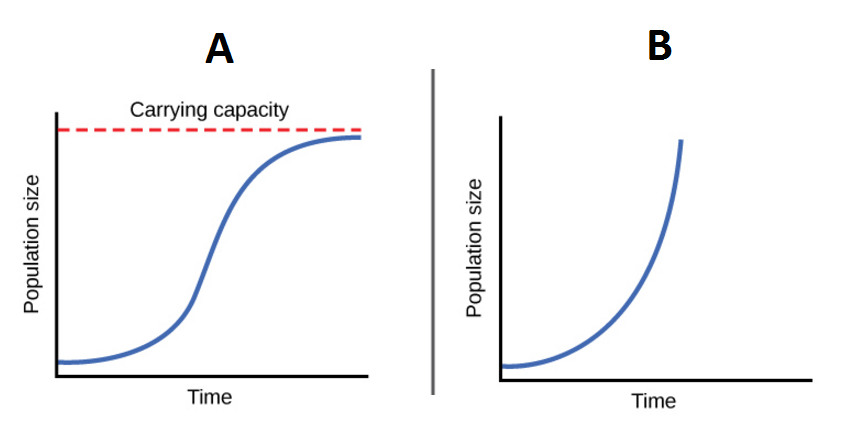
What type of growth model is shown in image B?
Exponential
Logistic
What type of growth model is shown in image A?
Exponential
Logistic
occurs when population slows or stops following a period of exponential growth.
no growth
population growth
logistic growth
exponential growth

Exponential Growth occurs when-
populations have plenty of food/space
home to keystone species
have few evasive species in a habitat
have little to no competition or predators

At what population was carrying capacity met?
250
1000
400
720

Exponential population growth can be described as
growth when resources are limited
a j-shaped curve
a s-shaped curve
growth that reaches carrying capacity
Logistic population growth can be described as
growth when resources are limited
a s-shaped curve
reaching carrying capacity
all of the above
What limits Population Growth?
birth rates increasing
resources being used up
natural selection taking place
none of the above
occurs when population slows or stops following a period of exponential growth.
no growth
population growth
logistic growth
exponential growth
Exponential Growth occurs when-
populations have plenty of food/space
home to keystone species
have few evasive species in a habitat
have little to no competition or predators

What might happen if the earth exceeds its carrying capacity?
There might not be room for people to move around.
There might not be enough food and water for everyone.
The continents might sink into the oceans.
Most of the people on the planet would starve.

Which of the following describes a population?
The total number of people, animals, and plants in New York City
The total number of apartments in New York City
The total number of people living in New York City
The amount of water in the Hudson River
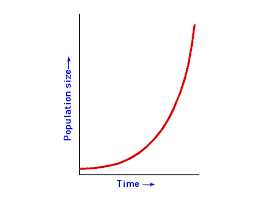
What type of growth is shown in the diagram?
exponential growth
logistic growth
predator-prey cycle
boom-bust curve
Largest number of individuals of a population that the environment can support...
carrying capacity
population
biome
mutualism
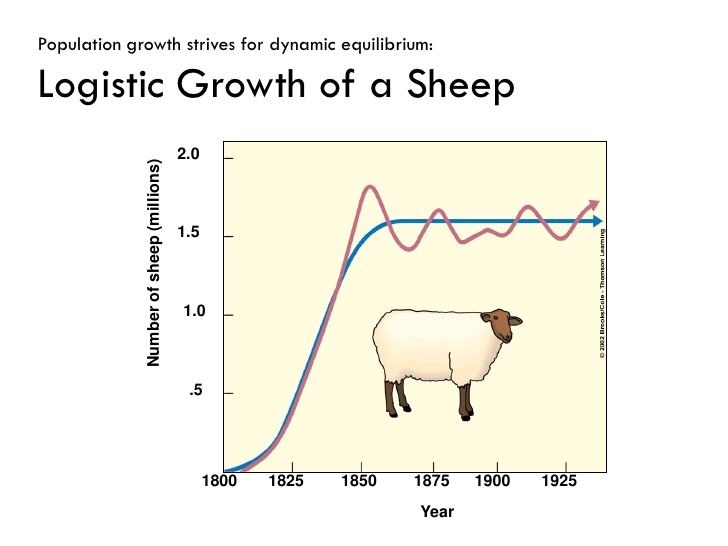
What is the carrying capacity for this sheep population?
2.0 million
1.0 million
1.6 million
0.5 million

Will competition increase or decrease the population of a species of animals?
Decrease
Increase

What point on the graph represents the carrying capacity?
A
B
C
D
When a population grows past the ecosystem's carrying capacity, what most likley happens to the population?
Continues to grow
The population starts to die off to return to carrying capcity
The population will go completely extinct due to lack of resources


