
 Worksheets
Bio2A final review #1
Total questions: 83
Worksheet time: 1hrs 6mins
Name
Class
Date
1.
Which is true of prokaryotic and eukaryotic cells?
a)
Prokaryotic cells are larger than eukaryotic cells.
b)
Eukaryotic cells do not have nuclei, and prokaryotic cells do have nuclei.
c)
Prokaryotic cells lack membrane-bound organelles, and eukaryotic cells contain membrane-bound organelles.
d)
Eukaryotic cells are simpler than prokaryotic cells.
2.

Type of cell shown?
a)
Eukaryotic
b)
Prokaryotic
c)
Bacterial
d)
Plant
3.
Proteins are produced at which cellular structures?
a)
nuclei
b)
ribosomes
c)
mitochondria
d)
chloroplasts
4.
Which of the following would be found in both eukaryotic AND prokaryotic cells?
a)
chloroplast
b)
cytoplasm
c)
nucleus
d)
endoplasmic reticulum
5.

Type of cell shown?
a)
Bacterial
b)
Prokaryotic
c)
Eukaryotic
d)
Red blood
6.
How are prokaryotes and eukaryotes similar?
a)
They both contain membrane-bound organelles.
b)
They both have cell membranes.
c)
The both have nuclei.
d)
They both have chloroplasts.
7.

a)
found only in plants
b)
contains chlorophyll
c)
produces energy
8.

a)
controls what enters and exits the cell
b)
contains chlorophyll
c)
thick and rigid
9.
a)
controls what enters and exits the cell
b)
contains chlorophyll
c)
thick and rigid
10.

a)
makes ribosomes
b)
storage for water
c)
breaks down worn out cell parts
11.

a)
where ribosomes are made
b)
receives proteins from ER and distributes them
c)
assembles amino acids into proteins
12.

a)
produces energy a cell needs
b)
where ribosomes are made
c)
packages amino acids and moves them out of the cell
13.

a)
assembles amino acids to create proteins
b)
control center of the cell
c)
capturesenergy from sunlight
14.
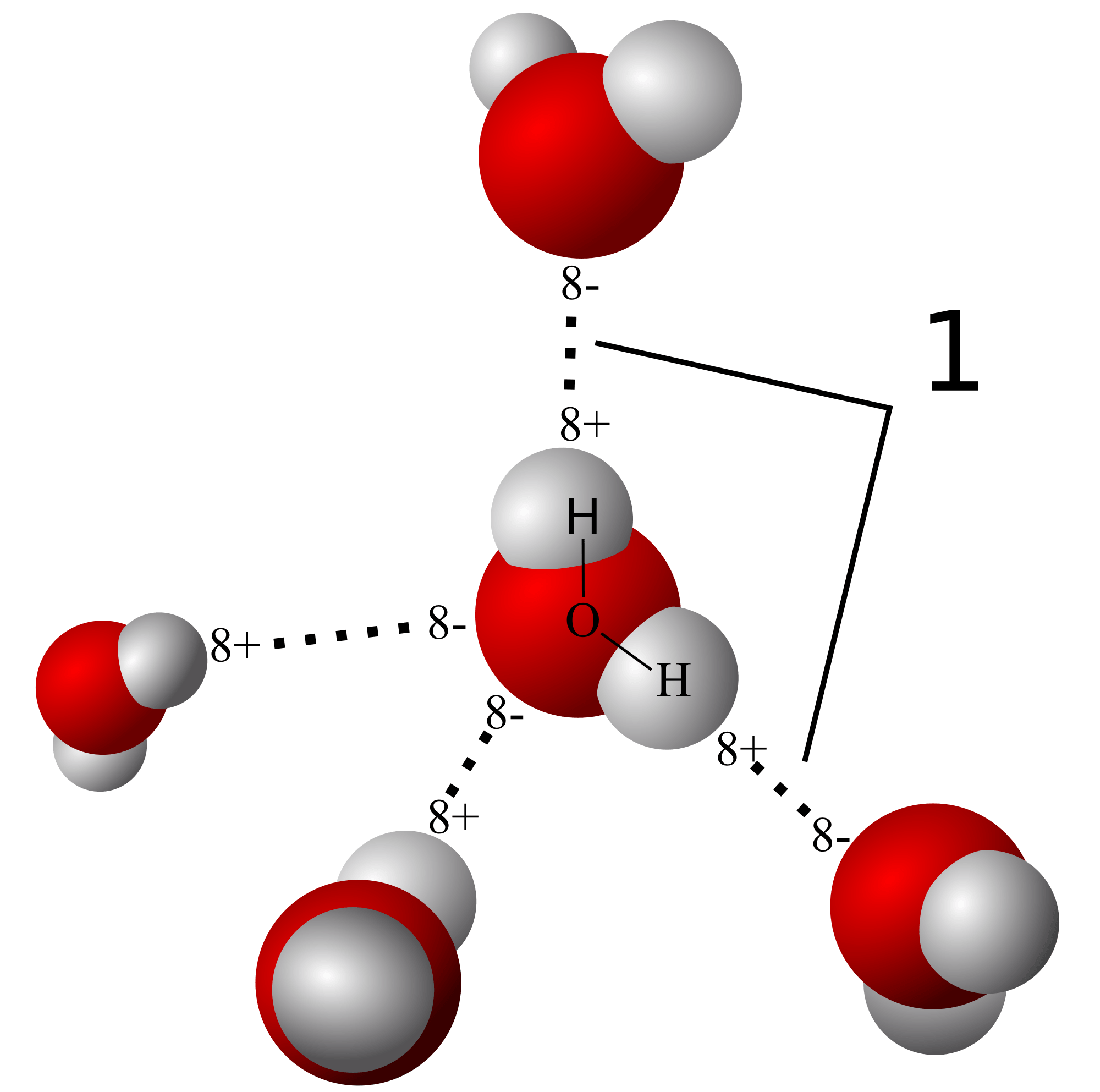
Attractions between water molecules are called
a)
Covalent bonds
b)
Ionic bonds
c)
Polar bonds
d)
Hydrogen bonds
15.
The pH scale is based off of the concentration of _________ ions.
a)
Oxygen
b)
Hydronium (H+)
c)
Nitrogen
d)
None of the others
16.
A solution that has a pH of 4 is how many times more acidic than a substance with pH 6?
a)
10x
b)
100x
c)
1000x
d)
2x
17.
Proteins are made of monomers called ___________
a)
Nucleotides
b)
Monosaccharides
c)
Amino Acids
d)
Glycerol and fatty acids
18.
DNA and RNA are examples of
a)
Carbohydrates
b)
Lipids
c)
Proteins
d)
Nucleic Acids
19.
Nucleotides are monomers of
a)
Carbohydrates
b)
Lipids
c)
Proteins
d)
Nucleic Acids
20.
Monosaccharides are monomers of
a)
Carbohydrates
b)
Lipids
c)
Proteins
d)
Nucleic Acids
21.
Glycerol and fatty acids are the monomers of
a)
Carbohydrates
b)
Lipids
c)
Proteins
d)
Nucleic Acids
22.

Which macromolecule is shown?
View Figure 1 (if not visible)
View Figure 1 (if not visible)
a)
lipid
b)
protein
c)
nucleic acid
d)
carbohydrate
23.
Hydrolysis literally means
a)
To join with water
b)
To split with oil
c)
To split with water
d)
To join with oil.
24.
What reaction is used to link monomers together to make polymers?
a)
Hydrolysis
b)
Dehydration Synthesis
25.
What is the energy needed to start a chemical reaction?
a)
Active Site
b)
Enzyme
c)
Activation Energy
d)
Exothermic Reaction
26.
Which chemical indicator test for proteins?
a)
Lugol’s (Iodine)
b)
Buriet Solution
c)
Benedicts
d)
Green paper
27.
What chemical indicator is used to test for Starch or Complex Carbohydrates?
a)
Benedicts
b)
Buriet Solution
c)
Lugol’s (Iodine)
d)
Green paper
28.
A scientist is attempting to test for carbohydrates and he/she added Benedict's solution. The test tube turned blue. Was there presence of the carbohydrates in the sample?
a)
yes
b)
no
29.
A scientist is attempting to test for proteins and he/she added Biuret solution. The test tube turned light blue. Was there presence of the protein in the sample?
a)
Yes
b)
No
30.
A scientist is attempting to test for proteins and he/she added Biuret solution. The test tube turned violet/purple. Was there presence of proteins in the sample?
a)
Yes
b)
No
31.
A scientist is trying to test a solution for sugars. What solution or indicator should he/she use?
a)
Lugol's (Iodine)
b)
Benedict's
c)
Biuret solution
d)
Sudan solution
32.
A scientist is trying to test for lipids. What indicator should he/she use?
a)
Benedict's
b)
Lugol's (Iodine)
c)
Biuret solution
d)
Green paper
33.
Which organ produces bile?
a)
liver
b)
pancreas
c)
small intestine
d)
gallbladder
34.
Which organ STORES the bile?
a)
liver
b)
colon
c)
pancreas
d)
gallbladder
35.
What process moves materials through the digestive tract efficiently?
a)
ingestion
b)
digestion
c)
peristalsis
d)
elimination
36.
Where does most digestion and absorption occur?
a)
stomach
b)
colon
c)
small intestine
d)
esophagus
37.
Carb digestion begins here.
a)
mouth
b)
small intestine
c)
large intestine
d)
stomach
38.

Tube that carries swallowed food to the stomach
a)
esophagus
b)
liver
c)
pancreas
d)
rectum
39.

The red organ is
a)
stomach
b)
small intestine
c)
large intestine
d)
liver
40.

What is structure A?
a)
Substrate
b)
Active site
c)
Enzyme
d)
Products
41.
Where do substrates bind on an enzyme?
a)
voltage-gated channels
b)
surface receptor
c)
calcium channels
d)
active site
42.
What is the purpose of an enzyme?
a)
give permission for the reaction
b)
raise activation energy
c)
speed up reactions
d)
control how many reactions occur
43.
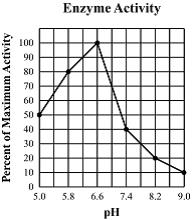
Which of the following conclusions can be drawn from this graph?
a)
The optimum pH of the enzyme is 6.6.
b)
The optimum pH of the enzyme is 5.8
c)
The enzyme’s activity increases as pH increases 5.0 to 9.0
d)
The enzyme’s activity is greater around pH of 8.0 .
44.
Enzymes are considered to be
a)
Lipids
b)
Carbohydrate
c)
Protein
d)
Nucleic Acid
45.

The graph shows how enzymes affect reactions in cells. Which statement best summarizes the information shown in the graph?
a)
Enzymes increase the energy of the reactants.
b)
Enzymes decrease the energy level of the products.
c)
Enzyme decrease the activation energy of the reaction.
d)
Enzymes reverse the direction of the reaction.
46.
What is a cataylst?
a)
A substance that speeds up a rate of chemical reaction.
b)
Molecules that make enzymes work harder and faster
c)
The reaction of an enzyme
d)
A substance that slows down a rate of chemical reaction.
47.
Adenine bonds with ______________.
a)
Guanine
b)
Thymine
c)
Cytosine
d)
Adenine
48.
Guanine bonds with ______________.
a)
Adenine
b)
Guanine
c)
Cytosine
d)
Thymine
49.
The process by which a DNA molecule is copied is called _____.
a)
binary fission
b)
mitosis
c)
DNA replication
d)
translation
50.
Which sequence of DNA bases would pair with this partial strand
ATG TGA CAG
ATG TGA CAG
a)
ATG TGA CAG
b)
TAC ACT GTC
c)
GTA AGT GAC
d)
CAT TCA CTG
51.
Before the cell divides, what process needs to happen?
a)
Transcription
b)
Translation
c)
DNA Replication
d)
Protein synthesis
52.

In which stage of the cell cycle does the nucleus and its contents divide?
a)
synthesis
b)
growth/gap 1
c)
mitosis
d)
growth/gap 2
53.

Which of the following phrases best describes cytokinesis?
a)
division of the cytoplasm
b)
division of the nucleus
c)
division of DNA
d)
division of surface area
54.

DNA is replicated during what phase of interphase?
a)
S
b)
G1
c)
M
d)
G2
55.
Which of the following shows the correct sequence of the cell cycle?
a)
Mitosis-> G1->S->G2->cytokinesis
b)
S->G1-> G2-> mitosis-> cytokinesis
c)
cytokinesis->mitosis->G1->S->G2
d)
G1->S->G2->mitosis->cytokinesis
56.
This enzyme is responsible for breaking the Hydrogen bonds between the Nitrogen bases
a)
Helicase
b)
Gyrase
c)
DNA Polymerase
d)
Ligase
57.
Seals the Okazaki fragments together
a)
DNA Polymerase
b)
ligase
c)
helicase
d)
primase
58.

Fruit fly body cells have 8 chromosomes. After mitosis, you would expect a resulting fruit fly daughter cell to have ...
a)
16 chromosomes.
b)
46 chromosomes.
c)
8 chromosomes.
d)
4 chromosomes.
59.

Structure (b) is a ____.
a)
chromosome
b)
chromatid
c)
centromere
60.

Name the phase:
a)
Anaphase
b)
Telophase
c)
Metaphase
d)
Prophase
61.

The organelle that helps in cell division and produces spindle fibers.
a)
Chromosome
b)
Centriole
c)
Cytoplasm
d)
Chloroplast
62.
Process in which cells become specialized in structure and function
a)
Definition
b)
Distinction
c)
Tarnation
d)
Differentiation
63.
Developing stage of a multicellular organism
a)
Cell
b)
Embryo
c)
Cub
d)
Baby
64.
What did Erwin Chargaff conclude from his experiments?
a)
Nitrogen bases are held together by peptide bonds
b)
A and T, C and G always occur in equal amounts
c)
Proteins are the carriers of genetic information
d)
C and G rarely occur in eukaryotic organisms
65.
What kind of mutation is the result of an insertion?
a)
Silent Mutation
b)
Missense mutation
c)
Nonsense mutation
d)
Frameshift mutation
66.
What mutation has occurred here?
T-G-A-C-C-A
T-G-A-G-C-A
T-G-A-C-C-A
T-G-A-G-C-A
a)
Substitution
b)
Deletion
c)
Insertion
d)
Frameshift
67.
Oncogenes, proto-oncogenes and tumor suppresor genes can all cause which disorder when faulty?
a)
sickle cell anemia
b)
cancer
c)
downs syndrome
d)
Turner syndrome
68.
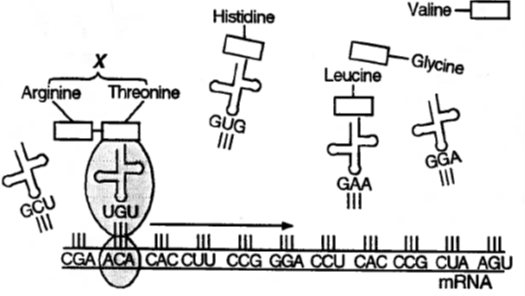
What process is going on in this photo?
a)
Transcription
b)
Translation
c)
Replication
d)
All the above
69.

The mRNA leaves the ________ to find the ribosome to make proteins.
a)
cell
b)
nucleotide
c)
nucleus
70.
The process to go from DNA to mRNA is _______
a)
translation
b)
transcription
c)
replication
71.
DNA holds the code for
a)
lipids
b)
carbohydrates
c)
protein
d)
sugar
72.
Choose the nucleotide sequence of the RNA strand that would be complementary to the following strand:
GTAGTCA
GTAGTCA
a)
UATUAGA
b)
ACGACTG
c)
CAUCAGU
d)
CATCAGT
73.

Transcription is a process that in eukaryotic cells takes place in the:
a)
Nucleus
b)
Cytoplasm
c)
Golgi Apparatus
d)
Rough E.R.
74.
RNA is read in sections called:
a)
Triplets
b)
Genes
c)
Codons
d)
Genes
75.

The enzyme that produces RNA in Transcription is called
a)
RNA Polymerase
b)
DNA Polymerase
c)
Transcriptase
d)
RNA Intrase
76.
A tRNA that carries the amino acid methionine pairs with which type of codon?
a)
serine codon
b)
tRNA codon
c)
start codon
d)
anticodon
77.
What would happen if we did not have start codons?
a)
Polypeptide chains would continue to grow
b)
Amino acids would bind to tRNA
c)
Protein synthesis wouldn't occur
d)
mRNA would form a double strand
78.

What amino acid is represented by the codon CAG?
a)
Aspartic Acid
b)
Histidine
c)
Glutamine
d)
Methionine
79.
Which viral life cycle kills its host cell by lysing?
a)
lytic
b)
mitosis
c)
lysogenic
d)
S phase
80.
Which viral life cycle allows viral genetic material to lay dormant while the host cell reproduces?
a)
lytic
b)
mitosis
c)
lysogenic
d)
S phase
81.

The genetic material of a virus is in the form of
a)
RNA
b)
DNA
c)
either RNA or DNA
82.

What process is this?
a)
phagocytosis
b)
lytic cycle
c)
lysogenic cycle
d)
formation of antibodies
83.
Which enzyme can convert RNA to DNA in the HIV virus?
a)
DNA helicase
b)
RNA polymerase
c)
Reverse transcriptase
d)
DNA ligase
100 %

