wayground logo

Free Printable Worksheets

Font size

S
M
L
XL
Worksheets

Bio End of Year Test

Total questions: 88

Worksheet time: 2hrs 6mins
Name
Class
Date
1.
One of the threadlike structures in the nucleus of a cell that contain directions for the cell's activities
a)
variation
b)
pedigree
c)
DNA
d)
chromosome
2.
Deoxyribonucleic acid, a long, complex molecule that controls heredity
a)
inherited trait
b)
chromosome
c)
DNA
d)
pedigree
3.
The study of Heredity
a)
science
b)
genetics
c)
english
d)
gene
4.
The hidden form of an inherited trait
a)
dominant trait
b)
recessive trait
c)
purebred
d)
hybrid
5.
The form of an inherited trait that masks the other form of the same trait.
a)
dominant trait
b)
recessive trait
c)
purebred
d)
hybrid
6.
A homozygous dominant dog with brown fur is crossed with a heterozygous dog with brown fur. What are the percentages of the possible genotypes?
a)
100% BB
b)
75% BB and 25%Bb
c)
50 % BB and 50% Bb
d)
50% Bb and 50% bb
7.
Genotype refers to the ...
a)
physical expression of the genes
b)
the possible combination of alleles in a gene
c)
whether an allele is dominant or recessive
d)
how an organism will appear
8.
An offspring will receive how many alleles from each parent to determine a specific trait?
a)
one
b)
two
c)
three
d)
five
9.
Which of the following is a phenotype?
a)
BB
b)
Bb
c)
bb
d)
Blue eyes
10.
having two of the same genes for the trait (sometimes called purebred).
a)
homozygous
b)
hetrozygous
c)
protein
d)
chromosome
11.
having two different genes for a trait (sometimes called hybrid).
a)
protein
b)
homozygous
c)
heterozygous
d)
genotype
12.
Two brown eyed parents (Bb) have a baby. What is the chance the baby is blue eyed?
a)
0 %
b)
25%
c)
50%
d)
75%
13.
G = green, g = yellow
The genotype for a yellow plant is...
a)
GG
b)
Gg
c)
gg
d)
all of the choices result in yellow
14.
Two heterozygous (Tt) tall pea plants are crossed. Which describes their offspring?
a)
50% tall and 50% short
b)
75%tall and 25% short
c)
100%short
15.
W=white hair
w= non-white hair
If you cross a horse with WW and a horse with ww what fraction of the offspring would be expected to have white hair?
a)
none
b)
3/4
c)
1/2
d)
all
16.

The process by which the nuclear material is divided equally between two new cells

a)

mitosis

b)

cancer

c)

spindle

d)

centromere

17.
Why would it be important to replicate DNA before a cell divides in mitosis or meiosis?
a)
In order for genetic information to be transferred into daughter cells.
b)
In order for the cell to be able to increase in size.
c)
In order for the DNA to be contained in the nucleus.
d)
In order for the cell to re-order the DNA sequencing in the new cells.
18.
In mitosis, the two resulting cells are
a)
different from the starting cell and identical to each other.
b)
different from the starting cell and different from each other.
c)
identical to the starting cell and different from each other.
d)
identical to the starting cell and identical to each other.
19.
The time between cell divisions in the life cycle of the cell is called
a)
anaphase
b)
interphase
c)
prophase
d)
metaphase
20.
A chromosome is a single, long DNA molecule in a compact formation
a)
True
b)
False
21.
Unlike mitosis, meiosis in male mammals results in the formation of
a)
one haploid gamete
b)
three diploid gametes
c)
four diploid gametes
d)
four haploid gametes
22.
If a body cell in a butterfly contains 24 chromosomes, a butterfly egg would contain
a)
3
b)
6
c)
12
d)
24
23.
Name the growth phase of the cell cycle for both Mitosis and Meiosis.
a)
metaphase
b)
telophase
c)
interphase
d)
anaophase
24.
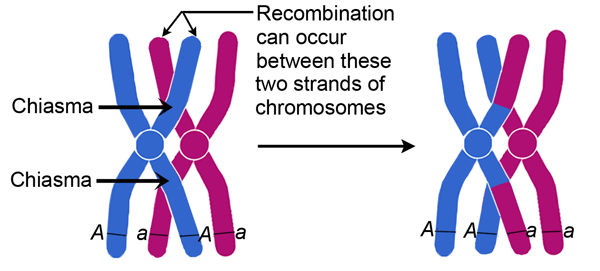
This image shows chromosomes during Prophase 1. Which of the following correctly describes the process shown?
a)
segregation of sister chromatids
b)
condensation and segregation of alleles
c)
mutationin which the DNA content of the gene is altered
d)
crossing - over in which alleles are exchanged
25.
Looking at the cell cycle diagram, what stage is represented by the letter C?
a)
Growth 1
b)
Synthesis
c)
Growth 2
d)
Mitosis
26.
What is the purpose of G2? 
a)
For the cell to rest
b)
For the cell to do its normal functions
c)
For the cell to prepare for mitosis
d)
For the cell to divide
27.

Sexual reproduction requires _____ parent(s) and asexual reproduction requires ___ parent(s).

a)

1,1

b)

2,2

c)

2,1

d)

1,2

28.

What type of cells undergo mitosis?

a)

all body cells

b)

only gametes (sex cells)

29.

Meiosis results in genetically ____________ offspring.

a)

different

b)

identical

c)

all

30.

This process creates new cells

a)

mitosis

b)

meiosis

c)

both mitosis and meiosis

31.

Sections of DNA on a chromosome that contain instructions for making specific proteins are called

a)

codons

b)

nucleotides

c)

genes

32.

The order of stages in mitosis is

a)

interphase, prophase, anaphase, telophase

b)

telophase, anaphase, metaphase, cytokinesis

c)

prophase, metaphase, anaphase, telophase

33.

One side of DNA is TTACGACT. Based on what you know about how nitrogen bases pair, choose the set of bases that would be on the other side.

a)

CCTGATGC

b)

GGCATCAG

c)

AATGCTGA

34.

Any permanent change in a gene or chromosome in a cell

a)

malignancy

b)

meiosis

c)

mutation

35.

What is the genetic material that carries

information about an

organism from one generation to the next.

a)

nitrogen base

b)

DNA

c)

RNA

36.
In the S stage of interphase_______________
a)
the cell grows
b)
the nucleus divides
c)
the cell membrane divides
d)
the DNA is replicated
37.
Which of the following shows the correct sequence of the cell cycle?
a)
Mitosis-> G1->S->G2->cytokinesis
b)
S->G1-> G2-> mitosis-> cytokinesis
c)
cytokinesis->mitosis->G1->S->G2
d)
 G1->S->G2->mitosis->cytokinesis
38.
Which of the following occurs during the interphase stage of the cell cycle?
I. DNA is replicated.
II. The cell divides.
III. The cell grows in size.
a)
I and III only
b)
I, II, and III
c)
II only
d)
I and II only
39.
How are the processes of mitosis and meiosis similar to each other?
a)
Both processes result in the same number of cells produced.
b)
Both processes begin with similar events, including chromosome replication.
c)
Both processes involve only one division of cellular materials.
d)
Both processes end with the same number of chromosomes present in each cell.
40.

The cellular process of creating two new DNA molecules from one original copy is called replication. Which statement is the BEST description of this process?

a)

DNA opens up and RNA copies it.

b)

DNA opens up and completely unwinds to make two new molecules.

c)

DNA opens up and each strand is used as a template for a new strand.

d)

RNA opens up the DNA and uses each strand as a template for a new strand.

41.

Which of these statements is true about plant and animal cells during the process of cell division?

a)

Both animal and plant cells develop a cell plate.

b)

Both animal and plant cells develop a cleavage furrow.

c)

Plant cells develop a cell plate while animal cells develop a cleavage furrow.

d)

Animal cells develop a cell plate while plant cells develop a cleavage furrow.

42.

Which of the following is part of nucleotides?

a)

5- carbon sugar

b)

phosphate group

c)

nitrogenous base

d)

All of the above.

43.
Adenine bonds with ______________.
a)
Guanine
b)
Thymine
c)
Cytosine
d)
Adenine
44.
Guanine bonds with ______________.
a)
Adenine
b)
Guanine
c)
Cytosine
d)
Thymine
45.
Why is DNA important?
a)
it is very small and very complicated
b)
it's in everything
c)
it serves as the blueprint for traits of all living things
d)
because we eat it every day for energy
46.
Which of the following monomers are repeatedly joined together to form a strand of DNA?
a)
amino acids
b)
nucleotides
c)
fatty acids
d)
polysaccharides
47.
What determines the code, or information, of a DNA molecule?
a)
the shape (structure) of the nitrogen bases
b)
the order (sequence) of the nitrogen bases
c)
the color of the nitrogen bases
d)
the frequency (number) of nitrogen bases
48.

What do genes do?

a)

make proteins

b)

store energy

c)

create covalent bonds

d)

create hydrogen bonds

49.

DNA is shaped in a:

a)

double helix

b)

tightly packed swirl

c)

twisted ladder

d)

nucleotide

50.

antiparallel stands of nucleotides run in:

a)

opposite directions

b)

the same direction

c)

base pairs

d)

chromosomes

51.

In which phase does the DNA copy itself?

a)

interphase

b)

metaphase

c)

anaphase

d)

telophase

52.

In which phase do the chromosomes line up?

a)

prophase

b)

metaphase

c)

anaphase

d)

telophase

53.

In which phase do the chromosomes form?

a)

prophase

b)

metaphase

c)

anaphase

d)

telophase

54.

In which phase do the chromatids split apart?

a)

prophase

b)

metaphase

c)

anaphase

d)

telophase

55.

In which phase do new nuclear membranes form?

a)

prophase

b)

metaphase

c)

anaphase

d)

telophase

56.

A process in which DNA has the unique ability to make an exact copy of itself.

a)

Replication

b)

Translation

c)

Transcription

d)

Protein Synthesis

57.
Who was given credit for determining the shape of DNA? 
a)
Avery
b)
Watson and Darwin
c)
Watson and Crick
d)
Franklin and Crick
58.

Differences in traits such as hair texture are determined by differences in-

a)

the location of sugar groups in DNA

b)

the sequence of nucleotides in DNA

c)

the number of nitrogenous bases in DNA

d)

the molecules attached to the phosphate in DNA

59.

What strand of DNA matches

a)
b)
c)
d)
60.

Characteristics such as widow's peak or attached earlobes are determined by the genetic code. What components of DNA are referred to as the genetic code?

a)

Phosphate groups

b)

Nitrogenous bases

c)

Deoxyribose sugars

d)

Hydrogen bonds

61.

How does DNA in cells determine an organism's complex traits?

a)

DNA contains codes for proteins, which are necessary for the growth and functioning of an organism

b)

DNA separates into long single strands that make up each part of an organism

c)

DNA produces the energy an organism needs to grow

d)

DNA folds into the nucleus of each of the cells organism

62.
DNA replication results in two DNA molecules,
a)
each one with two original strands
b)
each one with two new strands
c)
each one with one new strand and one original strand
d)
one with two new strands and the other with two original strands
63.
What type of RNA carries the DNA message out of the nucleus to the ribosomes?
a)
mRNA
b)
tRNA
c)
RNA
d)
DNA
64.
What do we call the process of turning DNA into mRNA?
a)
Translation
b)
Transcription 
c)
Replication
65.
Amino acids are the building blocks of... 
a)
DNA
b)
RNA
c)
Atoms
d)
Proteins
66.
What is a Codon?
a)
4 base pairs that transfer to amino acids
b)
3 base pairs that transfer to amino acids
c)
3 base pairs that transfer to DNA
d)
3 base pairs that transfer to mRNA
67.
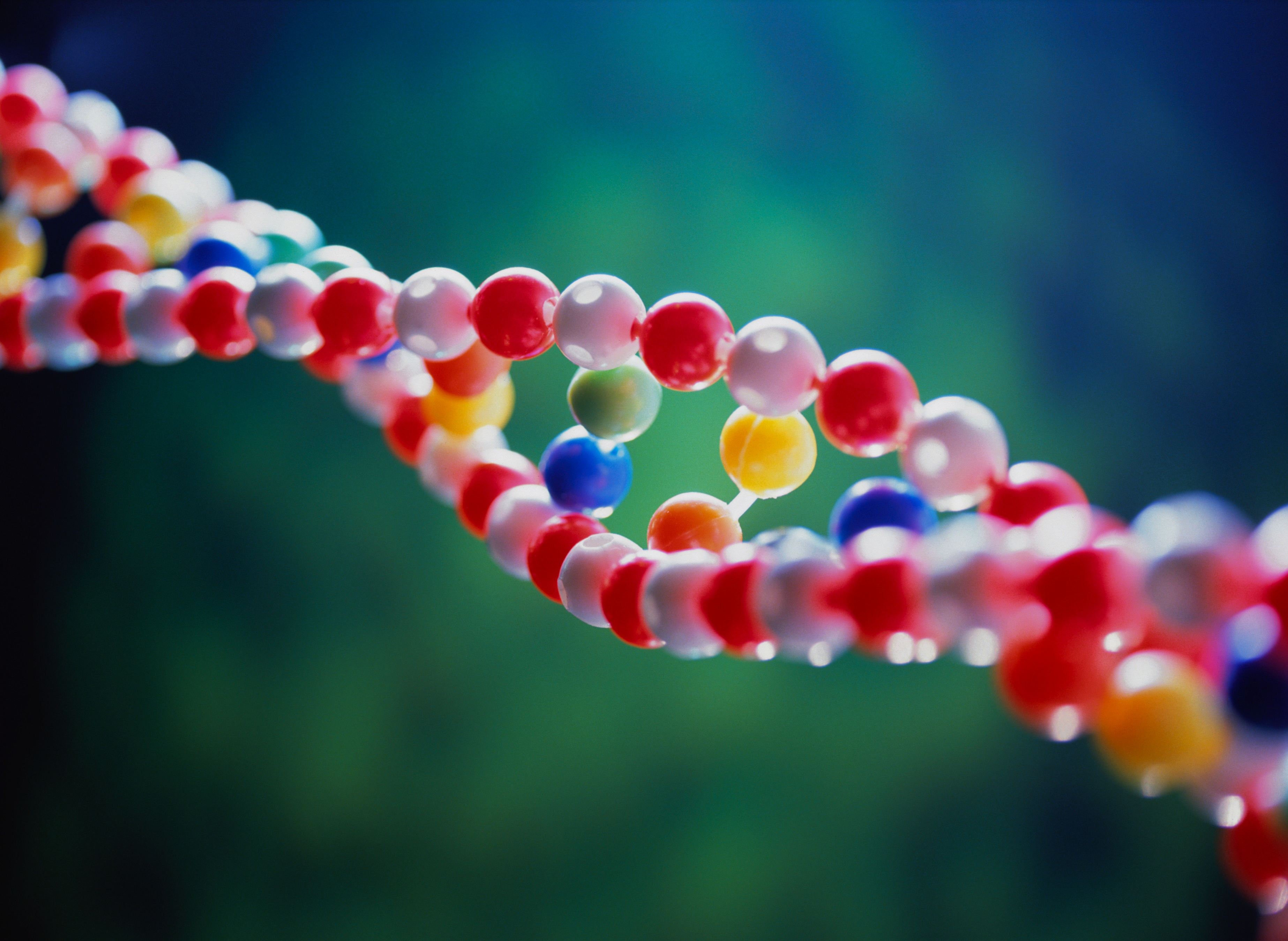
What process is occurring in this photo?
a)
Transcription
b)
DNA unwinding
c)
Translation
d)
Transfer RNA is creating bases
68.
Where does Translation occur?
a)
Proteins
b)
Mitochondria
c)
Ribosomes
d)
Cytoplasm
69.
One difference between DNA and RNA is that....
a)
Only RNA has the base Uracil
b)
only RNA contains the base Thymine
c)
only RNA contains the base Cytocine
d)
only RNA contained the base Guanine
70.
What is true about RNA?
a)
It is indestructible
b)
It can travel outside of the nucleus
c)
It has five nucleotides
d)
It contains twice as much thymine as DNA
71.
What is the correct order?
a)
Transcription then Translation
b)
Translation then transcription
c)
Translation then replication
d)
Replication then Translation
72.
What is the correct sequence?
a)
RNA --> DNA --> Protein
b)
Protein --> RNA --> DNA
c)
DNA --> RNA --> Protein
d)
DNA --> Protein --> RNA
73.
What is the relationship between a protein, the cell, and DNA?
a)
DNA is produced by protein which is produced in the cell
b)
Protein is composed of DNA which is produced in the cell
c)
DNA makes RNA which produces protein in the cell
d)
A cell is composed of DNA and protein
74.
What is the longest stage of the cell cycle called?
a)
Cytokinesis
b)
M phase
c)
Interphase
d)
G1 Phase
75.
During what phase of the cell cycle is DNA replicated?
a)
G1 phase
b)
S phase
c)
G2 phase
d)
M phase
76.
During what phase of the cell cycle does the cell grow?
a)
G1 phase
b)
S phase
c)
M phase
d)
Cytokinesis
77.
During what phase of the cell cycle does the cell prepare for mitosis?
a)
G1 phase
b)
S phase
c)
G2 phase
d)
M phase
78.

_____ is the uncontrolled growth of cells, often resulting in a tumor or mass of abnormal cells

a)

Cancer

b)

Apoptosis

c)

Radiation

79.

Apoptosis is

a)

programmed cell death

b)

mysterious cell death

c)

programmed cellular mutation

d)

mysterious cellular mutation

80.

If you look at a cell under a microscope, which phase is it MOST likely to be in?

a)

Cytokinesis

b)

M phase

c)

Interphase

d)

G1 Phase

81.
If the Diploid number of Carrots is 18, the haploid number is
a)
18
b)
9
c)
27
d)
36
82.
Which of the following phrases best describes cytokenesis
a)
division of the cytoplasm
b)
division of the nucleus
c)
division of DNA
d)
division of surface area
83.
What does NOT happen during interphase?
a)
growth
b)
DNA replication 
c)
obtaining nutrients
d)
cell divison
84.

Which of the following genotypes is homozygous dominant?

a)

Yy

b)

yY

c)

yy

d)

YY

85.

What are the phenotype percentages of the offspring?

(A-Brown fur color; a-white fur color)

a)

50 % Brown fur and 50% White fur

b)

25 % Brown fur and 75% White fur

c)

75 % Brown fur and 25% White fur

d)

0% Brown fur and 100% White fur

86.
In rabbits, black fur (B) is dominant over brown fur (b). If a rabbit has brown fur, what can you conclude about its genotype?
a)
It is BB.
b)
It is Bb
c)
It is brown
d)
It is bb.
87.
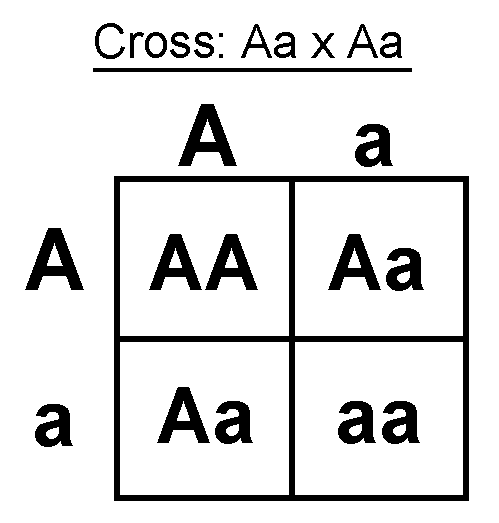
This punnett square shows a cross between
a)
A hybrid Parent and a Homozygous parent
b)
A heterozygous parent and a heterozygous parent
c)
Two homozygous parents
d)
Two Hybrid Parents
88.
Why are there no white rabbit babies?
a)
The white gene is not present in any of the babies.
b)
It takes two recessive genes to show the trait.
c)
Grey is a better color.
d)
Baby five will be white.