
 Worksheets
Cell Processes!
Total questions: 44
Worksheet time: 2hrs 1mins
Which type of biological macromolecule is the main component of the plasma membrane?
carbohydrate
lipid
protein
nucleic acid
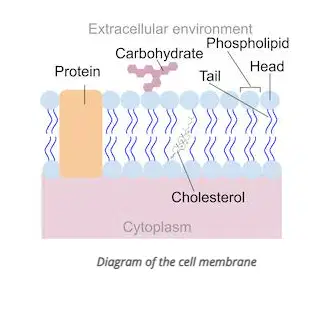
It allows the cell to interact with it's environment
It is semipermeable
Has a phospholipid bilayer
synthesizes proteins
1.) They act like gatekeepers, only let certain things in.
2.) Enzyme receptors embedded in the membrane.

This image is an example of a phospholipid. Which part of a phospholipid is HYDROPHOBIC?
the phosphate "head"
the lipid "tails"
This image is an example of a phospholipid. Which part of a phospholipid is HYDROPHILIC?
the phosphate "head"
the lipid "tails"
The organic molecule that is the cell's primary form of energy?
Glucose
ATP
ADP
GMP
Students are observing particles moving against the concentration gradient in a lab investigation. Which type of transport are they observing?
osmosis
active Transport
facilitated diffusion
diffusion
Students are observing particles moving with the concentration gradient in a lab investigation. Which type of transport are they observing?
using pumps to move things quickly
passive transport
osmosis
endocytosis

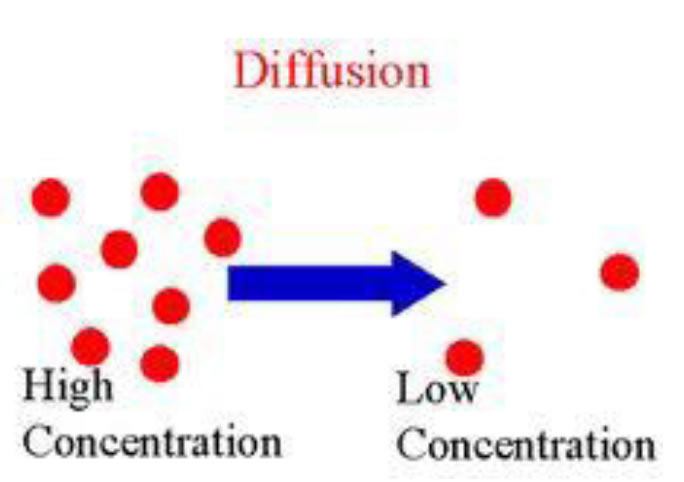
This picture shows molecules of red dye that have moved. What is this type of movement called?
Osmosis; the water molecules are moving from high concentration to low
Diffusion; the dye molecules are moving from low to high concentration
Diffusion; the dye molecules are moving from high to low concentration.
Facilitated diffusion; because the molecules are moving through a protein channel.
The cell membrane is responsible for allowing molecules to diffuse through a protein channel, from high concentration to low concentration. What type of transport is this?
Passive Transport
Active transport

This picture is a representation of what type of transport?
Osmosis because it is diffusing through a protein from an area of high concentration to low concentration.
Facilitated diffusion because it is diffusing through a protein from an area of high concentration to low concentration.
Facilitated diffusion because it is diffusing through a protein from an area of low concentration to high concentration.
Simple diffusion because it is diffusing through a protein from an area of high concentration to low concentration.

This picture describes the movement of molecules across the cell membrane. Choose 2 answers that correctly describes the movement of the molecules.
Molecules are moving up the concentration gradient.
Molecules are moving from an area of low concentration to area of high concentration .
Molecules are moving down the concentration gradient.
Molecules are moving from an area of high concentration to area of low concentration.

This a picture of an animal and plant cell placed in a solution. Describe the solution?
Isotonic
Hypotonic
Hypertonic

This a picture of an animal and plant cell placed in a solution. Describe the solution?
Isotonic
Hypotonic
Hypertonic

Which cell do you think would be most ideal for maintaining homeostasis?
The smallest cell because it would be more efficient to remove and obtains molecules
The largest one because it would be able to obtain more food and store for longer periods of time.
The largest one because it has more room to grow
The medium cell because it would be more efficient to remove and obtains molecules
Which type of passive transport focuses on the movement of water through the membrane?
Facilitated diffusion
Osmosis
Diffusion

What part of the cell regulates what can enter and leave the cell?
Which of these is NOT an example of active transport
Endocytosis
Exocytosis
Osmosis
Protein Pumps

Some cells move large particles out of the cell through the process of:
Protein Synthesis
Endocytosis
Exocytosis
Cytoplasmic Streaming


The sodium potassium pump is an example of
Passive Transport
Active Transport
Facilitated Diffusion
Endocytosis


Where would you most likely find water molecules?
A only
B only
C only
A and C

Hydrophilic region of the cell membrane?

Where can PROTEINS be found when part of a plasma membrane?
On the outside of the membrane
On the inside of the membrane
Embedded part of the way into the membrane
Embedded the whole way through the membrane
All of the above

All the proteins shown are transmembranes because they are proteins that
assist the cell in interacting with the external environment
stop chemical reactions in a cell
synthesize molecules embedded in the cell

