
 Worksheets
Evolution and Natural Selection
Total questions: 40
Worksheet time: 21mins
Name
Class
Date
1.
____ is when members of a species that are best suited for their environment survive and reproduce at a higher rate than other members of the species
a)
natural selection
b)
artificial selection
c)
speciation
d)
adaptation
2.
Which of the following means "change over time"
a)
natural selection
b)
speciation
c)
evolution
d)
isolation
3.
The differences among a species, like different bird beaks, are called
a)
theories
b)
variations
c)
adaptations
d)
genes
4.
___ are mistakes in the DNA that cause variation within a species.
a)
mutations
b)
adaptations
c)
speciations
d)
isolations
5.
Any inherited trait that gives an organism an advantage in its environment is called ___.
a)
a mutation
b)
an adaptation
c)
evolution
d)
natural selection
6.
Organisms with the most beneficial traits will survive. This is commonly known as ___.
a)
theory of evolution
b)
variations
c)
survival of the fittest
d)
ecosystems
7.
Most organisms have more offspring than will survive
a)
True
b)
False
8.
Why are advantageous traits more likely to be passed on to the offspring?
a)
Because parents with those traits can teach their offspring
b)
Because parents with those traits can surive and reproduce better
c)
Because parents with those traits care more about their offspring
9.
Survival of the Fittest and Evolution were proposed by what scientist?
a)
Charles Darwin
b)
Albert Einstein
c)
Steven Hawking
d)
Isaac Newton
10.
Behavioral changes of individuals of a species that allow for better survival. (Acquired traits)
a)
Variation
b)
Adaptation
c)
Behavior
d)
Environment
11.
When every organism of a species has died.
a)
Evolution
b)
Natural Selection
c)
Extinction
d)
Artificial Selection
12.
Where the better adapted organisms survive to pass traits along to offspring.
a)
Evolution
b)
Natural Selection
c)
Extinction
d)
Artifical Selection
13.
What was the name of the ship Darwin traveled the world on?
a)
HMS Beagle
b)
SS Beagle
c)
HMS Bugle
d)
SS Bugle
14.
What is the advantage of having different shaped beaks?
a)
To look different from other species.
b)
To be able to eat the food readily available in the environment.
c)
To protect itself against predators.
d)
To protect itself against prey.
15.
Why are advantageous traits more likely to be passed onto offspring?
a)
Because they are more likely to survive and reproduce.
b)
Because they come from dominant alleles.
c)
Because they come from recessive alleles.
d)
Because the trait is an acquired phenotype.
16.
Mutations are a change in what?
a)
DNA
b)
tRNA
c)
genotype
d)
phenotype
17.
Which organisms are most likely to survive?
a)
the best adapted
b)
the fastest
c)
the strongest
d)
the most domesticated (tamed)
18.
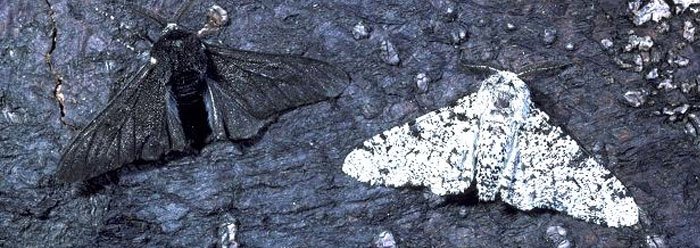
The trees these moths used to live on were white, but have been covered in soot from coal factories. Which moth will be more successful in this environment?
a)
Dark moth
b)
Light moth
c)
Both will be equally successful
d)
Neither will be successful
19.
Change over time
a)
Natural Selection
b)
Selective Breeding
c)
Homeostasis
d)
Evolution
20.
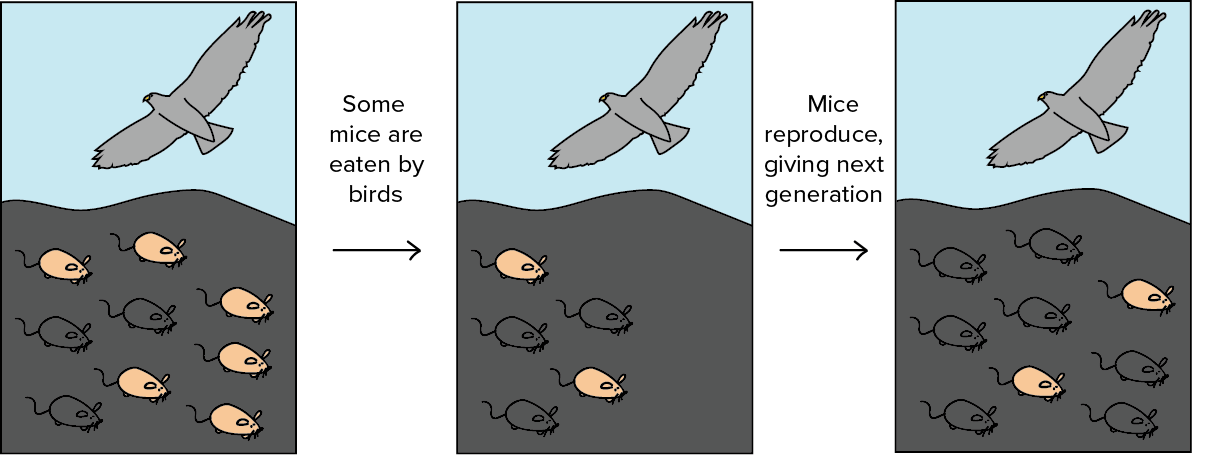
Why is the mouse population changing over time?
a)
The light mice can reproduce more successfully than the dark mice
b)
The hawks eat more dark mice than light mice because the dark mice taste better
c)
The hawks eat more light mice than dark mice because they can see the light mice more easily
d)
The hawks eat more dark mice than light mice because they can see the dark mice more easily
21.
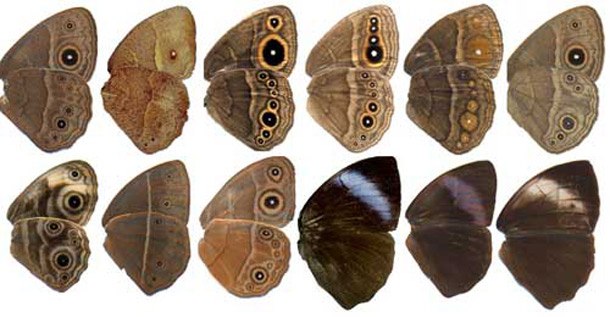
These moths are all the same species. The differences between their wings is an example of ________________
a)
Natural Selection
b)
Variation
c)
Homeostasis
d)
Extinction
22.
A slight difference in an inherited trait between individual members of the same species.
a)
variations
b)
adapatations
c)
homologous structures
d)
analogous structures
23.
The discovery of DNA and genes proved that
a)
Darwin was wrong
b)
mutations create variations and come from genes
c)
we are all the same species
d)
bats and butterflies have a very close common ancestor
24.
When an organism of a species is born with a variation in a trait that gives it an advantage in its environment, we call that trait an adaptation.
a)
true
b)
false
25.
When an organism of a species has an adaptation, it will compete for resources better, survive longer and pass that adaptation on to it's offspring. This process is called
a)
evolution by natural selection
b)
artificial selection
c)
inbreeding
d)
outbreeding
26.
When an organism has a trait that allows it to blend in with its environment, we call that ____.
a)
mimicry
b)
camouflage
c)
lucky
d)
sonic hedgehog gene
27.
Which of the following would represent a sudden environmental change?
a)
Wildfire
b)
Global Warming
c)
Competition for food
d)
Desert encroachment
28.
Survival of the Fittest and Evolution were proposed by what scientist?
a)
Charles Darwin
b)
Albert Einstein
c)
Steven Hawking
d)
Isaac Newton
29.
A fossil of an extinct dinosaur is found and the anatomy of the fossil shows similarities to that of a bird. What could this mean?
a)
This is purely by chance and isn't significant
b)
The extinct dinosaur and modern bird share a common ancestor
c)
All dinosaurs evolved into birds and that's why there aren't any dinosaurs alive today
d)
Dinosaurs choose to fly, and evolved into birds to escape predation and capture food
30.

Two organisms that are closely related would have
a)
very similar DNA sequence
b)
exactly the same DNA sequences
c)
no proteins in common
d)
completely different DNA sequence
31.
True or False?
Generations of a species that are farther apart from each other look the most different.
Generations of a species that are farther apart from each other look the most different.
a)
True
b)
False
32.
Which of the following is a fossil?
a)
a plant that has recently died
b)
a group of organisms that can reproduce
c)
a structure or organ that no longer functions
d)
a trace of an organisms that existed in the past
33.

what did Charles Darwin observe in finch populations of the Galapagos Islands off the coast of South America?
a)
different species on different islands
b)
all species on one of the islands
c)
identical species on all the islands
d)
the same species as North America
34.

Genetic variation can arise from a random change in the DNA of a gene. The change is called a(n)
a)
mutation
b)
gene flow
c)
gene pool
d)
allele
35.
The disappearance of a species.
a)
Evolution
b)
Extinction
c)
Migration
d)
Mutation
36.
The variety of living things on Earth is called:
a)
Life
b)
Biodiversity
c)
Similarity
d)
Genetics
37.

This image shows that
a)
These animals have no simliarities in their structures.
b)
two different species may have evolved from a common ancestor.
c)
These animals are from the same species.
d)
These animals likely evolved from different ancestors due to their differences.
38.
Which statement best describes the process of evolution?
a)
Populations can survive in different locations on earth
b)
Environmental conditions limit the number of species on Earth
c)
Populations grow when resources are abundant
d)
The traits of a species can change over time
39.
There are three species of birds on an island. Bird A has a heavy bill for eating seeds. Bird B has a pointed bill for eating insects. Bird C has a sharp bill for eating both insects and seeds. If all insects on the island suddenly disappeared, which bird or birds would be the LEAST affected?
a)
Bird A
b)
Bird B
c)
Bird C
d)
Bird A and Bird B
40.
1000 red and 1000 white ground beetles are placed in a cage on red clay containing beetle eating birds. The beetles are counted after 2 days. What is expected?
a)
Equal number of red and white beetles are left
b)
More red beetles are left
c)
More white beetles are left.
d)
All the beetles are gone.
100 %

