wayground logo

Free Printable Worksheets

Font size

S
M
L
XL
Worksheets

Biology Final REVIEW - Semester 1

Total questions: 81

Worksheet time: 41mins

Name
Class
Date
1.
The smallest unit of life is a(n)
a)
molecule
b)
atom
c)
cell
d)
electron
2.

Which Characteristic of Life is being described by the following statement: A plant using photosynthesis to make food.

a)

Made of Cells

b)

Response to Stimuli

c)

Metabolism

d)

Grow & Develop

e)

Reproduce

3.
All of the cells that make up you (a human) are
a)
eukaryotic
b)
chromatic
c)
bacteria
d)
prokaryotic
4.

Which of the following is an biotic factor?

a)
bacteria
b)

rain

c)

dirt

d)
rock
5.
One goal of scientists is to assign every organism a universally accepted 2-part name according to the system known as
a)
traditional classification
b)
cladistics
c)
evolutionary classification
d)
binomial nomenclature
6.

What is your scientific name?

a)

Animal species

b)

Homo sapiens

c)

Chordata sapiens

d)

Hominidae homo

7.
A group of closely related organisms that can mate and produce fertile offspring is called a
a)
kingdom
b)
species
c)
phylum
d)
genus
8.
Monomer is nucleotide.
a)
Lipid
b)
Protein
c)
Carbohydrate
d)
Nucleic Acid
9.
Main source of fast energy.
a)
Lipid
b)
Protein
c)
Carbohydrate
d)
Nucleic Acid
10.

What organelle is the site of protein synthesis?

a)

Chloroplast

b)

Cytoplasm

c)

Mitochondria

d)

Nucleus

e)

Ribosome

11.

What organelle is the site of photosynthesis?

a)

Chloroplast

b)

Cytoplasm

c)

Mitochondria

d)

Nucleus

e)

Ribosome

12.

What organelle is the site of cellular respiration?

a)

Chloroplast

b)

Cytoplasm

c)

Mitochondria

d)

Nucleus

e)

Ribosome

13.
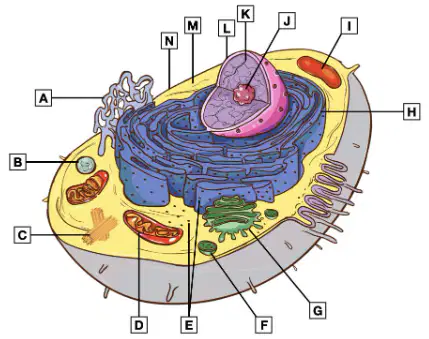
What is letter K - the control center?
a)
mitochondria
b)
ribosome
c)
nucleus
d)
cell membrane
14.

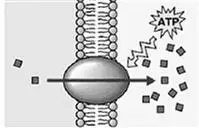
What process is shown in the diagram?

a)

Simple Diffusion

b)

Facilitated Diffusion

c)

Active Transport with Protein Pump

15.

What cell transport process requires the use of a protein channel?

a)

Simple diffusion

b)

Facilitated Diffusion

c)

Active Transport - Protein Pump

16.
A produce manager in a grocery store constantly sprays water on the vegetables in the produce section. The water creates a hypotonic solution when compared to inside the cells of the vegetables. What direction will water diffuse?
a)
Water will move out of the cells of the vegetables.
b)
Water will move into the cells of the vegetables.
c)
Water will move at equal rates, both in and out of the cells of the vegetables.
17.
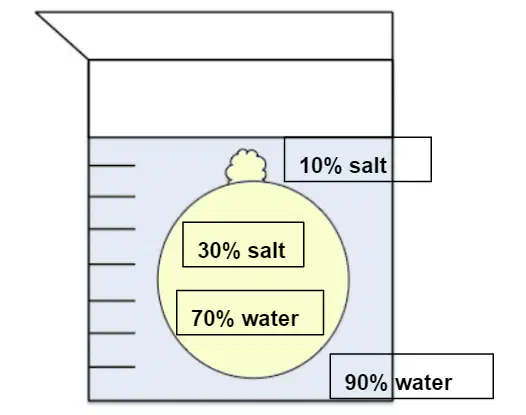
With the cell in this solution, in which direction will water move?
a)
Into the cell
b)
Out of the cell
c)
Equally in both directions
d)
No movement
18.
The relatively stable conditions the body maintains internally, despite changes in the internal and external environment is called
a)
Metabolism
b)
Homeostasis
c)
Stimuli
d)
Cephalization
19.
What type of feedback loop is shown in the graph?
a)
Positive Feedback Loop
b)
Negative Feedback Loop
c)
Prokaryotic Feedback Loop
d)
Eukaryotic Feedback Loop
20.
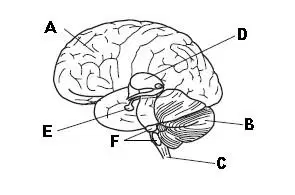
What part of the brain is Letter A?
a)
Brainstem
b)
Cerebellum
c)
Cerebrum
d)
Spinal Cord
21.
What part of the brain controls involuntary functions such as breathing and heartbeat?
a)
brainstem
b)
cerebrum
c)
cerebellum
22.
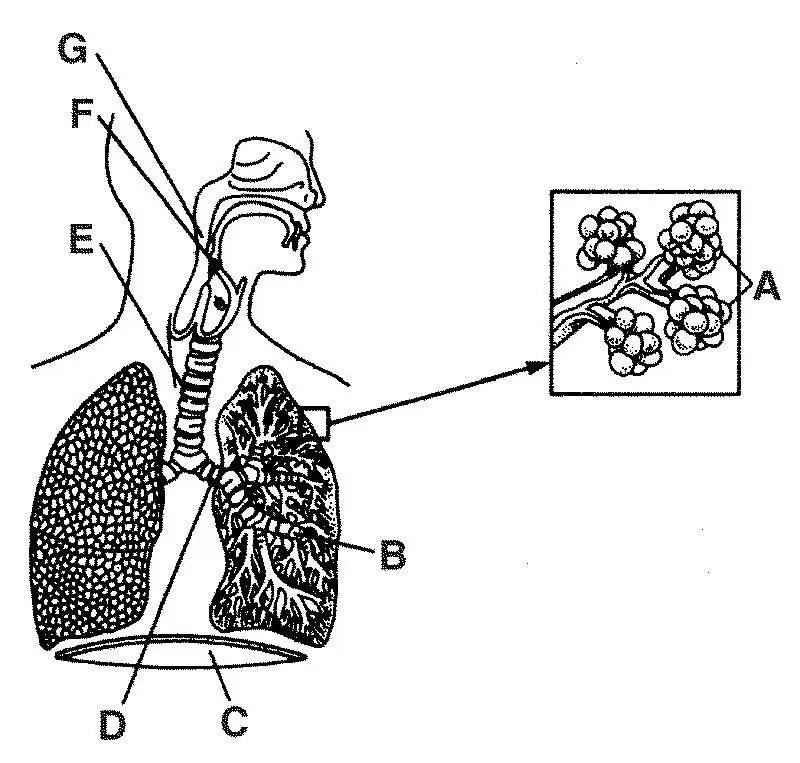
In the diagram, what is the label of the structures in which the exchange of oxygen and carbon dioxide takes place?
a)
A
b)
C
c)
E
23.
In the Feedback Loop Lab, it was shown that when you hold your breath, your brainstem is monitoring the level of ___ in the blood to help you maintain homeostasis.
a)
carbon dioxide
b)
oxygen
c)
water
d)
nitrogen
24.
Structures in heart and large veins that prevent the backward flow of blood.
a)
Atria
b)
Ventricles
c)
Pacemakers
d)
Valves
25.
Blood cell that transports oxygen.
a)
plasma
b)
red blood cell
c)
platelet
d)
white blood cell
26.
What chambers of the heart pump blood?
a)
atria
b)
valves
c)
ventricles
d)
capillaries
27.
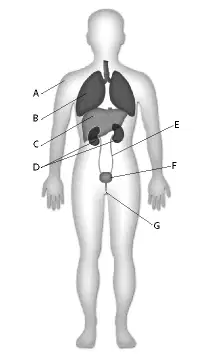
What structure is Letter D?
a)
Kidney
b)
Ureter
c)
Urinary Bladder
d)
Urethra
28.
The organ that produces bile.
a)
Gallbladder
b)
Small Intestine
c)
Liver
d)
Stomach
29.
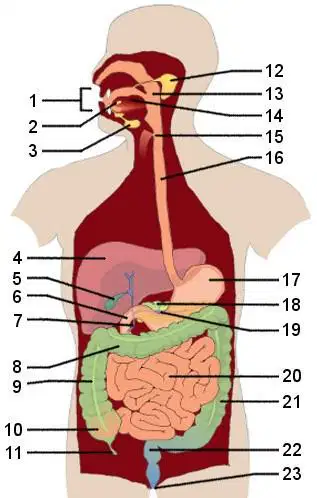
Structure 17 is the
a)
liver
b)
esophagus
c)
small intestine
d)
stomach
30.
Structure 20 is the
a)
liver
b)
large intestine
c)
small intestine
d)
stomach
31.
The teeth and tongue of the oral cavity break foodstuff down physically. This is an example of
a)
chemical digestion
b)
mechanical digestion
c)
peristalsis
d)
absorption
32.
The organ where chemical digestion and absorption of nutrients occurs.
a)
Esophagus
b)
Small Intestine
c)
Large Intestine
d)
Stomach
33.

Which hormone regulates body metabolism?

a)

Glucagon

b)

Growth Hormone

c)

Insulin

d)

Thyroxine

34.

Which hormone removes glucose from the blood?

a)

Glucagon

b)

Growth Hormone

c)

Insulin

d)

Thyroxine

35.

What disease is caused by the body producing too much growth hormone?

a)

Diabetes

b)

Gigantism

c)

Pituitary Dwarfism

36.

What disease is caused by the body producing not enough or no insulin?

a)

Diabetes

b)

Gigantism

c)

Pituitary Dwarfism

37.
If a person has memory B cells against a certain pathogen, the person is
a)
likely to develop that disease.
b)
much less likely to develop the disease a second time.
c)
able to spread the disease to others through physical contact.
d)
probably still sick with the disease.
38.
An infectious disease is one that is caused by
a)
heredity
b)
pollutants in the environment
c)
pathogens
d)
hemophilia
39.
Immune system second line of defense which serves to slow down or stop the growth of pathogens by elevating the internal body temperature.
a)
fever
b)
histamines
c)
antigens
d)
interferons
40.
Pictured in the diagram is the equation for the process of
a)
photosynthesis
b)
cellular respiration
c)
fermentation
d)
active transport
41.
What is the PURPOSE of the process shown in the diagram?
a)
to produce food
b)
to transport glucose across the cell membrane
c)
to change glucose energy to ATP
d)
to keep glycolysis running when there is not oxygen present
42.
When a young plant has leaves, is green, and has access to water, carbon dioxide, and sunlight, what process is happening that helps increase the plant’s biomass?
a)
photosynthesis
b)
fermentation
c)
cellular respiration
d)
active transport
43.

In what phase of Mitosis do sister chromatids split?

a)

Anaphase

b)

Interphase

c)

Metaphase

d)

Prophase

e)

Telophase & Cytokinesis

44.

In what phase of Mitosis does DNA replicate?

a)

Anaphase

b)

Interphase

c)

Metaphase

d)

Prophase

e)

Telophase & Cytokinesis

45.

During normal mitosis & cytokinesis, a parent cell that has 4 chromosomes will produce two daughter cells, each containing

a)
16 chromosomes
b)
4 chromosomes
c)
8 chromosomes
d)
2 chromosomes
46.
When a cancer cell spreads from its original location to other parts of the body, it is called
a)
differentiation
b)
cyclins
c)
metastasis
d)
benign
47.
How many chromosomes do normal human body cells have?
a)
43
b)
46
c)
23
d)
26
48.
This type of tumor is fast-growing, cancerous, and can metastasize.
a)
apoptosis
b)
metastasis
c)
benign
d)
malignant
49.
Using chemicals to kill cancer cells is called
a)
radiation
b)
metastasis
c)
chemotherapy
d)
differentiation
50.
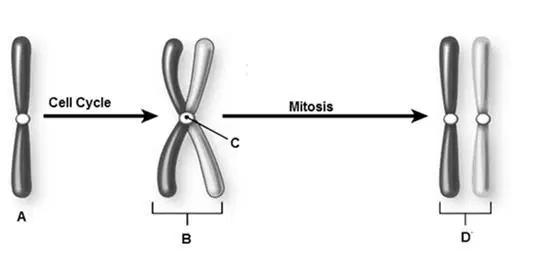
What is Letter B on the Diagram?
a)
sister chromatids
b)
cleavage furrow
c)
2 chromosomes
d)
centromere
51.
In the diagram, when during the cell cycle does the DNA go from Letter A to Letter B?
a)
G1 phase
b)
G2 phase
c)
S phase
52.
Cancer is a disorder in which some cells have lost the ability to control their
a)
growth rate
b)
spindle fibers
c)
surface area
d)
size
53.
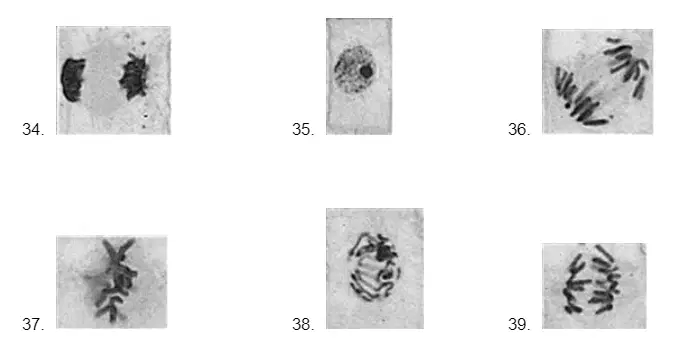
Which of the following gives the correct order of events for the plant cells pictured?
a)
34-36-39-37-38-35
b)
34-35-36-37-38-39
c)
35-38-37-36-39-34
d)
35-38-37-39-36-34
54.
A multicellular organism begins life as a single cell—a fertilized egg with a complete set of chromosomes. The picture in the diagram shows how the cell divides to become two cells, then four cells, eight cells, and so on. Which of the following statements best describes what happens during this process?
a)
Chromosomes are replicated before cell division so that each new daughter cell has a complete set.
b)
Chromosomes are divided evenly during cell division so that each new daughter cell has an equal share of the original set.
c)
Chromosomes are randomly distributed during cell division so that some new cells have partial sets while others have complete sets.
55.
The amino acids are actually carried by the rRNA.
a)
This statement is True.
b)
This statement is False - change rRNA to mRNA to make it true.
c)
This statement is False - change rRNA to tRNA to make it true.
d)
This statement is False - change rRNA to DNA to make it true.
56.
Genes contain instructions for assembling
a)
operons
b)
nucleosomes
c)
proteins
d)
mutagens
57.
One mRNA molecule carries the message of only one gene.
a)
This statement is True.
b)
This statement is False - change mRNA to tRNA to make it true.
c)
This statement is False - change mRNA to rRNA to make it true.
d)
This statement is False - change mRNA to DNA to make it true.
58.

The Table shows the % of bases in a DNA sample. How much Thymine should you expect to find in the sample?

a)
44%
b)
28%
c)
24%
d)
22%
59.
What is produced during transcription?
a)
mRNA
b)
DNA
c)
RNA polymerase
d)
proteins
60.
Diagrams A, B, and C are the three types of
a)
DNA
b)
Protein
c)
Enzymes
d)
RNA
61.
The genetic code in DNA is in the sequence of
a)
phosphate groups
b)
nitrogen bases
c)
sugars
d)
hydrogen bonds
62.
Process that results in 2 identical sister chromatids.
a)
Replication
b)
Mutation
c)
Transcription
d)
Translation
63.
Who was credited for discovering the structure of DNA?
a)
Franklin & Wilkins
b)
Hershey & Chase
c)
Franklin & Griffith
d)
Watson & Crick
64.
Which scientist made x-ray diffraction photos of DNA, with the most famous being Photo 51?
a)
Franklin
b)
Crick
c)
Watson
d)
Wilkins
65.
What is the central dogma of molecular biology?
a)
DNA to tRNA to mRNA
b)
RNA to DNA to Protein
c)
DNA to RNA to Protein
d)
mRNA to tRNA to rRNA
66.
What is the shape of DNA?
a)
double helix
b)
triple helix
c)
complementary helix
d)
nitrogen helix
67.
What happens during translation?
a)
Messenger RNA is made from a DNA code.
b)
The cell uses a messenger RNA code to make proteins.
c)
Transfer RNA is made from a messenger RNA code.
d)
Copies of DNA molecules are made.
68.
Which of the following is NOT a function of proteins?
a)
build tissues such as bone and muscle
b)
store and transmit heredity
c)
control the rate of reactions and regulate cell processes
d)
help to fight disease
69.
During DNA replication, a DNA strand that has the bases CTAGGT produces a complementary strand with the bases
a)
GAUCCA
b)
AGCTTG
c)
GATCCA
d)
TCGAAC
70.
A mutation that involves a single nucleotide is called
a)
a mutagen
b)
a point mutation
c)
a translocation
d)
a frameshift mutation
71.
Which of the following would result in a frameshift mutation?
a)
Insertion only
b)
Deletion only
c)
Substitution only
d)
Both Insertions and Deletions
72.
A mutation is defined as
a)
A change in the cell's structure
b)
Any change in the physical features of a human
c)
A change in the DNA sequence
d)
Anything that changes in an embryo
73.
Why are frameshift mutations so harmful?
a)
They change all of the codons from the mutation on down the line, which changes the amino acid sequence
b)
They often delete things that organisms need.
c)
They insert things that an organism doesn't need.
74.

What does this statement pertain to: I am a nucleic acid.

a)

DNA

b)

RNA

c)

Both DNA & RNA

75.

What does this statement pertain to: I have the sugar ribose.

a)

DNA

b)

RNA

c)

Both DNA & RNA

76.

What does this statement pertain to: I have the sugar deoxyribose.

a)

DNA

b)

RNA

c)

Both DNA & RNA

77.

What does this statement pertain to: I am found both inside and outside of the nucleus in eukaryotic cells.

a)

DNA

b)

RNA

c)

Both DNA & RNA

78.

What does this statement pertain to: I am single-stranded.

a)

DNA

b)

RNA

c)

Both DNA & RNA

79.

What does this statement pertain to: I remain in the nucleus in eukaryotic cells.

a)

DNA

b)

RNA

c)

Both DNA & RNA

80.

What does this statement pertain to: Each of my nucleotides includes a phosphate, sugar, and base.

a)

DNA

b)

RNA

c)

Both DNA & RNA

81.

What does this statement pertain to: I have the nitrogen base uracil.

a)

DNA

b)

RNA

c)

Both DNA & RNA