
 Worksheets
Muscular System Review
Total questions: 80
Worksheet time: 44mins
What type of muscle tissue is found in the heart?
skeletal
smooth
cardiac
voluntary
Muscles move bones by
relaxing (getting longer)
contracting (getting shorter)
both contracting and relaxing
Muscles contract when
thin filaments slide past thin filaments
thick filaments slide past thick filaments
thin filaments slide past thick filaments
What type of muscles are attached to bones?
cardiac
Which connective tissue surrounds fasicles?
epimysium
endomysium
perimysium
Which connective tissue surrounds the whole muscle?
epimysium
endomysium
perimysium
Which connective tissue surrounds individual muscle fibers?
epimysium
endomysium
perimysium
Actin myofilaments are
attached to the z disk
are found primarily in the h zone
are thicker than myosin myofilaments
all of these options
Which area of a sarcomere contains only actin?
Z disk
A band
H zone
I band
Which part of the sarcomere does not shorten during muscle contraction?
A band
H zone
I band
None of these
Which type of muscle cell is striated, voluntary and has multiple nuclei located at the periphery?
Cardiac
Smooth
Skeletal
Which type of muscle cell has one nucleus, is striated and has intercalated disks?
Skeletal
Cardiac
Smooth
Which of the following muscle cells are not striated, involuntary, and have one nucleus per cell?
Skeletal
Cardiac
Smooth

Which of the following puts the structures of the muscle in order from largest to smallest?
Whole muscle, muscle fiber, actin & myosin, myofibril, muscle fasicle
Whole muscle, muscle fasicle, muscle fiber, myofibril, actin & myosin
Whole muscle, muscle fiber, muscle fasicle, myofibril, actin & myosin
Whole muscle, muscle fasicle, muscle fiber, actin & myosin, myofibril

Identify the highlighted muscle
Deltoid
Biceps
Trapezius
Hamstring

Identify the highlighted muscle (not required)
Latissimus dorsi
Deltoid
External Oblique
Pectoralis Major

Identify the highlighted muscle
Biceps
Gluteus Maximus
Triceps
Deltoid

Identify the highlighted muscle (not required)
Extensor Carpi
Extensor Digitorum longus
Gastrocnemius
Tibialis anterior

Identify the highlighted muscle (not required)
Deltiod
Trapezius
Latissimus Dorsi
Sartorius

Identify the highlighted muscle (not required)
Tibialis Anterior
Gastrocneminus
Deltoid
Biceps

Identify the highlighted muscle
Hamstrings
Deltoid
Gluteus Maximus
Oblique

Identify the highlighted muscle (not required)
illopsoas
Biceps
Sartorius
Trapezius
Which ion, when present, changes the shape of the protein, tropomyosin, so that myosin will be able to form cross-bridges with actin?

The sarcolemma is:
a material that fills up the space inside a muscle cell
the membrane that surrounds a muscle fiber
the smallest unit of a myofibril
the organelle that makes up a muscle fiber
Calcium's purpose in muscle contraction is to
cross the neuromuscular junction and stimulate the sarcolemma
travel down the T-tubule to reach interior myofibrils
bind to troponin, move tropomyosin, and expose actin's binding sites
attach to actin, forming a crossbridge
The contracting unit of a muscle is the _______________.
sarcomere
myofibril
muscle fiber
muscle cell
Movement of the arm/leg away from the midline
adduction
eversion
inversion
abduction
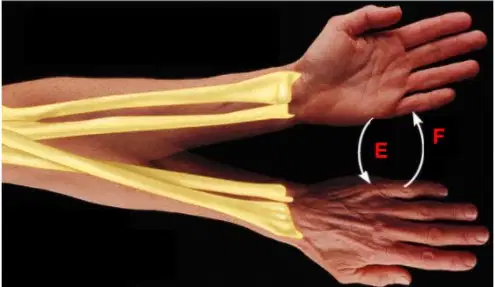
Movement of the forearm/hand so the palm faces up (refer to the direction shown by letter F)
pronation
supination
extension
flexion

Movement of arm/leg toward the midline as (see the direction of letter D).
flexion
extension
adduction
abduction
Movement to bend a joint making the angle smaller
extension
circumduction
eversion
flexion
Body part movement in a circular or conical motion
ovicular
pronation
rotation
circumduction
Movement of the forearm/hand so palm faces downward or backwards
supination
pronation
palmar
flexion

extension
flexion
circumduction
adduction
abduction

extension
flexion
circumduction
adduction
abduction

supination
pronation
circumduction
adduction
rotation

supination
pronation
abduction
adduction
opposition

supination
pronation
abduction
adduction
opposition

NOT REQUIRED
inversion
plantar flexion
extension
dorsiflexion
circumduction

What is muscle D?
Rectus femoris
Fibularis longus
Vastus lateralis
Extensor digitorum longus
What is muscle J? NOT REQUIRED
Rectus femoris
Fibularis longus
Vastus lateralis
Gastrocnemius
What is muscle A? NOT REQUIRED
Rectus femoris
Fibularis longus
Vastus lateralis
Gastrocnemius
What is muscle C? NOT REQUIRED
Vastus medialis
Fibularis longus
Vastus lateralis
Gastrocnemius
What is muscle H?
Vastus medialis
Fibularis longus
Vastus lateralis
Adductor muscle
What is muscle G?
Vastus medialis
Sartorius
Vastus lateralis
Adductor muscle
What is muscle F? NOT REQUIRED
Vastus medialis
Sartorius
Vastus lateralis
Tibialis anterior

What is muscle A?
Frontalis
Orbicularis oculi
Zygomaticus
Orbicularis oris
What is muscle B?
Frontalis
Orbicularis oculi
Zygomaticus
Orbicularis oris
What is muscle C? NOT REQUIRED
Frontalis
Orbicularis oculi
Zygomaticus
Orbicularis oris
What is muscle D?
Frontalis
Orbicularis oculi
Zygomaticus
Orbicularis oris
What is muscle E? NOT REQUIRED
Platysma
Sternocleidomastoid
Pectoralis major
Intercostals
What is muscle F? NOT REQUIRED
Platysma
Sternocleidomastoid
Pectoralis major
Intercostals
What is muscle G?
Platysma
Sternocleidomastoid
Pectoralis major
Intercostals
What is muscle H? NOT REQUIRED
Platysma
Sternocleidomastoid
Pectoralis major
Intercostals
What is muscle I?
Rectus abdominis
External oblique
Internal oblique
Transverse abdominus
What is muscle J? NOT REQUIRED
Rectus abdominis
External oblique
Internal oblique
Transverse abdominus
What is muscle K?
Rectus abdominis
External oblique
Internal oblique
Transverse abdominus
What is muscle L? NOT REQUIRED
Rectus abdominis
External oblique
Internal oblique
Transverse abdominus
What is muscle S? NOT REQUIRED
Rectus abdominis
Iliopsoas
Internal oblique
Transverse abdominus
What is muscle T?
Temporalis
Masseter
Deltoid
Triceps brachii
What is muscle U? NOT REQUIRED
Temporalis
Masseter
Deltoid
Triceps brachii
What is muscle M?
Temporalis
Masseter
Deltoid
Triceps brachii
What is muscle N?
Temporalis
Masseter
Deltoid
Triceps brachii
What is muscle O?
Biceps brachii
Brachialis
Flexor carpi radialis
Brachioradialis
What is muscle P?
Biceps brachii
Brachialis
Flexor carpi radialis
Brachioradialis
What is muscle R? NOT REQUIRED
Biceps brachii
Brachialis
Flexor carpi radialis
Brachioradialis
What is muscle Q?
Biceps brachii
Brachialis
Flexor carpi radialis
Brachioradialis

Which label is pointing to the endomysium?
A
B
C
D

What is another name #2? (Hint: It is a muscle layer)
Skeletal muscle
Epimysium
Perimysium
Endomysium
What is another name #5? (Hint: It is a muscle layer)
Skeletal muscle
Epimysium
Perimysium
Endomysium
What is another name #6? (Hint: It is a muscle layer)
Skeletal muscle
Epimysium
Perimysium
Endomysium

What is the name of connective tissue that wraps around a fascicle (C) and is designated by the letter A or C?
Perimysium
Endomysium
Epimysium
Myfiber

