
 Worksheets
Pre-AP Biology Ecology Review
Total questions: 78
Worksheet time: 54mins

Why does increasing producers increase the populations of all trophic levels?
Producers increase the size of a habitat
Producers help keep predator populations in check
With more energy available the carrying capacity increases
Producers do not have a large impact on population sizes
What causes trophic cascades?
Increasing the number of producers
Pollution
The removal of a keystone species
Introducing a new species to an ecosystem
What are limiting factors?
The maximum number of organisms an area can sustain
Scarce resources that limit the size of a population
Conditions that limit how much energy flows to the next trophic level
How diverse the populations of a community are
If the producer level of an ecosystem has 750,000 J of energy, how much energy would be passed on to the secondary consumers?
75,000 J
7,500 J
750 J
75 J
What type of graph represents exponential population growth?
A fluctuating graph
W - shaped curve
S-shaped curve
J - shaped curve
Which of the following would be a density independent limiting factor?
A virus spreading through a population
A forest fire burning down a forest
Birds competing for a limited amount of seeds
A new predator moving to an area
Frogs lay ~4000 eggs at a time. Based on this frogs would be classified as -
R-strategists
K-strategists
The carrying capacity for a population of lizards is 2700. If the current population is 1340 and the rmax for the population was found to be 0.83, what would the population size be after 1 year?
Answer is 1900
2356
2100
1825
1900
There is a population of 75 wolves in a forest that has a carrying capacity of 120. What is the maximum population growth rate if the population grows to 92 in one year? Answer is 0.6
0.833
1.00
0.604
0.523
Which of these describes a mutualistic relationship?
When one organism is harmed, but the other is benefitted
When one organism is unaffected, and the other is harmed
When one organism benefits, and the other is unaffected
When both organisms involved benefit
What is a niche?
A species that outcompetes others in an area
The level on a food chain an organism occupies
An organisms role in an ecosystem and the resources they obtain
A species that disproportionately affects an ecosystem
What will happen if two species occupy the same niche in an ecosystem?
The ecosystem will be stressed and could collapse
One species will either alter their niche or be eliminated
The niche will expand to accommodate both species
The species will share the niche
How does competition affect population?
Most populations do not have competition
It maximizes the carrying capacity of an ecosystem
It limits population sizes and drives natural selection
It benefits both species and increases their populations
How do ecosystems obtain energy in environments that have no light?
Through chemosynthetic organisms
Without light the organisms will need to move or they may go extinct
Through photosynthetic organisms
All ecosystems have some light
What are keystone species?
Non-native species that have adapted to a new environment
Species that have disproportionate effects on ecosystem stability
The first species to return to an area after a natural disaster
Organisms that can collapse an ecosystem if they overpopulate an area

Why does increasing producers increase the populations of all trophic levels?
Producers increase the size of a habitat
Producers help keep predator populations in check
With more energy available the carrying capacity increases
Producers do not have a large impact on population sizes


Which curve best describes an organism that invests a lot of energy in parenting?

Use the graph above to identify a mature, well-established population in favorable conditions.
A
B
C
D

Use the graph above to identify the carrying capacity of the environment.
B
C
D
E

Use the graph above to identify a population in unfavorable conditions.
B
C
D
E

Use the graph above to identify the exponential growth phase of a new population.
A
B
D
E
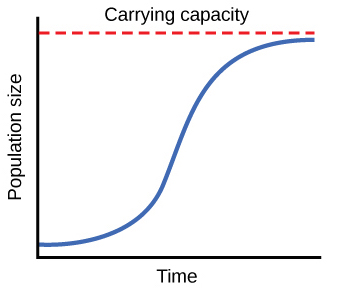

What is the carrying capacity of the following population?
1000
8000
800
600

What is the rate of change for the population grown without a parasite from day 200 to day 400?
200 days
a loss of approximately 15 beetles/200 days
a loss of approximately 30 beetles/200 days
30 beetles

Dispersal pattern 1 is one of the most common in nature because...
there is power in numbers
its easier for organisms to fight diseases with this pattern
its easier to obtain resources
there is less competition

Volcanic eruptions may change global climate because...
large amounts of CO2 is released, adding to the greenhouse gas layer
large amounts of N2 is released, adding to the greenhouse gas layer
debris from the eruption block the sun which decreases primary productivity
the eruption results in the eutrophication of lakes and the ocean

What type of growth are humans in?
exponential growth
logistic growth
Which of the following are causes of habitat destruction by humans?
agriculture/
farming
urbanization/ building homes
deforestation/ mining
pollution

The image above represents
the carbon cycle
eutrophication
biological magnification
spread of disease

How does habitat fragmentation as seen in the image above showing agricultural fragmentation, affect biodiversity?
increases biodiversity
decreases biodiversity
has not effect on biodiversity
Chemical pesticides tend to be used in terrestrial ecosystems, but they are commonly found in the tissues of aquatic organisms. Because of this, birds and other animals with a diet high in fish commonly suffer the effects of biological magnification. How do these pesticides end up in these aquatic ecosystems?
Pesticides evaporate and are delivered to water sources by rainfall
Land animals containing pollutants die and decompose in waterways
Pesticides are carried to water sources by freshwater runoff.
Human fishing practices add pesticides to water sources.
Most health experts recommend only eating tuna a few times a week and only eating shark a few times a month. Why would health experts have this view of eating these fish?
Most fish are low in protein and high in saturated fats which can cause health problems
People with diets high in fish tend to have high blood pressure and heart issues
These fish are endangered species, and eating them contributes to their decline
Eating these fish could result in the buildup of pollutants in the fat tissue of humans
What causes ozone depletion?
Faster trade winds and cooler waters off of the Americas coasts
Pollution of nitrogen oxides into the atmosphere destroys the ozone gases
Pollution of CO2 and methane into the atmosphere destroys the ozone gasses
Pollution of CFCs into the atmosphere destroys the ozone gases
The ozone layer
helps maintain the temperature of the planet
helps protect organisms from harmful UV radiation
helps reflect heat
helps maintain oxygen gas levels in the atmospher
The two main causes of climate change are (choose 2)
sulfer dioxide
deforestation
burning of fossil fuels
production of CFCs
Which of the following are the 3 main effects of climate change?
Increased global temperatures due to thicker greenhouse gas layer
Increased acid rain due to productions of sulfur dioxides
Increased water temperatures
Ocean acidification due to higher amounts of CO2 dissolved into the ocean
What causes ocean acidification?
Burning of fossil fuels by humans that increases sulfur dioxides
Extra CO2 being absorbed by the ocean and converted into carbonic acid which splits to release H+ ions
Biological Magnification
The release of high amounts of CFCs into the atmosphere which dissolve into the ocean

The lines on the diagram above represent three species within a single isolated ecosystem as observed by a team of qualified researchers. What relationship between two populations can you reasonably deduce when comparing curves I and II?
There is strong evidence of competition but with resource
partitioning.
The population designated II appears to be an invasive species
that outcompetes the other.
The population designated I appears to be an invasive species
that could not survive in a new niche.
The population designated II appears to be a parasitic species
that uses the other as its host.
The lionfish is a venomous fish found primarily in the Red Sea and the Indian Ocean. In the 1990s, lionfish were accidentally released into the Atlantic Ocean, where they found abundant resources and favorable environmental conditions. Which of the following scenarios is most likely to result in the lionfish having a major impact on the communities into which they were introduced?
With no natural predators, the lionfish population will become very large.
Some native species of invertebrates will develop a resistance to lionfish venom.
Random mating will allow the lionfish population to reach Hardy-Weinberg equilibrium.
A virus that specifically infects lionfish will become more prevalent.

The lines on the diagram above represent three species within a single isolated ecosystem as observed by a team of qualified researchers. What relationship does the population designated as III reasonably have with the other two populations?
The population designated III is a competitor of both of the
other populations.
The population designated III is a predator of population II but
not I.
The population designated III is a predator of population I but
not II.
The population designated III is a predator of both populations
II and I.

The lines on the diagram above represent three species within a single isolated ecosystem as observed by a team of qualified researchers. To what might you reasonably attribute the loss of population III within the ecosystem?
Population III was a prey of population I, which completely
consumed all its members within the ecosystem.
Population III was a prey of population II, which completely
consumed all its members within the ecosystem.
Population III was a predator of population II, but it could not
survive in the ecosystem.
Population III was a predator of population I but it could not
survive in the ecosystem.
Which of the following pairs the correct biome with some of its characteristics?
grassland, modern winter temps and dry summers
taiga, very cold winters, short growing season
savannah, long cold winters, abundant precipitation
desert, cold winters, wet and dry seasons
Of these biomes, a vertical stratification (layer of plants) is most pronounced in a __
desert
tundra
grassland
tropical rain forest
A herd of elephants living in the same area make up a(n)
community
population
ecosystem
biosphere
What term would describe all the living factors in an ecosystem?
abiotic
biology
biotic
community


How many times more wolves are there compared to moose in 1990? answer is 80
80
24
10
60
Bird Species A is small while bird species B is large. Scientists believe that they have been living together in the same type of pine tree for hundreds of years. Which of the following statements is most likely to be true?
Species B will eventually out-compete Species A.
They both eat the same type of food, but species A can survive because it needs less.
There is considerable niche overlap
Species A and Species B occupy different niches

Use the above food web. Which option pairs the organisms with their correct trophic levels?
Grasses: 1st level consumer, Birds: 2nd level consumer
Grasses: Primary Producer, Birds: 3rd level consumer
Mice: 2nd Level Consumer, Birds: 3rd level consumer
Rabbits: 1st level consumer, Owl: 2nd level consumer

On average, how much of the energy in one trophic level is transferred to the level above it?
50%
25%
10%
1%

In 1997, the sea otter population plummeted. What effect did this have on the kelp?
Kelp density increased due to decreased sea urchin biomass.
Kelp density increased due to increased sea urchin grazing intensity.
Kelp density decreased due to increased sea urchin grazing intensity.
Kelp density decreased due to decreased sea urchin biomass.


Based on the figure you can conclude that interspecific competition
allows for both rock barnacles and stellate barnacles to inhabit the same area.
causes the stellate barnacles to grow more slowly than they would normally grow.
restricts stellate barnacles to a smaller portion of the intertidal zone.
causes the rock barnacles to grow more slowly than they would normally grow.
causes the stellate barnacles to grow more quickly than they would normally grow.
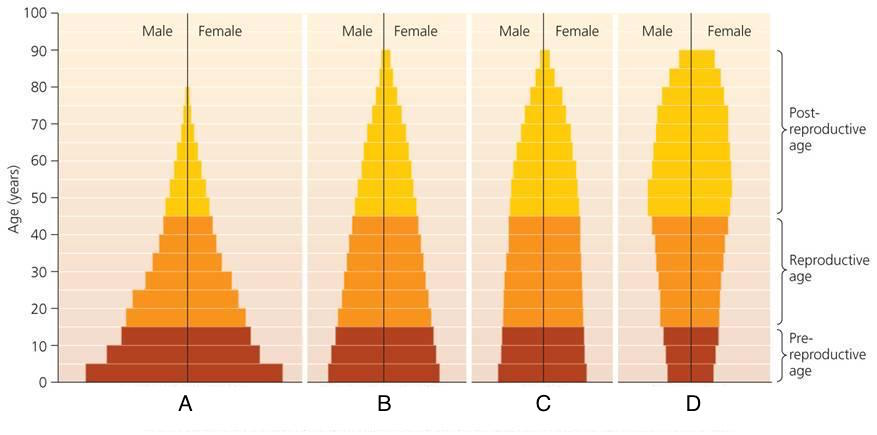
The giant octopus lays 20,000 to 100,000 fertilized eggs. After hatching, most octopuses become prey to larger marine organisms, and less than 5% will reach adulthood to reproduce. One benefit of the giant octopus laying many eggs is to —
increase the average body size for surviving individuals to avoid predation
decrease competition between different octopus species to maintain resources in the population
increase the chance that more individuals will survive to maintain the population
decrease the likelihood of offspring being consumed by predators
Leaf-cutter ants harvest leaves and carry them to fungi that convert plant material into a usable form for the ants to digest. The fungi depend on the leaves for nutrients. The ants also produce an antibiotic on their bodies that helps protect the fungi from harmful bacteria. Which of these explains the relationship between the leaf-cutter ants and the fungi?
Predation, because the ants feed on the fungi
Mutualism, because both the ants and the fungi benefit from each other
Competition, because both organisms consume the same resource for energy
Commensalism, because the ants receive energy from the fungi and the fungi are unaffected

Which statement provides the best explanation for the difference in biomass of organisms found at each trophic level?
Organisms at higher trophic level have less energy available to them than organism at lower trophic levels.
Organisms at higher trophic levels require smaller habitats that organisms at lower trophic levels.
Organisms at lower trophic levels provide less energy than organisms at higher trophic levels.
Organisms at lower trophic levels outcompete organisms at higher trophic levels.
The San Marcos salamander, Eurycea nana, is a light reddish-brown translucent salamander about 2–5 cm in length. E. nana is found only in Spring Lake and a portion of the San Marcos River.
Which human activity would most likely decrease the ability of the salamanders to survive?
Increasing water consumption that decreases the flow of clean water from the springs that
feed the river
Public transportation that reduces the number of automobiles that contribute to pollution
runoff into the river
Tourism that helps fund the educational programs related to river ecosystem conservation
The addition of a new food source into the river that limits competition for resources

A remora is a fish that has an adhesive disk on the back of its head that it uses to attach to a large shark. When food floats away from the shark's mouth as it feeds. Drawings of a shark with a remora attached and a remora's adhesive disk are shown. The relationship of the remora and the shark is........
Predation
Parasitism
Commensalism
Competition


In a Central Texas grassland, the producers incorporate 12,000 kJ of energy from the sun into their tissues. About how much energy would be incorporated into the tissues of herbivores?
12,000 kJ
1,200 kJ
10,800 kJ
1,080 kJ


After a wheat field is cleared, wild grasses and weeds begin growing. This process is considered —
primary succession because pioneer species appear
primary succession because there are no large trees
secondary succession because soil is already present
secondary succession because the field contains inorganic matter


Biosphere
Organelle
Ecosystem
Community

The energy pyramid below shows the energy made available by producers.
Based on the energy flow between trophic levels in an energy pyramid, how much energy would be expected to be found at the secondary consumer level in this pyramid?
100 Joules
500 Joules
1,000 Joules
50 Joules

Students construct a graphic organizer to illustrate the different levels of biological organization.
Which terms does the X represent?
cell
organism
ecosystem
biosphere
Which statement is an example of how carbon moves through a food chain as part of the carbon cycle?
Producers release carbon dioxide, and consumers take it in.
Producers take in carbon dioxide, and consumers release it.
Producers take in carbon from the soil, and they release it when they decompose.
Producers release carbon into the soil, and consumers take it in from the soil.

