wayground logo

Free Printable Worksheets

Font size

S
M
L
XL
Worksheets

Semester 1 Final

Total questions: 93

Worksheet time: 2hrs 51mins

Name
Class
Date
1.

Amino acids make up which macromolecule?

a)

lipids

b)

proteins

c)

nucleic acids

d)

carbohydrates

2.
Proteins are made of monomers called ___________
a)
Nucleotides
b)
Monosaccharides
c)
Amino Acids
d)
Glycerol and fatty acids
3.
The element _______is found in all of the organic compounds.
a)
Iron
b)
Nitrogen
c)
Carbon
d)
Oxygen
4.
DNA and RNA are examples of 
a)
Carbohydrates
b)
Lipids
c)
Proteins
d)
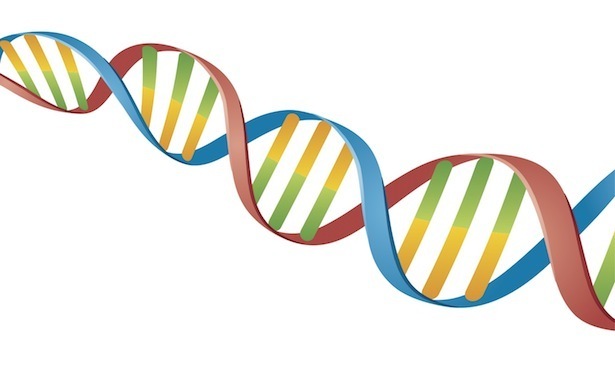
Nucleic Acids
5.
Which macromolecule is made of simple and complex sugars?
a)
lipids
b)
proteins
c)
carbohydrates
d)
nucleic acids
6.
Another name for fats and oils
a)
proteins
b)
sugar
c)
lipids
d)
nucleic acids
7.
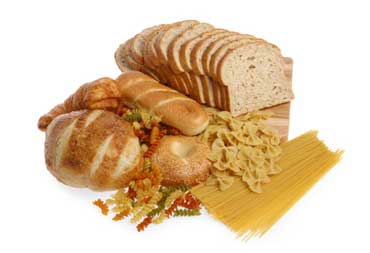
Which biomolecule is found in pasta and bread?
a)
Lipid
b)
Protein
c)
Nucleic Acid
d)
Carbohydrate
8.
Which biomolecule is a main source of quick energy?
a)
Nucleic Acid
b)
Protein
c)
Lipid
d)
Carbohydrate
9.
What is the function of a nucleic acid?
a)
Stores genetic information
b)
Stores energy
c)
Quick source of energy
d)
Builds structures
10.

Enzymes are an example of

a)

Lipids

b)

Carbohydrate

c)

Protein

d)

Nucleic Acid

11.
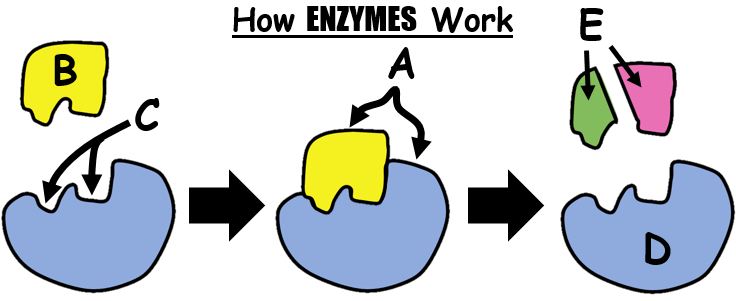
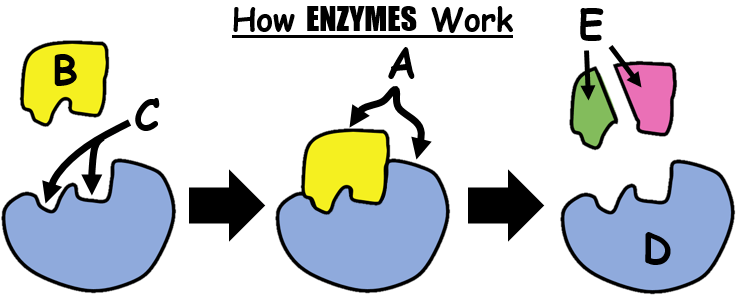
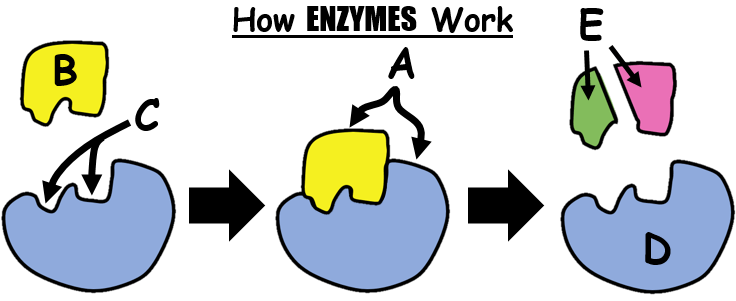
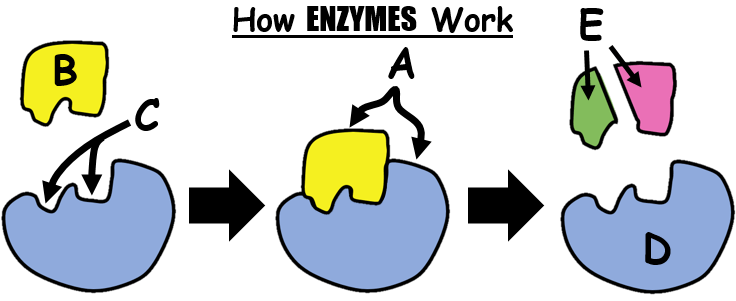
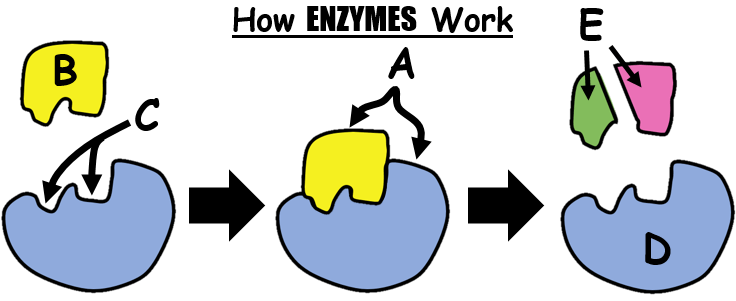
In the diagram, what is letter A? 
a)
product
b)
substrate
c)
enzyme-substrate complex
d)
active site
12.
Letter D...
a)
active site
b)
enzyme
c)
substrate
d)
products
13.
Letter B...
a)
active site
b)
enzyme
c)
substrate
d)
products
14.
Letter C...
a)
active site
b)
enzymes
c)
substrate
d)
products
15.
Letter E...
a)
active site
b)
enzyme
c)
substrate
d)
products
16.

What important material is contained in the nucleus?

a)

Jeans

b)

Digestive enzymes

c)

DNA

d)

Nuclear ladders

17.
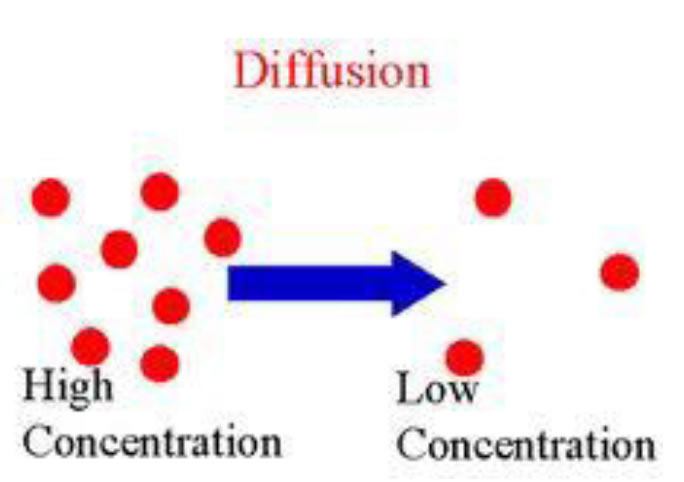
Movement of particles from high to low concentration. 
a)
Passive Transport
b)
Active Transport
18.
Osmosis is a form of ______________. 
a)
Passive Transport
b)
Active Transport
19.

The solution surrounding the cell in Diagram B, would be defined as:

a)

hypertonic

b)

hypotonic

c)

isotonic

20.
The cell below is in a _________ solution.
a)
Hypotonic
b)
Hypertonic
c)
Isotonic
21.
The cell below is in a _____________ solution.
a)
Hypertonic
b)
Hypotonic
c)
Isotonic
22.
What is diffusion?
a)
when molecules move 
b)
when molecules move from a high concentration to a low.
c)
no movement 
d)
molecules move everywhere
23.
Passive transport requires no
a)
concentration gradients
b)
osmosis
c)
motion
d)
energy
24.
Which type of transport requires an input of energy?
a)
Passive Transport
b)
Osmosis
c)
Simple Diffusion
d)
Active Transport
25.
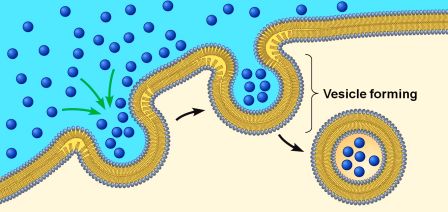
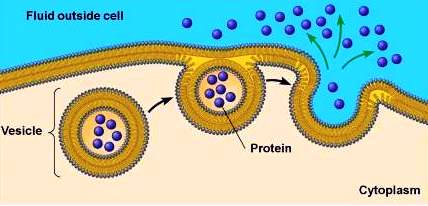
Which form of active transport is being shown?
a)
Facilitated Diffusion
b)
Exocytosis
c)
Endocytosis
d)
Protein Pumps
26.
Which is NOT a form of active transport?
a)
Endocytosis
b)
Osmosis
c)
Exocytosis
d)
Pinocytosis
27.
Which form of active transport is being shown?
a)
Pinocytosis
b)
Endocytosis
c)
Exocytosis
d)
Osmosis
28.

What type of solution is shown in the picture?

a)

Hypertonic

b)

Hypotonic

c)

Isotonic

29.
During which phase of the cell cycle does the cell spend the most time?
a)
Mitosis
b)
Cytokinesis
c)
Interphase
30.
During which part of the cell cycle does the cell divide?
a)
Interphase
b)
Mitosis
c)
S phase
31.
During which part of the cell cycle is DNA copied?
a)
Mitosis
b)
Cytokinesis
c)
S phase
32.
Which phase of mitosis is shown in the picture?
a)
Prophase
b)
Anaphase
c)
Telophase
33.
Which phase of mitosis is shown in the picture?
a)
Interphase
b)
Metaphase
c)
Telophase
34.
Which phase of mitosis is shown in the picture?
a)
Prophase
b)
Metaphase
c)
Anaphase
35.
Which phase of mitosis is shown in the picture?
a)
Prophase
b)
Telophase
c)
Metaphase
36.
What is the purpose of the cell cycle?
a)
To create new daughter cells
b)
To prevent cancer from developing
c)
To help the body fight viruses and bacteria
37.

The stage of mitosis where the sister chromatids separate:

a)

prophase

b)

anaphase

c)

telophase

d)

metaphase

38.

The first phase of mitosis is called _______________ .

a)

telophase

b)

metaphase

c)

anaphase

d)

prophase

39.

The phase of mitosis when chromosomes align in the

middle is called ________

a)

anaphase

b)

prophase

c)

telophase

d)

metaphase

40.
Put the following actions in order: DNA replicates, cell grows, cell divides, cell prepares for mitosis. 
a)
DNA replicates, cell grows, cell prepares for mitosis, cell divides
b)
cell grows, cell prepares for mitosis, DNA replicates, cell divides
c)
cell grows, DNA replicates, cell prepares for mitosis, cell divides
d)
DNA replicates, cell prepares for mitosis, cell grows, cell divides
41.
Which of the following phrases best describes cytokenesis
a)
division of the cytoplasm
b)
division of the nucleus
c)
division of DNA
d)
division of surface area
42.

What is the result of the cell cycle?

a)

Three cells

b)

Four daughter cells

c)

Two identical cells

d)

One clone cell

43.

In which stage of the cell cycle is protein and organelle synthesis?

a)

G1

b)

G2

c)

S

d)

Cytokinesis

44.
During what phase of the cell cycle does the cell grow?
a)
G1 phase
b)
S phase
c)
M phase
d)
Cytokinesis
45.
During what phase of the cell cycle is DNA replicated?
a)
G1 phase
b)
S phase
c)
G2 phase
d)
M phase
46.

Cancer is defined as the

a)

uncontrolled division of mutated cells

b)

normal division of cells

c)

normal DNA replication

d)

abnormal ATP synthesis

47.

A ________________is a critical point where stop and go signals can regulate the cycle

a)

tumor

b)

checkpoint

c)

growth factor

d)

oncogene

48.

Identical cells formed during cell division are called:

a)

daughter organelles

b)

daughter cycles

c)

daughter nucleus

d)

daughter cells

49.

____________ ensures that our bodies grow and repair

themselves.

a)

The cell growth

b)

The cell repair

c)

The cell recycle

d)

The cell cycle

50.

The G1, S, and G2 are parts of which phase of the cell cycle?

a)

Prophase

b)

Interphase

c)

Telophase

d)

Anaphase

51.

What are the parts of a nucleotide?

a)

phosphate, sugar, base

b)

A, T, G, C

c)

Nucleic Acids

d)

two base pairs connected

52.

Label the picture in order:

a)

phosphate ; sugar ; base

b)

phosphate ; base ; sugar

c)

base ; sugar ; phosphate

d)

base ; phosphate ; sugar

53.

DNA is shaped in a:

a)

double helix

b)

tightly packed swirl

c)

twisted ladder

d)

nucleotide

54.
Connects monomers to form a polymer
a)
Dehydration synthesis
b)
hydrolysis
55.
Water is used to break bonds between polymers
a)
dehydration synthesis
b)
Hydrolysis
56.
The process of removing water in order to form a bond between monomers is called....
a)
Dehydration Synthesis
b)
Hydrolysis
57.
The following figure is illustrating
a)
Dehydration Synthesis
b)
Hydrolysis
58.
The following figure is illustrating
a)
Dehydration Synthesis
b)
Hydrolysis
59.
Can you infer the cause of this picture?
a)
He was not looking where he was going.
b)
He was in a hurry and was peddling too fast.
c)
His backpack was too heavy.
d)
He was trying to drive the bike in the rain while holding an umbrella and lost his balance.
60.
[Cara sands the wood. Grandpa hums happily as he works on replacing the cracked piece.]suggests
a)
He is only good a repairing rocking chairs.
b)
He is enjoying his task.
c)
He has the tools needed to make repairs to the chair.
61.

The information you collect while doing your experiment is called

a)

conclusions

b)

data

c)

hypotheses

d)

procedures

62.

The _________________________ answers the problem you are trying to solve in an experiment and explains the results to others.

a)

procedure

b)

hypothesis

c)

conclusion

d)

data

63.

Which of the following shows the correct sequence for the scientific method inquiry?

a)

Conclusion, Experimentation, Hypothesis, Observation

b)

Observation, Experimentation, Hypothesis, Conclusion

c)

Observation, Hypothesis, Experimentation, Conclusion

d)

Experimentation, Conclusion, Observation, Hypothesis

64.

Cell programmed self destruction is called

a)

Atopic

b)

Apoptosis

c)

Antiparallel

d)

Anticellular

65.

Which of the 5 C means loose invisible DNA

a)

Chromosomes

b)

Centromere

c)

Centrioles

d)

Chromatin

e)

Sister Chromatids

66.

What does number 3 represent

a)

Chromatin

b)

Centromere

c)

Centriole

d)

chromosome

67.
The structures labeled B are
a)
centrioles
b)
chromatids
c)
centromeres
d)
chromopheres
68.

Each chromosome contains two identical _____.

a)

chromotids

b)

chromosomes

c)

first

d)

meiosis

e)

second

69.

Which of the following is considered DNA in its normal, non dividing state, sometimes looks like spaghetti?

a)

Chromatin

b)

Chromatids

c)

Centromere

d)

Chromosome

e)

Centriole

70.

DNA that has been wound up into a tight pattern. Seen during Cell division.

a)

Chromatin

b)

Chromosome

c)

Centormere

d)

Centriole

71.

This regulates the movement of molecules from one side of the membrane to the other.

a)

cell membrane

b)

equilibrium

c)

passive transport

d)

diffusion

72.

What cell organelle provided protection and structure to a plant cell?

a)

cell wall

b)

cell membrane

c)

cytoplasm

d)

stem

73.

This part of the experiment serves as a basis of comparison; the one variable being tested has been omitted. 

a)

Experimental group

b)

Control group

c)

Data

d)

Variables

74.

This variable in an experiment is the one being deliberately changed by the scientist. 

a)

Dependent Variable

b)

Independent Variable

c)

Control group

d)

Data

75.

A student wants to test the effects of type of exercise on heart rate.  What is the dependent variable?

a)

Heart rate

b)

Type of exercise

c)

TIme of day exercise occurs

d)

The amount of exercise

76.
The ___________ holds the replicated sister chromatids together.
a)
centriole
b)
chromosomes
c)
centromere
d)
cycles
77.

Active transport is the movement of large materials across a cell membrane from ______ to ______ concentration

a)

high to low

b)

low to high

c)

high to high

d)

low to low

78.

states your position/opinion

a)

claim

b)

inference

c)

refute

d)

context

79.

supports your claim with details from the text

a)

reasoning

b)

context

c)

paraphrase

d)

evidence

80.

justifies your claim and evidence using logic

a)

inference

b)

cite

c)

refute

d)

reasoning

81.

Which type of cell growth results in more cells being produced? (1 point)

a)

cancer cel growth

b)

normal cell growth

82.

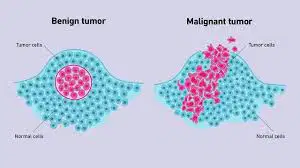
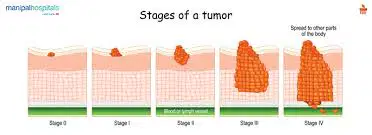
What is a tumor?

a)

A normal cell

b)

A single cell

c)

A large group of cells

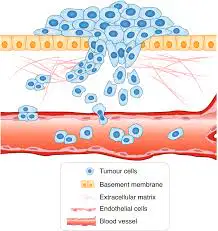
83.

What problem do cancer cells have with communication signals?

a)

Cancer cells respond very good

b)

Cancer cells listen very well.

c)

Cancer cells do not respond to signals.
84.

Cancer cells grow and divide ____________.

a)

slowly (lento)

b)

every 60 seconds

c)

rapidly (rapido)

85.

What do the grades of cancer explain? *2 answers!*

a)

What type of cancer is present

b)

How mature the cells are

c)

How aggressive (harmful) the cancer cells are

d)

Why cells are important.

86.

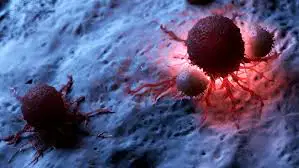
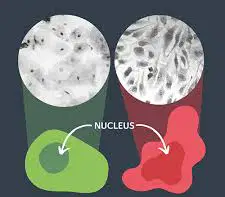
Which cell is a cancer cell?

a)

The green cell

b)

The red cell

87.

Which 2 factors can affect the rate of enzyme activity?

a)

Light intensity

b)

Temperature

c)

pH

d)

Oxygen concentration

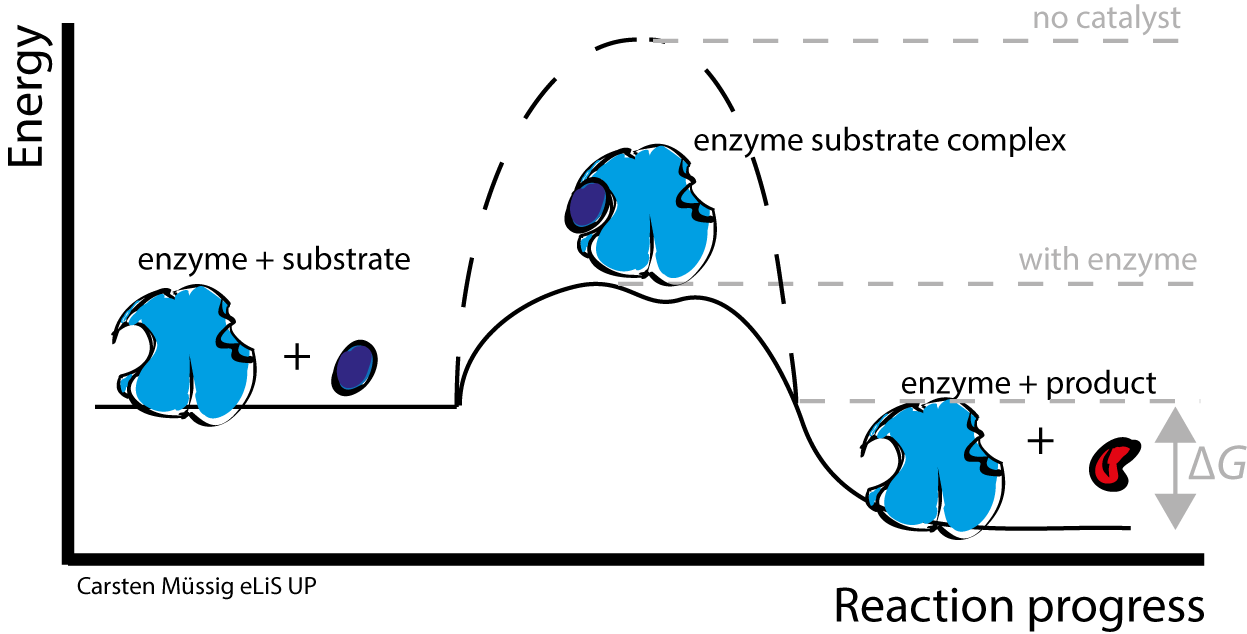
88.
What is the activation energy?
a)
The energy of the products
b)
The energy of the reactants
c)
The minimum energy needed by the reactants to form the products.
d)
The energy lost in the reaction
89.
What type of carbohydrate is shown?
a)
monosaccharide
b)
disaccharide
c)
polysaccharide
90.
What type of fatty acid is shown here?  Note that the (b) is just another way of showing the same thing as (a)
a)
saturated
b)
unsaturated
91.

This molecule would make up a ____.

a)

nucleotide

b)

amino acid

c)

steroid

d)

disaccharide

92.
An enzyme speeds up a reaction by
a)
lowering the activation energy.
b)
raising the activation energy.
c)
releasing energy.
d)
absorbing energy.
93.
A possible explanation to a problem that has not yet been tested. 
a)
data
b)
theory
c)
hypothesis
d)
fact