
 Worksheets
AP Biology Exam Review
Total questions: 88
Worksheet time: 44mins
Meiosis results in _____________ because there is/are _______________.
2 identical haploid cells, 1 round of division
4 identical diploid cells, 2 rounds of division
4 unique haploid cells, 2 rounds of division
2 unique diploid cells, 1 round of division
This process involves homologous chromatids exchanging genetic material to increase genetic diversity.
crossing over
random fertilization
independent assortment
gene flow

Which of the following best describes the inheritance pattern of the shown pedigree?
Autosomal Dominant
Sex-Linked Dominant
Autosomal Recessive
Sex-Linked Recessive
In animals, traits determine by the mitochondrial DNA are inherited from the _______________.
mother
brother
father
sister

Identify the type of inheritance of the pedigree.
Sex-Linked
Mitochondrial
Autosomal
Random
Describe the process of nondisjunction.
Homologous chromosomes exchange genetic information
The alignment of the chromosomes on the metaphase plate
Homologous chromosomes or sister chromatids remain attached during anaphase
The process of sperm and egg fusing to create a zygote
What are the three parts of signal transduction pathway?
reception, transduction, response
confirmation, transduction, transcription
reception, amplification, transcription
confirmation, amplification, response
Transduction step traditionally amplifies the signal, which of the following are NOT involved with transduction?
secondary messengers
protein modification
phosphorylation cascade
ligands
Which of the following is NOT a response by the cell from a signal transduction pathway?
cell growth
gene expression
secretion of molecules
all of the above are responses
Describe what occurs when the ligand binds to the receptor.
confirmation change in shape of receptor
phosphorylation of ligand
ligand passes through the membrane
receptor binds additional ligands
Which feedback mechanism involves amplifying responses and processes in biological organisms?
Positive Feedback
Negative Feedback
Which of the following is NOT a stage of the cell cycle?
interphase
cytokinesis
mitosis
apoptosis
Which of the following is the stage where the cell no longer divides?
G0
G1
G2
S
Which of the following describes the order of the steps in mitosis?
metaphase, telophase, anaphase, prophase
prophase, metaphase, anaphase, telophase
telophase, anaphase, metaphase, prophase
prophase, anaphase, metaphase, telophase
Mitosis results in...
2 identical diploid cells
4 unique diploid cells
2 unique haploid cells
4 identical haploid cells
Where on an enzyme does the substrate bind?
active site
allosteric site
C-terminus
N-terminus
Which structure is unaffected by denaturation?
Primary
Secondary
Tertiary
Quaternary
Which of the following will increase the rate of the reaction?
increase product
increase substrate
increase inhibitor
increase enzyme
Describe why an increase in temperature increases the rate of the reaction.
increase in temperature increases the speed/kinetic energy of particles
increase in temperature activates more enzyme to increase the rate
increase in temperature results in increase in substrate available
increase in temperature allows for a tighter fit in the active site
Describe the difference between competitive and noncompetitive inhibitors.
noncompetitive binds to active site and competitive binds to other site
competitive binds to active site and noncompetitive binds to other site
competitive is irreversible and noncompetitive is reversible binding
noncompetitive is irreversible and competitive is reversible binding
What is the process of an endergonic reaction being fueled by an exergonic reaction called?
second law of thermodynamics
energy coupling
first law of thermodynamics
endergonic/exergonic switch
What are the products of the light-dependent reactions of photosynthesis?
ATP & NADH
CO2 & H2O
NADPH & ATP
Organic Compounds & O2
What is the function of the electron transport chain between Photosystem II and Photosystem I?
establish electrochemical gradient of protons
to funnel electrons into photosystem I for the Calvin cycle
transport electrons to oxygen to make water
to synthesize ATP using ATP synthase
Where does the Calvin cycle take place?
thylakoid membrane
cristae
stroma
matrix
Which of the following are electron carriers for the electron transport chain in cellular respiration?
NADPH
FADH2
NADH
NADH & FADH2
Which process releases energy in glucose to form ATP, NADH, and pyruvate?
Glycolysis
Oxidative Phosphorylation
Krebs Cycle
Fermentation
Why is water considered polar?
Nonpolar covalent bonds in structure
Ionic bonds in structure
Polar covalent bonds in structure
Hydrophobic interaction in structure
Which macromolecule(s) have nitrogen?
Carbohydrates
Proteins
Nucleic Acids
Nucleic Acids & Proteins
Which macromolecule(s) have phosphorus?
Carbohydrates
Proteins
Nucleic Acids
Fats
Which macromolecule(s) have sulfur?
Carbohydrates
Proteins
Nucleic Acids
Fats
Describes the forming of a bond between monomers with the removal of a water molecule.
Hydrolysis
Dehydration
Describes the breaking of a bond within a polymer using water.
Hydrolysis
Dehydration
Which of the following is NOT in the monomer of a nucleic acid?
pentose sugar
nitrogenous base
phosphate
amino acid
Which of the following is NOT in the monomer of a protein?
Amine Group
R Group
Carboxyl Group
Nitrogenous Base
Describe the orientation of the phospholipids in the membrane.
Phospholipids orient in bilayer with hydrophilic heads on exterior
Phospholipids orient in monolayer with hydrophilic head on extracellular
Phospholipids orient in bilayer with hydrophobic tails on exterior
Phospholipids orient in monolayer with hydrophobic tails on extracellular
How is DNA/RNA synthesis directionally oriented?
new nucleotides are added to 5' phosphate
new nucleotides are added to 3' phosphate
new nucleotides are added to 5' hydroxyl
new nucleotides are added to 3' hydroxyl
Identify the pairing and number of bonds in DNA double helix
A pairs with T (2 bonds) & G pairs with C (3 bonds)
A pairs with G (2 bonds) & T pairs with C (3 bonds)
A pairs with T (3 bonds) & G pairs with C (2 bonds)
A pairs with G (3 bonds) & T pairs with C (2 bonds)
What component of the polypeptide is the next amino acid added forming the peptide bond?
amino group
hydrogen
carboxyl group
R groups
Which protein involves R group bonding to form the final three dimensional structure?
primary
secondary
tertiary
quaternary
Which protein structure involves the peptide bonds between amino acids?
primary
secondary
tertiary
quaternary
In a population of 100 individuals, 20 individuals are born and there are 5 deaths. What is the r value?
Recall: r = per capita growth rate of population
.05
.15
.20
.25
If the population size is 100 individuals and there is a r value of 0.3, what is dN/dt?
Recall: dN/dt = rN
10
15
30
60
As the population size approaches carrying capacity, dN/dt...
increases steadily
increases slowly
decreases slowly
decreases steadily
Which of the following describes the disadvantage of little species diversity in a community?
less likely to have immigration
more likely to be consumed by predators
more likely to have mutations
less resilient to changes in the environment
Which of the following is an organism that is disproportionate relative to their abundance and when removed from the ecosystem causes it to collapse?
dominant species
invasive species
keystone species
primary consumer
A group of bacteria are resistant to antibiotics. Which of the following describes HOW the bacteria became resistant?
the bacterial population got changed by the antibiotic in the environment
the bacterial population had random mutations making them favorable in the presence of the antibiotic
the bacterial population consumed the antibiotic providing a food source
the bacterial population uses the antibiotic for reproduction
Describe the difference between rough ER and smooth ER.
Rough ER compartmentalizes cell; Smooth ER functions in detox and lipid synthesis
Rough ER functions in ribosome synthesis; Smooth ER functions in lipid synthesis
Rough ER functions in detox and lipid synthesis; Smooth ER compartmentalizes cell
Rough ER functions in lipid synthesis; Smooth ER functions in ribosome synthesis
Which organelle is a membrane-bound structure that functions in correct folding/chemical modification of proteins?
Golgi complex
Lysosome
Mitochondria
Chloroplast
Which is membrane-enclosed sacs that contain hydrolytic enzymes?
Golgi complex
Lysosome
Mitochondria
Chloroplast
Which is responsible for storage and release of macromolecules and cellular waster products. In plants, aids in turgor.
Endoplasmic Reticulum
Lysosome
Mitochondria
Vacuoles
Which of the following is the location for the light-dependent reactions?
grana/thylakoid membrane
matrix
stroma
cristae
Which of the following is the location for the Krebs cycle?
grana/thylakoid membrane
matrix
stroma
cristae
Describe the relationship between cell size and SA:V ratios.
As cells increase in size, the SA:V ratio increases
As cells decrease in size, the SA:V ratio decreases
As cells increase in size, the SA:V ratio decreases
Cell size has no effect on the SA:V ratio
Which of the following requires an input of energy for membrane transport?
Charged ion moving against concentration gradient
Water moving into a hypertonic cell
Charged ion moving with concentration gradient
Water moving out of a hypotonic cell
What is the difference between endocytosis and exocytosis?
Endocytosis involves cytoplasm of a neighboring cell entering
Endocytosis involves phagocytosis or pinocytosis to bring materials in cell
Exocytosis involves cytoplasm of a neighboring cell exiting
Exocytosis involves phagocytosis or pinocytosis to remove material from cell
Which of the following correctly describe the movement of water?
Cell with 0.5M concentration will gain water from the 1.0M exterior solution
Cell with 0.5M concentration will gain water from the 0.5M exterior solution
Cell with 1.0M concentration will gain water from the 0.5M exterior solution
Cell with 0.5M concentration will lose water to the 0.5M exterior solution
Why is a eukaryotic cell able to be larger than a prokaryotic cell?
Membrane-bound organelles compartmentalize intracellular processes
Prokaryotic cells have a nucleus which decreases the volume of the cell
Eukaryotic cells have a nucleus which decreases the volume of the cell
Absence of membrane-bound organelles allows for enzymatic reactions.
How does the DNA in a prokaryote differ from a eukaryote?
Prokaryote has circular DNA, Eukaryotes has linear DNA
Prokaryote has single stranded DNA, Eukaryotes has double stranded DNA
Prokaryote has linear DNA, Eukaryotes has prokaryote DNA
Prokaryote has double stranded DNA, Eukaryotes has single stranded DNA
Both eukaryotes and prokaryotes have plasmids. What are plasmids?
large extra-chromosomal, double-stranded, linear DNA molecules
large extra-chromosomal, double-stranded, circular DNA molecules
small extra-chromosomal, double-stranded, circular DNA molecules
small extra-chromosomal, double-stranded, linear DNA molecules
Identify which of the following best describes purines and pyrimidines.
Purines (C, T, & U) have single ring, Pyrimidines (A & G) have double ring
Purines (C, T, & U) have double ring, Pyrimidines (A & G) have single ring
Purines (A & G) have single ring, Pyrimidines (C, T, & U) have double ring
Purines (A & G) have double ring, Pyrimidines (C, T, & U) have single ring
Which of the following demonstrates base pairing rules to 5' - CAGGT - 3'
3' - TGGAC - 5'
3' - GTCCA - 5'
5' - GTCCA - 3'
5' - CAGGT - 3'
Which enzyme is responsible for relaxing supercoiling in front of the replication fork?
helicase
DNA polymerase
topoisomerase
ligase
Which enzyme is responsible for unwinding the DNA strands?
helicase
DNA polymerase
topoisomerase
ligase
Which enzyme is requires RNA primers to initiate DNA synthesis?
helicase
DNA polymerase
topoisomerase
ligase
Which enzyme is responsible for joining the fragments on the lagging strand?
helicase
DNA polymerase
topoisomerase
ligase
How do the three types of RNA work together?
mRNA carries message, tRNA carries amino acids, and rRNA makes ribosome
mRNA makes ribosomes, tRNA carries amino acids, and rRNA relays information
mRNA carries amino acids, tRNA transfer message, and rRNA makes ribosome
mRNA is made, tRNA holds the DNA in place, and rRNA removes the deoxyribose
Which of the following are NOT post-transcriptional modifications?
5' cap
intron removal
poly-A tail
TATA box
What is the sequence of nucleotides on mRNA read in triplets called?
anticodon
codon
triplet box
wobble
How do retroviruses violate the central dogma?
Retroviruses are responsible for using DNA to synthesize more viral RNA
Retroviruses are pre-historic and existed prior to the central dogma
Retroviruses use enzymes to make DNA from RNA & integrate into host DNA
Retroviruses use host DNA to make viral RNA, then incorporate into host DNA
Identify the primary source of genetic variation
crossing over
mutations
random fertilization
independent assortment
Northern elephant seals were hunted by humans in the 1890s, reducing their population size to 20 individuals. Even though their population is now over 30,000, the seals still have reduced genetic variation. What’s the best explanation of this phenomenon?
Bottleneck effect
Founder effect
Hererozygote advantage
Relatice fitness
Certain cavefish and salamanders have non-functional eyes, which are remnants of the functional eyes of their ancestors. Such examples of “leftover” structures are referred to as:
Homologous structures
Analogous structures
Vestigial structures
Genetic drift
Western spotted skunks (Spilogale gracilis) breed in the fall, whereas and eastern spotted skunks (Spilogale putorius) breed in late winter. What type of reproductive barrier prevents these species from being classified as the same species?
Habitat isolation
Mechanical isolation
Gametic isolation
Temporal isolation
It is hypothesized that eukaryotic features evolved from prokaryotic cells when smaller prokaryotic cells, the precursors of mitochondria and plastids, began living within larger cells. This model is referred to as:
Endosymbiosis
Adaptive radiation
Simple metabolism
The Cambrian explosion
Male peacocks are famous for their colorful, showy tails, whereas female peahens are brown with no fancy tails. This is an example of sexual dimorphism, found in organisms with two different looks within the species. What mode of selection produces species exhibiting sexual dimorphism?
Stabilizing selection
Directional selection
Sexual Selection
Artificial selection
Thermoregulation involves maintaining an internal body temperature within a tolerable range. Which of the following organisms are considered ectothermic?
Mallard duck
Walrus
Python
Bat
Finch populations were separated in the Galapagos islands by the ocean. This lead to speciation. What type of speciation does this represent?
Allopatric speciation
Sympatric speciation
Reproductive isolation
Temporal isolation
Identify the type of prezygotic barrier that each example represents:
A type of fruit fly lays its eggs on the leaves of plants while other fruit fly species lay their eggs in tree bark.
Mechanical isolation
Gametic isolation
Habitat isolation
Temporal isolation
Identify the type of prezygotic barrier that each example represents:
The males from one species of bird have a specific mating call, while birds from another species have a different mating call.
Temporal isolation
Behavior isolation
Mechanical isolation
Habitat isolation
Identify the type of postzygotic barrier that each example represents:
A male donkey and a female horse can mate to produce a mule, but mules are sterile
Reduced hybrid fertility
Reduced hybrid viability
Hybrid breakdown
Identify the type of postzygotic barrier that each example represents:
When different species of frogs and salamanders mate the zygote fails to develop or mature.
Reduced hybrid viability
Reduced hybrid fertility
Hybrid breakdown
All of the following are part of Hardy Weinberg law for populations in equilibirum EXCEPT
Large population
No immigration or emigration
No natural selection
Non random mating
No genetic mutations

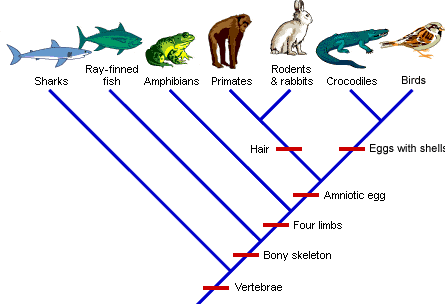
Which species on this cladogram have four walking legs?
Lancelet
Leopards only
All of the species have this trait
Salamander, turtle, leopards
Which Hardy-Weinberg factor represents the frequency of heterozygous individuals in a population?
p2
2pq
q2
p2 + 2pq
The allele frequency of p=.20 What is the percentage of recessive genotype?
.80
.04
.32
.64

