
 Worksheets
Kingdoms & Classification
Total questions: 90
Worksheet time: 2hrs 32mins


Which of the following are kingdoms of life? (Check all that apply)
viruses
animals
archea
plants
fungi
Which kingdom is prokaryotic?
Animalia
Archae
Planta
Fungi
Which two kingdoms contain ONLY multicellular organisms? (Pick 2)
Plants
Animals
Fungi
Protists
Bacteria
Which kingdoms contain some unicellular organisms and some multicellular organisms? (Pick 2)
Bacteria
Animal
Protist
Fungi
Which kingdoms contain organisms whose
cells HAVE cell walls?
protists, fungi, and plants
plants, fungi, and bacteria
animals, bacteria, plants
plants , protists, animals
Unicellular organisms that have no nucleus are classified as:
fungus
bacteria
bacteria or protist
protist or fungus
Contain cell walls with cellulose
Animalia
Plantae
Protista
Archaea
Fungi
Which of these kingdoms contain PROKARYOTES?
Animalia
Plantae
Fungi
Bacteria
Archaea

Animalia
Plantae
Fungi
Protista
Bacteria
Live in extreme environments
Animalia
Bacteria
Plantae
Archaea
Fungi

Animalia
Plantae
Protista
Fungi
Bacteria
Most are MOTILE for at least part of their life
Animalia
Plantae
Fungi
Bacteria
Archaea
Prokaryotes whose cell walls contain peptidoglycan
Animalia
Plantae
Fungi
Archaea
Bacteria
ALL are heterotropic and multicellular
Animalia
Plantae
Fungi
protista
Bacteria
Contain Chloroplasts for photosynthesis
Animalia
Plantae
Fungi
Archaea
Batceria

Bacteria
Archaea
Plantae
Protista
NONE OF THESE
Prokaryotes whose cell walls do not contain peptidoglycan
Animalia
Plantae
Archaea
Bacteria
Fungi
Absorb nutrients from organic material - and the best pizza topping!
Animalia
Fungi
Plantae
Bacteria
Archaea
I am an autotroph
I am multicellular
What am I?
I am eukaryotic
I reproduce sexually
I am multicellular
What kingdom do I belong to?
Plantae
Animalia
Protista
Fungi
I am unicellular
I am prokaryotic
I am found in extreme environments
What kingdom do I belong to?
The Candy Kingdom
Kingdom Plantae
Kingdom Animalia
Kingdom Archaebacteria
I can be either a heterotroph or an autotroph-
I am mostly unicellular-
I am the "Junk Drawer" kingdom
The only thing for sure about me is that I have a nucleus in my cells...
I am Kingdom ____________ .
Plantae
Protista
Animalia
of Oz
This kingdom includes unicellular organisms, they reproduce quickly by binary fission (asexual), and are common bacteria that get you sick.
Archaebacteria
Fungi
Eubacteria
Protists
Single celled organisms that live in extreme conditions getting energy from taking in chemicals from their surrounds
Fungi
Eubacteria
Protists
Archaebacteria
Reasons that viruses are considered to be nonliving is because
They are not cellular
They cannot reproduce on their own
They cannot make proteins
all of the above
What do viruses need to reproduce?
they need genetic material
They need a host cell
They need bacteria
They need insulin
A(n) _____ is a virus that enters a bacterial cell.
endospore
decomposer
plasmid
bacteriophage
When a virus invades a living cell, its _______
takes over the cell's functions.
outer coat
genetic material
core
cytoplasm
What do viruses have in common with living cells? They both...
store genetic information
have chloroplasts
use glucose for cellular respiration
have endoplasmic reticulum
Which of the following occurs after a virus attaches to a host cell in the viral reproduction process?
The host cell dies
The virus dies
The virus inserts its genetic information into the host cell
copies of the virus are immediately released from the host
How do viruses reproduce?
They copy their own genetic material inside a protein coat.
They kill a cell and reproduce inside it.
They invade a living cell and use the cell's functions to replicate their genetic material.
They do not reproduce because they are not technically living things.
What is one way that a lysogenic infection differs from a lytic infection?
A lysogenic virus does not act on bacteria as a lytic virus does.
A lysogenic virus can remain in the host DNA for a longer period without becoming active.
A lysogenic virus contains RNA instead of DNA.
A lysogenic virus directs the production of new viruses right away.
What is the lytic and lysogenic cycle have in common?
The host cell dies
The virus dies
The virus inserts its genetic information into the host cell
copies of the virus are immediately released from the host

The projections on the surface of this virus allow the virus to —
move inside a host cell
attach to a host cell
control a host cell’s DNA
signal other viruses to infect a host cell
What statement about viruses is true?
Viruses metabolize
Viruses reproduce on their own
Viruses have DNA or RNA
Viruses have a nucleus
Viruses, bacteria, protists, and fungi can all be pathogens.
True
False
What part of a virus is the protein capsule that houses the genetic material (DNA/RNA)?
tail
nucleus
capsid
glycoprotein
Viruses are prokaryotic cells.
True
False
A researcher is studying a particular disease-causing agent. The agent has a protein coat, but it lacks a nucleus, contains no other organelles, and can reproduce only when it is inside an animal cell.
The researcher should classify the agent as which of the following?
a virus
a protist
a fungus
a bacterium
Which of the following statements is correct about the hierarchy of the taxonomic system currently used to classify organisms?
All organisms of a given order belong to the same species.
Many different classes of organisms belonging to the same order.
All organisms of a given phylum belong to the same kingdom.
Many different families of organisms belong to the same genus.
The scientific name for the woodchuck is Marmota monax, and the scientific name for the long-tailed marmot is Marmota caudata. Which of the following statements describes the taxonomic relationship between the woodchuck and the long-tailed marmot?
They belong to different phyla.
They belong to the same genus.
They belong to the same species.
They belong to different families.
An organism is eukaryotic, multicellular, heterotrophic, and has a cell wall. To which kingdom does it belong?
Animal
Fungi
Plant
Protist
Which character distinguishes Fungi from Plantae?
presence of membrane-bound organelles
presence of membrane-bound nucleus
cell walls with chitin
multicellular
Multicellular eukaryotes that are usually mobile and obtain food from other organisms probably belong to the kingdom _____.
Plantae
Fungi
Animalia
Protista
Dr. Bennett is a physician. One of his patients presents with a high fever and muscle aches. After examining the patient, Dr. Bennett diagnoses the patient with influenza.
Influenza is caused by a ______, which contains genetics information but cannot reproduce independently and is not considered to be a living organism.
Yeast
Virus
Fungus
Bacterium

According to the cladogram, which organism evolved first?
Shark
Ray-Finned Fish
Crocodiles
birds

According to the cladogram, which group of organisms are the most closely related?
crocodiles and birds
crocodiles and primates
sharks and ray-finned fish
sharks and amphibians
According to the cladogram, which characteristic separates sharks from ray-finned fish?
Vertebrae
Bony Skeleton
Fourlimbs
Amniotic egg
What kingdom- prokaryotic-single celled-found on humans & other surfaces
eubacteria
archaebacteria
protists
fungi
HOW MANY KINGDOMS ARE THERE?
4
5
6
7
This category is the broadest or most general taxonomic classification of living organisms
Kingdom
Domain
Species
Organisms
All organisms in the kingdoms Protista, Plantae, Fungi, and Animalia are
multicellular organisms
eukaryotes
photosynthetic organisms
prokaryotes
Traits that appear along an evolutionary timeline and are found in some organisms but not all are...
*hint they are dashes on a cladogram
clade
node
derived characters
phyla
Which of the following is correctly written in the binomial nomenclature system?
Canis lupus
Red wolf
Ailurus Fulgens
canis Lupus
A group of related families make up this taxonomic level
Class
Kingdom
Domain
Order
Largest division of modern classification - there are 3 of them (Archaea, Bacteria, Eukarya)
Class
Kingdom
Domain
Order
Canis lupus and Canis latrans both belong to the same ____?
Genus
Sub-species
Species
A group of organisms able to produce fertile offspring
Genus
Kingdom
Species
Kingdom of multicellular autotrophs with cellulose in their cell walls
Archaea
Fungi
Archaebacteria
Plantae
Kingdom of the true bacteria such as the ones that cause strep throat (streptococcus) or staph infections (staphylococcus)
Archaebacteria
Protista
Eubacteria
Animalia
The correct order for the levels of Linnaeus's classification system, from general to specific, is
kingdom, species, class order, family, genus, phylum
kingdom, phylum, class, order, family, genus, species
phylum, kingdom, family, class, order, genus, species
species, genus, kingdom, family, order, class, phylum

Which taxa (level) contains only the wolf?
Phylum
Order
Species
Genus
Which taxa contains the bat and shark, but no spiders
Phylum
Order
Species
Genus
A Phylum is divided into this taxonomic level
Class
Order
Kingdom
Genus
Which taxa includes all the animals in this diagram
Class
Species
Kingdom
Genus
Which taxa contains only the dogs, wolves, and foxes?
Class
Species
Kingdom
Family
Which taxa contains only the wolf, fox, dog, and bear?
Order
Species
Kingdom
Family
Which taxa contains only the wolf and the dog?
Order
Species
Genus
Family

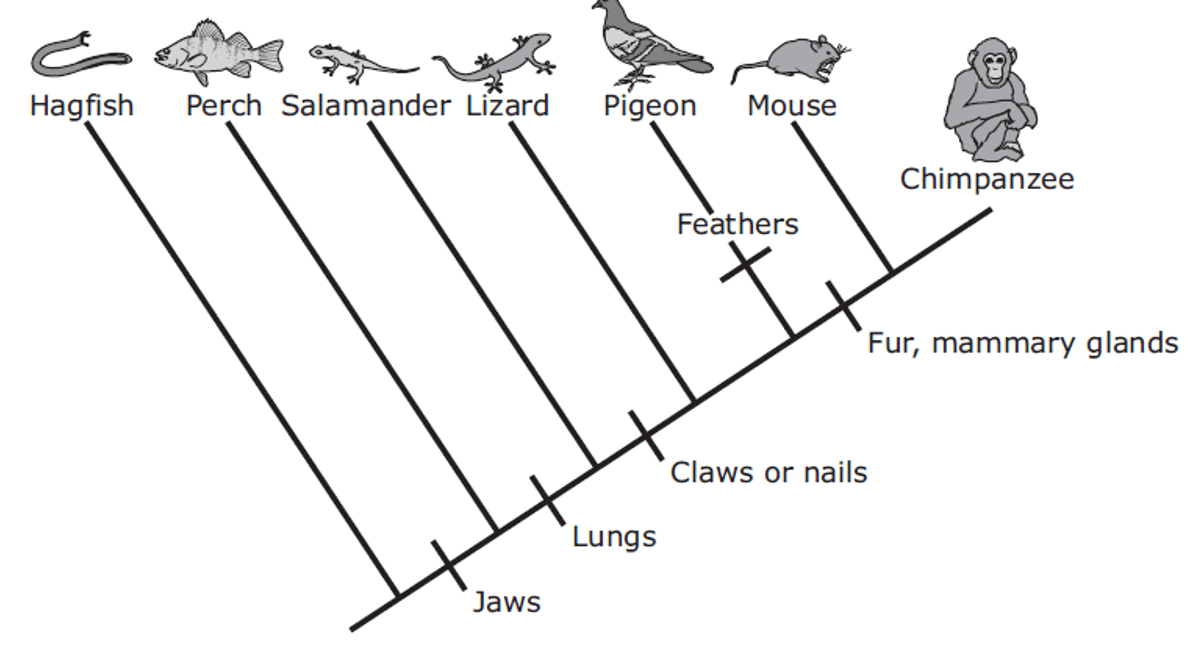
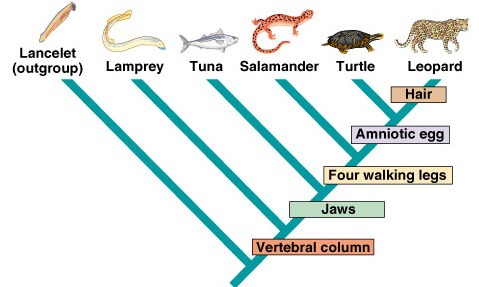
Which is the newest trait?
Amniotic egg
Walking legs
Jaws
Hair

What number is the common ancestor of C and D
1
2
3
4

Where is the alligator and T. rex's common ancestor?
Point A
Point B
Point C
Point D

Scientific names are usually written in what language?
English
Hebrew
Arabic
Latin
Which type of character is found within an entire line of descent of organisms?
ancestral
biochemical
derived
morphological
Which of the following is useful in treating bacterial diseases, but not viral diseases?
antivirals
antibiotics
aspirin
vaccines
Which method is not used to control bacterial growth?
vaccination
sterilization
freezing
heating
When scientists place a species on a certain part of a cladogram, which of the following factors are they least likely to consider?
population size
fossil record
DNA similarities
physical similarities

