
 Worksheets
Biology Final Fall Exam Review
Total questions: 94
Worksheet time: 2hrs 31mins
What is one similarity between eukaryotic and prokaryotic cells?
Both cells have a cell wall
Both cells have mitochondria
Both cells are complex
Both cells have ribosomes (Protein factories)
What role do lipids have in the cell? Recall that lipids are oils/fats.
to provide structure
to provide short term memory
to create cell structure
to synthesize amino acids
Which macromolecule is made up of nucleotides?
Lipids
Carbohydrates
Proteins
Nucleic Acids
Which macromolecule is used for quick energy and includes sugars and starches?
Carbohydrates
Proteins
Lipids
Nucleic Acids
Which macromolecule is made up of amino acids and is involved in growth and repair of muscle?
Carbohydrates
Lipids
Proteins
Nucleic Acids
Which macromolecule is responsible for creating cell structure and includes fatty,waxy, or oily compounds?
Carbohydrates
Lipids
Proteins
Nucleic Acids
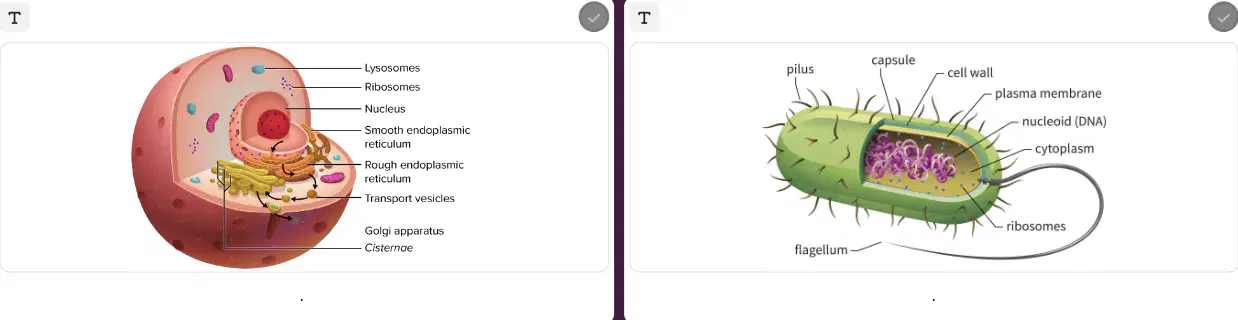
Which one of the cells is eukaryotic?
The cell that contains cytoplasm
The cell that contains ribosomes
The cell that contains a nucleus
The cell that does not contain a nucleus
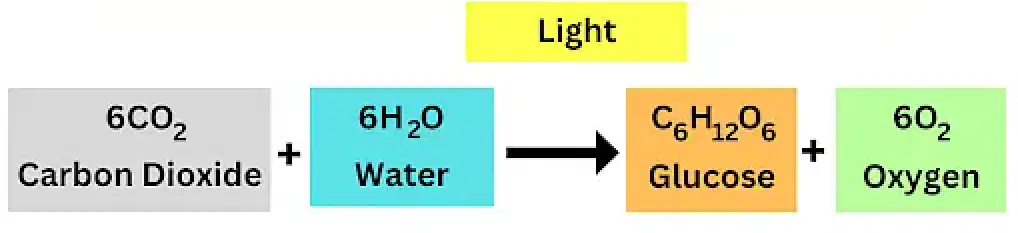
What process is represented by this chemical equation?
Cellular Respiration
Combustion
Citric Acid Cycle
Photosynthesis
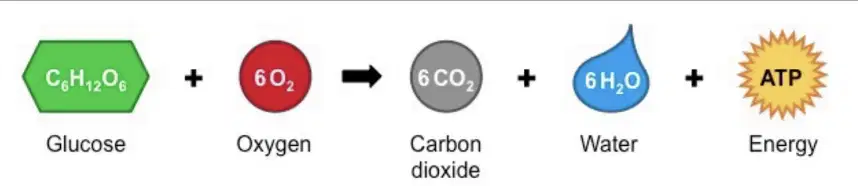
What process is represented by this chemical equation?
Cellular Respiration
Combustion
Citric Acid Cycle
Photosynthesis
True or False: Photosynthesis occurs only in plants, not animals.
True
False
True or False: Cellular Respiration occurs in both plants and animals.
True
False
What are the main reactants in the photosynthesis equation?
Oxygen and glucose
Carbon dioxide and water
Glucose and sunlight
Oxygen and carbon dioxide
What are the primary products of photosynthesis?
Glucose and oxygen
Water and carbon dioxide
Glucose and carbon dioxide
Oxygen and sunlight
What are the main reactants in the cellular respiration equation?
Glucose and oxygen
Carbon dioxide and water
Glucose and sunlight
Oxygen and glucose
What are the primary products of cellular respiration?
Glucose and oxygen
Water and carbon dioxide
Oxygen and glucose
Carbon dioxide and sunlight
Which of the following scenarios best illustrates the concept of active transport in cells?
A plant root absorbing water from the soil through osmosis.
A cell taking in glucose from the bloodstream against its concentration gradient.
A red blood cell releasing carbon dioxide into the lungs.
A cell exchanging oxygen and carbon dioxide during respiration.

Which part of the diagram supplies the energy needed for active transport in the cell?
A
B
C
True or False: Osmosis is the the movement of water across a semipermeable membrane.
True
False
Which type of diffusion requires a special protein to assist in the movement of molecules across the cell membrane?
Simple diffusion
Osmosis
Facilitated diffusion
Active transport

Below is an image of a typical bacterial cell. Which three cellular components are present in ALL cells?
Plasma Membrane (Cell Membrane), Nucleus, and Cytoplasm
Cytoplasm, Flagellum, and Ribosomes
Plasma Membrane (Cell Membrane), Ribosomes, and DNA
DNA, Ribosomes, and Capsule
True or False: Viruses are classified as living organisms and categorized as prokaryotic cells.
True
False
Which of the following statements correctly describes the similarities or differences between viruses and cells?
Select TWO correct answers:
A. Viruses and cells both have a form of genetic material, such as DNA or RNA.
B. Viruses can carry out their life cycle independently of a host cell.
C. Cells, but not viruses, have surface proteins for binding to hosts.
D. Viruses cannot replicate without being inside a host cell.
E. Both viruses and cells have organelles that perform basic functions like energy production.
Which of the following best explains the difference between viruses and cells?
Both cells and viruses use organelles to carry out their functions.
Cells have both genetic material and organelles, while viruses have genetic material but lack organelles.
Viruses and cells both replicate independently, using their own cellular machinery.
Both viruses and cells contain DNA, but only viruses rely on host machinery for replication.
Long term energy, insulation for the body, and cushioning for vital organs, are all functions of which organic molecule?
carbohydrate
fat
protein
sugar
What is the fundamental element found in all organic compounds studied by chemists?
carbon
hydrogen
oxygen
nitrogen
A student is reading about the chemical composition of a category of molecules. The molecules are found as repeating units of proteins.
What type of molecule are the repeating units?
amino acids
fatty acids
monosaccharides
nucleotides
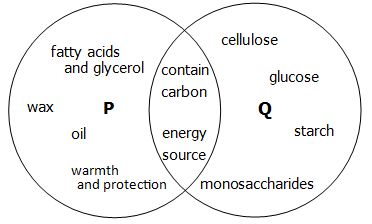
Use the Venn diagram to compare and contrast two macromolecules.
What is the best title for the letter Q?
carbohydrates
lipids
nucleic acids
proteins


Osmosis is
diffusion of water molecules through a semi-permeable mebrane from an area of low concentration to an area of high concentration
the diffusion of particles from an area of high concentration to an area of low concentration
diffusion of water molecules through a semi-permeable membrane from an area of high concentration to an area of low concentration
the diffusion of particles from an area of low concentration to an area of high concentration

which organelle is responsible for energy production
nucleus
mitochondria
ribosomes
lysosomes

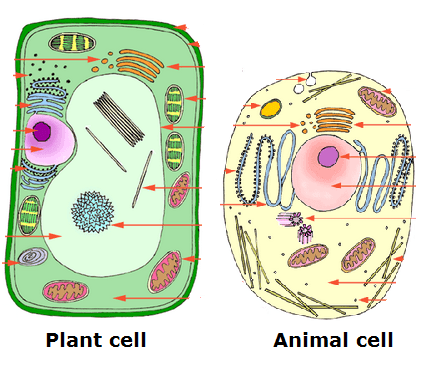
What distinguishes a plant cell from an animal cell? (How do you tell them apart) Hint: There's 3 ways (Check all 3)
Large Central Vacuole
Mitochondria
Cell Wall
Ribosomes
Chloroplasts

What is one way in which all living things on Earth are alike?
All living things have hair.
All living things are made of cells and come from other cells.
The cells of all living things have chloroplast.
All living things eat other organisms for nutrition.
Which type of cell has membrane bound organelles?
Prokaryotic cells
Bacteria cells
Eukaryotic cells
E-coli bacterium
Jayden knows that multicellular organisms are more complex than unicellular organisms. Which of these is a characteristic of multicellular organisms?
obtaining food
breathing
being able to move
having specialized cells

a type of cell that DOES NOT have a nucleuse (Hint: NO nucleus)
prokaryotic cell
eukaryotic cell

makes proteins
golgi body
endoplasmic reticulum
mitochondria
ribosomes

What is the longest stage (cell spends 90% here) of the cell cycle called?
Cytokinesis
M phase
Interphase
G1 Phase
Put the following stages of MITOSIS in order: anaphase, prophase, metaphase, and telophase.
prophase, metaphase, telophase, anaphase
prophase, anaphase, metaphase, telophase
prophase, metaphase, anaphase, telophase
prophase, telophase, metaphase, anaphase

Why would it be important to replicate DNA before a cell divides in mitosis?
In order for genetic information to be transferred into daughter cells.
In order for the cell to be able to increase in size.
In order for the DNA to be contained in the nucleus.
In order for the cell to re-order the DNA sequencing in the new cells.


The cell membrane pinches in, cutting the cytoplasm into 2 daughter cells
Metaphase
Anaphase
Telephase
Cytokinesis
T A G G A C T
The complementary strand is...
T A G G A C T
A T G G T G A
A T C C T G A
T T C C A G T
What is the first step of DNA Replication?
Helicase unwinds the DNA strands
DNA polymerase adds nucleotides
RNA polymerase adds nucleotides
Helicase zips up the DNA
What enzymes are involved in DNA replication?
helicase, catalase
RNA polymerase, catalase
helicase, DNA polymerase
DNA polymerase, catalase
How many nucleotide bases are there?
1
2
3
4
Translate the mRNA molecule for this gene:
C-A-T-G-T-A-A-A-C
T-C-G-A-T-U-U-C-C
G-G-G-A-T-C-U-U-T
G-U-A-C-A-U-U-U-G
G-T-A-C-A-T-T-T-G
What is the difference between mRNA and DNA?
DNA is a double helix, mRNA is a single strand
DNA has deoxyribose sugar, and mRNA has ribose sugar
DNA uses Thymine, and mRNA uses Uracil
All of the above

GTAGTCA
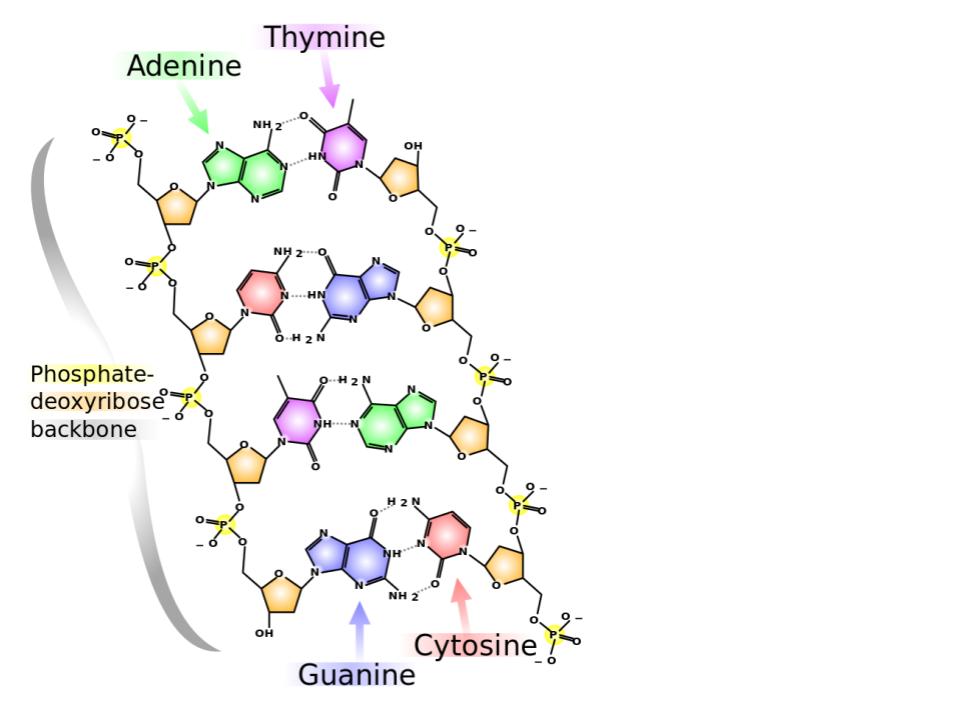


AATCATGGA
Transcribe the following DNA strand: CTG AAT
GAC TTA
CTG AAT
GAC UUA
CUG AAU
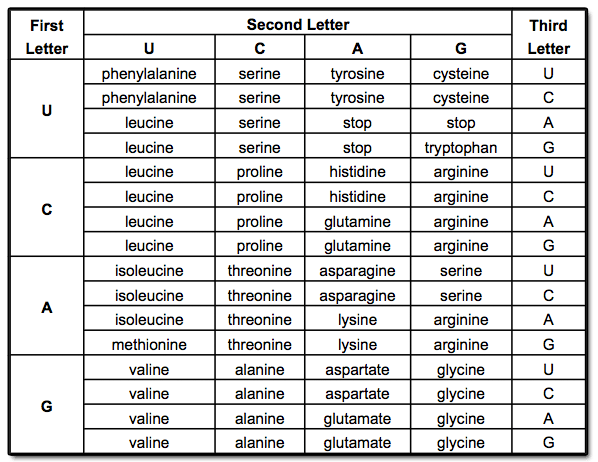



If the mRNA codon is AUG, what amino acid be added to the growing polypeptide?
Met
Glu
Ala
Phe
Where in the cell does translation occur?
Cytoplasm
Nucleus
Endoplasmic Reticulum
Golgi apparatus

