wayground logo

Free Printable Worksheets

Font size

S
M
L
XL
Worksheets

Biology Semester Exam Review (H22)

Total questions: 98

Worksheet time: 1hrs 2mins

Name
Class
Date
1.
The difference in the concentration of a substance from one location to another is called a/an
a)
diffusion
b)
osmosis
c)
concentration gradient
d)
passive transport
2.
A molecule that diffuses down a concentration gradient goes from an area of ______ concentration into an area of ______ concentration.
a)
high, low
b)
low, high
c)
passive, active
d)
active, passive
3.
Passive transport requires no
a)
concentration gradients
b)
osmosis
c)
motion
d)
energy
4.
This example of passive transport is the diffusion of water.
a)
osmosis
b)
concentration gradient
c)
isotonic
d)
facilitated diffusion
5.
Controlling what goes into or out of the cell without energy is called
a)
active transport
b)
endocytosis
c)
passive transport
d)
exocytosis
6.
This example of passive transport gets energy from the natural motion of particles
a)
osmosis
b)
concentration gradient
c)
isotonic
d)
diffusion
7.
The higher the concentration of dissolved particles in a solution (solute), the _______ the concentration of water molecules in that solution. 
a)
higher
b)
greater
c)
lower
d)
smaller
8.
In facilitated diffusion, molecules move
a)
Down a concentration gradient
b)
Against a concentration gradient
9.
This is the simplest form of passive transport:
a)
osmosis
b)
diffusion
c)
facilitated diffusion
d)
endocytosis
10.
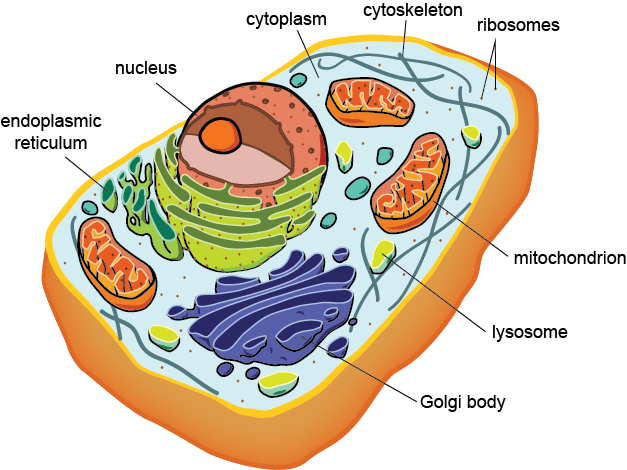
This cell organelle helps organisms maintain homeostasis by controlling what substances may enter or leave cells.
a)
vacuole
b)
nucleus
c)
cell membrane
d)
cell wall
11.
Controlling what goes into or out of the cell with the help of energy is called
a)
active transport
b)
endocytosis
c)
passive transport
d)
exocytosis
12.
This active process gets rid of wastes.
a)
endocytosis
b)
exocytosis
c)
osmosis
d)
diffusion
13.
The movement of molecules against a concentration gradient
a)
simple diffusion
b)
facilitated diffusion
c)
active transport
d)
osmosis
14.
The movement of molecules down a concentration gradient is all of the following except
a)
simple diffusion
b)
facilitated diffusion
c)
active transport
15.
The movement of molecules through selective membrane proteins happens in all of the following except
a)
simple diffusion
b)
facilitated diffusion
c)
active transport
16.
Most active transport proteins use energy from the breakdown of:
a)
nucleus
b)
cell membrane
c)
ATP
d)
mitochondria
17.
This moves substances in vesicles
a)
endocytosis
b)
exocytosis
c)
both
18.
This releases substances outside a cell
a)
endocytosis
b)
exocytosis
c)
both
19.
This takes substances into a cell
a)
endocytosis
b)
exocytosis
c)
both
20.

This type of transport occurs when small particles travel from an area of high concentration to low concentration through a membrane:

a)

Osmosis

b)

Facilitated Diffusion

c)

Diffusion

d)

Endocytosis

21.

The process which water travels from high concentration to low concentration through a membrane:

a)

active transport

b)

facilitated diffusion

c)

exocytosis

d)

osmosis

22.

Which picture best represents active transport?

a)
b)
c)
d)
23.

Which of the following is true regarding a cell membrane? (choose all that apply)

a)

A cell membrane is selectively permeable.

b)

A cell membrane blocks all substances from entering the cell.

c)

A cell membrane is made up of phospholipids and proteins

d)

It is responsible for what comes in an out of the cell

e)

It is the control center of the cell.

24.

The picture shown is how red blood cells can shrink or swell due to its environment. The process responsible for this change is:

a)

osmosis

b)

diffusion

c)

active transport

d)

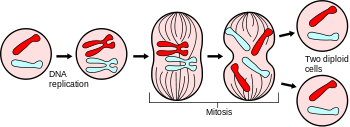
mitosis

25.

Which definition best explains this picture?

a)

Diffusion- the process of small particles moving through a membrane.

b)

Facilitated diffusion- the process which particles travel from [H] to [L] concentration through a protein.

c)

Active transport- the process which particles travel from [L] to [H] concentration and requires ATP.

d)

Endocytosis- the process which cells bring large particles into the cell.

26.

You smell fresh cookies baking in your kitchen oven. What process is responsible for this?

a)

Endocytosis

b)

Exocytosis

c)

Osmosis

d)

Diffusion

27.

The reactants for photosynthesis are __________.

a)

oxygen and sugar

b)

oxygen, carbon dioxide, and water

c)

carbon dioxide, water, and light energy

d)

ATP, ADP, phosphate

28.

The purpose of cellular respiration is to make __________.

a)

food from energy

b)

ATP from glucose

c)

heat for the organism

d)

oxygen

29.

What are the products of cellular respiration?

a)

water, carbon dioxide, and ATP

b)

oxygen and glucose

c)

oxygen and carbon dioxide

d)

oxygen, carbon dioxide, and water

30.

Fermentation occurs when there is a lack of __________.

a)

oxygen

b)

water

c)

glucose

d)

carbon dioxide

31.

When animals exercise with a lack of oxygen their muscles can form __________.

a)

lactic acid

b)

alcohol

c)

carbon dioxide

d)

oxygen

32.

Where does photosynthesis take place?

a)

Mitochondria

b)

Cytoplasm

c)

Chloroplasts

d)

Chlorophyll

33.

Which answer shows the correct number of molecules for the reactants of photosynthesis?

a)

C6H12O6 + 6CO2

b)

6CO2 + 6H2O

c)

C6H12O6 + 6O2

d)

6CO2 + 6O2

34.

Organized structures of DNA are referred to as:

a)

Deoxyribonucleuic Acid

b)

Chromatid

c)

Chromosome

d)

Centromere

35.
What is the function of the mitochondria?
a)
Pack and ship proteins
b)
Make proteins
c)
Make energy (ATP)
d)
Removes waste
36.
I am the control center of the cell and house the DNA. Who am I?
a)
Cytoplasm
b)
Nucleus
c)
Ribosome
d)
Golgi Apparatus
37.

What is the function of the cell membrane?

a)

Produces ATP

b)

Produces proteins and lipids

c)

Keep the organelles in place

d)

Control what enters and leaves the cell

38.
I am the tough exterior that protects plant cells and gives them their shape. Who am I?
a)
Cell wall
b)
Cell membrane
c)
Cytoplasm
d)
Mitochondria
39.
I am way bigger in plant cells than I am in animal cells. What am I?
a)
Golgi Apparatus
b)
Nucleus
c)
Vacuole
d)
Ribosomes
40.
I am the "security gate" of the cell and controls what enters and leaves. Who am I?
a)
Cell wall
b)
Golgi Apparatus
c)
Cytoplasm
d)
Cell membrane
41.
I am very present in muscles in order to provide massive amounts of ATP for movement and exercise. Who am I?
a)
Nucleus
b)
ER
c)
Mitochondria
d)
Ribosomes
42.

Which of the following best describes the function of vacuoles?

a)

Transferring energy throughout all kinds of cells

b)

Storing materials in plant cells

c)

Digesting food in animal cells

d)

Protecting cells from the environment

43.

Which of the following organelles is found in plant cells but NOT in animal cells?

a)

Cell membrane

b)

Nucleus

c)

Chloroplasts

d)

Mitochondria

44.

Reproduction requires the copying of genetic material stored in what part of the cell?

a)

Nucleus

b)

Cell wall

c)

Cell membrane

d)

Vacuole

45.

Which two parts of the cell are unique to plant cells?

a)

Cell membrane and cytoplasm

b)

Cell wall and cytoplasm

c)

Cell wall and chloroplasts

d)

Cell membrane and chloroplasts

46.
A student views cells from several different prokaryotic and eukaryotic organisms under a high-powered microscope. Which of the following statements describes how the prokaryotic cells appear different from the eukaryotic cells?
a)
The prokaryotic cells are much larger.
b)
The prokaryotic cells do not have nuclei.
c)
The prokaryotic cells have mitochondria.
d)
The prokaryotic cells have a less distinct shape.   
47.
Each of the illustrations below shows either a prokaryotic cell or a eukaryotic cell. Each cell is numbered. Which two cells should be classified as prokaryotic cells?   
a)
1 and 2
b)
1 and 3
c)
2 and 4
d)
3 and 4
48.
The cell membrane of the red blood cell will allow water, oxygen, carbon dioxide, and glucose to pass through. Because other substances are blocked from entering, this membrane is called
a)
perforated.
b)
semi-permeable.
c)
non-conductive.
d)
permeable.
49.
Where is the nucleus located?
a)
Only Prokaryotic Cells
b)
Only Eukaryotic Cells
c)
All Eukaryotic and Prokaryotic Cells
50.
Where is the cytoplasm located?
a)
Only Prokaryotic Cells
b)
Only Eukaryotic Cells
c)
All Eukaryotic and Prokaryotic Cells
51.
Where is the cell membrane located?
a)
Only Prokaryotic Cells
b)
Only Eukaryotic Cells
c)
All Eukaryotic and Prokaryotic Cells
52.
Which of the following scientists contributed to the cell theory?
a)
Rudolf Virchow, Robert Hooke, Anton van Leuwenhoek
b)
Matthais Schleiden, Theodor Schwann, Rudolf Virchow
c)
Robert Hooke, Theodor Schwann, Anton von Leuwenhoek
d)
Theodor Schwann, Matthais Schleiden, Robert HookeOption 4 (optional)
53.
Which of the following statements is not part of the cell theory?
a)
Cells are the basic unit of structure and function in all living things.
b)
All cells are produced from other cells.
c)
Only animal cells are composed of cells.
d)
All living things are composed of cells.
54.
Which statement reflects one of the major components of the cell theory?
a)
All living things are multi-cellular.
b)
Organs are the basic unit of structure and function for all living things.
c)
All cells come from previously existing cells.
d)
Every organism has a reproductive system to ensure survival of the species.
55.
When cells are damaged, new cells are created by cell division. How does the cell theory support this fact?
a)
It states that all cells have a nucleus which divides.
b)
It states that all living things are made up of one or more cells.
c)
It states that cells come from previously existing cells.
d)
 It states that the basic units of structure and function are cells.
56.
You might think of me as the trash collector, but recycler is maybe more accurate. What am I?
a)
mitochondria
b)
lysosome
c)
vacuole
d)
ribosome
57.
What is the name of the genetic material that is inside the nucleus?
a)
ER
b)
ATP
c)
YOLO
d)
DNA
58.
What are tiny organelles that convert glucose into ATP?
a)
Ribosomes
b)
Vesicles
c)
Cytoskeleton
d)
Mitochondria
59.
Which of the following is the correct equation for PHOTOSYNTHESIS?
a)
CO+ light + H2O --> O+ Sugar
b)
CO+ sugar + H2O --> O+ light
c)
O2 + light + H2O --> CO+ Sugar
d)
CO+ O2 + H2O --> Light+ Sugar
60.
Which of the following is an example of an AUTOTROPH?
a)
Appletree
b)
Dog
c)
Mushroom
d)
Human
61.
Which of the following is an example of a HETEROTROPH?
a)
Grass
b)
Algae
c)
Lemon Tree
d)
Bear
62.
What is the pigment in chloroplasts that performs photosynthesis?
a)
Chlorosynthesis
b)
Chlorophyll
c)
ADP
d)
Electron Transport
63.
Which gas is removed from the atmosphere during photosynthesis?
a)
hydrogen
b)
oxygen
c)
nitrogen
d)
carbon dioxide
64.
Leaves look green because.....
a)
they eat their vegetables
b)
to blend into their environment
c)
they contain a molecule named chlorophyll
d)
they are sick
65.
What are the reactants (what's needed) for photosynthesis?
a)
glucose and oxygen
b)
light, water, and carbon dioxide
66.
______________ produces the most ATP.
a)
photosnthesis
b)
aerobic respiration
c)
anaerobic respiration
d)
glycolysis
67.
This is referred to as the energy currency of the cell
a)
ADP
b)
ATP
c)
Mitochondria
d)
Nucleus
68.
This process releases chemical energy from sugars and other carbon-based molecules to make ATP when oxygen is present.
a)
photosynthesis
b)
light-independent reaction
c)
cellular respiration
d)
light-dependent reaction
69.
This molecule contains three phosphate groups
a)
ADP
b)
ATP
c)
Mitochondria
d)
Nucleus
70.
This is the first step of cellular respiration
a)
Glycolysis
b)
Lactic Acid Fermentation
c)
Alcoholic Fermentation
d)
Aerobic Respiration
71.
True or False: All cells have DNA.
a)
True
b)
False
72.

How do enzymes speed up chemical reaction?

a)

Increasing activation energy

b)

Decreasing activation energy

c)

Increasing deactivation energy

d)

Decreasing deactivation energy

73.
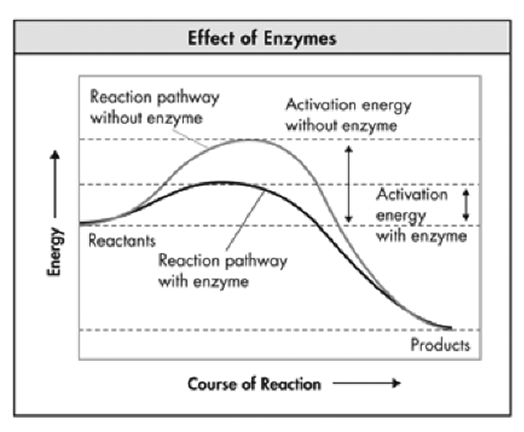
The graph shows how enzymes affect reactions in cells. Which statement best summarizes the information shown in the graph?
a)
Enzymes increase the energy of the reactants.
b)
Enzymes decrease the energy level of the products.
c)
Enzyme decrease the activation energy of the reaction.
d)
Enzymes reverse the direction of the reaction.
74.
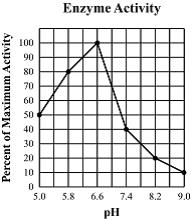
Which of the following conclusions can be drawn from this graph?
a)
The optimum pH of the enzyme is 6.6.
b)
The optimum pH of the enzyme is 5.8
c)
The enzyme’s activity increases as pH increases 5.0 to 9.0
d)
The enzyme’s activity is greater around pH of 8.0 .
75.
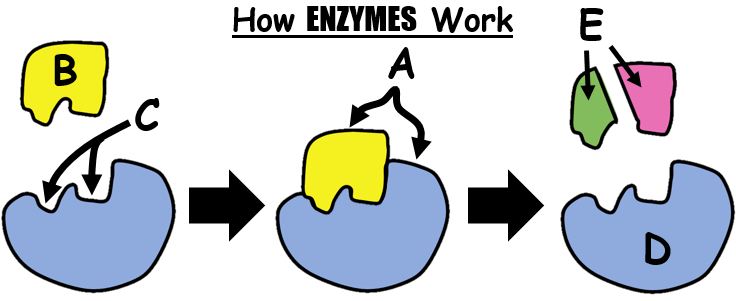
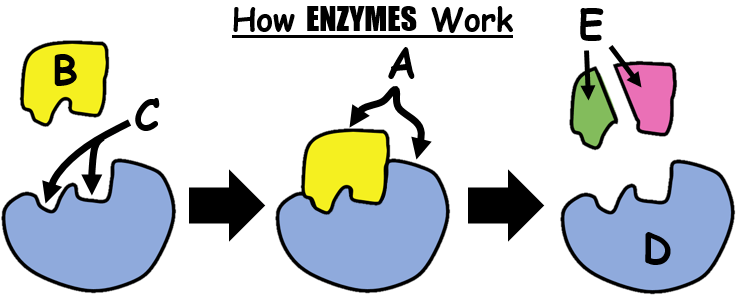
In the diagram, what is letter A? 
a)
product
b)
substrate
c)
enzyme-substrate complex
d)
active site
76.
What happens when enzymes are heated to a high temperature?
a)
The enzymes die.
b)
The shapes of the enzyme are altered denature
c)
The enzymes' amino acid sequence changes.
d)
The enzymes remain the same
77.
Letter D...
a)
active site
b)
enzyme
c)
substrate
d)
products
78.
Ionic Bonding involves...
a)
The transfer of protons
b)
The transfer of nuetrons 
c)
The transfer of electrons
d)
None Of the above
79.
Covalent compounds
a)
Share electrons
b)
transfer electrons
c)
contain a sea of electrons
d)
conduct electricity
80.
What elements generally make an ionic bond?
a)
metal and nonmetal
b)
2 or more nonmetals
c)
metal
d)
none of the above
81.
What elements generally make a covalent bond?
a)
metal and nonmetal
b)
2 or more nonmetals
c)
metal
d)
none of the above
82.
What is a valence electron?
a)
an electron that is found in the outermost shell of an atom. 
b)
an electron found in the innermost shell of an atom.
c)
an electron found in the middle shell.
83.
A water molecule (H2O) is an example of a covalent bond becuase ____.
a)
The hydrogen gains an electron an the oxygen loses one.  
b)
Electrons are shared btween the hydrogen and oxygen
c)
They do not form a eutral goup of atoms. 
d)
Hydrogen and oxygen are both negative ions.   
84.
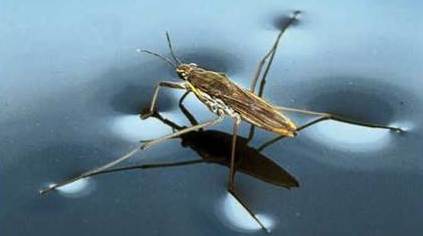
Refer to the picture; this is occurring due to:
a)
Adhesion
b)
Cohesion
85.

Describe CAPILLARY ACTION.

a)

Measure of how difficult it is to break the surface of a liquid.

b)

Water molecules climbing up against the force of gravity.

c)

Water molecules attracted to other substances.

d)

Water molecules dissolving many substances because of its polarity.

86.

Which of the following is NOT a monomer?

a)

a glucose molecule

b)

a protein

c)

an amino acid

d)

a nucleotide

87.

Which structure contatins water and other materials (such as enzymes) and also contains organelles?

a)

vesicle

b)

cytoplasm

c)

cell wall

d)

cell membrane

88.

All organic compounds contain which of the following elements?

a)

hydrogen

b)

oxygen

c)

carbon

d)

nitrogen

89.

Cellular respiration uses 1 molecule of glucose to produce approximately

a)

2 ATP molecules

b)

4 ATP molecules

c)

32 ATP molecules

d)

36 ATP molecules

90.

When the body needs to exercise for longer than 90 seconds, it generates ATP by carrying out

a)

lactic acid fermentation

b)

glycolysis

c)

alcoholic fermentation

d)

cellular respiration

91.

Plants contain mitochondria and chloroplasts.

a)

True

b)

False

92.

All DNA nucleotides contain

a)

deoxyribose

b)

uracil

c)

phosphate

d)

guanine

93.

Which of the following organisms are prokaryotes?

a)

plants

b)

bacteria

c)

animals

d)

fungi

94.

Which type of microscope can create a 3-d image of the surface of a cell?

a)

compound light microscope

b)

scanning electron microscope

c)

transmission electron microscope

d)

dissecting microscope

95.

This structure, found in bacteria and plants, is made of carbohydrates like lignin and cellulose.

a)

cell membrane

b)

cell wall

c)

cytoplasm

d)

vacuole

96.

The enzyme responsible for adding new complementary bases in DNA replication is

a)

telomerase

b)

DNA polymerase

c)

ligase

d)

helicase

97.

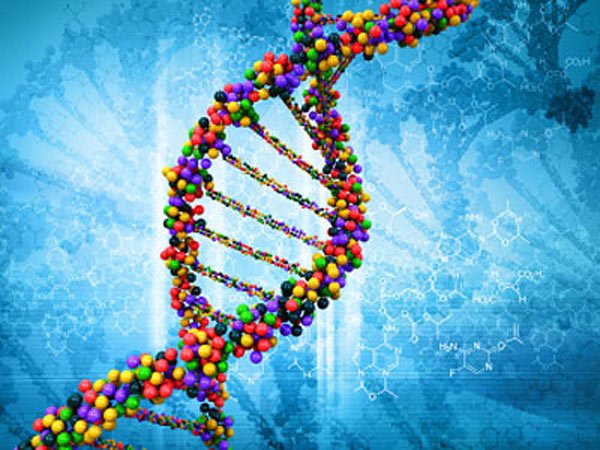
The sides of the DNA ladder are made of

a)

phosphate

b)

deoxyribose

c)

guanine

d)

adenine

98.

The complementary DNA sequence to AATTCCGTA is

a)

TTAAGGCAT

b)

AATTCCGTA

c)

ATGCCTTAA

d)

TACGGAATT