
 Worksheets
Semester 1 Practice Quiz
Total questions: 79
Worksheet time: 1hrs 28mins
What is the primary source of energy for the food web?
What happens to the amount of energy as it moves through each trophic level?
Why is it not possible to have unlimited Top Carnivores?
Due to warmer water temperature, kelp populations have decreased. Predict what will happen to the carrying capacity of this ecosystem and explain why.
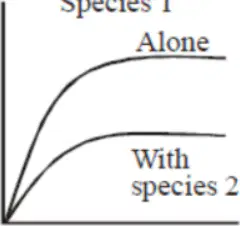
Using information from Figure 1, describe the growth of each species while grown alone. a. Species 1 - b. Species 2 -
How does the cell membrane help the cell maintain homeostasis?
What does “selectively permeable” mean?
Lactic acid is a wasteful product produced in the cytoplasm of muscle cells. Lactic acid will move (a) the cell.
What is the role of proteins in the cell membrane?
Describe the general reaction that occurs during cellular respiration.
The reintroduction of wolves led to a decrease in biodiversity in Yellowstone National Park.
True
False
Describe what would happen to a cell in the following situations:
Cell surrounded by an environment with equal solute concentration to the internal environment -
(a)
Name 4 ways in which carbon is moved into the atmosphere.
Match the function to each organelle by placing the letter on the blank. Lysosome: Removes wastes from the cell by using digestive enzymes.
(a)
Match the function to each organelle by placing the letter on the blank. Golgi apparatus: Collects, modifies, & packages molecules such as proteins.
(a)

What molecule is pictured?
Integral Protein
Carbohydrate chain
Phospholipid

Where would you most likely find water molecules?
A only
B only
C only
A and C


This image is an example of a phospholipid. Which part of a phospholipid is HYDROPHOBIC?
the phosphate "head"
the lipid "tails"

Where can PROTEINS be found when part of a plasma membrane?
On the outside of the membrane
On the inside of the membrane
Embedded part of the way into the membrane
Embedded the whole way through the membrane
All of the above

Hydrophilic region of the cell membrane?

identify a glycolipid
structure a
structure d
structure e
structure g

Selectively Permeable
Only Large Molecules can get through the membrane
Charged Molecules can get through the membrane
Only Small Molecules can get through the membrane
No molecules can get through the membrane

Name the correct trophic level for level 1.
Tertiary
Consumer
Producer
Quatemary

Name the trophic level in Level 2.
Primary
Tertiary
Consumer
Secondary


A carnivore obtains energy by eating other animals. Which of the following shows the process by which energy flows to a carnivorous animal?
light energy → plant → carnivore
plant → light energy → carnivore
light energy → herbivore → carnivore
light energy → plant → herbivore → carnivore

In the energy pyramid below, which organism has the least amount of energy available?
Producers
Herbivores
Carnivores
Top Predator

The diagram below represents four trophic levels in an ecosystem. Which explanation best explains how energy passes through the trophic levels?
Energy flows through all the trophic levels and then back to the producers.
Most of the energy from the plants is transferred to the mice, grasshoppers, and rabbits because plants don't have to search for their food.
About ten percent of the energy at one trophic level is passed to the next trophic level.
Birds have the most energy because energy from all the other trophic levels flows to the birds.

In the energy pyramid below, which organism has the most amount of energy available?
Producers
Herbivores
Carnivores
Top Predator


Think about how energy decreases as we go higher up in the energy pyramid. Why do you think there can't be more trophic levels above the hawk?

Energy for this ecosystem originally comes from
water
consumers
sunlight
plants
Isla is studying an energy pyramid in her biology class. In the energy pyramid below, which organism has the least amount of energy available?
Producers
Herbivores
Carnivores
Top Predator


12D: Students designed an experiment to model the carbon cycle. The students combined water and carbon dioxide-producing disks in a sealed flask. The flask represented Earth’s atmosphere, and the lamp represented the sun. Their design is shown. Which component can be added to the flask to reduce the concentration of carbon dioxide in the model atmosphere created by the disks?
Bacteria to use carbon during nitrification
Plants to absorb carbon in the process of photosynthesis
Snails to use carbon through cellular respiration
Mushrooms to absorb carbon during decomposition


Which of the following will DECREASE the amount of carbon dioxide in the atmosphere?
Combustion of fossil fuels
Respiration
Photosynthesis
Decomposition

Which type of organisms are responsible for turning nitrogen gas into a form useable by other organisms?
Animals
Plantae
Fungi
Bacteria

Animals inhale oxygen and exhale....
CH4
CO2
NH3
N2O

In order to be considered organic, a compound must contain...
Hydrogen
Carbon
Nitrogen
Phosphorus


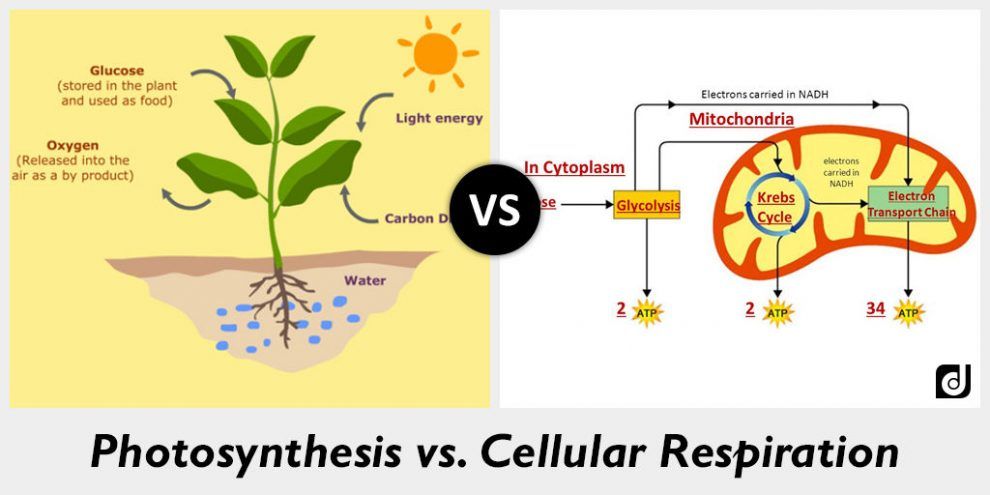

What type of Energy does Cellular Respiration create?
ATP
Water
Carbon Dioxide
Oxygen
Explain how the structure of the cell membrane contributes to its function.
The cell membrane is rigid, providing structural support.
The cell membrane is composed of a phospholipid bilayer with embedded proteins, allowing selective permeability.
The cell membrane is made of cellulose, providing a barrier to all substances.
The cell membrane is a single layer of lipids, allowing free passage of all molecules.
Which process in the carbon cycle involves the conversion of carbon dioxide into organic compounds by plants?
Respiration
Combustion
Photosynthesis
Decomposition
In a food web, which type of organism is typically at the base of the energy pyramid?
Decomposers
Herbivores
Carnivores
Producers
What is the primary role of bacteria in the nitrogen cycle?
To produce oxygen
To fix nitrogen gas into a usable form
To decompose organic matter
To absorb carbon dioxide
The following describes _________ during mitosis. Two new nuclei form, chromosomes are no longer visible, and the spindle fibers disappear.
prophase
metaphase
anaphase
telophase
The cell spends most of it's life in...
interphase
G2
cytokinesis
metaphase
Last stage of the cell cycle in which the cytoplasm divides to form two identical cells.
interphase
cytokinesis
prophase
telophase

