wayground logo

Free Printable Worksheets

NEW

Font size

S
M
L
XL
Worksheets

Ecology

Total questions: 74

Worksheet time: 56mins

Name
Class
Date
1.
All of the living and nonliving things in an area that interact with each other are called a/an ______.
a)
community
b)
habitat
c)
population
d)
ecosystem
2.
The living part of an ecosystem
a)
Biotic
b)
Abiotic
c)
Mother Earth
d)
Flowers
3.
The non-living part of an ecosystem
a)
Ocean
b)
Lava Flow
c)
Birds
d)
Abiotic
4.
The study of how living things interact with one another and with their environment.
a)
Biology
b)
Lithology
c)
Ecology
d)
Farmacology
5.
Organisms that look similar and can produce fertile offspring
a)
Species
b)
Fish
c)
Community
d)
Trees
6.
Two or more members of a particular species living and interacting in the same area
a)
Community
b)
Population
c)
Organisms
d)
Biosphere
7.
What does every food chain start with? (Even if it's not drawn or written there!)
a)
producers
b)
sun
c)
consumer
d)
decomposers
8.
An organism that needs to eat other organisms to obtain energy is known as a:
a)
Autotroph
b)
Producer
c)
Consumer
d)
Mutualist
9.
Consumer that eats plants
a)
heterotroph
b)
herbivore
c)
producer
d)
community
10.
What does a food web represent?
a)
All connections of energy flow throughout all organisms in a habitat.
b)
The specific ways that mutualism is carried out.
c)
A single pathway or energy flow between organisms. 
d)
How carnivores get their food. 
11.
In this Food Web Pyramid Which type of consumer gets only 10% of the energy stored in plants?
a)
Herbivore
b)
Carnivore
c)
Omnivore
d)
Secondary Consumer
12.
What is the term for each step in the transfer of energy and matter within a biological community?
a)
energy path
b)
food web
c)
trophic level
d)
food pyramid
13.
The image provided is an example of a(n):
a)
Carnivore
b)
Herbivore
c)
Producer
d)
Autotroph
14.
The amount of energy that usually transfers from one trophic level to the next...
a)
10%
b)
20%
c)
80%
d)
50%
15.
A collection of organisms that make up a community as well as all of the nonliving aspects of the environment.
a)
Population
b)
Community
c)
Habitat
d)
Ecosystem
16.
As you move upward, from level to level, in an energy pyramid, energy _____.
a)
increases
b)
decreases
c)
stays the same
d)
increases exponentially
17.
 plants that convert energy from the sun
a)
decomposer
b)
primary consumer
c)
secondary consumer
d)
producer
18.
What are the Abiotic factors in this image? 
a)
water, sunlight, dirt, air
b)
birds and plants
c)
birds, water, dirt
d)
plants, water
19.
The diagram below shows the cycling of nutrients in an ecosystem.
The removal of which of the following groups would cause an immediate decrease in the amount of energy flowing through the system?
a)
Producers
b)
Consumers
c)
Decomposers
d)
Inorganic nutrients
20.
What is the original source of almost all energy in most ecosystems?
a)
carbohydrates
b)
sunlight
c)
water
d)
carbon
21.
An organism that produces its own food supply from inorganic compounds is called a(an)
a)
heterotroph
b)
consumer
c)
detritivore
d)
autotroph
22.
A pond ecosystem is shown in the diagram below. Which statement describes an interaction that helps maintain the dynamic equilibrium of this ecosystem?
Which statement describes an interaction that helps maintain the dynamic equilibrium of this ecosystem?
a)
The frogs make energy available to this ecosystem through the process of photosynthesis.
b)
The algae directly provide food for both the rotifers and the catfish.
c)
The green-backed heron provides energy for the mosquito larvae.
d)
The catfish population helps control the populations of water boatman and waterfleas.
23.
Organisms that relies on other organisms for food; consumer
a)
herbivore
b)
decomposer
c)
heterotroph
d)
species
24.
What may happen if the snowshoe hare was removed from the food web pictured?
a)
The insects in the habitat would increase.
b)
The shrew population would decrease due to being only hawk food source.
c)
The willow tree population would decrease.
d)
Foxes would dies due to no food source. 
25.
Which of the following leads to a decrease in biodiversity?
a)
protection of ecosystems
b)
pollution control
c)
selective cutting
d)
introduction of exotic or invasive species
26.
Which of the following best describes an ecosystem?
a)
all the living organisms in an area and their physical surroundings
b)
a region with a distinct climate
c)
all the living organisms of the same species throughout the world
d)
all the living organisms in an area
27.
The energy pyramid below shows a possible amount of energy, in kilocalories, available in the organisms at each trophic level in an ecosystem.  According to the law of conservation of energy, energy can neither be created nor destroyed.  If this is true, why is there less energy in the top of the energy pyramid than there is in the bottom of the energy pyramid?
a)
Energy is lost between each trophic level as heat.
b)
The law of conservation of energy does not apply to ecosystems.
c)
Organisms in the top of the energy pyramid use up energy the fastest.
d)
The extra energy in the bottom is slower to reach the top.
28.
The graph below shows population data for two species.  What can be said about the relationship between species 1 and species 2?
a)
When the population of species 1 increases, the population of species 2 decreases.
b)
The population of species 1 and species 2 stay the same over the time period shown.
c)
The population of species 1 is not influenced by the population of species 2.
d)
When the population of species 1 increases, the population of species 2 increases.
29.
Overpopulation occurs when a population exceeds its carrying capacity.  White-tailed deer are considered to be an overpopulated species in the central United States.  What is one consequence of white-tailed deer exceeding their carrying capacity?
a)
People don't see deer as often in urban areas.
b)
The deer are less healthy and more prone to disease.
c)
There are more predators to eat the deer.
d)
The deer have stopped breeding.
30.
After a natural disaster such as a hurricane or tornado, what will happen in the damaged ecosystem?
a)
Nothing; it will remain uninhabited.
b)
A new, different ecosystem will evolve.
c)
An ecosystem like the previous one will be re-established.
d)
No one really knows what to expect after a natural disaster.
31.
Anything that can decrease the size of a population including living (biotic) and non living (abiotic) features of an ecosystem such as predators and drought.
a)
limiting factor
b)
habitat
c)
ecosystem
d)
carrying capacity
32.
At what stage does this population reach it's carrying capacity on the Demographic Transition Model
a)
1
b)
2
c)
3
d)
4
33.
Which limiting factor would increase due to the number of individuals in a population?
a)
Unusual weather
b)
Natural disaster
c)
Births
d)
Disease
34.
What is an autotroph
a)
An organism that can produce its own form of energy (via the Sun) 
b)
An organism that can eat other organisms to gain energy
c)
An organism that decomposes other organisms for energy
d)
An organism that eats a variety of other organisms for energy
35.
What is an heterotroph
a)
An organism that can produce its own form of energy (via the Sun) 
b)
An organism that consumes only plants for energy
c)
Various organisms that consume other organisms for energy
d)
An organism that decomposes other organisms 
36.
What are the correct types of Trophic levels? 
a)
Producers 
Primary 
Secondary 
b)
Primary
Secondary
c)
Producers 
Consumers 
Decomposers
d)
Producers 
Primary 
Secondary 
Tertiary 
37.

If there were 500,000 kcals available at trophic level 1, how many would be available at trophic level 4?

a)

50,000

b)

5,000

c)

500

d)

50

38.

Which of the following would cause a REDUCTION in the population of a species?

a)

Less competition

b)

Fewer prey

c)

Fewer parasites

d)

More available mates

39.

An environmental change that removed which of the following organisms would cause the most instability in the ecosystem?

a)

Humans

b)

Zooplankton

c)

Harbour Porpoise

d)

Salmon

40.

Which of the following would be a limiting factor?

a)

Food supply

b)

Water supply

c)

Available mates

d)

All of these are limiting factors

41.

Which organism has the most available energy?

a)

Snakes

b)

Insects

c)

Grasses

d)

Rabbits

42.

As energy moves up the trophic pyramid through an ecosystem, 90% of the energy is lost. Where does this lost 90% go?

a)

It disappears

b)

It is lost as heat and lost to decomposers

c)

It is lost to decomposers and as liquid when organisms sweat

d)

It is lost as an organism exhales

43.
Which of the following is a biotic factor?
a)
lizards
b)
temperature
c)
clouds
d)
humidity
44.
Which term means the number of different species that live in a particular area?
a)
Ecosystem
b)
Biodiversity
c)
Invasive Species
d)
Food Web
45.
Which of the following is not a threat to biodiversity?
a)
deforestation
b)
introduction of invasive species
c)
farming and agriculture
d)
protecting natural resources
46.
What percentage of energy is used up by the organism at any level of the energy pyramid for everyday life processes?
a)
10%
b)
25%
c)
50%
d)
90%
47.
Which level of a trophic pyramid would have the fewest number of organisms?
a)
primary consumers
b)
producers
c)
tertiary consumers
d)
secondary consumers
48.
When the animal dies, what do you call those organisms that break them down?
a)
Producers
b)
Decomposers
c)
Consumers
d)
None of the choices
49.

What is an invasive species?

a)

an organism that IS native to an area and causes harm to the environment/humans

b)

an organism that is NOT native to an area and causes harm to the environment/humans

c)

an organism that is NOT native to an area and helps the environment/humans

d)

an organism that IS native to an area and helps the environment/humans

50.

What is a keystone species?

a)

A species that helps to hold an ecosystem together

b)

A species that lives in or around rocks

c)

Keys and stones have nothing to do with ecology

d)

A keystone isn't a living thing, it's just a stone

51.
A species that maintain biodiversity by keeping prey populations controlled are called...
a)
Introduced Species
b)
Apex Predators
c)
Invasive Species
d)
Keystone Species
52.
Based on the graph shown, how can you tell sea otters are a keystone species?
a)
as the sea otter population decreases, biodiversity increases
b)
as sea otter population increases, biodiversity increases
c)
changes in the sea otter population have little effect on biodiversity 
d)
the sea otter population dereases due to the presence of urchins
53.
How do invasive plants damage the environment?
a)
by competing with native species
b)
by changing plant communities
c)
by decreasing diversity
d)
all of these damage an ecosystem
54.
Study the graph. In what year were zebra mussels introduced into the Hudson River?
a)
1987
b)
1991
c)
1993
d)
2009
55.
a deer population has significantly increased, the best hypothesis is 
a)
the deer's main predator has been eliminated
b)
competition increased
c)
decreased water levels of local ponds
d)
organisms that rely on similar food sources migrated to the area
56.
Use the diagram to answer the question.
The trout is a source of food for the human and the eagle. When there are more than one organism vying for the same source we call this____?
a)
Population
b)
Resources
c)
Community
d)
Competition
57.
In a food web, arrows point at:
a)
who gets energy.
b)
who gets eaten.
58.
Bacteria, fungi, and earthworms are examples of: 
a)
scavengers
b)
predators
c)
prey
d)
decomposers
59.

If the grasshopper were to be removed completely from the food web, what organism would be most affected?

a)

The squirrel

b)

The shrew

c)

The deer

d)

The rabbit

60.
What might happen if you remove a primary consumer from the ecosystem?
a)
There would be more food for secondary consumers.
b)
The number of primary consumers would increase.
c)
The number of plants would increase.
d)
The number of secondary consumers would increase.
61.
Which of the following would be the most likely effect, if there were a sudden increase in the cricket population?
a)
There would be a decrease in the small bird population.
b)
There would be a decrease in the grass/flowers population.
c)
There would be a decrease in the mice population.
d)
There would be an increase in the grass/flowers population.
62.
How many primary consumers are there in this food web?
a)
1
b)
2
c)
3
d)
4
63.
A food pyramid represent the relative amount of energy in trophic levels. Which of the following correctly shows a food pyramid?
a)
A
b)
B
c)
C
d)
D
64.
The  number of individuals a habitat can sustain with the resources it has available
a)
Carrying capacity
b)
Limiting factors
c)
Resources
d)
Population
65.
Which of the following is an EXAMPLE of a limiting factor?
a)
Water
b)
Disease
c)
Migration
d)
Thick fur
66.
Which of the following would INCREASE the carrying capacity of an ecosystem?
a)
increase in predators
b)
disease
c)
increase in available food
d)
drought
67.
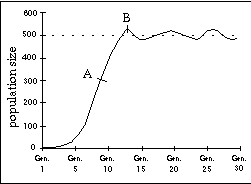
What is the carrying capacity of the graph?
a)
around 500
b)
more than 500
c)
less than 500
d)
around 600
68.
What is the carrying capacity of the following graph?
a)
1000
b)
8000
c)
800
d)
600
69.

Which of the following is a biotic factor that would affect the carrying capacity of a population?

a)

Soil

b)

Predator

c)

Rainfall

d)

Sunlight

70.

What occurs when ecological niches overlap and multiple organisms seek the same resources?

a)

Symbiosis

b)

Mutualism

c)

Competition

d)

Predation

71.

Which statement best describes the predator-prey relationship displayed on this graph?

a)

There is no relationship between the predator and prey.

b)

When the prey population increases, the predator population decreases.

c)

When the prey population increases, the predator population increases.

d)

when the predator population increases, the prey population increases.

72.

What is carrying capacity?

a)

A condition that occurs when two or more organisms compete for the same resources within an ecological community

b)

A relationship in which two organisms are mutually dependent on each other for survivial

c)

All the biotic and abiotic factors and the interactions among them in a given area

d)

The maximum number of organisms an ecosystem can support

73.

Which statement best describes the term limiting factors?

a)

All the biotic and abiotic factors and the interactions among them in a given area

b)

A finite resource organisms in an ecosystem require

c)

The biotic and abiotic factors in an ecosystem

d)

The maximum number of organisms an ecosystem can support

74.
What are some consequences of deforestation?
a)
increased population in cities
b)
building of more infrastructure
c)
soil erosion, loss of biodiversity, loss of ability to remove CO2
d)
more mercury and cyanide released into rivers