wayground logo

Free Printable Worksheets

NEW

Font size

S
M
L
XL
Worksheets

Biology Mid-Year

Total questions: 80

Worksheet time: 1hrs 21mins

Name
Class
Date
1.
The main function of chloroplasts is:
a)
To control what enters and leaves the cell.
b)
To break down food to release energy for the cell.
c)
To control all activities of the cell.
d)
To produce food for the cell using the sun's energy.
2.
What is the main difference between prokaryotic and eukaryotic cells?
a)
Prokaryotic cells have a nucleus and Eukaryotic cells do not
b)
Prokaryotic cells are unicellular and Eukaryotic cells are multicellular.
c)
Prokaryotic cells do not have a nucleus, Eukaryotic cells do have a nucleus.
d)
Prokaryotic cells are plant cells and Eukaryotic cells are animal cells.
3.
Ribosomes are the cell organelle that
a)
Break down food to produce energy for the cell.
b)
Produce proteins for the cell.
c)
Break down broken cell parts.
d)
Make food for the cell using the sun's energy.
4.
Organisms composed of many cells are called
a)
Prokaryotic
b)
Eukaryotic
c)
Unicellular
d)
Multicellular
5.
Which types of organisms are Prokaryotes?
a)
Animals
b)
Plants
c)
Fungi
d)
Bacteria
6.
This is referred to as the energy currency of the cell
a)
ADP
b)
ATP
c)
Mitochondria
d)
Nucleus
7.
Stores genetic information and carries out protein synthesis
a)
Carbohydrates
b)
Lipids
c)
Proteins
d)
Nucleic Acids
8.
What is the purpose  of an enzyme?
a)
give permission for the reaction
b)
raise activation energy
c)
speed up reactions
d)
control how many reactions occur
9.
What 3 letters do enzymes typically end in?
a)
-ose
b)
-ase
c)
-ese
d)
-tic
10.
Which of the following conclusions can be drawn from this graph?
a)
The optimum pH of the enzyme is 6.6.
b)
The optimum pH of the enzyme is 5.8
c)
The enzyme’s activity increases as pH increases 5.0 to 9.0
d)
The enzyme’s activity is greater around pH of 8.0 .
11.
Which of the following is the correct equation for PHOTOSYNTHESIS?
a)
6CO2 + 6H2O --> 6O+ C6H12O6
b)
6CO+ C6H12O6 + 6H2O --> O
c)
6O2 + 6H2O --> 6CO+ C6H12O6
d)
C6H12O6 + 6O2 ---> 6H2O + 6CO2 
12.
What is the purpose of cellular respiration?
a)
to break down food
b)
to create energy in the body
c)
to release energy from food
d)
there is none; it's a waste of time
13.
Made of monomers of amino acids
a)
Carbohydrates 
b)
Lipids
c)
Proteins 
d)
Nucleic Acids
14.
Made of monomers of nucleotides
a)
Carbohydrates
b)
Lipids
c)
Proteins
d)
Nucleic Acids
15.
Made of glycerol and fatty acids
a)
Carbohydrates
b)
Lipids
c)
Proteins
d)
Nucleic Acids
16.
Made of glycerol and fatty acids
a)
Carbohydrates
b)
Lipids
c)
Proteins
d)
Nucleic Acids
17.
Include sugars (ex. glucose) and starches
a)
Carbohydrates
b)
Lipids
c)
Proteins
d)
Nucleic Acids
18.
Include waxes, oils, steroids (hormones)
a)
Carbohydrates
b)
Lipids
c)
Proteins
d)
Nucleic Acids
19.
Includes collagen, hemoglobin and insulin
a)
Carbohydrates
b)
Lipids
c)
Proteins
d)
Nucleic Acids
20.
Includes DNA and RNA
a)
Carbohydrates
b)
Lipids
c)
Proteins
d)
Nucleic Acids
21.
Provide quick energy and serve as structural components of plant cells
a)
Carbohydrates
b)
Lipids
c)
Proteins
d)
Nucleic Acids
22.
Waterproofs, insulates, and stores energy long-term
a)
Carbohydrates
b)
Lipids
c)
Proteins
d)
Nucleic Acids
23.
Speed up chemical reactions, protects against infections, and structural component of hair, skin, and muscles
a)
Carbohydrates
b)
Lipids
c)
Proteins
d)
Nucleic Acids
24.
What are the reactants (what's needed) for photosynthesis?
a)
glucose and oxygen
b)
light, water, and carbon dioxide
25.
What is the purpose of photosynthesis?
a)
make glucose
b)
make ATP
c)
make light
d)
release carbon dioxide
26.
In which organelle (part of the cell) does photosynthesis take place?
a)
mitochondria
b)
chloroplast
c)
nucleus
d)
cell membrane
27.
What is the gas we breath out that plants use for photosynthesis?
a)
sulfur
b)
carbon dioxide
c)
oxygen
d)
hydrogen
28.
How can photosynthesis be related to cellular respiration?
a)
What's produced (made) by one is needed (the reactants) for the other
b)
They both produce the same products
c)
They both have the same reactants (need the same things)
d)
These 2 processes have nothing in common
29.
Another term for equilibrium is...
a)
Not enough
b)
Too little
c)
Homeostasis
d)
Too much
30.
The cell membrane is selectively permeable, which means...
a)
All materials can enter and leave the cell
b)
Certain things can enter while others cannot
c)
The cell manually sorts through all materials
d)
Only certain cells can interact with the cell.
31.
Against the concentration gradient
low to high
uses energy/ATP
a)
facilitated diffusion
b)
osmosis
c)
active transport
d)
simple diffusion
32.
A molecule that diffuses down a concentration gradient goes from an area of ______ concentration into an area of ______ concentration.
a)
high, low
b)
low, high
c)
passive, active
d)
active, passive
33.
Structure A refers to the _____.
a)
chromatid
b)
chromosome
c)
centromere
34.
Before cells can divide, what must be copied?
a)
mitochondria
b)
cytoplasm
c)
DNA
d)
Cell Wall
35.
Which of the following is NOT occuring during interphase?
a)
Cell growth
b)
DNA being copied
c)
DNA condensing
d)
Two new cells are made
36.
The process by which the nuclear material is divided equally between two new cells
a)
mitosis
b)
cancer
c)
spindle
d)
centromere
37.
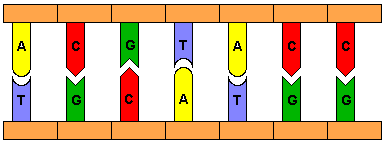
Which sequence of DNA bases would pair with this partial strand
ATG TGA CAG
a)
ATG TGA CAG
b)
TAC ACT GTC
c)
GTA AGT GAC
d)
CAT TCA CTG
38.
Which 2 molecules form the sides (backbone) of the DNA ladder?
a)
deoxyribose sugar and adenine
b)
deoxyribose sugar and a hydrogen bond
c)
deoxyribose sugar and the nucleus
d)
deoxyribose sugar and phosphate
39.

A process in which DNA has the unique ability to make an exact copy of itself.

a)

Replication

b)

Translation

c)

Transcription

d)

Mitosis

40.
What are the three components of a nucleotide?
a)
sugar, hydrogen, nitrogen base
b)
sugar, oxygen, nitrogen base
c)
sugar, phosphate, nitrogen base
d)
sugar, phosphate, protein
41.
In DNA, Adenine pairs with ___________. 
a)
Guanine
b)
Cytosine
c)
Thymine
d)
Uracil
42.
What process does a multi-cellular organism use to replace its damaged body cells?
a)
mitosis
b)
meiosis
c)
replication
d)
transcription
43.
breaks down glucose to release energy for the cell
a)
nucleus
b)
lysosomes
c)
mitochondria
d)
vacuole
44.

What is the cell organelle that contains digestive enzymes to break down unwanted material?

a)

The cytoplasm

b)

The lysosomes

c)

The vacuole

d)

The mitochondria

45.
Identify which of these is NOT a major difference between plant and animal cells.
a)
Only plant cells have a cell wall.
b)
Only animal cells have mitochondria.
c)
Animal cells do NOT contain chloroplasts.
d)
Plant cells have a large central vacuole.
46.
Most of the life cycle of a cell is spent in in what phase of the cell cycle? 
a)
Mitosis 
b)
Interphase
c)
Cytokinesis
d)
Sythesis 
47.
During interphase, the DNA is replicated to create two complete sets of DNA.  The DNA is copied during which stage of the cell cycle? 
a)
G1
b)
S
c)
G2
d)
M
48.
Before DNA can be replicated, the DNA must separate-- 
a)
between the phosphate groups
b)
behind the deoxyribose sugars
c)
from the sugar-phosphate backbone
d)
between the nitrogen bases
49.
This is a picture of
a)
Cell wall
b)
Cell membrane
c)
chloroplast
d)
mitochondria
50.
The movement of oxygen from the alveoli to the blood and from the blood to the tissues is due to the process of... 
a)
osmosis
b)
diffusion
c)
cytokinesis
d)
phagocytosis
51.

Which of the following statements about viruses is true?

a)

They contain ribosomes

b)

They do not contain genetic material

c)

They need a host cell to reproduce

d)

They have a cell membrane

52.

How many chromosomes are in this cell?

a)

12

b)

3

c)

6

53.

After mitosis, how many cells will be produced, and how many chromosomes will be in each cell?

a)

1 cell, 4 chromosomes

b)

2 cells, 2 chromosomes

c)

1 cell, 2 chromosomes

d)

2 cells, 4 chromosomes

54.
A new organism is produced from one parent organism.
a)
Sexual Reproduction
b)
Asexual Reproduction
55.
Fruit fly body cells have 8 chromosomes. After mitosis, you would expect a resulting fruit fly daughter cell to have ...
a)
16 chromosomes.
b)
46 chromosomes.
c)
8 chromosomes.
d)
4 chromosomes.
56.

How many chromosomes are normally found in human body cells?

a)

46

b)

23

c)

26

d)

44

57.
What causes genetic variation in meiosis?
a)
chromosomes lining up
b)
crossing over of chromosomes
c)
separation of chromosomes
d)
chromosomes pulling apart
58.
What kind of cells are made in MEIOSIS?
a)
Haploid cells
b)
Diploid Cells
c)
Skin Cells
d)
Liver Cells
59.
Diploid Cells are represented by
a)
2n
b)
n
c)
4n
d)
1/2 n
60.
Which cellular process is shown?
a)
meiosis
b)
endocytosis
c)
mitosis
d)
phagocytosis
61.
Meiosis makes sperm and egg cells. In humans, sperm and egg cells each have _____ chromosomes. Therefore a fertilized human egg cell (sperm and egg cell combined) would create a cell with _____ chromosomes.
a)
23, 46
b)
46, 23
c)
2, 4
d)
50, 100
62.
How many daughter cells does Meiosis create?
a)
2
b)
4
c)
8
d)
1
63.
The science of heredity
a)
heredity
b)
genetics
c)
trait
d)
gene
64.
This trait is hidden whenever the dominant allele is present
a)
dominant allele
b)
codominance
c)
recessive allele
d)
Punnett Square
65.
This trait always shows up in an organism when the allele is present
a)
dominant allele
b)
codominance
c)
probability
d)
recessive allele
66.
In pea plants, the tall allele is dominant to the short allele. What key would demonstrate this?
a)
Tall = T
Short = S
b)
Tall = T
Short = t
c)
Tall = t
Short = T
d)
Tall = TT
Short = tt
67.
A brown-furred ewok has 12 babies with a black-furred ewok. 9 ewok babies have black fur, while 3 ewok babies have brown fur. What are the probable genotypes of the parents?
a)
BB and bb
b)
BB and Bb
c)
Bb and Bb
d)
Bb and bb
68.
A brown-furred ewok has 12 babies with a black-furred ewok. 9 ewok babies have black fur, while 3 ewok babies have brown fur. What are the probable genotypes of the parents?
a)
BB and bb
b)
BB and Bb
c)
Bb and Bb
d)
Bb and bb
69.
Bob the abominable snowman lives in the snowy Andes mountains. He has white fur, which blends in nicely. He is therefore dismayed when his mate keeps having red-furred babies. What is Bob's likely genotype?
a)
Homozygous Dominant
b)
Heterozygous
c)
Homozygous Recessive
70.
What gamete possibilities could come from this parent's genotype?
a)
AB, AB, aB, aB
b)
Ab, AB, Ab, ab
c)
Ab, Ab, Ab, Ab
d)
AB, aB, ab, aB
71.

What goes in box 3

a)

Aabb

b)

AABB

c)

AAbb

d)

aaBb

72.
Aa, DD, bB, yy are all examples of
a)
genotypes
b)
phenotypes
73.
Which of the following genotypes is homozygous dominant?
a)
A
b)
Aa
c)
AA
d)
aa
74.
Which of the following genotypes is heterozygous?
a)
Bb
b)
BB
c)
bb
d)
B
75.
Cross Two Homozygous plants
(
RRYY x rryy)
R = round seeds, r  = wrinkled seeds Y = yellow seeds, y = green seeds
What percent will have Round and Yellow seeds? 
a)
0%
b)
25%
c)
50%
d)
100%
76.
What goes in box 1
a)
AABb
b)
AABB
c)
aabb
d)
AaBb
77.
In the energy pyramid here, which organisms have the most energy available?
a)
Producers
b)
Carnivores
c)
Herbivores
d)
Top Predator
78.

Which list does NOT include biotic factors?

a)

elephants, zebras, acacia trees, bushes, bacteria

b)

rocks, water, temperature, sun, clouds

c)

algae, seaweed, fungi

d)

decayed zebra, bird eggs, poo from a kangaroo

79.

The biotic and abiotic factors that work together in an area

a)

Community

b)

Ecosystem

c)

Organism

d)

Population

80.

Which of the following correctly lists the levels of organization from least complex to most complex?

a)

Community, Organism, Population, Ecosystem

b)

Population, Community, Ecosystem, Organism

c)

Ecosystem, Community, Population, Organism

d)

Organism, Population, Community, Ecosystem