wayground logo

Free Printable Worksheets

Font size

S
M
L
XL
Worksheets

Final Exam Review Sem 2 2023 biology

Total questions: 78

Worksheet time: 3hrs 26mins

Name
Class
Date
1.

The blending of two traits is known as ---

a)

incomplete dominance

b)

codominance

2.

A condition in which both alleles for a gene are expressed so that both traits are visible is known as ---

a)

Codominance

b)

Incomplete dominance

3.

What type of inheritance pattern is shown here?

a)

Codominance

b)

Incomplete dominance

4.

This is an example of ---

a)

Incomplete dominance

b)

Codominance

5.

What does this Punnett square and the probabilities of the ofspring represent?

a)

incomplete dominance

b)

codominance

6.

Some flowers are controlled by codominance. Red flowers (FRFR), blue flowers (FBFB) and Speckled flowers (FRFB).


Cross a red flower with a speckled flower. What is the phenotypic ratio?

a)

50% red, 50% speckled

b)

25% red, 25% blue

c)

100% blue

7.

A red flowered plant (RR) is crossed with a white flowered plant (WW). The gene for petal color in these plants expresses incomplete dominance. What percentage of the offspring will have red (RR) flowers?

a)

0%

b)

25%

c)

50%

d)

100%

8.

Some flowers are controlled by codominance. Red flowers (RR), blue flowers (BB) and Speckled flowers (RB).


Cross a red flower with a speckled flower. What is the phenotypic ratio?

a)

2 red, 2 speckled

b)

2 red, 2 blue

c)

2 blue, 2 speckled

9.

Some flowers are controlled by codominance. Red flowers (RR), blue flowers (BB) and Speckled flowers (RB).


Cross a red flower with a blue flower.

a)

1 red, 2 speckled, 1 blue

b)

2 red, 2 blue

c)

4 speckled

d)

1 red, 1 speckled, 2 blue

10.

Radish color is completely dominant, red and white are pure breeding colors. While heterozygous are purple.


Cros a red radish with a purple.

a)

4 purple

b)

1 red, 2 purple, 1 white

c)

2 red, 2 purple

d)

1 red, 1 purple, 2 white

11.

In cattle red coats are represented as RR, and white coats are represented as WW.


What is the genotype for Roan color?

a)

RR

b)

RW

c)

WW

12.
A red flowered plant (RR) breeds with a White flowered plant (WW). The gene for petal color in these plants expresses incomplete dominance.  What percentage of the offspring will have pink (RW) flowers?
a)
0%
b)
25%
c)
50%
d)
100%
13.

Two of the same allele

a)

Genotype

b)

Phenotype

14.

Curly hair

a)

Genotype

b)

Phenotype

15.

Homozygous dominant

a)

FF

b)

Ff

c)

ff

16.

Free earlobes (F) are dominant to attached earlobes (f).

State phenotype for Ff.

a)

free earlobes

b)

attached earlobes

17.

No hair on fingers (h) is recessive to hair on fingers (H).

State the phenotype for hh.

a)

Hair on fingers

b)

No hair on fingers

18.

The two types of alleles are (select two)

a)

dominant

b)

doughnut

c)

expressive

d)

recessive

19.
Which of the following is homozygous recessive?
a)
rr
b)
AA
c)
TT
d)
Ff
20.
What you see, or the physical appearance.
a)
Genotype
b)
Phenotype
c)
Homozygous
d)
Heterozygous
21.
T - tall and t = short
In the punnett square below, what belongs in the missing square
a)
tt
b)
Tt
c)
Bb
d)
TT
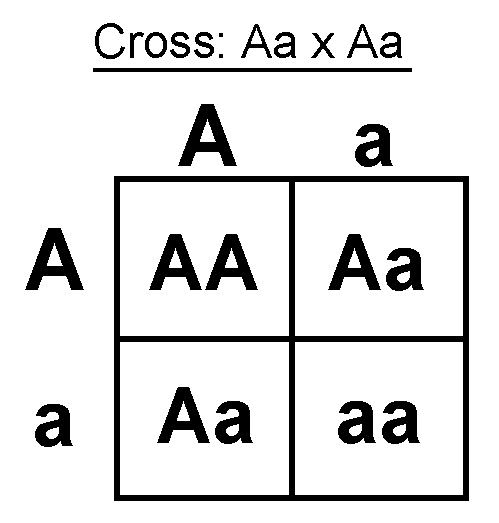
22.
What allele combination should go in the missing box?
a)
AA
b)
Aa
c)
aa
d)
none of these
23.
If B = brown hair and b = blonde hair, what is the probability of brown hair?
a)
25%
b)
50%
c)
0%
d)
75%
24.
Black hair color is dominant to white hair color in mice.  Determine the phenotypic ratio for the offpring of a heterozygous black mouse and a white mouse.
a)
4 Black: 0 White
b)
3 Black: 1 White
c)
2 Black: 2 White
d)
0 Black: 4 White
25.
In a certain species of rabbits, black coat color is dominant over brown coat color. What is the probability of producing a rabbit with brown coat color from two rabbits that are both heterozygous for black coat color?
a)
0%
b)
25%
c)
75%
d)
100%
26.
Tay-Sachs disease is a lethal, autosomal recessive genetic disorder. If both parents are heterozygous carriers of the disease, what are the chances of them having a child who is also a heterozygous carrier for Tay-Sachs?
a)
0%
b)
25%
c)
50%
d)
75%
27.
Phenylketonuria (PKU) is inherited as a recessive condition. A man with PKU marries a woman without any alleles for PKU. What is the probability that their child will inherit PKU?
a)
0%
b)
25%
c)
50%
d)
75%
28.
In certain species of plants, purple flowers (P) are dominant to white flowers (p). If two heterozygous plants are crossed, what will be the phenotype of the offspring?
a)
100% purple flowers
b)
100% white flowers
c)
75% white flowers, 25% purple flowers
d)
25% white flowers, 75% purple flowers
29.

What does a punnet square show us?

a)

The age of the offspring

b)

The chance of a genotype (trait) showing up in offspring

c)

Numbers

d)

Blue eyes

30.
What is the phenotype of the offspring? (A-Brown hair; a-blond hair) 
a)
50 % Brown Hair and 50% Blond Hair 
b)
25 % Brown Hair and 75% Blond Hair 
c)
75 % Brown Hair and 25% Blond Hair 
d)
0% Brown Hair and 100% Blond Hair 
31.
What does a filled in square represent?
a)
Not affected Female
b)
Not affected Male
c)
Affected Male
d)
Affected Female
32.
What do half colored symbols represent?
a)
The individual is a carrier (heterozygous).
b)
The individual expresses the trait.
c)
The individual has both recessive alleles.
d)
The individual has both dominant alleles.
33.
In the second generation-how many people are carriers of the trait?
a)
2
b)
3
c)
5
d)
6
34.
How many people in the pedigree are carriers for the disorder? 
a)
b)
8
c)
2
d)
9
35.

Objective #13

On a pedigree how do we know if they have the trait?

a)

Not shaded

b)

Shaded

36.
This pedigree represents the inheritance of hemophilia in this family. How many of the females have the hemophilia trait?
a)
8
b)
5
c)
2
d)
3
37.

Objective #13

This is a pedigree that follows blue eyes which is a recessive trait. What is the genotype of the father (square) in generation 1?

a)

Aa

b)

AA

c)

aa

d)

A?

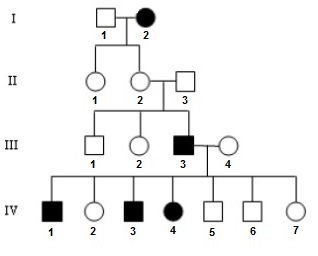
38.

Individuals that are shaded in have premature hair whitening. Is this trait dominant or recessive? How do you know?

a)

Dominant because it skips generations

b)

Dominant because it is present in every generation

c)

Recessive because it skips generations

d)

Recessive because it is present in every generation.

39.

Huntington's Disease is a dominant trait.

What is the correct genotype for individual I-2?

a)

HH

b)

Hh

c)

hh

d)

H?

40.

If this pedigree shows a recessive disorder, what MUST the genotype of individual 4 be?

a)

HH

b)

Hh

c)

hh

41.

What is the mode of inheritance shown here?

a)

Recessive because it "skips" a generation

b)

Dominant because it shows up in every generation

42.

Which of the following equations represents the overall chemical reaction for photosynthesis?

a)

6O2+ 6H2O → C6H12O6+ 6O2

b)

C6H12O6 + 6H2O→ 6O2+ 6O2

c)

6CO2+ 6H2O→ C6H12O6+ 6O2

d)

6O2 + 6H2O→ C6H12O6 + 6CO2

43.

The rate of photosynthesis can be influenced by...

a)

Temperature

b)

Carbon dioxide levels

c)

Light intensity

d)

Oxygen concentration

44.

Which of the following light color is absorbed by plants?

a)

Red

b)

Green

c)

yellow

d)

Light green

45.

Which of the following colors is not absorbed by chlorophyll pigments?

a)

green

b)

blue

c)

violet

46.
Chlorophyll absorbs _____ and _______ light from the light.
a)
purple and green
b)
red and blue
c)
black and orange
d)
yellow and green
47.
Which organisms perform Photosynthesis?
a)
Only Autotrophs
b)
Only Heterotrophs
c)
Autotrophs and Heterotrophs
48.
Which organelle performs PHOTOSYNTHESIS?
a)
Chloroplast
b)
Mitochondria
49.
What do plants need for the photosynthesis process?
a)
a camera and tripod
b)
light, carbon dioxide, and water
c)
roots, flowers, and bees
d)
soil, air, and oxygen
50.
What are the reactants of photosynthesis?
a)
carbon dioxide and oxygen
b)
water and oxygen
c)
carbon dioxide and water
d)
water and glucose
51.
After photosynthesis, plants store their energy as _________ .
a)
chlorophyll
b)
pigment
c)
glucose (sugar)
d)
Oxygen
52.
What gas does the process of photosynthesis release into the atmosphere?
a)
oxygen
b)
carbon dioxide
c)
water
d)
nitrogen
53.
Cellular Respiration helps organisms to get energy from
a)
sunlight
b)
oxygen
c)
water
d)
food
54.
What three things are always needed for photosynthesis
a)
water, light, fertilizer, oxygen
b)
water, light, chlorophyll, oxygen
c)
water, roots, stems, leaves
d)
water, light, chlorophyll, carbon dioxide
55.
how do you obtain energy
a)
photosynthesis
b)
growing
c)
breathing
d)
cellular respiration
56.
What gas is USED in Respiration?
a)
O2
b)
CO2
c)
H2O
d)
CHO2
57.

What are the reactants in cell respiration?

a)

water, carbon dioxide, light

b)

oxygen, sugar

c)

sugar, water, carbon dioxide

58.

What is the energy that is produced in cell respiration?

a)

ADP

b)

Sugar

c)

ATP

59.

Aerobic means

a)

without oxygen

b)

with oxygen

c)

without effort

60.

Anaerobic means

a)

with oxygen

b)

without oxygen

c)

to run for a long time

61.

If you wanted to produce more energy, what pathway would you choose?

a)

aerobic

b)

anaerobic

62.

What are the products of cell respiration?

a)

water, light, and sugar

b)

water, carbon dioxide, ATP

c)

oxygen, water, sugar

63.

Photosynthesis _________ the energy that cell respiration ______.

a)

builds ; breaks

b)

breaks ; build

c)

eats ; builds

64.

Carbon dioxide levels will _______ during exercise.

a)

increase

b)

decrease

c)

see no change

65.

Why would oxygen levels decrease during aerobic respiration?

a)

oxygen is being used for energy

b)

photosynthesis is releasing oxygen

c)

oxygen shouldn't decrease, it should increase

66.
What is the function of ATP in living things?
a)
provides energy for cells
b)
stores genetic information
c)
provides structure in the nucleus
67.
Most Plants are green because? 
a)
Chlorophyll reflects green light 
b)
Chlorophyll absorbs green light
c)
mitochondria reflects green light
d)
none of the above 
68.
Which one is a reactant for cell respiration? 
a)
Carbon Dioxide 
b)
ATP 
c)
Glucose 
d)
Water 
69.
Where does cell respiration take place 
a)
Mitochondria 
b)
Endoplasmic Reticulum 
c)
Nucleus 
d)
Ribosomes 
70.
Which of the following is produced when sugar is broken down in an animal cell
a)
chlorophyll
b)
Carbon Dioxide 
c)
Oxygen
d)
Sunlight 
71.
During Photosynthesis in plants, what is the source of the carbon in the sugar molecule (C6H12O6) 
a)
Carbon in the soil 
b)
Carbon in water 
c)
Carbon Monoxide in the are 
d)
Carbon Dioxide in the Air
72.
Organisms that can not make their own food?
a)
Heterotrophs
b)
Autotrophs 
c)
chloroplasts 
d)
plants 
73.
Unlike photosynthesis, cellular respiration occurs in ? 
a)
animals only 
b)
plants and bacteria only
c)
bacteria only 
d)
all eukaryotes 
74.
What are the products of anaerobic respiration?
a)
Glucose and oxygen
b)
Carbon dioxide and water
c)
Lactic acid
d)
Carbon monoxide
75.
What type of respiration does not require oxygen?
a)
Aerobic
b)
Anaerobic
76.
Which type of respiration is most efficient?
a)
Aerobic
b)
Anaerobic
77.

The correct word equation for Anaerobic respiration is

a)

glucose → lactic acid + oxygen

b)

glucose → lactic acid (+ energy released)

c)

glucose + oxygen → lactic acid (+ energy released)

d)

lactic acid → energy released

78.
When you breathe, your lungs take in ___ and remove ___. 
a)
Air/Oxygen
b)
Oxygen/Carbon Dioxide 
c)
Carbon Dioxide/Waste 
d)
Waste/air