wayground logo

Free Printable Worksheets

Font size

S
M
L
XL
Worksheets

Biology - Final Exam

Total questions: 75

Worksheet time: 2hrs 16mins

Name
Class
Date
1.

Organisms that rely on other organisms for food are called

a)

producers

b)

autotrophs

c)

consumers

d)

saprophytes

2.

What is the simplest level of organization in the body?

a)

cell

b)

tissue

c)

organ

d)

organ system

3.

What happens to the chromosome number during meiosis?

a)

doubles

b)

halves

c)

stays the same

d)

becomes diploid

4.

All organism in a food chain will eventually return to environment by the action of ____?

a)

top carnivores

b)

producers

c)

decomposers

d)

secondary consumers

5.

Sperm cells of a Russian Dwarf hamster contain 14 chromosomes. What is the total number of chromosomes in a newly formed zygote?

a)

7

b)

14

c)

28

d)

42

6.

Brown eyes are dominant to blue eyes. 2 brothers both have brown eyes but one of them has both B and b while the other has B alleles. Which statement is true about the brothers?

a)

they have the same genotype and phenotype

b)

they have the different phenotypes and genotypes

c)

they have the same phenotype but different genotypes

d)

they have the same genotype but different phenotypes

7.
1. ___ combine to form DNA.
2. ___ combine to form proteins.
a)
1. amino acids
2. nucleotides
b)
1. sugars
2. amino acids
c)
1. nucleotides
2. amino acids
d)
1. lipids
2. nucleotides
8.
What is the functions of lipids?
a)
Quick source of energy
b)
Builds muscles, skin, enzymes
c)
Stores genetic information
d)
Stores energy, insulation, protection
9.
Which is true of prokaryotic and eukaryotic cells?
a)
Prokaryotic cells are larger than eukaryotic cells.
b)
Eukaryotic cells do not have nuclei, and prokaryotic cells do have nuclei.
c)
Prokaryotic cells lack membrane-bound organelles, and eukaryotic cells contain membrane-bound organelles.
d)
Eukaryotic cells are simpler than prokaryotic cells.
10.
The enzyme that unzips the DNA to prepare for replication
a)
helicase
b)
replicase
c)
polymerase
d)
synthase
11.
What  is the highest trophic level of the Rabbit on this food web?
a)
Primary Consumer
b)
Tertiary Consumer
c)
Secondary Consumer
d)
Producer
12.
The maintenance of an organism’s internal environment is called:
a)
compensating
b)
homeostasis
c)
balancing
d)
routine
13.
The picture shown shows which class of biomolecule?
a)
Protein
b)
Nucleic Acid
c)
Carbohydrate
d)
Lipid
14.
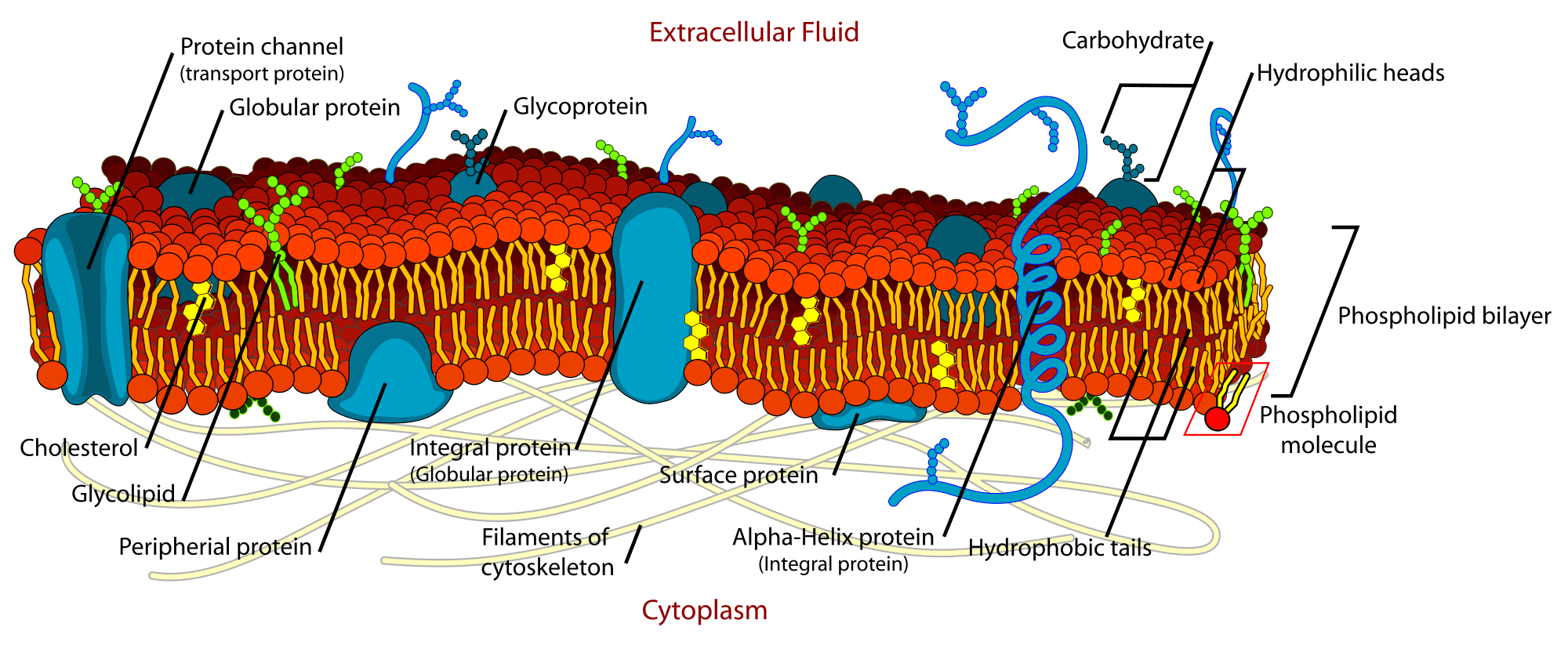
What is this image?
a)
cell membrane
b)
proteins
c)
carbohydrates
d)
lipids
15.

Evolution is...

a)

change in a population over many generations

b)

New organisms are born

c)

sudden change in population

d)

gradual change in environment

16.

Evidence for evolution can be found in studies of all of the following EXCEPT

a)

biochemistry (DNA comparisons)

b)

comparative embryology

c)

the fossil record

d)

comparative anatomy (vestigial & homologous structures)

e)

verbal stories passed down from ancient ancestors

17.

On a particular island it is an advantage if a bird has a long and narrow beak. Assuming the initial population has variation for beak length...the beak length would increase over time by __________ and would continue to be maintained after by ____________.

a)

stabilizing selection, directional selection

b)

disruptive selection, stabilizing selection

c)

directional selection, disruptive selection

d)

directional selection, stabilizing selection

18.

which of these pairs are less closely related than the other three

a)

horned dinos and domeheads

b)

sauropods and prosauropods

c)

other theropods and birds

d)

armored dinos and sauropods

19.

which domain should a unicellular organism be placed?

a)

bacteria

b)

eukarya

c)

animalia

d)

eubacteria

20.
The graph below shows the number of sunny days and rainy days in a city during four months.

Based on the graph,how many more sunny days than rainy days did this city have during the months of April, May, and June?
a)
21
b)
56
c)
26
d)
20
21.

A scientist performs an experiment to see if acids have an effect on the health of a particular type of plant. Three sets of plants were treated with acidic solutions of known pH while the control set was treated with a solution of neutral pH 7.

Which is the best conclusion for this experiment?

a)

Acid has no effect on the health of this type of plant

b)

High acidity, pH 2 is helpful to this type of plant.

c)

Low acidity, pH 6 is harmful to this type of plant.

d)

High acidity, pH 2 is harmful to this type of plant.

22.

Which is the correct order of mitosis in the above image?

a)

1, 2, 3, 4, 5

b)

2, 4, 3, 1, 5

c)

2, 4, 3, 5, 1

d)

4, 2, 3,1,5

23.

All represent A type blood

a)

IAIA

b)

IAi

c)

ii

d)

IAIB

24.
Two organisms that are closely related would have
a)
very similar DNA sequence
b)
exactly the same DNA sequences
c)
no proteins in common
d)
completely different DNA sequence
25.
Reestablishing a damaged ecosystem where even the soil was destroyed...
a)
Secondary succession
b)
Primary succession
c)
Carrying capacity
d)
Homeostasis
26.
What is it called when molecules move across the cell membrane from an area of high concentration to an area of low concentration through a carrier protein?
a)
Diffusion
b)
Osmosis
c)
Active Transport
d)
Facilitated Diffusion
27.
This diagram shows a plant cell. Which structure is found in a plant cell but is absent in an animal cell? 
a)
1
b)
2
c)
3
d)
4
28.

Cells need these molecules to be able to make energy effectively. Choose all the are needed.

a)

Amino acids

b)

Oxygen

c)

Glucose

d)

sucrose

29.
What are all of the chemical reactions that occur within an
organism referred to?
a)
Enzymes
b)
Macromolecules
c)
Metabolism
d)
Activation Energy
30.

A system is...

a)

a set of interacting parts forming a complex whole.

b)

a category of large molecules that perform important functions inside living things.

c)

a group of atoms joined together in a particular way.

d)

the ability to make things move or change.

31.

Why would you wear goggles in the lab?

a)

to prevent eye strain

b)

to improve your vision

c)

for protection from UV rays

d)

for protection from chemicals, heat, or glassware

32.

The group that does not receive treatment and is used for comparison.

a)

Independent

b)

Dependent

c)

Control

d)

Constant

33.

What is the ideal amount of water (mL/day) for plant growth?

a)

10

b)

20

c)

30

d)

40

34.

Why is the statement "swimming is the coolest sport" a bad hypothesis?

a)

it's definatley not true

b)

basketball is the best sport

c)

it is opinion based and not testable

d)

not everyone can swim

35.
An experiment is conducted to test how different cleats change an athletes running speed.  Six different types of cleats are tested and the 100m run time is recorded.  What is the independent variable?
a)
The type of cleat
b)
The run time
c)
The 100 meters
d)
The athlete
36.

The above probeware can measure all of the following EXCEPT-

a)

number of atoms

b)

dissolved oxygen

c)

temperature

d)

pH

37.
All of the living and nonliving things in an area that interact with each other are called a/an ______.
a)
community
b)
habitat
c)
population
d)
ecosystem
38.
What type of growth model is this?
a)
exponential growth model
b)
logistic growth model
c)
Type I curve
d)
Type III curve
39.
The final stable community of plants and animals is called:
a)
pioneer community
b)
farmland
c)
climax community
d)
old field
40.
What is the species that is usually introduced to an area by accident, but soon take over the indigenous species?
a)
Invasive species
b)
bully
c)
absent species
d)
dominant species
41.

What are the pioneer species in a climax community?

a)

larger plants and trees

b)

shrubs and grasses

c)

rocks and soil

d)

lichens and mosses

42.

If you and your friends find a new species of plant in the woods. What would be the BEST way to identify the plant?

a)

compare it to other plants

b)

develop a theory about the plant

c)

disect the plant

d)

determine the best way to grow the plant at home.

43.
The scientific name for water bear is Hypsibius dujardini.  What is its genus?
a)
Hypsibius 
b)
dujardini
c)
water 
d)
tardigrade
44.
If two species share the same class, they also share the same______.
a)
phylum
b)
order
c)
genus
d)
species
45.
What do plants and fungi have in common?
a)
They are both autotrophic
b)
They are both unicellular
c)
They both have cell walls
d)
They both are prokaryotes 
46.
Over time, adaptions can lead populations to experience 
a)
environmental changes
b)
genetic changes
c)
geological changes
d)
extinction
47.
Lightning bugs using different blinking patterns to attract a mate is an example of
a)
reproductive isolation.
b)
behavioral isolation.
c)
geographic isolation.
48.

What kingdom-Prokaryotic-lives in hot,salts environments

a)

plants

b)

animals

c)

archaebacteria

d)

eubacteria

49.

AMOEBA-PARAMECIUM-EUGLENA-DINOFLAGELLATES BELONG TO WHAT KINGDOM

a)

PLANT

b)

PROTIST

c)

FUNGI

d)

ANIMAL

e)

ARCHAEBACTERIA

50.
The scientific name for water bear is Hypsibius dujardini.  What is its genus?
a)
Hypsibius 
b)
dujardini
c)
water 
d)
tardigrade
51.
Use the dichotomous key above to classify the unknown organism in the picture
a)
Kentuckyus
b)
Californius
c)
WalaWala
d)
Beverlus
52.
Which trait do only humans have, according to the cladogram?
a)
jaws
b)
mammary glands & hair
c)
terrestrial during all life stages
d)
bipedal & opposable thumbs
53.

How does DNA replicate/copy itself?

a)

Carefully

b)

Semiconservatively

c)

Mitosis

d)

Xerox

54.

Homozygous are shown by

a)

same alleles like a and a = aa

b)

same alleles like A and A = AA

c)

are different alleles like A and a

55.

The sides of the helix labeled as A are made of _______________________ groups.

a)

sugar-phosphate

b)

nitrogen

c)

nucleotide

d)

protein

56.
Which sequence of DNA bases would pair with this partial strand?
ATG    TGA   CAG
_ _ _   _ _ _  _ _ _ 
a)
ATG TGA CAG
b)
TAC ACT GTC
c)
GTA AGT GAC
d)
CAT TCA CTG
57.
Identifies unique patterns in an individual's DNA and can be used to identify individuals
a)
replication
b)
heredity
c)
DNA fingerprint
d)
genetics
58.
The function of a protein 
a)
is used in the body for building, repair, and maintenance
b)
helps transfer DNA
c)
is used in creating DNA
d)
helps make sugars
59.
Trisomy 21 is an example of
a)
insertion
b)
inversion
c)
crossing over
d)
nondisjunction
60.

What is the central dogma of biology

a)

RNA --> DNA --> PROTEIN

b)

Protein --> RNA --> DNA

c)

DNA--> RNA --> Protein

d)

DNA --> Protein --> RNA

61.

A man sues his wife for infidelity. She has type A blood and her child has type O blood. What would his blood type have to be for him to win his court case?

a)

AB

b)

heterozygous B

c)

heterozygous A

d)

o

62.
What can you infer about the temperature for E.coli bacterial growth?
a)
E. coli does not grow well at low and high temperatures.
b)
E coli will continue to grow at very high temperatures.
c)
E.coli grows best at very low temperatures
d)
E.coli grows best at very high temperatures.
63.
Students use a dissolved oxygen probe during a laboratory activity involving 1,000mL samples of water. The function of the probe is to--
a)
create a model
b)
test a hypothesis
c)
gather data
d)
analyze investigation conditions
64.
Determine which graph (A, B, or C) best represents the information in the table.
a)
A
b)
B
c)
C
65.
The primary purpose the body uses monosaccharides for is?
a)
Building muscles
b)
Helping the Immune System
c)
Immediate Energy
d)
Generating Heat
66.
Attractions between water molecules are called
a)
Covalent bonds
b)
Ionic bonds
c)
Polar bonds
d)
Hydrogen bonds
67.
What happens when enzymes are heated to a high temperature?
a)
The enzymes die.
b)
The shapes of the enzyme are altered or denatured
c)
The enzymes' amino acid sequence changes.
d)
The enzymes remain the same
68.
The property where water molecules are attracted to other water molecules.
a)
adhesion
b)
capillary action
c)
cohesion
d)
universal solvent
69.

What kingdoms are prokaryotic?

a)

animalia

b)

fungi

c)

eubacteria

d)

archeabacteria

70.
Which two kingdoms are immobile?
a)
Plant / Animal
b)
Protist / Plant
c)
Plant / Fungi
d)
Fungi / Bacteria
71.
The dependent variable in this experiment is - 
a)
Number of Bacteria
b)
Time of Incubation
c)
Culture Number
d)
Type of Bacteria
72.
Look at the way the sea otter population changed from 1940 until 2000.  If this trend continues, what do you think the population of sea otters was in 2010?
a)
Less than 20 otters
b)
More than 57 otters
c)
Between 40 - 50 otters
d)
Exactly 22 otters
73.
According to the picture, which of these is an inference rather than an observation?
a)
This animal has hair
b)
This animal has a tail.
c)
This animal is arching its back.
d)
This animal is frightened.
74.

Jeanine and her friends decide to conduct an experiment comparing the bacterial growth in each of WF’s halls. Jeanine swabs the water fountain in Coulter, Judith checks the toilets in Smith, and Jasmine examined the bathroom sinks in Camper. What is wrong with this experiment?

a)

too many uncontrolled variables

b)

too many constants

c)

bathrooms are gross

d)

No independent variable

75.

Which of the following is not a characteristic of life?

a)

made of cells

b)

respond to the environment

c)

maintain homeostasis

d)

ability to move