wayground logo

Free Printable Worksheets

Font size

S
M
L
XL
Worksheets

Biology Final Review

Total questions: 75

Worksheet time: 2hrs 3mins

Name
Class
Date
1.

Why is DNA replication and example of semi-conservative replication?

a)

Each new stand of DNA has all new material.

b)

The DNA happens to just duplicate each base pair.

c)

Part of the original DNA is used to create each of the new DNA strands.

d)

The phosphate groups are no longer attached to the 5 carbon sugar or the leg bone.

2.
DNA replication results in two DNA molecules,
a)
each one with two original strands
b)
each one with two new strands
c)
each one with one new strand and one original strand
d)
one with two new strands and the other with two original strands
3.

_____ is the uncontrolled growth of cells, often resulting in a tumor or mass of abnormal cells

a)

Cancer

b)

Apoptosis

c)

Radiation

4.
Put the following actions in order: DNA replicates, cell grows, cell divides, cell prepares for mitosis. 
a)
DNA replicates, cell grows, cell prepares for mitosis, cell divides
b)
cell grows, cell prepares for mitosis, DNA replicates, cell divides
c)
cell grows, DNA replicates, cell prepares for mitosis, cell divides
d)
DNA replicates, cell prepares for mitosis, cell grows, cell divides
5.

Which type of cell has DNA IN A NUCLEUS?

a)

Prokaryotic

b)

Eukaryotic

6.

Which type of cell is surrounded by a cell membrane?

a)

Prokaryotic

b)

Eukaryotic

c)

Both

7.
What type of cell has a nucleus? 
a)
eukaryotic
b)
prokaryotic 
8.
What is the function of ATP in living things?
a)
provides energy for cells
b)
stores genetic information
c)
provides structure in the nucleus
9.
Which bond of the ATP molecule is broken in order to release energy?
a)
A
b)
B
c)
C
d)
D
10.

Which organism goes through cellular respiration?

a)

animals

b)

plants

c)

both animals and plants

d)

none

11.

Cellular Respiration occurs in what cell organelle?

a)

chloroplast

b)

cytoplasm

c)

mitochondria

d)

animal

12.

Which is a product of glycolysis?

a)

2 molecules of pyruvic acid

b)

1 molecule of glucose

c)

NAD+

d)

oxygen

13.

Glycolysis requires oxygen

a)

True

b)

False

14.
What is the goal of Glycolysis?
a)
Break Glucose into 2 molecules of Pyruvic Acid
b)
Harvest Energy Carrier
c)
Harvest Energy
d)
Break 2 molecules of pyruvic acid into Glucose
15.
What are the two products of the light reactions that are needed for the calvin cycle?
a)
NAD and NADPH
b)
NADP + and Glucose
c)
NADPH and ATP
d)
Oxygen and NADPH
16.
Which is NOT a way to decrease your ecological footprint?
a)
Eating less meat and processed foods
b)
Walking or biking to school
c)
Turning off electricity and water when you're not using it. 
d)
Driving a large car around for fun.
17.

Which one of the following are Greenhouse Gases

a)

Carbon dioxide

b)

Oxygen

c)

Hydrogen

d)

Helium

18.
Ocean acidification begins with 
a)
pollution from ships
b)
carbon dioxide released from combustion
c)
dumping of waste from cities into the ocean
19.
Carbon dioxide levels in the air have changed throughout earth's history.  The difference today is how ______ the change is happening.
a)
rapidly 
b)
slowly 
c)
wide spread
20.

Which molecule makes water acidic?

a)

Carbonate Ions

b)

Carbon Dioxide

21.
Carbon dioxide and seawater combine to form
a)
calcium carbonate
b)
carbon monoxide
c)
carbonic acid 
22.

In Stage 2, the Total Population is...

a)

Growing Slowly

b)

Growing Quickly

c)

Not Growing

23.

In Stage 2, the Death rate is...

a)

High

b)

Falling Quickly

c)

Low

24.

In Stage 1, the birth rate is...

a)

High

b)

Falling

c)

Low

25.

An organism that produces its own nutrients from inorganic substances or from the environment instead of consuming other organisms.

a)

Autotrophs

b)

Heterotroph

c)

Omnitrophs

d)

Herbitrophs

26.
Which of the following removes carbon from the atmosphere?
a)
Combustion
b)
Respiration
c)
Photosynthesis
d)
Death
27.
All of the carbon in existence is continually recycled in the carbon cycle
a)
True
b)
False
28.

oxygen is a gas produced by _____ and used by ________

a)

plants and animals

b)

photosynthesis and carbon dioxide

c)

animals and plants

d)

carbon dioxide and photosynthesis

29.
Attractions between the negative Oxygen atom of one water molecule and the positive Hydrogen atom of another water molecule are called
a)
Covalent bonds
b)
Ionic bonds
c)
Polar bonds
d)
Hydrogen bonds
30.
Water is a universal solvent because it...
a)
It can be found anywhere
b)
It freezes when it gets cold
c)
floats when frozen
d)
Dissolves most substances
31.
Which of the following best describes a DNA molecule?
a)
double helix
b)
contains ribose
c)
made of amino acids
d)
contains Uracil
32.
Why is DNA important?
a)
it is very small and very complicated
b)
it's in everything
c)
it serves as the blueprint for traits of all living things
d)
because we eat it every day for energy
33.
The genetic code is nearly universal, meaning that almost all organisms use the same genetic code. Which statement does NOT help explain why the genetic code is nearly universal?
a)
All organisms encode their genes using DNA or RNA.
b)
All organisms can grow, respond to stimuli, and reproduce
c)
All organisms use the same codon for the same amino acid.
d)
All organisms are genetically related to all other organisms.
34.
Which of the following best describes a DNA molecule?
a)
double helix
b)
contains ribose
c)
made of amino acids
d)
contains Uracil
35.
Which of the following best describes a DNA molecule?
a)
double helix
b)
contains ribose
c)
made of amino acids
d)
contains Uracil
36.
What is a factor that is measured for change in an experiment?
a)
control
b)
constant
c)
independent variable
d)
dependent variable
37.
What is the factor that an experimenter changes on purpose?
a)
Dependent Variable
b)
Independent Variable
c)
Constant
d)
Control
38.
A summary of the experiment that includes whether hypothesis was right or wrong
a)
Hypothesis
b)
Results
c)
Conclusion
d)
Independent Variable
39.
The part of the experiment that does not contain the independent variable. Used for comparison.
a)
Control Group
b)
Experimental Group
c)
Results
d)
Data
40.
An explanation of why something occurs in the natural world
a)
theory
b)
law
c)
hypothesis
d)
predicition
41.
A description of how something always occurs in nature
a)
Law
b)
Theory
c)
Model
d)
Conclusion
42.
How does RNA differ from DNA?
a)
RNA contains uracil and deoxyribose
b)
RNA contains ribose and thymine
c)
RNA contains uracil and ribose
d)
RNA contains adenine and ribose
43.
What would the complimentary DNA strand be to this DNA template?
CGA
a)
GTU
b)
GCU
c)
GCT
d)
TCA
44.
What is the process of turning DNA into mRNA?
a)
Central Dogma
b)
Transcription
c)
Translation
d)
Trapezoid
45.
Every three letters (example: ATC) in DNA codes for what??
a)
Amino Acid
b)
Nucleotide
c)
Lipid
d)
Carbohydrate
46.
Which type of RNA takes the instructions from the nucleus to the cytoplasm?
a)
mRNA
b)
tRNA
c)
rRNA
d)
RNA polymerase
47.
The process to go from mRNA to a protein is called ____
a)
transcription
b)
rRNA
c)
replication
d)
translation
48.
Are all mutations bad?
a)
Yes
b)
No
49.

Which type of mutation is MOST LIKELY to cause the greatest disruption?

a)

Frameshift

b)

Silent

c)

Point

50.
The sex of a child is determined by
a)
whether the father's sperm contains an x or y chromosome
b)
whether the mother's egg contains an x or y chromosome
c)
the age of the parents
51.
Males are more likely to suffer from a sex-linked disease or disorder because
a)
males are the weaker sex
b)
males have less DNA
c)
males have 1 X chromosome, so the disorder is more likely to be expressed
52.

The failure of one or more pairs of homologous chromosomes or sister chromatids to separate "normally" during meiosis is called _____________________.

a)

nondisjunction

b)

anaphase I

c)

nondiploidy

d)

karyotype

53.
A protein of interest is _____________. 
a)
the entire genome of the organism
b)
a section of DNA (a gene) that codes for a protein
c)
a protein that can be used to treat a disease
d)
a protein that has an interesting shape
54.
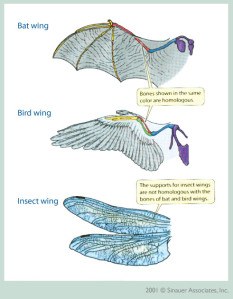
  The diagram shows an image of a Pterosaur wing, bat wing, and bird wing.  These are all different organisms, but share similar wing structures.  If these structures are similar due to common ancestry, which of the following best describes them?
a)
a.  Vestigial Organ
b)
b.  Embryological Similarities
c)
c.  Homologous Structures
d)
d.  Analogous Structures
55.

What

type

of structure?

a)

Homologous

b)

Analogous

c)

Embryological

d)

Vestigial

56.
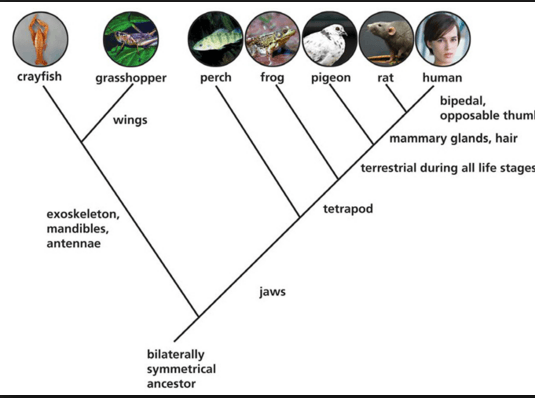
Which trait do only humans have, according to the cladogram?
a)
jaws
b)
mammary glands & hair
c)
terrestrial during all life stages
d)
bipedal & opposable thumbs
57.

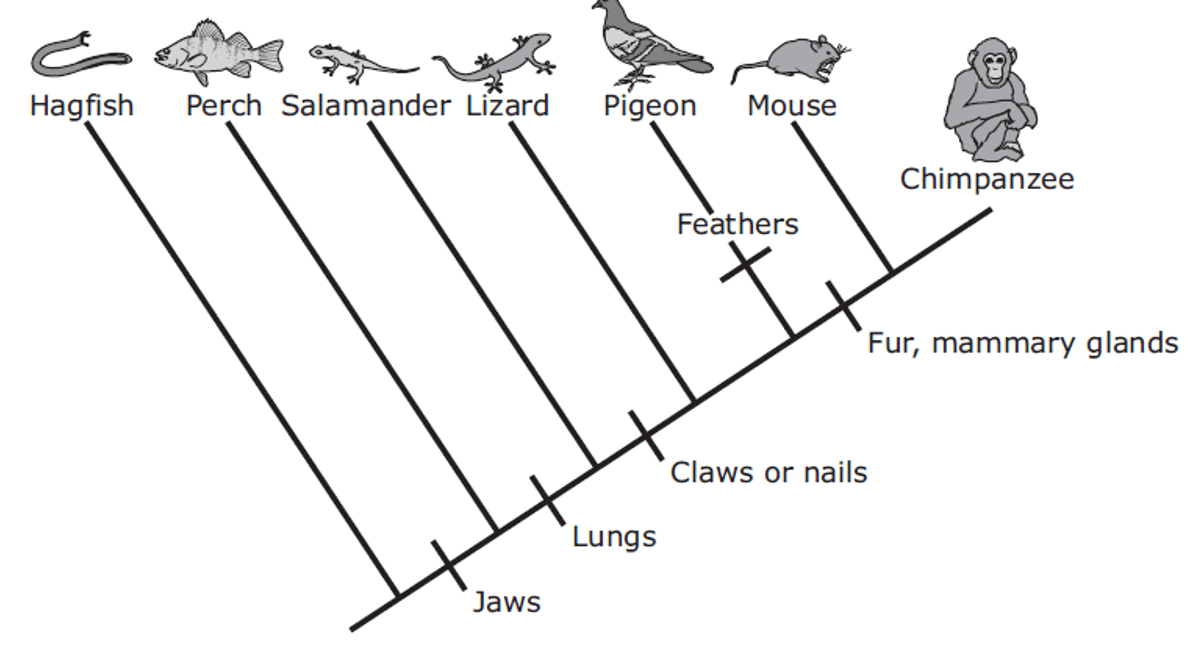
All the animals to the right of the salamander would have the common characteristic of...

a)

Fur

b)

Claws or nails

c)

Lungs

d)

Jaws

58.
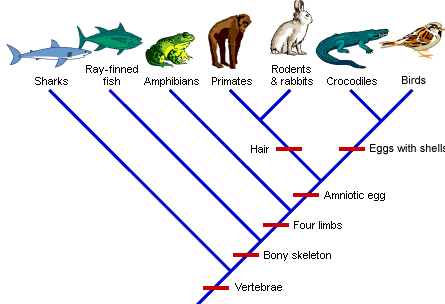
According to this cladogram, sharks are MOST closely related to which organism? 
a)
Amphibians
b)
Ray finned fish
c)
Crocodiles
d)
Birds
59.

The Miller-Urey experiment of 1953 was designed to test the hypothesis that lightning supplied the energy needed to turn atmospheric gases into organic molecules such as amino acids. Which of the following describes why the Miller-Urey theory is widely accepted today?

a)

Amino acids spontaneously form from molecules in the atmosphere today.

b)

Organic molecules are present today in extremely high concentrations.

c)

The process of synthesizing organic molecules from a mixture of gases has been successfully modeled in the laboratory.

d)

No other alternative hypotheses have been introduced.

60.

One of the accepted scientific theories describing the origin of life on Earth is known as chemical evolution. According to this theory, which of the following events would need to occur first for life to evolve?

a)

onset of photosynthesis

b)

origin of genetic material

c)

Synthesis of organic molecules

d)

formation of the plasma membrane

61.

One theory for the dinosaurs becoming extinct is competition with __

a)

Smaller, smarter reptiles

b)

Larger, stronger mammals

c)

Smaller, smarter mammals

d)

Larger, stronger reptiles

62.
Reasons that viruses are considered to be nonliving is because
a)
They are not cellular
b)
They cannot reproduce on their own
c)
They cannot make proteins
d)
all of the above
63.

_____ cells have a nucleus that contains their DNA. Protists have this type of cell.

a)

eukaryotic

b)

prokaryotic

64.

Protists that make their own food are ---

a)

Autotrophs.

b)

Heterotrophs.

65.

Where does the pollen land on the flower? Its structure is sticky to catch the pollen better.

a)

anther

b)

stamen

c)

stigma

d)

style

66.

What part of the angiosperm contains the reproductive structures?

a)

sepal

b)

receptacle

c)

flowers

d)

seeds

67.

What is the purpose of Mitosis?

a)

To produce gametes

b)

Sexual Reproduction

c)

To cause mutations

d)

To heal, grow and replace cells.

68.

Homeostasis is the maintenance of a constant...

a)

internal environment

b)

external environment

c)

living environment

69.
Clusters of tiny air sacs that allow the exchange of oxygen and carbon dioxide
a)
Pharynx
b)
Diaphragm
c)
Alveoli
d)
Lungs
70.
Alveoli increase the surface area in the lungs to allow...
a)
More nutrients to be absorbed
b)
You to breathe faster
c)
You to breathe slower
d)
More O2 and CO2 to exchange
71.

Senses recognize ____________ which are recognized by the brain and results in a response.

a)

Synapses

b)

Brain messages

c)

Stimuli (plural of stimulus)

d)

Cerebrums

72.
Which of the following describes the relationship between sensory neurons and motor neurons?
a)
Motor neurons bring a stimulus input to the brain and sensory neurons carry a movement output. 
b)
Sensory neurons tell motor neurons what to do.
c)
Sensory neurons bring a stimulius input to the spinal cord or brain and the brain or spinal cord sends a motor neuron  response.
d)
Sensory neurons do more than motor neurons
73.

The vaccines trigger the immune system creating specific ______________ for the pathogen.

a)

antigens

b)

antibodies

c)

medicine

d)

cells

74.

Why do we need a new vaccine for Influenza every year?

a)

because the virus mutates very quickly

b)

because the virus is unknown

c)

because the vaccine works for a short time

d)

none of the answers

75.

A vaccination

a)

Is a type of white blood cell that eats bacteria

b)

Protects your body via needle or capsule

c)

Causes your body to react as if it had met a pathogen

d)

Is made up of collagen, and can be in the form of gelatine