
 Worksheets
Weather
Total questions: 80
Worksheet time: 1hrs 16mins
Name
Class
Date
1.

This weather instrument is a...
a)
thermometer
b)
wind vane
c)
anemometer
d)
rain gauge
2.

What does this tool measure?
a)
Wind speed
b)
Wind direction
c)
Air pressure
d)
Temperature
3.

This weather instrument is a...
a)
anemometer
b)
Christmas ornament
c)
wind vane
d)
barometer
4.

What is the name of this tool?
a)
Barometer
b)
Hygrometer
c)
Rain Gauge
d)
Thermometer
5.

This weather instrument is a...
a)
anemometer
b)
barometer
c)
wind vane
d)
thermometer
6.
A rain gauge measures what?
a)
Air pressure
b)
Wind speed
wind speed
wind speed
c)
Amount of rain fall
d)
Wind direction
7.

This weather instrument is an...
a)
wind vane
b)
anemometer
c)
barometer
d)
thermometer
8.
The weather forecast tomorrow says there will be a 15 mph northeast wind and a high temperature of 52 degrees. What three instruments will a meteorologist use to make this prediction?
a)
anemometer, wind vane, thermometer
b)
barometer, hygrometer, wind vane
c)
thermometer, satellite image, hygrometer
d)
wind vane, satellite image, barometer
9.
Which tool measures humidity or the amount of moisture in the air?
a)
wind vane
b)
barometer
c)
anemometer
d)
hygrometer
10.
Which tool measures air pressure?
a)
Thermometer
b)
Barometer
c)
Wind Vane
d)
Hygrometer
11.
Which tool measures wind speed?
a)
Anemometer
b)
Hygrometer
c)
Barometer
d)
Wind Vane
12.
Temperature is measured in...
a)
degrees
b)
inches
c)
centimeters
d)
feet
13.
A high pressure system means we might have this weather.
a)
Snow blizzard
b)
Sunny and dry
c)
Rain storm
d)
Tornado
14.
A low pressure system means we might have this weather.
a)
Sunny
b)
A clear sky
c)
Dry day
d)
Stormy or wet
15.

What temperature is this in Fahrenheit?
a)
84 degrees
b)
85 degrees
c)
86 degrees
d)
30 degrees
16.

What part of the illustration shows Evaporation?
a)
1
b)
2
c)
3
d)
4
17.

Which number illustrates Condensation?
a)
1
b)
2
c)
3
d)
4
18.

What does this symbol on a weather map indicate?
a)
High pressure system
b)
Low pressure system
c)
Cold front
d)
Warm front
19.

What does this symbol indicate on a weather map?
a)
High pressure system
b)
Low pressure system
c)
Cold front
d)
Warm front
20.
What kind of weather is usually associated with a high pressure system?
a)
Sunny weather
b)
Precipitation (rain, snow, etc.)
21.
The boundary between two air masses is known as:
a)
front
b)
storm
c)
climate
d)
flood
22.
Mark looks at the clouds in the sky and decides that he does not need to
take his umbrella with him today. Which clouds did Mark most likely see
in the sky?
take his umbrella with him today. Which clouds did Mark most likely see
in the sky?
a)
cirrus
b)
nimbostratus
c)
cumulonimbus
23.
Which type of cloud is most often observed during a thunderstorm?
a)
cirrus
b)
stratus
c)
cumulus
d)
cumulonimbus
24.
Hot air (RISES / FALLS) __________.
a)
RISES
b)
FALLS
25.
Cold air (RISES/ FALLS) _________.
a)
RISES
b)
FALLS
26.

a)
nimbostratus cloud
b)
cumulonimbus cloud
c)
cirrocumulus cloud
d)
altostratus cloud
27.

name this front
a)
warm front
b)
cold front
c)
stationary front
d)
occluded front
28.
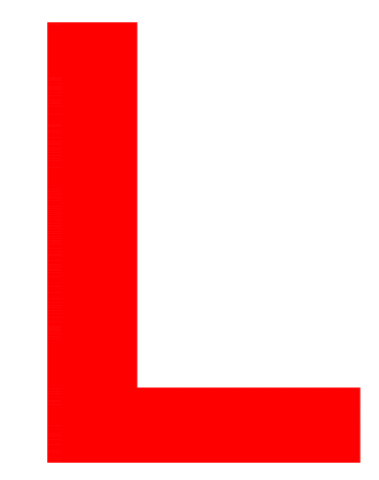
What does this symbol on a weather map indicate?
a)
High pressure system
b)
Low pressure system
c)
Cold front
d)
Warm front
29.

A _____ is a large, swirling, low-pressure system that forms over the Atlantic Ocean.
a)
blizzard
b)
cold front
c)
tornado
d)
hurricane
30.

A violently rotating column of air called a _____ when it comes in contact with the ground.
a)
hurrican
b)
tornado
c)
trade wind
d)
local wind
31.

Identify the type of front that is shown in the image.
a)
Occluded Front
b)
Cold Front
c)
Stationary Front
d)
Warm Front
32.

What is the barometric pressure?
a)
18
b)
19
c)
147
d)
-13
33.

What type of air mass is circled?
a)
continental polar
b)
continental tropical
c)
maritime polar
d)
maritime tropical
34.
How much Oxygen is in our air?
a)
78%
b)
21%
c)
1%
d)
100%
35.
How much Nitrogen is in our air?
a)
78%
b)
21%
c)
1%
d)
100%
36.
where does radiation come from
a)
sun
b)
moon
c)
day
d)
night
37.
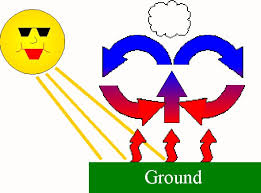
Warm air rises and the cool air sinks demonstrates this type of heat transfer.
a)
conduction
b)
convection
c)
radiation
d)
Insolation
38.
____________ are connected lines of equal pressure.
a)
Isobars
b)
Isopleths
c)
Isotherms
d)
Isochrons
39.
Where we live.
a)
stratosphere
b)
thermosphere
c)
troposphere
d)
mesosphere
40.
Where weather occurs.
a)
stratosphere
b)
thermosphere
c)
troposphere
d)
mesosphere
41.
Where do hurricanes form?
a)
Over Mountain ranges
b)
Over warm ocean water
c)
Over cold ocean water
d)
Over open deserts
42.
Where you will find the ozone layer.
a)
stratosphere
b)
thermosphere
c)
exosphere
d)
mesosphere
43.
The hottest layer.
a)
troposphere
b)
thermosphere
c)
exosphere
d)
mesosphere
44.
What does the earth's atmosphere do?
a)
help to regulate the temperature on Earth
b)
Help UV rays to reach the Earth's surface
c)
Creates meteors in the sky
d)
Keep ocean waters cold
45.
As you go higher in the mesosphere, the temperature _______________.
a)
decreases
b)
increases
c)
stays the same
46.
As you go higher in the stratosphere, the temperature _______________.
a)
decreases
b)
increases
c)
stays the same
47.
What gas from the list below is a cause for global warming?
a)
Urethane
b)
Oxygen
c)
Carbon Dioxide
48.
What do scientists think the effect will be of having more greenhouse gases in our atmosphere?
a)
More warming of the atmosphere
b)
More cooling of the atmosphere
c)
More air in the atmosphere
d)
Less air in the atmosphere
49.
What do humans do that releases greenhouse gases into the atmosphere?
a)
Burn fossil fuels (like gas and coal)
b)
Build cement buildings
c)
Ride bikes and use solar energy
d)
Compete in the Olympics
50.
Max wind speeds 74 to 200 mph.
a)
Hurricane
b)
Tornado
c)
Thunderstorm
51.
Typically short duration (minutes to hours)
a)
Hurricane
b)
Tornado
c)
Thunderstorm
52.
Most form in the central plains states.
a)
Hurricane
b)
Tornado
c)
Thunderstorm
53.
Form in the Caribbean or Atlantic Ocean.
a)
Hurricane
b)
Tornado
c)
Thunderstorm
54.
Usually occur in the spring or early summer.
a)
Hurricane
b)
Tornado
c)
Thunderstorm
55.
Usually occur in the late summer or during fall
a)
Hurricane
b)
Tornado
c)
Thunderstorm
56.
Critical for the formation of a hurricane?
a)
lower latitudes
b)
80 degrees or warmer water
c)
None of the above
d)
All of the above
57.
The Saffir-Simpson Scale measures
a)
Hurricane's rainfall
b)
Hurricane's area
c)
Hurricane's intensity
d)
Hurricane's storm surge
58.
Calmest winds of a hurricane
a)
Eye wall
b)
Eye
c)
Upper elevations
d)
Storm surge
59.
How many categories of hurricanes
a)
2
b)
3
c)
4
d)
5
60.
Year they begun using male and female names
a)
1943
b)
1963
c)
1953
d)
1978
61.
What is the difference between a hurricane, a typhoon, and a tropical cyclone?
a)
Begin on different dates
b)
Begin in warm waters
c)
Begin in different locations
d)
Begin/end on time
62.
Direction hurricanes spin in the northern hemisphere
a)
clock-wise
b)
counter clock-wise
63.
What is the reference point used to measure elevation?
a)
lake level
b)
sea level
c)
zero
d)
elevation
64.
What are the two main factors that determine the climate of an area?
a)
precipitation and humidity
b)
temperature and air pressure
c)
wind conditions and humidity
d)
temperature and precipitation
65.
What causes winds to form on Earth?
a)
solar energy
b)
ocean currents
c)
elevation differences
d)
uneven heating of the Earth by the sun
66.
What are the surface features of an area called?
a)
latitude
b)
longitude
c)
topography
d)
elevation
67.
What are the 3 major climate zones in order from equator to the poles?
a)
polar, temperate, tropical
b)
tropical, temperate, polar
c)
temperate, polar, tropical
68.
What is the condition of the Earth's atmosphere at a certain time and place?
a)
climate
b)
temperature
c)
weather
d)
air pressure
69.
What is the measure of distance in degrees north and south from the equator?
a)
latitude
b)
longitude
c)
elevation
d)
topography
70.
What is the weather conditions in an area over a long period of time?
a)
climate
b)
temperature
c)
elevation
d)
precipitation
71.

Which season is shown in the northern hemisphere?
a)
winter
b)
spring
c)
summer
d)
fall
72.
Which is a period of dryer weather than normal?
a)
drought
b)
equinox
c)
monsoon
d)
upswelling
73.
Which is a natural source of greenhouse gases?
a)
aerosols
b)
deforestation
c)
volcanic eruptions
d)
burning fossil fuels
74.
What do greenhouse gases do?
a)
absorb Earth's outgoing infrared radiation
b)
reflect Earth's incoming infrared radiation
c)
magnify ultraviolet radiation in the atmosphere
d)
block the Sun's infrared radiation
75.
Which of these negative effects is most likely to occur because of global warming?
a)
rising sea levels
b)
shorter growing seasons
c)
increased volcanic eruptions
d)
falling sea levels
76.
Which natural process removes carbon dioxide from the atmosphere?
a)
forest fires
b)
volcanic eruptions
c)
cellular respiration
d)
photosynthesis
77.
cold, short above freezing summer, short grasses
a)
tundra
b)
subarctic
c)
ice cap
d)
cool summer
78.
temperate rainforests
a)
marine west coast
b)
tropical rainforest
c)
humid subtropical
d)
continental warm summer
79.
How many climate groups are there according to the Koppen Classification System.
a)
1
b)
5
c)
7
d)
3
80.
What are characteristics of Dry Climates?
a)
Annual precipitation is more the the potential loss of water by evaporation
b)
The annual precipitation is less every year.
c)
The annual precipitation is less than the potential loss of water by evaporation.
d)
The annual precipitation is more every year.
100 %

