
 Worksheets
Unit 9: Heredity Study Guide
Total questions: 75
Worksheet time: 2hrs 31mins
A flower's red color an example of a....
Genotype
Phenotype
A dog's soft fur an example of a....
Genotype
Phenotype
The genotype TT is considered to be....
Homozygous dominant
Heterozygous
Homozygous recessive
The genotype Tt is considered to be....
Homozygous dominant
Heterozygous
Homozygous recessive
The genotype tt is considered to be....
Homozygous dominant
Heterozygous
Homozygous recessive
If red color is dominant in flowers, what would a heterozygous flower's genotype look like?
RR
Rr
rr
Hairy is dominant to hairless. A guinea pig who is hairless will have the genotype of?
HH
Hh
hh
HH or Hh
Hairy is dominant to hairless. A guinea pig who is hairy will have the genotype of?
HH
Hh
hh
HH or Hh
Principle that states genes for different traits do not influence each other’s segregation
heterozygous
dominance
independent assortment
codominance
Scenario in which a gene has more than two alleles
polygenic trait
multiple alleles
hybrid
independent assortment
A segment of DNA that codes for a specific trait.
gene
allele
trait
chromosome
Inheritance pattern in which both alleles are dominant so the heterozygous shows both phenotypes.
dominant
genotype
codominant
incomplete dominance
Inheritance pattern in which neither allele is dominant so the heterozygous shows as a
blend.
dominant
genotype
codominant
incomplete dominance
Traits controlled by more than one gene resulting in a wide range of phenotypes
codominant
polygenic
hybrid
true- breed
This allele that will mask another when present.
dominant
recessive
genotype
probability

Allele
The way an organism looks and behaves
Different forms of a gene
Alleles for a trait are the same
The alleles for different traits are sorted separately and don't affect one another.
Law of Dominance
Law of Independent Assortment
Law of Conservation of Matter
Law of Segregation
Gametes produced by an organism contain a combination of genes from that organism. In
every gamete, this combination is —
the same because it is created from the same DNA
the same because chromosomes are copied prior to meiosis
different due to DNA replication prior to mitosis
different due to independent assortment during meiosis

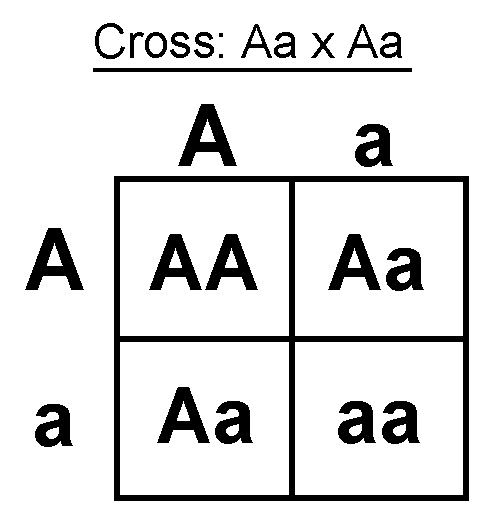
In the punnett square below, what belongs in the missing square

In the punnett square, what is the probability for white fur?
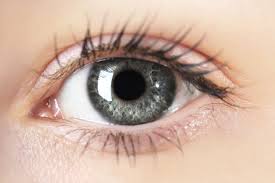
b = blue eyes
What is true about these two brothers that have brown eyes?
One has genotype BB the other Bb.


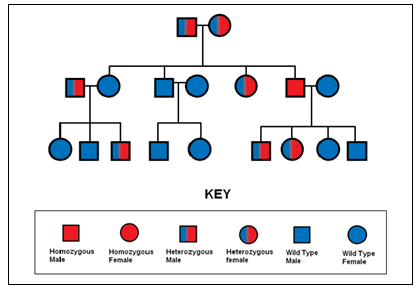


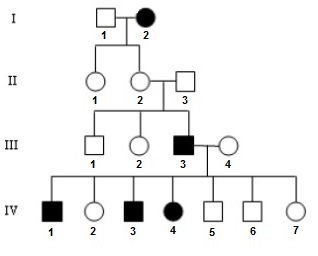

If this pedigree shows a recessive disorder, what MUST the genotype of individual 4 be?
HH
Hh
hh


Name the proteins on the surface of red blood cells.
Antibodies
Antigens
Plasma
Collagen
What type of antigens can be found on the surface of RBC's when someone has blood type O?
A
B
AB
none
During a blood typing test, a droplet of blood is found to have both A and B antigens. What is the blood type?
A
B
AB
O

What type of blood is shown here?
A positive
A negative
B positive
B negative
This determines whether a person's blood type is positive or negative...
Rh factor
platelets
D antibodies
plasma

A woman with blood type B, whose father had blood type O, marries a man with blood type O. What are the odds they have a child with blood type B?
0%
25%
50%
100%
75%
The A and B alleles in human blood types are ___________ to each other.
codominant
homozygous
completely dominant
recessive
There are multiple alleles for the ABO blood group. Why are only two of these alleles present in any one individual?
Each parent contributes only one allele for the ABO blood group to the offspring.
There are not enough nucleotides in a red blood cell to produce a third allele.
Each allele in the ABO group must be dominant or recessive
Blood group alleles are not segregated during meiosis.

What are the parents' blood types. Mark two answers.
Type A
Type B
Type AB
Type O
What is the probability these two parents will have a child with type AB blood?
0%
25%
50%
100%

What are the parents' blood types? Mark all that apply.
Type A
Type B
Type AB
Type O
Which of the following genotypes shows a CARRIER for a trait?
XBXb
XbXb
XBXB
XbY
Colorblindness is a recessive X-linked disorder.
Which genotype represents a male with normal vision?
XN YN
Xn Yn
XN Y
Xn Y


Colorblindness is more common in males than in females because......
fathers pass the allele for colorblindness to their sons only
the allele for colorblindness is located on the Y chromosome
the allele for colorblindness is recessive and located on the X chromosome
males who are colorblind have two copies of the allele for colorblindness
Colorblindness is a recessive X-linked disorder.
Which genotype represents a male with normal vision?
XN YN
Xn Yn
XN Y
Xn Y
What would the genotype be of a colorblind male?
XNY
XNYn
XnY
XnYn
How many recessive genes does a carrier female have for colorblindness?
1
2
0
3
Colorblindness is a sex-linked recessive trait. A colorblind woman marries a male with normal color vision. What is the percent chance of them having a color blind son?
0%
25%
50%
75%
The woman who is colorblind marries a man with normal vision. What is the probability that their sons will be colorblind?
0%
25%
50%
100%
Which best explains why males cannot be carriers of X-linked traits?
Males only have one X chromosome
Males have two copies of the X chromosome
Males can be heterozygous for a particular trait
Males do not have an X chromosome
A woman who is a carrier for the sex-linked trait hemophilia has children with a man with hemophilia. What percentage of offspring would be expected to have hemophilia?
0%
25%
50%
75%
What is the reason farmers cultivate GMO crops?
Increase Yields
Decrease Pesticide Input Costs
Save Time
All of the Above
Why do bacteria have CRISPR? Check all that apply.
To be able to remember which viruses they have been infected with
To be able to edit virus DNA
To cut apart virus DNA thereby stopping the virus infection
To be able to edit their own DNA

What is the role of the guide RNA?
It helps the cell repair the DNA
ensures that the Cas9 enzyme cuts at the right point in the genome
Recognizes PAM sequences and opens up the DNA
makes a cut across both strands of the DNA
How does the guide RNA help the cell know where to cut the DNA?
Guide RNA helps to find the PAM
Guide RNA is complementary to the DNA sequence
Guide RNA always binds to the same sequence of DNA
Like restriction sites, they are always palindromes
The following sequence is a known GENE MUTATION that geneticists would like to remove. What would be the guide RNA they need to build into a CRISPR-Cas9 enzyme?
TTA CCG
AAU GGC
AAT GGC
TTA CCG
GCC ATT
How does CRISPR edit DNA? Check ALL that apply.
CRISPR chemically changes A's to C's
CRISPR cuts the DNA and the cell makes errors when it tries to fix the broken DNA
CRISPR cuts the DNA and the cell can use a similar DNA sequence as a template to try to fix the DNA
CRISPR changes all PAM's so that they are no longer able to be recognized

