
 Worksheets
CIE IG Space Physics
Total questions: 80
Worksheet time: 1hrs 23mins
How was Hubble able to calculate a rough estimate for the formation of the Universe?
By calculating when hydrogen was first formed
By calculating the age of the oldest atoms
By calculating the rate at which the Universe is expanding
By calculating the rate at which the Universe is shrinking
According to the standard model of Big Bang cosmology, approximately how old is the Universe?
65 million years old
3.8 billion years old
13.7 billion years old
4.5 billion years old
What were the first two elements to form once the Universe expanded and cooled?
Hydrogen and oxygen
Carbon and helium
Helium and oxygen
Hydrogen and helium
What is cosmic microwave background radiation (cosmic background radiation)?
Energy released during the fusion of hydrogen nuclei in the center of stars
Energy used in the laboratory to sterilize equipment
Energy released 380,000 years after the Big Bang
Energy emitted by the Sun
What are two important pieces of evidence we have for the Big Bang?
Ptolemy’s work on epicycles and Hubble’s law (the expansion of the Universe)
Hubble’s law (the expansion of the Universe) and cosmic background radiation
The fact that we have multiple Universes to compare and study and cosmic background radiation (CBR)
The abundance of hydrogen, helium, and lithium found in the Universe and Ptolemy’s work on epicycles
The Big Bang Theory states that all matter started as a small volume and then...
expanded in all directions
contracted even smaller
caused an atomic explosion
burned up and exploded
What do we observe when stars/galaxies are moving away from us?
Cosmic Background Radiation
Blueshift
Nothing
Redshift
Why does redshift occur in stars/galaxies?
Light waves stretch as a star moves away
Light waves squish as a star moves away
Redshift does not occur in stars
Light waves change shape as stars move
What is cosmic background radiation?
Microwave radiation from the Big Bang
Visible light from the stars
Gamma radiation from the Big Bang
Matter that has gravity but no light
Which of the following best describes the creation of cosmic background radiation:
Microwaves from the BB stretched into radio waves
Gamma Rays from the BB stretched into microwaves
Gamma radiation from the BB stretched into ultraviolet radiation
Visible light from the BB stretched into gamma radiation

What is the final stage of a low mass star?
White Dwarf
Black Hole
Red Giant
Neutron Star

Which stage of life is the sun currently in?
White Dwarf
Planetary Nebula
Main Sequence
Red Giant

What is the name of the cosmic cloud of dust and gas that is the first stage in the birth of a star?
Protostar
Spiral Galaxy
Quasar
Stellar Nebula

A stellar nebula will eventually condense into a hot ball of mostly hydrogen called a __________. At this point, nuclear fusion has not yet started but it will soon.
Protostar
White Dwarf
Brown Dwarf
Main Sequence
In a low-medium mass star, after the end of the red giant phase, a hot inner core of the star is left over. This core is a called a __________. There is no longer nuclear fusion happening at this stage.
White Dwarf
Planetary Nebula
Supernova
Neutron Star

True or False: All stars will eventually become a black hole
True
False

How many stars are in our solar system?
too many to count
billions
one
only the stars that we can see
How will our sun end its life?
Black hole
Black dwarf
Brown dwarf
Neutron star
What is the final stage of a high mass star?
White Dwarf
Black Hole
Red Giant
Neutron Star
In a low-medium mass star, at the end of the red giant stage, the red giant's atmosphere expands outward to create a...
White Dwarf
Planetary Nebula
Supernova
Neutron Star
In a high mass star, at the end of the red giant phase, the gravity causes the star to rapidly collapse. This collapse causes a massive explosion called a __________
White Dwarf
Planetary Nebula
Supernova
Neutron Star

Which elements are found in a main sequence star?
Hydrogen (H)
Helium (He)
Carbon (C)
Oxygen (O)

Which is one of the heaviest element found in a red giant star?
Nitrogen (N)
Iron (Fe)
Sulfur (S)
Magnesium (Mg)
This quantity is the quantity that is crucial for deciding what route the star’s life will go down?
Temperature
Mass
Age
Formation Speed

Hydrogen nuclei combining to form helium is referred to as nuclear
fusion
fission
fallout
decay
armageddon


Pluto is no longer considered a planet, it is a dwarf planet that is in an asteroid belt known as the
Oort Cloud
Kuiper Belt
Asteroid Belt
Hubble Belt
In this layer of the sun, nuclear fusion takes place, providing the energy for the sun's heat and light.
The core
The radiation zone
The convection zone
The photosphere
A collection of gas and dust in space is called
a planet
a moon
the sun
a nebula
The process in which hydrogen atoms collide and fuse with each other to form helium in the sun's core is called
radiation
convection
nuclear fusion
conduction
How many planets are in our solar system?
4
9
6
8
What is Pluto's classification?
planet
comet
dwarf planet
star
In which galaxy is our Solar system located?
Milky Way
Sagittarius
Orion's Belt
Asteroid Belt

Identify the planets (in order) starting from the one nearest to the Sun.
Mercury, Venus, Mars, Earth, Jupiter, Saturn, Neptune, Uranus
Neptune, Venus, Mars, Earth, Jupiter, Saturn, Mercury, Uranus
Mercury, Venus, Earth, Mars, Jupiter, Saturn, Uranus, Neptune
Mercury, Neptune, Uranus, Venus, Mars, Earth, Jupiter, Saturn
Which planet is the largest?
Jupiter
Saturn
Mercury
Earth
Which planet is the smallest?
Jupiter
Saturn
Mercury
Earth
Which planet is the lightest?
Jupiter
Saturn
Mercury
Earth
Which planet has the most water?
Jupiter
Saturn
Mercury
Earth
Which of the following is the odd one out?
Asteroids
Meteoroid
Universe
Comet
How long does it take for the Earth to revolve around the Sun?
365.25 days
88 days
687 days
28 days

The planets travel around it in almost circular paths or __________
Circle
Triangle
Orbits
Animals
In the solar system, the sun's _________ keeps the planets and other solar system objects traveling in orbits around it
Sun
Moons
Gravity
Comets
Earth is included among Mercury, Venus, and Mars in the inner, or ____________ planets.
Echelon
Peripheral
Celestial
Terrestrial
The outer planets include Saturn, Jupiter, Uranus, and Neptune. They are called the _______________.
Ringed Planets
Gas Giants
Ice Giants
Peripheral planets
The rotation of a planets dictates the length of the planet's...
Seasons
Days and Nights
Years
Months
The orbital period of a planet is...
The time it takes for moons to revolve around the planet
The time it takes to revolve around the sun
The time it takes the planet to turn on its axis
The distance of the planet from the sun
Comets are large chunks of rock and ice that....
Travel in a straight line
Destroy planets
Orbit the sun
Originate in other galaxies
The equation to find orbital speed is
v = 2πr2/t
v = 2πr/t
v = s/t
v = d/t
What is the speed of light in a vacuum?
300 km/s
3.0x10⁶ m/s
3.0x10⁸ m/s
300 000 000km/s
What is 1 light year?
The length of a year on Earth
The time it takes light to reach Earth
9.5x10¹⁵m
3.0x10⁸m/s
Which planet(s) is/are in between Earth and the sun?
A. Mercury and Mars
B. Mercury and Venus
C. Just Mercury
Earth is a terrestrial planet. What does that mean?
A. It is made mostly of rock.
B. It has dirt on its surface.
C. It has an atmosphere that can sustain life.


1. Antarctica experiences six months of complete darkness during winter. What is the best explanation of this occurrence?
Earth’s tilt
Sun’s distance from Earth
Earth's rotation
not here
1. What would happen if earth's rotation speed were to increase?
The year would be shorter
The day would be shorter
The year would be longer
The day would be longer
1. Which diagram shows how the Earth’s axis is tilted when it is summer in the Southern Hemisphere?


1. Based on the picture, people living in the Northern hemisphere are generally experiencing_____
Fewer hours of daylight and warmer temperatures
Fewer hours of daylight and cooler temperatures
More hours of daylight and warmer temperatures
More hours of daylight and cooler temperatures

With the Earth in the position shown, is there anywhere that would receive no sunlight for more than a 24 hr period?
No, everywhere will get sunlight over a 24 hour period
Yes, the North Pole will be dark for more than 24 hrs.
Yes, the South Pole will be dark for more than 24 hrs.
Yes, the left side of Earth by the Equator will be dark for more than 24 hrs.
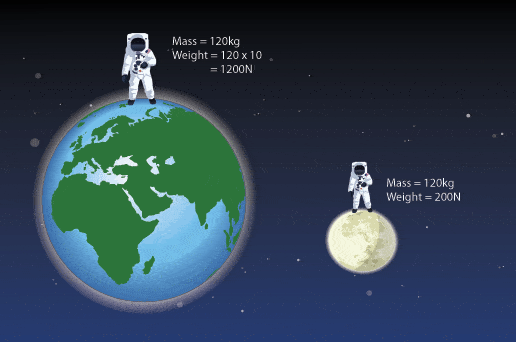
As distance increases, gravitational forces:
Decrease
increase
Disappear
Stay the same
Why does the comet's tail always point away from the sun?
because of opposite magnetic forces
because of solar wind
because you can't see it pointing toward the sun
because of gravity
What are asteroids?
small pieces of stars
small planets
large metallic rocks that orbit the sun
icy stars that orbit the sun
Where is the asteroid belt located?
between Mars and Jupiter
between Neptune and the Kuiper Belt
between the sun and the Earth
between the Kuiper Belt and the Oort Cloud
Which of the following is NOT an evidence of the Big Bang?
Red Shift
Steady state
Cosmic Microwave Background Radiation
Nucleosynthesis
The farther away galaxies are from us, the _______________ it is that they are moving away from us.
more uncertain
faster
slower
more unpredictable
Most scientists believe the Big Bang explains which of the following questions?
How the planets & moons formed.
How our Universe began.
How the sun turns hydrogen into helium.
How fast light travels through space.
What term below is defined as electromagnetic radiation aligned according to wavelength and frequency?
interferometry
visible light
electromagnetic spectrum
gamma radiation

