wayground logo

Free Printable Worksheets

NEW

Font size

S
M
L
XL
Worksheets

MAP - Strand 11 - Cardiovascular System

Total questions: 80

Worksheet time: 1hrs 1mins
Name
Class
Date
1.

What is the main organ of the circulatory system?

a)

small intestine

b)

bone

c)

lungs

d)

heart

2.

The heart is a ____________, which pumps blood through the body.

a)

tendon

b)

bone

c)

tissue

d)

muscle

3.
Which is NOT a function of the circulatory system?
a)
deliver O2 and nutrients to cells
b)
remove CO2 and wastes from cells
c)
break down carbohydrates into glucose
d)
transport other materials through body
4.
What does the Circulatory System do?
a)
Circulates the Blood throughout the body
b)
Circulates Water throughout the body
c)
Excretes Waste
d)
Controls all parts of the body
5.
When you exercise, your heart beats faster to...
a)
spread oxygen throughout your body more quickly.
b)
make you feel excited.
c)
let you know you're working hard.
d)
inflate your lungs
6.
What system helps to take oxygen throughout the body?
a)
Digestive System
b)
Respiratory System
c)
Circulatory System
d)
Muscular System
7.
The three layers of the heart are as follows:
a)
Myocardium,pericardium,endocardium
b)
Myocardium,epicardium,endocardium
c)
Myocardium,endocarditis,endocardium
d)
Myocardium,exocardium,pericardium
8.
This is the thickest layer of the heart
a)
Pericardium
b)
Endocardium
c)
Myocardium
d)
Epicardium
9.

Which of these is the layer that lines the chambers and covers the valves?

a)

pericardium

b)

epicardium

c)

myocardium

d)

endocardium

10.
Which of the following is a function of the heart?
a)
Ensuring 2 way blood flow
b)
Regulating blood supply
c)
Exchange of oxygen and CO2
d)
Falling in love
11.
How many chambers in the heart?
a)
1
b)
2
c)
3
d)
4
12.
How many valves in the heart?
a)
4
b)
3
c)
2
d)
1
13.
The right side of the heart carries oxygenated blood
a)
True
b)
False
14.
Bicuspid valve is also called __________
a)
tricuspid
b)
mitral
c)
pulmonary
d)
aortic
15.
The flow of blood between the heart and the lungs
a)
systemic circulation
b)
oxygenated circulation
c)
Pulmonary circulation
d)
none of the above
16.
The left side of the heart pumps deoxygenated blood
a)
True
b)
False
17.
The upper chambers of the heart that receives blood from veins are called ventricles.
a)
True
b)
False
18.
The largest artery of the body is the
a)
renal artery
b)
femoral artery
c)
carotid artery
d)
aorta
19.
What valves prevents the backflow of blood into the right atrium?
a)
tricuspid
b)
bicuspid
c)
aortic semilunar
d)
pulmonary semilunar
20.
What is a lower, thick-walled chamber that receives blood from the Atrium?
a)
Ventricle
b)
Valve
c)
Aorta
d)
Pericardium
21.

Which of these is not a atrioventricular valves?

a)

tricuspid

b)

mitral

c)

pulmonary

22.
a)
Left atrium
b)
Right atrium
c)
Left ventricle
d)
Right ventricle
23.
Blood enters the right atrium through 
a)
pulmonary veins
b)
vena cavaes
c)
pulmonary arteries
d)
aorta
24.
Which part of the heart pumps deoxygenated (oxygen-poor) blood?
a)
Left side
b)
Right side
c)
Top side
d)
Bottom side
25.
What creates the "lub dub" heart sounds?
a)
Flow of blood
b)
Closing of valves
c)
Opening of valves
d)
Breathing
26.
_______ circulation takes blood from the heart to the lungs and back.
a)
Systemic
b)
Pulmonary
c)
Body
d)
Blood
27.
Myocardium
a)
Middle
b)
outter
c)
inner 
28.
Blood that flows from the heart to the rest of the body is known as the
a)
Pulmonary circuit
b)
Systemic circuit
29.
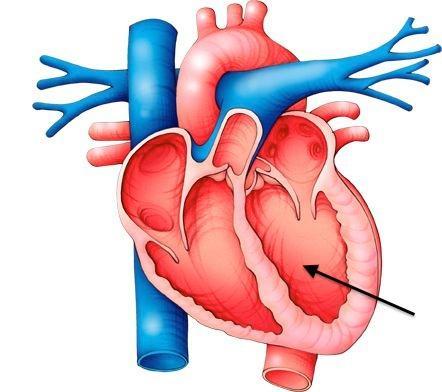
Identify
a)
Left atrium
b)
Right atrium
c)
Left ventricle
d)
Right ventricle
30.
Identify
a)
Left atrium
b)
Right atrium
c)
Left ventricle
d)
Right ventricle
31.
What part of the hear prevents back flow into the atria?
a)
AV valves
b)
Sinoatrial node
c)
Pericardium
d)
Semilunar valves
32.
The Sinoatrial node is also known as the ________
a)
action potential
b)
refractory period
c)
pacemaker
d)
semilunar valvce
33.
What is the function of the atrioventricular node?
a)
Ensures atria contracts
b)
Ensures ventricles receive signal to contract
c)
Release blood to the ventricles
d)
Ensures that the left side of the heart is larger than the right
34.
Where in the heart could I find the SA Node?
a)
Right Atrium
b)
Left Atrium
c)
Right Ventricle
d)
Left Ventricle
35.
Which one of the following represents the correct path for the transmission of an impulse in the intrinsic conduction system of the heart?
a)
AV node, Bundle of His, SA node, Purkinje fibers, bundle branches
b)
SA node, AV node, Bundle of His, bundle branches, Purkinje fibers
c)
SA node, Bundle of His, AV node, Purkinje fibers, bundle branches
d)
SA node, Bundle of His, bundle branches, Purkinje fibers, AV node
36.
Order the phases an action potential travels in the conduction system
a)
SA node--> AV bundle branches--> AV node--> Purkinje fibers
b)
SA node--> AV node--> AV bundle branches-->  Purkinje fibers
c)
Av bundle branches--> AV node--> SA node--> Purkinje fibers
d)
Purkinje fibers--> SA node--> AV node--> AV bundle branches
37.

The yellow arrow points to which heart valve?

a)

Tricuspid

b)

Bicuspid (Mitral)

c)

Aortic Semilunar

d)

Pulmonic Semilunar

38.

The yellow arrow points to which hear valve?

a)

Tricuspid

b)

Bicuspid (Mitral)

c)

Aortic Semilunar

d)

Pulmonic Semilunar

39.
Which of the following define diastole and systole
a)
systole is the contraction of the heart and diastole is the relaxation of the heart
b)
diastole is the contraction of the heart and systole is the relaxation of the heart
c)
diastole and systole are both contractions of the heart
d)
diastole and systole are both relaxation phases of the heart
40.

Which term means heart contraction?

a)

diastole

b)

tachycardia

c)

systole

d)

fibrillation

41.
Pulmonary vein
a)
carries oxygenated blood to left atrium
b)
carries deoxygenated blood to left ventricle
c)
carries oxygenated blood to left ventricle
d)
carries deoxygenated blood to left atrium
42.

Calculate the Cardiac output


SV= 70 ml/beat

HR = 75 beats/min

a)

5 L/min

b)

5.25 L/min

c)

5.5 L/min

d)

5.35 L/min

43.
Cardiac output increases during exercise.
a)
True
b)
False
44.

The volume of blood pumped out of the left ventricle per minute.

a)

Cardiac Output

b)

Stroke Volume

c)

End Diastolic Volume

d)

Heart Rate

45.

The volume of blood pumped out of the left ventricle per beat.

a)

Heart Rate

b)

Stroke Volume

c)

Cardiac Output

d)

End diastolic volume

46.

How is Cardiac Output Calculated?

a)

Heart Rate + Stroke Volume

b)

Heart Rate - Stroke Volume

c)

Heart Rate X Stroke Volume

47.

What is the contraction phase of a hearbeat called?

a)

diastole

b)

sinoatrial

c)

systole

d)

atrioventricular

48.

What are thick walled vessels that carry blood away from the heart?

a)

Arteriols

b)

venules

c)

capillaries

d)

Arteries

49.

what carries blood to the heat?

a)

blood

b)

veins

c)

venules

d)

magic

50.
blood vessels that allow exchange of nutrients with body tissues
a)
arteries
b)
veins
c)
capillaries
d)
coronary arteries
51.

heart rate is

a)

beats per minutes

b)

all pulses produced

c)

amount of blood it pumps

d)

non of the above

52.
______________ are the smallest blood vessels.
a)
Arteries
b)
Veins
c)
Capillaries
53.

What is "pulse"

a)

how many times you breathe per minute

b)

how many times you sneeze per minute

c)

how many times your heart beats per minute

54.

What does "bpm" stand for?

a)

breaths per minute

b)

beats per minute

c)

boogers per minute

55.
I am located on the thumb side of the hand.  I can be measured in one minute.
a)
radial pulse
b)
brachial pulse
c)
apical pulse
d)
 femoral
56.
I am found on the neck near the larygnx
a)
carotid
b)
oral
c)
femoral
d)
axillary
57.

What is a "normal" blood pressure

a)

120/110 mmHg

b)

120/80 mmHg

c)

100/80 mmHg

d)

140/80 mmHg

58.

lowest pressure against the blood vessels of the body. Measures between contractions

a)

diastolic pressure

b)

systolic pressure

c)

hypotension

d)

hypertension

59.

Which specific chamber of the heart is responsible for pumping blood to the entire body?

a)

Lt Atrium

b)

Rt Atrium

c)

Lt Ventricle

d)

Rt Ventricle

60.

Blood pressure is recorded as a fraction noting Systolic/Diastolic

a)

True

b)

False

61.

When blood enters the right atrium, where is it coming from?

a)

The body

b)

Left ventricle

c)

Right Atrium

d)

Lungs

62.

_____ are thick walled vessels designed to withstand high pressure.

a)

Veins

b)

venuoles

c)

capillaries

d)

arteries

63.

This circulation is trying to get blood oxygenated, high in oxygen.

a)

Coronary

b)

Pulmonary

c)

Systemic

64.

What is arteriosclerosis?

a)

A sudden and sometimes fatal occurrence of coronary thrombosis, typically resulting in the death of part of a heart muscle.

b)

A dilatation in the wall of an artery supplying blood to a specific area.

c)

A loss of elasticity of the arteries due to a buildup of fatty deposits.

d)

Muscle weakness on one side of the body.

65.

Which of these is a bulge in the wall of an artery?

a)

aneurysm

b)

bradycardia

c)

tachycardia

d)

atherosclerosis

66.

Which of these happens because there's a buildup of plaque on the artery walls?

a)

aneurysm

b)

CVA

c)

tachycardia

d)

atherosclerosis

67.

High blood pressure

a)

leukemia

b)

atherosclerosis

c)

hypertension

d)

aneurysm

68.

Blockage in the coronary arteries that cuts off the blood supply to the heart. Also known as a heart attack

a)

atherosclerosis

b)

hypertension

c)

myocardial infarction

d)

aneurysm

e)

Leukemia

69.

Which one is NOT the main symptom of stroke?

a)

speech not clear (slurred speech)

b)

weakness of upper or lower limbs

c)

dropping eye and mouth (assymetry)

d)

severe chest pain

70.

Heart Attack occurs when

a)

the blood supply to the heart is restricted.

b)

the heart beats irregularly.

c)

blood flow to the brain is interrupted.

d)

the heart can no longer maintain its regular pumping rate.

71.
Atherosclerosis is caused by 
a)
a buildup of fat in the arteries
b)
a buildup of protein in the arteries
c)
a buildup of calcium in the arteries
d)
a buildup of sodium in the arteries
72.

If a blood clot prevents blood from reaching the brain, we call this a _______

a)

stroke

b)

heart attack

c)

tumor

d)

hernia

73.

What is a stroke?

a)

When the brain doesn't get oxygen because of a blockage or a bleed.

b)

When the heart cells don't get oxygen because of a clot.

c)

A communicable disease.

d)

A type of eating disorder

74.
Which of the following factors cannot be controlled but do influence the risk of developing atherosclerosis and heart disease?
a)
Diabetes
b)
family history
c)
weight
d)
smoking
75.

When the coronary _____ are blocked, blood does not flow as well and coronary artery disease begins to develop.

a)

arteries

b)

arteriosclerosis

c)

symptoms

d)

blood pressure

76.

What is a heart murmur

a)

Abnormal heart sounds

b)

a song

c)

nothing to worry about

d)

A normal sound

77.

abnormal heart sound associated with the turbulent flow of blood

a)

stroke volume

b)

heart murmur

c)

cardiac output

d)

heart block

78.
Which of the following is a possible long-term side effect of smoking?
a)
Heart Disease
b)
Cancer
c)
Stroke
d)
All of these
79.
When cholesterol builds up inside a vessel it is called
a)
high blood pressure
b)
a stroke
c)
artherosclerosis
d)
heart failure
80.

The loss of arterial elasticity that causes poor circulation is called

a)

arteriosclerosus

b)

arthritis

c)

common cold

d)

broken bone