
 Worksheets
Cell Structure and Function Concepts
Total questions: 84
Worksheet time: 3hrs 24mins
Cells that contain a nucleus and other membrane bound organelles are called:
Prokaryotic
Eukaryotic
Simple
Bacteria
Eukaryotic cells all have MITOCHONDRIA. What is the function?
To create proteins for the cell
To clean out cell waste
To generate energy from glucose
To store DNA
A type of cell has a nucleus, lysosomes, cell membrane & chloroplast. The type of cell is:
Animal Cell
Plant Cell
Bacteria
All of the above
None of the Above
What cell part is responsible for the conversion of sunlight and water into glucose (photosynthesis)?
Lysosome
Central Vacuole
Endoplasmic Reticulum
Chloroplast
Select all cell organelles that are found ONLY in plant cells.
Cell Wall
Central Vacuole
Cell Membrane
Chloroplast
Golgi Apparatus
A cell has a cell wall, ribosomes, but NO nucleus. What type of cell is it?
Plant Cell
Bacteria Cell
Animal Cell
What cell organelle is responsible for synthesizing proteins?
Nucleus
Ribosome
Flagella
Mitochondria
What makes up a nucleotide?
Sugar
Polymer
Nitrogen Base
Polypeptide
Phosphate
What is a biotic factor?
Geographic Features
Living things
Hydrologic Cycle
Non-living things
What is an abiotic factor?
Hydrologic Cycle
Living Things
Non-living Things
Geographic Features
Check off ALL of the ABIOTIC factors below. (Choose all that apply.)
Soil
Rocks
Birds
Sun
Check off ALL of the examples of biotic factors below. (Choose all that apply.)
Soil
Rocks
Birds
Fish
Since species within an ecosystem depend on one another, why don't populations of species continuously grow?
Not enough food, water, shelter
Organisms don't reproduce
What is a population?
1 organism
Groups of individuals of the same species living in a particular area
All life, biotic and abiotic in an area
Groups of non-related/multiple species living in the same area
What is a community?
1 species living in a given location
Biotic and Abiotic Factors
Many populations living in the same location
1 organism
How is an ecosystem different from a community?
They are the same
An ecosystem includes the interaction between a community of organisms (biotic factors) interacting with their environment (abiotic factors)
An ecosystem has only abiotic factors
An ecosystem is more specific
What provides energy for an entire ecosystem?
Sun
Air
Water
Fish

The nitrogen cycle is important because
plants need nitrogen to grow
a majority of the air we breathe is nitrogen
animals get nitrogen they need from eating plants
all of the above is true

Rhizobium is a bacteria that lives on the root nodules of legumes and is involved in
decomposition
nitrogen fixation
cellular respiration
photosynthesis

Which organism in the diagram takes Nitrogen from the atmosphere and makes it usable to the plants?
organism 1
organism 2
organism 3
organism 4

Carbon is stored deep in the lithosphere as
biomass
roots
fossil fuels
factory emissions

Check all the ways that carbon is released in to the atmosphere.
animal respiration
emissions/combustion
plant respiration
decaying organisms
What beneficial gas does algae put into ponds, lakes, and oceans?
carbon dioxide
oxygen
nitrogen
argon
How does competition affect population?
Most populations do not have competition
It maximizes the carrying capacity of an ecosystem
It limits population sizes and drives natural selection
It benefits both species and increases their populations
How do ecosystems obtain energy in environments that have no light?
Through chemosynthetic organisms
Without light the organisms will need to move or they may go extinct
Through photosynthetic organisms
All ecosystems have some light
Why are decomposers necessary in ecosystems?
They recycle essential nutrients back down to producers
They enrich soil with nitrogen
They help keep ecosystems clean
All of the above
Why does high biodiversity increase ecosystem stability?
Ecosystems do best when populations are as large as possible
High biodiversity increases the carrying capacity of an ecosystem
More diversity increases the chances that organisms can survive changes to an ecosystem
Ecosystems are most stable when biodiversity is low
How do invasive species impact ecosystems?
The increase density dependent limiting factors
They establish themselves as new keystone species in an area
The open up new niches in the ecosystem
They outcompete native species and overpopulate the area
What are keystone species?
Non-native species that have adapted to a new environment
Species that have disproportionate effects on ecosystem stability
The first species to return to an area after a natural disaster
Organisms that can collapse an ecosystem if they overpopulate an area
Cells must be large enough to house ________, __________, and structures needed to survive and ____________.
DNA, Proteins, Live
DNA, Proteins, Reproduce
Carbohydrates, Proteins, Reproduce
DNA, Phagocytosis, Reproduce
Cells must remain small enough to allow for a surface-to-volumen ratio that will adequate echange with the _______________.
lungs
DNA
environment
surface area
Cells need to exchange materials across the ______________________.
villi mircovilli
CO2 and O2
plasma membrane
lungs
Hydrophilic
Heads face outward, exposed to water
Heads face inward, shielded from water
Tails face inward, drinking water
Hydrophobic
Hydrophobic
tails point outward
head point inward
tails point inward, shielded from water
heads point outward, loving water
What are the components to a plasma membrane?
DNA, Carbohydrates, Enzymes, Golgi
Phospholipids, Vesicle, Carbohydrates
Phospholipids, Cholesterol, Proteins, Carbohydrates
Heads and tails
Phospholipids are produced in the ______________.
vesicle
lysosome
smooth ER
golgi apparatus
After the vesicle pinches off, it migrates to the _________.
Smooth ER
Golgi
Cell
Lungs
True or False: The membrane protein transport things in and out of the cell.
True
False
True or False: Membrane proteins relay signals from outside the cell to the inside of the cell and vice versa.
True
False
True or False: Membrane porteins hold the cell to other cells to move things between cells. Also known as intercellular junction.
False
True
Membrane proteins are cell to cell recognition which is....
ID markers so recognized by other humans
ID markers so recognized by other cells (if not recognized could be attacked by immune system)
building walls
ID markers in the colors red, blue, and green
When water moves until the solute concentration on both sides of the membrane is the same, this is known as ____________.
equality
everclear
equilibrium
every day I'm hustlin
True or False: Water balance between cells and their environment is not important.
False
True
____________ the solute concentration is the same on both sides of the membrane. Cell volume will not change.
Hypotonic
Hypertonic
Isotonic
The solute concentration is lower on the outside of the cell. Water molecules move into the cell. Cell expands and may burst.
Hypotonic
Hypertonic
Isotonic
The solute concentration is high on the outside of the cell. Water molecules move out to the cell. Cell shrinks
Hypotonic
Hypertonic
Isotonic.
Which of the following is NOT an example of passive transport?
endocytosis
diffusion
facilitated diffusion
osmosis
If a cell is 80% water and the outside environment is 90% water. What is likely to happen?
water will rush into the cell
water will rush out of the cell
water will not move into or out of the cell
net movement of water will be equal
What is Passive Transport?
moves molecules and ions from high to low concentration with NO energy
moves molecules and ions from high to low concentration using energy
Active transport...
is limited to only things leaving the cell
includes diffusion
requires energy
What is selectively permeable?
allows no substances to pass through
allows all substances to pass through
only allows certain substances to pass through
What organelle controls the movement of susbstances into and out of the cell?
cell membrane
cell wall
The movement of water down a concentration gradient within the cell is called?
diffusion
osmosis
Predict what would happen to a cell that was placed in a hypertonic solution.
the cell would shrivel
the cell would expand
the cell would remain the same
When a cell uses energy to transport ions against the concentration gradient _________ is used.
active transport
passive transport
In what direction will water move in a cell placed into a hypotonic solution?
out of the cell
into the cell
What is Homeostasis?
A stable, internal conditions
A unstable, internal conditions

Atom → molecule → organelle → cell→ tissue → organ
→ system → organism
→ population → community
→ ecosystem → biosphere.
Taxonomic System
Classification system
Levels of Organization
Periodic Table

The smallest unit that makes up the known elements.
Molecule
Organelle
Cell
Atom

The smallest unit
of a compound consisting of two or more atoms
bonded together.
Organelle
Cell
Molecule
Atom

Structures in a cell that have specialized jobs.
Similar concept to organs for the human body.
Tissue
Molecule
Atom
Organelles

The basic building block of living things, made up of organelles.
Tissue
Organelle
Cell
Atom

Groups of cells with similar functions.
Organs
Molecules
Tissues
Organelles

Group of tissues with similar functions.
Organelles
Cells
Tissues
Organs

Group of organs with similar functions.
Organism
Cell
Organ
System
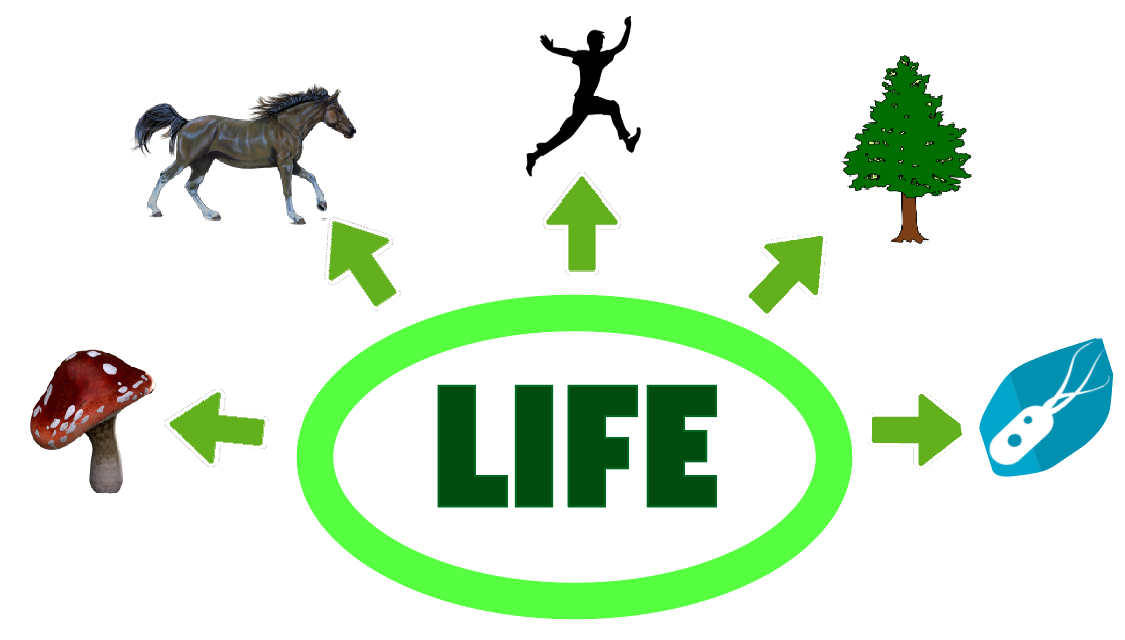
Any single living individual, and can refer to a single human, animal, plant,
Protista, bacteria, or fungi.
Community
Cell
Population
Organism

Organisms who are members of the same species in an ecosystem.
Organism
Population
Organ
Community

A biological community that includes various species and their physical environment (Biotic and Abiotic Factors).
Organism
Community
Biosphere
Ecosystem

Where life is found on earth.
Community
Habitat
Ecosystem
Biosphere

The hawk is an example of a
producer
primary consumer
secondary consumer
tertiary consumer

Which organism gets the LEAST amount of energy from the grass?
grasshopper
mouse
owl

What does a primary consumer eat?
secondary consumers
tertiary consumers
other primary consumers
producers

Level B represents
producers
primary consumers
secondary consumers
tertiary consumers

The rabbit is a
producer
primary consumer
secondary consumer
tertiary consumer
Level C represents
producers
primary consumers
secondary consumers
tertiary consumers
Level D represents
producers
primary consumers
secondary consumers
tertiary consumers
This type of consumer eats producers and other consumers
carnivore
herbivore
decomposer
omnivore

According to the food web, which organism(s) is an herbivore?
grass
mouse
fox
wolf
deer
which organisms recycle dead organic matter back into the environment?
herbivores
carnivores
omnivores
detritivores
decomposers
If the producer level of a given organism contains 42 kcal, how much of that energy will be transferred to primary consumers?
42 kcal
0.42 kcal
0.042 kcal
4.2 kcal

If 2100 kcal of energy is available at the producer level, how much of that energy will be transferred to the tertiary consumers?
21,000 kcal
2,100 kcal
210 kcal
2.1 kcal
Which of the following eats other consumers?
producers
primary consumers
secondary consumers
tertiary consumers
carnivores

