wayground logo

Free Printable Worksheets

NEW

Font size

S
M
L
XL
Worksheets

Electricity Review One

Total questions: 80

Worksheet time: 40mins

Name
Class
Date
1.

Subatomic particles with a negative charge

a)

Electrons

b)

Neutrons

c)

Protons

d)

Quarks

2.
Subatomic particles with a positive charge
a)
neutrons
b)
atomic mass
c)
protons
d)
isotopes
3.

These are found in the nucleus and have a neutral charge.

a)

proton

b)

electron

c)

neutron

4.

In a neutral atom, the number of protons will_________________ the number of electrons.

a)

Be greater than

b)

Be less than

c)

Equal to

5.
Ions are: 
a)
atoms with a positive or negative charge
b)
atoms with no charge
c)
atoms with ONLY a positive charge
d)
atoms with ONLY a negative charge
6.
When an atom loses a valence electron, it becomes a(n) _____________ ion.
a)
positive
b)
negative
c)
neutral
d)
polyatomic
7.
the central region of an atom where its neutrons and protons are is its 
a)
nucleus 
b)
electron cloud
c)
core 
d)
center 
8.
Two like charges:
a)
 neutralize each other.
b)
repel each other. 
c)
must be neutrons. 
d)
attract each other.
9.
An object that has more electrons than protons would have what kind of charge?
a)
Positive
b)
Negative
10.
Electric charges that are alike _______ each other.
a)
Attract
b)
Repel
11.
Plastic is an example of _______.
a)
an insulator
b)
a conductor
12.
A metal spoon is an example of _____.
a)
a conductor
b)
an insulator
13.
What types of charges attract?
a)
Positive and Positive
b)
Positive and Neutral
c)
Negative and Neutral
d)
Positive and Negative
14.

Turning on a space heater is an example of electrical energy being transformed into ______ energy.

a)

light

b)

sound

c)

heat

d)

chemical

15.

A series circuit has _______ conductive path(s).

a)

one

b)

two

c)

three

d)

four

16.

A parallel circuit has ________ conductive path(s).

a)

one

b)

more than one

c)

zero

17.

Which of the following is a good insulator?

a)

copper

b)

aluminum

c)

glass

d)

silver

18.

Which of the following is a good conductor?

a)

gold

b)

wood

c)

ceramic

d)

plastic

19.

When a switch is _________, the electric current can flow through the circuit.

a)

open

b)

closed

20.

If a switch is ______, a light bulb will not light.

a)

open

b)

closed

21.

A(n) ________ is formed when an electric current passes through an unbroken path of conductors.

a)

battery

b)

insulator

c)

surge protector

d)

circuit

22.

________ electricity is the buildup of charged particles in a material.

a)

current

b)

charge

c)

static

d)

circuit

23.
Ions are atoms that have lost or gained ____________________.
a)
protons
b)
neutrons
c)
electrons
d)
any one of these particles
24.
When measuring how much electrons are slowed down in a circuit by payloads, we use the unit ________
a)
amps
b)
volts
c)
ohms
25.
The type of current in a cell phone is 
a)
AC
b)
DC
c)
could be either AC or DC
26.

What is a conductor?

a)

Material that does NOT transfer energy.

b)

Materials that are connected to circuits.

c)

Materials that transfer energy.

d)

Materials that

27.
The plastic covering is there to:
a)
Provide a conductor for electrical energy to flow.
b)
Provide an insulator so that electrical energy will not pass outside of the wires.
c)
Provide a conductor so that electrical energy can NOT flow.
d)
Provide an insulator so that electrical energy can flow.
28.
The metal copper is there to:
a)
Provide a conductor for energy to flow from one place to another.
b)
Provide an insulator for energy to flow from one place to another.
c)
Provide an insulator to slow the flow of energy.
d)
Provide a conductor so slow the flow of energy.
29.

Materials which can conduct electricity better than insulator,but not as well as conductors. This is the definition of

a)

diode

b)

semiconductor

c)

conductor

d)

insulator

e)

superconductor

30.

Doping of Semiconductors

a)

materials which can conduct electricity better than insulator, but not as well as conductors.

b)

The process of adding of a certain amount of specific impurities atoms in the pure semiconductor.

c)

when 4 electrons in outermost orbit.

31.
Static electricity is 
a)
The balance of electrical charge on an object
b)
The imbalance of electrical charge on an object
c)
The discharge of electrical charge
d)
The build up of protons in the nucleus of an atom 
32.
The mathematical relationship among Voltage, Current, and Resistance
a)
Faraday's Law
b)
Tesla's Law
c)
Edison's Law
d)
Ohm's Law
33.
Current times Resistance equals
 (I X R)
a)
Power
b)
Voltage
c)
Amperage
d)
Ohm
34.
Voltage divided by Current
(E / I)
a)
Current
b)
Power
c)
Resistance
d)
Watts
35.
Voltage times Current
(E X I)
a)
Power
b)
Amperage
c)
Resistance
d)
Ohms
36.
If the Voltage is increased and the resistance stays the same, Current will
a)
Increase
b)
Decrease
c)
Stay the same
d)
X
37.
If the Voltage stays the same and Resistance is increased, Current will 
a)
Increase
b)
Decrease
c)
Stay the same
d)
X
38.
Which word means how hard it is for electrons to flow?
a)
Current
b)
Voltage
c)
Resistance
d)
Power
39.
This is an example of a _______ circuit
a)
open
b)
series
c)
parallel
d)
square
40.
In a series circuit, which of the following is the same throughout the circuit?
a)
Resistance
b)
Voltage
c)
Current
d)
Power
41.
What is current measured in?
a)
Ω (Ohms)
b)
V (Volts)
c)
A (Amps)
d)
W (Watts)
42.
What does power mean?
a)
Joules transferred per second
b)
Electron flow per second
c)
Speed of electrons
d)
Electron energy
43.
What is resistance measured in?
a)
Ω (Ohms)
b)
V (Volts)
c)
A (Amps)
d)
W (Watts)
44.
What is the unit of power?
a)

Ohms

b)
Volts
c)
Amps
d)

Watts

45.
What is voltage?
a)

The flow of protons

b)
The number of charged particles that pass each second
c)
The difference in potential energy of charged particles
d)
The rate at which energy is being transformed
46.
AC stands for ___.
a)
Alternating Current
b)
Attraction Connections
47.
Current is...
a)
moving protons
b)
moving electrons
c)
measured in volts
d)
measured in ohms
48.
In the U.S most electrical outlets supply a voltage of....
a)
240 Volts
b)
120 Volts
c)
100 watts
d)
60 amps
49.
Good insulators are _______ resistors
a)
good
b)
bad
50.
If the current increases it could be because of...
a)
increasing voltage
b)
decreasing resistance
c)
both
51.

Who discovered chemical effect of elecric current?

a)

Thomas Edison

b)

Joule-Lenz

c)

Michael Faraday

d)

James Watt

52.
If the battery produced 12.6 Volts and what would be the current flow be for a 6 Ohm resistor
a)
2.1 Amps
b)
2.4 Amps
c)
1.71 Amps
d)
15 Amps
53.

The current of circuit with a voltage of 12 V and a resistance of 4 ohms is

a)

48 A

b)

3 A

c)

0.3 A

d)

none of these

54.
what is this symbol for?
a)
light bulb
b)
switch
c)
battery
d)
resistor
55.
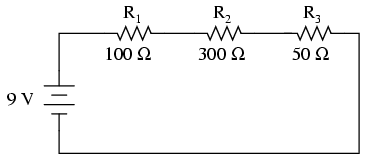
The total resistance in this circuit is 
a)
100 ohms
b)
450 ohms
c)
400 ohms
d)
30 ohms
56.
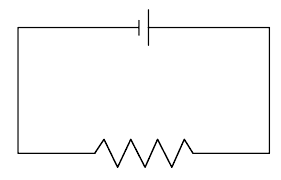
Pick the correct sentence.
a)
This circuit will work because it is a closed circuit.
b)
Energy will freely flow in this circuit.
c)
This circuit will not work because there is no energy source.
d)
This circuit will not work because there is no switch.
57.
What will happen if one light bulb is removed from this circuit?
a)
The other bulbs will go out.
b)
The other bulbs will stay on
c)
The other bulbs will get dimmer.
d)
The battery will become stronger.
58.
Does this diagram represent a series or parallel circuit?
a)
series circuit
b)
parallel circuit
59.
This measures the speed of the current in a circuit
a)
voltage
b)
ammeter
c)
switch
d)
resistance
60.
this is the symbol for a _____?
a)
switch
b)
light 
c)
battery
d)
wires
61.
This is the circuit symbol for ...
a)
an AC current source
b)
a DC current source
c)
an ammeter
d)
a voltmeter
62.
This is the symbol for a ...
a)
Wire
b)
Battery
c)
Buzzer
d)
Fuse
63.
This is the circuit symbol for ...
a)
an AC current source
b)
a DC current source
c)
an ammeter
d)
a voltmeter
64.
This is the symbol for 
a)
An Ammeter
b)
A Voltmeter
c)
A Meter
d)
A Motor
65.

What is the following symbol represent?

a)

Wire

b)

Resistor

c)

Battery

d)

Switch

66.
This is the symbol for a _____?
a)
Lamp
b)
Water wheel
c)
Loudspeaker
d)
Motor
67.
Define electron affinity.
a)
The energy it takes to add an electron to an atom.
b)
The energy it takes to remove an electron from an atom.
68.

Type of current in your house

a)

direction (DC)

b)

direct current (DC)

c)

alternating current (AC)

d)

electrodes

69.
How many Volts would it take to push 1 Amp through a resistance of 1 Ohm
a)
10 volts
b)
1 volt
c)
48 volts
d)
5 volts
70.
What would the circuit resistance be if a 7.5 Amp draw was present with the engine running and the charging system producing 15 Volts
a)
15 Ohms
b)
4 Ohms
c)
0.3333 Ohms
d)
2 Ohms
71.
A Charging system producing 14.5 Volts with a current flow of 43.5 Amps, what is the circuit resistance
a)
58 Amps
b)
0.33 Amps
c)
13 Amps
d)
1 Amp
72.
What size resistor would produce a 3 Amp current flow with a 12 Volt battery
a)
1 Ohm
b)
3 Ohms
c)
4 Ohms
d)
12 Ohms
73.
What is the Voltage of a circuit that has a resistance of 5 Ω and a current of 2 A?
a)
25 V
b)
10 V
c)
2.5 V
d)
0.4 V
74.
The mathematical relationship among Voltage, Current, and Resistance
a)
Faraday's Law
b)
Tesla's Law
c)
Edison's Law
d)
Ohm's Law
75.

If the battery produced 12.6 Volts what would be the current flow for a 6 Ohm resistor?

a)

2.1 Amps

b)

2.4 Amps

c)

1.71 Amps

d)

15 Amps

76.
How many Volts would we need to produce a current flow of 8 Amps through a 6 Ohm resistor
a)
12 volts
b)
24 volts
c)
1.3333
d)
48 volts
77.
This circuit has a 24 volt battery and the resistor is 8 ohms. How many amps are running through the circuit?
a)
3 Amps
b)
192 Amps
c)
2 Amps
d)
4 Amps
78.

Calculate the power rating of an oven that uses 561 amps of current when plugged into a 220-volt outlet.

a)

2.55W

b)

123,420W

c)

2.55V

d)

.39 V

79.

–Calculate the amount of current through a 60-watt light bulb that is connected to a 120-volt circuit.

a)

7,200W

b)

7,200A

c)

2A

d)

.5A

80.

Your dryer has a power rating of 699 watts and a current of 103 amps. What voltage does the machine have?

a)

71,997A

b)

.15V

c)

6.77V

d)

71,997V