wayground logo

Free Printable Worksheets

Font size

S
M
L
XL
Worksheets

Science Test Review

Total questions: 79

Worksheet time: 3hrs 0mins
Name
Class
Date
1.
What does temperature measure?
a)
Heat of Molecules
b)
ºC
c)
Average Kinetic Energy of Molecules
d)
Thermal Energy
2.
Specific heat is....
a)
The measure of kinetic energy of an objects particles
b)
A measure of the energy needed to increase the average kinetic energy of the particles
c)
The heating caused by the motion of flluid due to temperature difference
d)
The transfer of energy by electromagnetic radiation
3.
How does heat flow?
a)
Always from cold to warm
b)
Always from warm to cold
c)
Both warm to cold & cold to warm
d)
It depends on the temperature
4.
The amount of energy required to raise the temperature 1ºC for every kilogram is called____?
a)
Thermal Energy
b)
Specific Heat
c)
Temperature
d)
Kinetic Energy
5.
What is the equation to measure change in Thermal Energy?
a)
Q=mc∆t
b)
Q=mc
c)
Q= ∆mct
d)
m=QC
6.
What is the symbol for Thermal Energy in the specific heat formula?
a)
Q
b)
t
c)
m
d)
C
7.
What unit do you use to measure Thermal Energy?
a)
J/Kg ºC
b)
Kg
c)
ºC
d)
J
8.
A high specific heat means...
a)
It requires less energy to change temperature
b)
It requires more energy to change temperature
c)
It heats up very quickly
9.
When a  piece of aluminum foil is taken out of the oven and cools from 100° C to 50°C, What is the change in temperature?
a)
50°
b)
c)
100°
d)
150°
10.
The specific heat of aluminum is 0.21 cal/g°C.  How much heat(Q) is released when a 10 g piece of aluminum foil is taken out of the oven and cools from 100° to 50°?
a)
105 J
b)
10.5 J
c)
1.05 J
d)
50 J
11.
If 200 grams of water is to be heated from 24.0° C to  100.0° C to make a cup of tea, what is the mass and what is the change in temperature?
a)
m=100g,  ∆t= 224 C
b)
m=200g,  ∆t=124 C
c)
m=100g,  ∆t=24 C
d)
m=200g,  ∆t=76 C
12.
20 g of water. specific heat of water is 4.18 J/g°C.  temperature changes from 25° C to 20° Chow much heat energy (Q) moves from the water to the surroundings?
a)
418 Joules
b)
209 J
c)
83 J
d)
4.18 J
13.
The specific heat(c) of copper is 0.39 J/g °C. What is the temperature change(∆t) when 100 Joules of heat(Q) is added to 20 grams of copper?
a)
12.82 °C
b)
24.12°C
c)
351 °C
14.
lowest possible temperature on the Kelvin scale
a)
boiling point
b)
insulation
c)
absolute zero
d)
heat
15.
What is the symbol for Thermal Energy?
a)
Q
b)
t
c)
m
d)
C
16.
What is the equation to measure change in Thermal Energy?
a)
Q=mc∆t
b)
Q=mc
c)
Q= ∆mct
d)
m=QC
17.
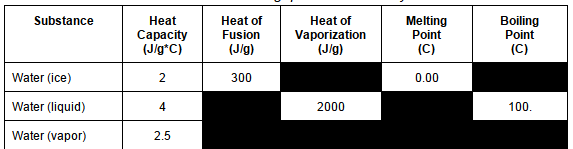
How many Joules of energy are required to make 100 grams of ice at 0 C completely melt?
a)
200 J
b)
400 J
c)
30,000 J
d)
2,000,000 J
18.
Which of the following would be the best insulator?
a)
air
b)
aluminum
c)
copper
d)
silver
19.

The specific heat of aluminum is 0.21 J/g°C. How much heat(Q) is released when a 10 g piece of aluminum foil is taken out of the oven and cools from 50° to 100°?

a)

105 J

b)

10.5 J

c)

1.05 J

20.

20 g of water. specific heat of water is 4.18 J/x°C. temperature changes from 20° C to 25° C, how much heat energy (Q) moves from the water to the surroundings?

a)

418 Joules

b)

209 J

c)

83 J

d)

4.18 J

21.
As the kinetic energy of the molecules in a substance increases, the temperature of the substance __________.
a)
increases
b)
decreases
22.

20.0 g of water. specific heat of water is 4.184 J/g°C. temperature changes from 25.0° C to 20.0° C, how much heat energy (Q) moves from the water to the surroundings?

a)

418 Joules

b)

209 J

c)

83 J

d)

4.18 J

23.
If 200 grams of water is to be heated from 24.0° C to  100.0° C to make a cup of tea, what is the mass and what is the change in temperature?
a)
m=200g
∆t= 66
b)
m=200g
∆t=124
c)
m=200
∆t=100
d)
m=200g
∆t=76
24.

The specific heat(c) of copper is 0.38 J/g °C. What is the temperature change(∆t) when 100.0 Joules of heat(Q) is added to 20.0 grams?

a)

13 °C

b)

13.2°C

c)

13.16 °C

25.
Heat transfers from an area of ________temperature to an area of ______ temperature.
a)
high to low
b)
low to high
c)
high to high
26.

__________is heat transfer or movement by direct contact, usually through solids.

a)

Conduction

b)

Convection

c)

Radiation

27.

Heat that is transferred or moved in circle currents through liquids or gases is __________________.

a)

radiation

b)

convection

c)

conduction

28.

What does m stand for and what is it's unit?

a)

temperature change, oC

b)

Heat, Joules

c)

mass, grams

d)

specific heat, J/goC

29.

A sample of rubidium goes through a temperature change of -102.33 K while releasing 15152 joules of heat. The specific heat capacity of rubidium is 0.3601 J/(g·K). What is the mass of this sample?

a)

271 g

b)

313 g

c)

382 g

d)

411 g

30.

Which electromagnetic waves have the highest frequencies and the shortest wavelengths?

a)

microwaves

b)

visible light

c)

gamma rays

d)

x-rays

31.

Which electromagnetic waves are used in ovens and cell phone communications?

a)

microwaves

b)

infrared rays

c)

gamma rays

d)

ultraviolet rays

32.

A wave with a large wavelength will have a ______ frequency and _____ energy

a)

high, low

b)

low, high

c)

high, high

d)

low, low

33.

Which type of waves are used in broadcasting?

a)

infrared rays

b)

X-rays

c)

radio waves

d)

gamma rays

34.

Select the correct order of waves on the EMS from the longest wavelength to the shortest wavelength

a)

Radio, Micro, Infra, Visible, Ultra, X-ray, Gamma

b)

Gamma, X-ray, Ultra, Vis, Infra, Micro, Radio

c)

Vis, Micro, Infra, Ultra, X-ray, Gamma, Radio

d)

Micro, Radio, Vis, Infra, Ultra, X-ray, Gamma

35.

Electromagnetic waves that help your body produce vitamin D are called?

a)

Ultraviolet rays

b)

X-rays

c)

Radio waves

d)

Gamma rays

36.

Which has the SHORTEST wavelength and, therefore, the highest frequency/most energy

a)

Ultraviolet Rays

b)

Radio Waves

c)

Gamma Rays

d)

X-Rays

37.

Which section of the spectrum is the ONLY one we can see?

a)

Ultraviolet Rays

b)

Gamma Rays

c)

X-Rays

d)

Visible Light

38.

How are electromagnetic waves different from other waves?

a)

They have very short wavelengths

b)

They transmit energy instead of matter

c)

They can travel through empty space

d)

They can change direction by reflection

39.

Which electromagnetic waves are used in devices such as heat lamps & TV remote controls?

a)

Ultraviolet Rays

b)

Microwaves

c)

Infrared Rays

d)

Gamma Rays

40.
What is an example of a wave with a long wavelength and low frequency?
a)
Gamma rays
b)
Infrared
c)
Radio
d)
Visible light
41.
An example of a wave with a short wavelength, high frequency, and high energy is a 
a)
X-ray
b)
Microwave
c)
Visible light wave
d)
Infrared wave
42.

Match the following

a)

Radio waves

1.

Has the longest wavelengths and the lowest frequency

b)

Microwaves

2.

Used in cell phone communication and police radar systems

c)

Infrared rays

3.

It is used in thermal imaging

d)

UV rays

4.

Overexposure to this can result in sunburns and skin cancer

e)

Gamma Rays

5.

Has the highest energy of all electromagnetic radiation and is the most damaging to human tissue

43.

Communicating with satellites is an application of gamma rays.

a)

True

b)

False

44.

Which of the following transmits information using microwaves?

a)
b)
c)
d)
45.

What might happen if the ozone layer did not block the sun's ultraviolet rays?

a)

Humans would be able to see in the ultraviolet range of the EM spectrum

b)

Devices that use electromagnetic radiation would no longer work

c)

The surface of the earth would be much hotter

d)

Rates of skin cancer would skyrocket

46.
Which part of the electromagnetic spectrum has high enough energy to cause damage to eyes and skin, and sometimes even cancer? 
a)
infrared light
b)
visible light
c)
ultraviolet light
d)
microwaves
47.
EM waves are always____________
a)
Transverse
b)
Compression
c)
Longitudinal
d)
Seismic
48.
Cell phones use_____________waves.
a)
Microwaves
b)
Gamma
c)
XRays
d)
Radio 
49.
Infrared waves are used in__________________.
a)
Bath tubs
b)
Microwaves
c)
Remote Controls
d)
Tanning
50.
_____ have the longest wavelengths and lowest frequencies of all electromagnetic waves.
a)
microwaves
b)
radio waves
c)
gamma rays
d)
ultraviolet
51.
Nuclear weapons are examples of __________. 
a)
x-rays
b)
ultraviolet rays
c)
gamma rays
d)
infrared rays
52.
This type of EM wave shows a break in bones.
a)
gamma ray
b)
x-ray
c)
brokenometer
d)
radio wave
53.
As light travels through a lens in causes an object to appear larger, this is due to which behavior?
a)
Transmission
b)
Reflection
c)
Absorption
d)
Refraction
54.
Which of the figures represents reflection?
a)
A
b)
B
c)
C
d)
D
55.

The diagram shows a series of wave fronts approaching an opening in a barrier. Point P is located on the opposite side of the barrier. The wave fronts reach point P as a result of

a)

resonance

b)

refraction

c)

reflection

d)

diffraction

56.
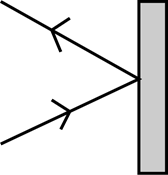
The illustration shows a light ray striking an object.
In the illustration, the light ray striking the object is-
a)
absorbed
b)
stopped
c)
reflected
d)
refracted
57.
What type of wave behavior is pictured above?
a)
Refraction
b)
Reflection
c)
Absorption
d)
Diffraction
58.
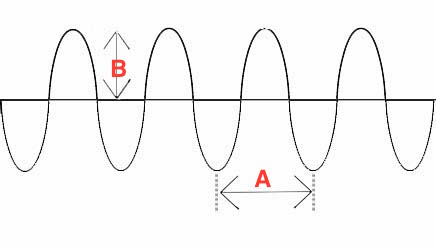
Which letter(s) represent the crest of the wave?
a)
A
b)
D
c)
B & F
d)
F
59.
Which letter(s) represent the trough of the wave?
a)
A
b)
D
c)
B & F
d)
F
60.
When a sound wave experiences reflection, we hear
a)
a louder sound
b)
an echo
c)
a quieter sound
d)
nothing
61.
What property of the wave is represented by the letter "B"?
a)
amplitude
b)
crest
c)
trough
d)
wavelength
62.
All waves carry 
a)
water
b)
light
c)
energy
d)
sound
63.
If you want to change the pitch of a sound, you have to change the ___
a)
frequency
b)
amplitude
c)
speed
d)
volume
64.
The speed of a sound wave depends on
a)
the frequency
b)
the medium
c)
both air temperature and medium
d)
the air temperature
65.

Bats use ________ to locate mosquitoes in the air.

a)

solar

b)

ecology

c)

echolocation

d)

refraction

66.
A part in a longitudinal wave where the particles are spread apart
a)
compression
b)
rarefaction
c)
crest
d)
trough
67.
The part of a longitudinal wave where the particles of the medium are close together.
a)
rarefaction
b)
compression
c)
crest
d)
trough
68.
The number of wavelengths that pass a point each second
a)
frequency
b)
wavelength
c)
pitch
d)
amplitude
69.
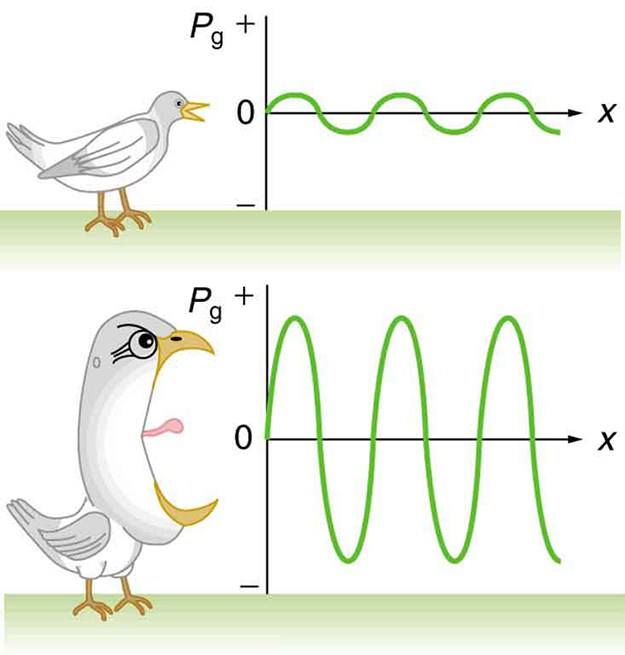
When a sound is louder what measurement gets bigger?
a)
Frequency 
b)
Amplitude 
c)
Wavelength 
d)
Crest
70.
What is B?
a)
crest
b)
trough
c)
compression
d)
rarefaction
71.
Refraction is the bending of a wave disturbance as it passes from one _________ into another.
a)
glass
b)
medium
c)
area
d)
boundary
72.
A student placed a pencil in a cup of water.  The pencil appears broken because light-
a)
always travels in a straight line
b)
bends when it passes through water
c)
makes the water in the glass evaporate
d)
reflects the pencil on the water's surface
73.
What happens when light hits a mirror?
a)
it makes a color
b)
it reflects
c)
it makes a rainbow
d)
it passes through
74.
The bouncing back of a ray of light, sound, or heat when the ray hits a surface that it does not penetrate
a)
A. refraction
b)
B. reflection
c)
C. resonance
d)
D. standing wave
75.
When a wave strikes and object and bounces off. (example echo)
a)
medium
b)
refraction
c)
reflection
d)
interference
76.
Why do we see objects as white?
a)
They absorb all light
b)
They reflect all light
c)
They absorb some light and reflect some light
77.
The color you see is the color that is ___.
a)
reflected
b)
absorbed
78.
Which color absorbs all light?
a)
White
b)
Black
c)
Orange
d)
Green
79.

This image depicts which of the following wave behaviors?

a)

Reflection

b)

Refraction

c)

Diffraction

d)

Resonance