wayground logo

Free Printable Worksheets

Font size

S
M
L
XL
Worksheets

Chemistry

Total questions: 81

Worksheet time: 43mins

Name
Class
Date
1.

How many atoms of sodium (Na) are in one molecule of baking soda?

a)

1

b)

2

c)

3

d)

4

2.

Ozone and Oxygen molecules are the same substance because they both are made only of oxygen atoms.

a)

true

b)

false

3.

What is the chemical symbol for carbon?

a)

C

b)

Ca

c)

Cn

d)

Crn

4.

Molecules bonded together make up atoms.

a)

true

b)

false

5.

How many atoms make up one molecule of laughing gas?

a)

1

b)

2

c)

3

d)

4

6.

In a chemical reaction or change a new substance is not created.

a)

true

b)

false

7.
What kind of change is a phase change?
a)
Physical - it's still the same substance
b)
chemical - it's made of chemicals 
8.
A chemical change happens when...
a)
a substance is changed at the atomic level 
b)
bonds are broken and formed 
c)
a new substance is made
d)
all of the above! 
9.
Chemical Formulas ...
a)
are written in alphabetical order 
b)
represent the destruction or creation of atoms 
c)
represent how atoms are arranged in a chemical reaction 
10.
The compounds or elements present at the end of a reaction 
a)
reactants
b)
catalyst
c)
products
d)
energy 
11.
The compounds and elements that are present at the beginning of a reaction:
a)
reactants
b)
catalyst
c)
products
d)
energy 
12.
What is the law of Conservation of Mass?
a)
A measure of how much mass is created or destroyed. 
b)
Mass can neither be created nor destroyed during a chemical reaction. 
13.
What is a reactant?
a)
The starting substance
b)
The ending substance
14.
What is a product?
a)
The starting substance
b)
The ending substance
15.
Using the following chemical reaction
Hydrogen + Oxygen --> water
Identify the reactant(s).
a)
Hydrogen and Oxygen
b)
water
16.
Using the following chemical reaction
Hydrogen + Oxygen --> water
Identify the product(s).
a)
Hydrogen and oxygen
b)
water
17.

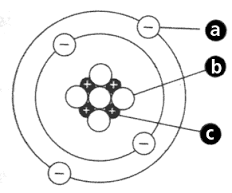
What does a represent?

a)

Proton

b)

Neutron

c)

Electron

18.

What does b represent?

a)

Proton

b)

Neutron

c)

Electron

19.

What does c represent?

a)

Proton

b)

Neutron

c)

Electron

20.

What is the atomic mass of this element?

a)

20

b)

60

c)

40

d)

41

21.

What is the symbol of this element?

a)

Calcium

b)

P

c)

Ca

d)

C

22.

protons

a)

negative charge, nucleus

b)

positive charge, shells

c)

positive charge , nucleus

d)

neutral charge, nucleus

23.

neutrons

a)

no charge, shells

b)

positive charge, nucleus

c)

neutral, no charge, nucleus

d)

negative charge, shells

24.

electrons

a)

no charge, nucleus

b)

positive charge, nucleus

c)

negative charge, shells

d)

negative charge, nucleus

25.
The characteristics or properties of metals include
a)
shiny and solid
b)
ductile and malleable
c)
lose electrons
d)
all of the above
26.
Which particle contributes the negative charge to the atom?
a)
proton
b)
electron
c)
neutron
d)
nucleus
27.
Water is an element?
a)
true
b)
false
28.

A molecule is

a)

a singular particle of a particular element

b)

another name for an element

c)

2 or more atoms that are combined

29.

A pure substance that is a compound is made out of

a)

particles of more than one type of atom

b)

particles of the same type of atom

c)

a mixture of two or more substances that can be physically separated

30.

What is the number of protons that the element in this image contain?

a)

14

b)

7

c)

15

d)

18

31.
"C" is the element symbol for which element?
a)
calcium
b)
carbon
c)
chlorine
d)
cadmium
32.

True or False? Neutrons have a negative charge

a)

True

b)

False

33.
A _________ is a substance made of two or more DIFFERENT elements chemically combined. 
a)
mixture
b)
compound
c)
substance 
34.
A mixture can be separated by ________ means. 
a)
physical
b)
chemical
35.

What is the atomic number of this element?

a)

20

b)

60

c)

40

d)

41

36.

electrons

a)

no charge, nucleus

b)

positive charge, nucleus

c)

negative charge, shells

d)

negative charge, nucleus

37.

atomic number

a)

number of protons/stands for an element

b)

number of neutrons

c)

number of electrons

d)

number of protons and neutrons

38.

mass number

a)

number of protons

b)

number of electrons

c)

number of protons and electrons

d)

number of protons and neutrons

39.

atomic symbol

a)

capital letter

b)

lowercase letter

c)

2 capital letters

d)

2 lowercase leters

40.

lst shell holds

a)

2

b)

8

c)

18

d)

32

41.

2nd shell holds

a)

2

b)

8

c)

18

d)

32

42.
What is a pure substance that cannot be broken down into any other substance by physical or chemical means. Ex: Gold, Silver, Oxygen, & Nitrogen
a)
element
b)
compound
c)
mixture
d)
salad
43.
What is a  pure substance made of two or more elements chemically combined in a set ratio. Ex: CO2 has a set ratio of 1:2, meaning for every one carbon atom there are two oxygen atoms.
a)
element
b)
compound
c)
mixture
d)
salad
44.
What is matter
a)
Anything which is solid
b)
Anything that takes up space and has mass
c)
when something is wrong
45.
In a mixture items can be separated __________
a)
chemically
b)
physically
46.
Elements in a compound can be separated __________
a)
physically
b)
chemically
47.
who developed the modern day periodic table of elements?
a)
Darwin
b)
Shultz
c)
Hooke
d)
Mendeleev
48.
On the Periodic Table each element increases by one _________
a)
electron
b)
proton
c)
neutron
d)
letter
49.
A row across the Periodic Table where each element has the same number of energy shells
a)
column
b)
family
c)
period
50.
In a family or column, the elements have similar properties because they all have the same number of
a)
protons
b)
neutrons
c)
valence electrons
d)
electrons
51.
The Law of Conservation of Matter says
a)
Matter can be created, but not destroyed
b)
matter can be destroyed, but not created
c)
matter cannot be created or destroyed
52.

Chemistry is the study of

a)

chemicals and chemical reactions

b)

carrying out experiments

c)

smelly experiments

d)

the universe

53.

A chemical is

a)

a harmful substance

b)

something that explodes or smells funny

c)

a substance or material

54.

An atom is

a)

any small simple particle

b)

a small unit particle of an element

c)

a small unit particle of a compound

d)

a molecule

55.

A molecule is

a)

a particle made up of atoms joined together

b)

a particle made up of different types of atoms joined together

c)

any partilcle

d)

a compound

56.

An element is

a)

a simple chemical

b)

a complex chemical

c)

a simple partilcle made of one type of atom

d)

a particle made of different types of atoms

57.

A compound is

a)

a simple chemical

b)

a simple chemical made of one type of atom

c)

a simple chemical made up of two different types of atom

d)

a simple chemical made up of different types of atom

58.

Which is the odd one out below ?

a)

hydrogen

b)

copper

c)

copper chloride

d)

scandium

59.
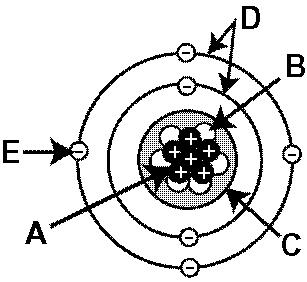
In the atom diagram shown, E is pointing to
a)
An electron
b)
a proton
c)
a neutron
d)
the nucleus
60.

In the atom diagram shown, A is pointing to the darker particles, these are known as

a)

electrons

b)

protons

c)

neutrons

d)

the nucleus

61.
B and C are found in the ______ of an atom.
a)
electron cloud
b)
Space
c)
Nucleus
d)
Outside
62.

In this chemical equation, the elements in red are the_______.

a)

Products

b)

Reactants

c)

Subscripts

d)

Coefficients

63.

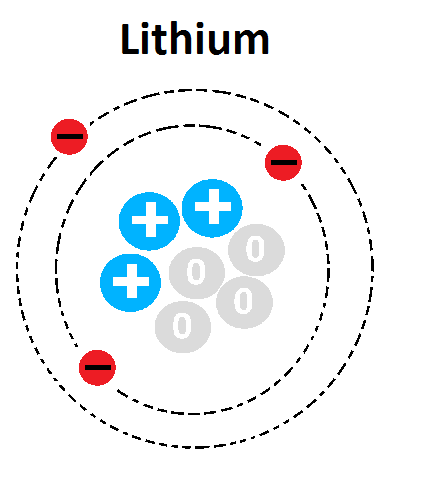
What is the atomic mass of this atom?

a)

1

b)

3

c)

4

d)

7

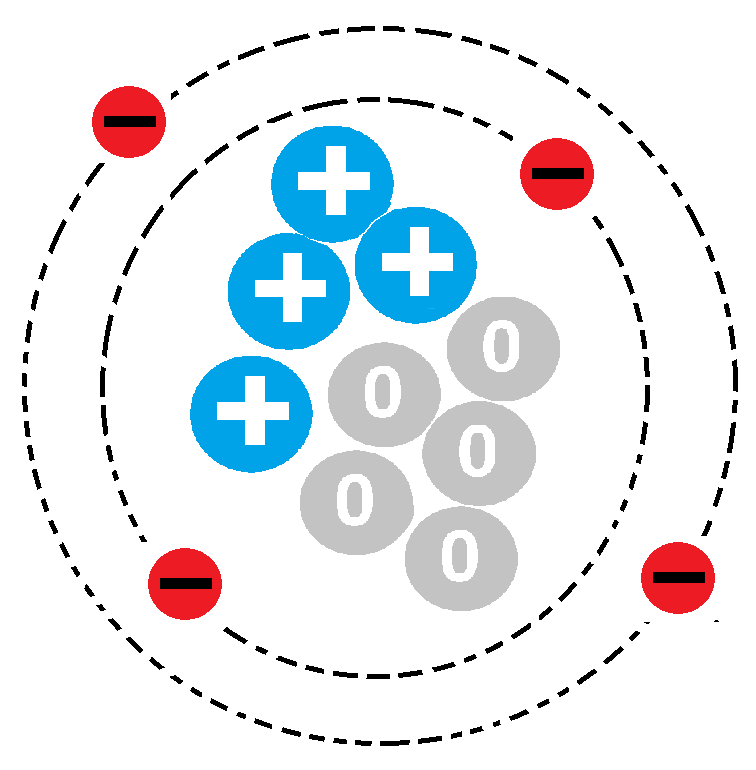
64.
What is the atomic number of this atom?
a)
4
b)
5
c)
9
d)
none of the above
65.
What is a valence electron?
a)
an electron that is found in the outermost orbital of an atom. 
b)
an electron found in the innermost orbital of an atom.
c)
an electron found in the middle orbital.
66.

The neutral subatomic particles located in the nucleus of an atom

a)

protons

b)

neutrons

c)

electrons

d)

ions

67.

An atomic diagram that shows protons, neutrons, and all electrons

a)

valance electrons

b)

diatomic molecules

c)

bohr models

d)

isotopes

68.

Is a classification of matter that includes both elements and compounds

a)

pure substances

b)

elements

c)

compound

d)

mixtures

69.

Is the number of protons in an element

a)

atomic mass

b)

atomic number

c)

valance protons

d)

diatomic molecules

70.

Is the protons plus the neutrons

a)

valance electrons

b)

atomic number

c)

atomic mass

d)

bohr diagram

71.

What does the number 3 represent in 4NH3?

a)

Subscript

b)

Superscript

c)

Coefficient

72.

What does the number 4 represent in 4NH3?

a)

Subscript

b)

Superscript

c)

Coefficient

73.

How many Nitrogen (N) atoms are in 4NH3?

a)

4

b)

1

c)

3

d)

12

74.

How many Hydrogen (H) atoms are in 4NH3?

a)

4

b)

1

c)

3

d)

12

75.

How many total molecules is 4NH3?

a)

4

b)

1

c)

3

d)

12

76.

How many total atoms make up 4NH3?

a)

4

b)

16

c)

3

d)

12

77.

In the equation shown, what are the reactant(s)?

a)

N2 + H2

b)

NH3

78.

In the equation shown, what are the product(s)?

a)

N2 + H2

b)

NH3

79.

Is this equation balanced?

a)

Yes

b)

No

80.

Is this equation balanced?

a)

Yes

b)

No

81.

Is this equation balanced?

a)

Yes

b)

No