
 Worksheets
Final Exam Review
Total questions: 78
Worksheet time: 53mins
What is a mutation?
When animals have extra legs
When a frog has 3 eyes
When genes or DNA have been alterd or changed
When RNA is upside down
Can mutations be passed down to offspring?
Yes
No

What happens when DNA or a gene is changed?
A trait is made
A trait is lost
A mutation may occur
A non-adaptive trait will be lost
Do genes code for traits?
yes
no
A female giraffe with a short neck is having a difficult time reaching the leaves in the taller trees. According to the theory of natural selection, which of the following is possible?
The giraffe stretches to reach the taller trees and her neck grows longer. Her offspring all have longer necks.
The giraffe decides that she and her offspring should have longer necks. She finds a mate with a long neck.
The giraffe survives on leaves from shorter trees. Her offspring with longer necks are more likely to survive.
The giraffe survives on leaves from shorter trees. Her offspring all have long necks.
Which of the following can describe a mutation in the population?
Long-beaked birds have long-beaked offspring
Striped cats have striped offspring
Beige worms have beige offspring
Hornless cows have horned offspring
More and more bacteria are becoming resistant to antibiotics. This is an example of:
evolution by natural selection
chance
predation
competition
Pollution has caused the trees of a forest to be covered by dark soot. Which moth is more likely to survive?
Light colored moth
Dark colored moth
The sickle cell mutation is:
harmful in all environments
helpful in all environments
helpful in some environments and harmful in others
neutral - neither helpful nor harmful
In a population with 100% chance of getting malaria and zero healthcare available, who is most likely to survive?
People who are normal for the sickle cell trait (HH)
People who are carriers for the sickle cell trait (Hh)
People who have sickle cell anemia (hh)
In a population with 50% chance of getting malaria and great healthcare available, who is most likely to survive?
People who are normal for the sickle cell trait (HH)
People who are carriers for the sickle cell trait (Hh)
People who have sickle cell anemia (hh)
When the chance of getting malaria is high, the presence of the sickle cell trait in the population will:
increase
decrease
When the chance of getting malaria is low, the presence of the sickle cell trait in the population will:
increase
decrease

Which two species are most closely related?
U and S
U and T
R and S
R and Q
Which species is the common ancestor?
R
S
U
Q
In layers of rock, the layers further down are:
older
younger
In layers of rock, the layers closer to the top are:
older
younger
Fossils can be:
bone
teeth
footprints
all of the above

The organisms that lived most recently likely:
was a fish
was a plant
had a shell
The organisms that lived longest ago likely:
was a fish
was a plant
had a shell
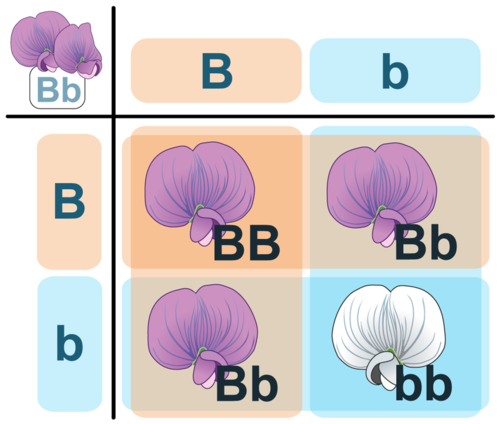
In this punnett square, which is the dominant trait?

According to the Punnett Square, what is the probability of an offspring being purple?

According to the Punnett Square, what is the probability of an offspring being white?
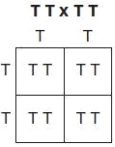

Which of the following statements is NOT true of animal mating behaviors?
They are influenced by genetic factors.
They are influenced by environmental factors.
They increase the chance of successful reproduction.
They are only displayed by males.
Which of the following is an example of a behavioral trait that is likely to increase reproductive success?
colorful feathers
a dance
tail length
body weight
A trait can be determined by
one gene.
many genes.
the environment.
all of the above.
The height of a plant is likely to be determined by
genes
environment
both genes and environment
neither genes nor environment
Diseases that are inherited are
caused by genes.
caused by viruses.
caused by environmental factors.
all of the above.
Which of the following organisms reproduce sexually?
humans
plants
both a and b
none of the above
A clone is
genetically identical to the parent
genetically different from the parent
Which of the following statements about mutations is correct?
They act by changing the function of proteins.
They are always helpful.
They are always harmful.
Which set of organs belong to the Nervous System?
Heart, blood vessels
Kidneys, urinary bladder
Esophagus, stomach, intestines
Brain, spinal column
Which organs belong to the Circulatory System
Heart, blood vessels
Esophagus, stomach
Trachea, larynx, pharynx, lungs
Brain, spinal column
Which organs belong to the Respiratory System?
Bones, cartilage
Cardiac, smooth, skeletal
Trachea, larynx, pharynx, lungs
Kidneys, urinary bladder
What is the purpose of the Circulatory System?
Transports oxygen and nutrients
Removes extra water and wastes
Digests foods and absorbs nutrients
Collects, transfers and processes information
What is the purpose of the Skeletal System?
Transports oxygen and nutrients
Supports and protects the body, creates blood
Movement and heat production
Gas exchange in the body and lungs
What is the purpose of the Nervous System?
Transports oxygen and nutrients
Removes extra water and wastes
Supports and protects the body and produces blood
Collects, transfers and processes information
Which level of organization is a heart at?
Cell
Tissue
Organ
Organ System
Which level of organization are you at?
Tissue
Organ
Organ System
Organism
What are the levels of organization in order?
Cell, Tissue, Organ, Organ System, Organism
Cell, Tissue, Organ, Organ System
Cell, Tissue, Organ, Organism, Organ System
Cell, Organ, Tissue, Organ System, Organism
What is the biggest function of the respiratory system?
to pump blood
to help us digest food
to take in oxygen and release carbon dioxide
to help us fight disease and infection
What is the biggest function of the muscular system?
to help digest food
to help us move
to help us breathe
to help us remove waste
Which of the following statements describes the function of the heart?
The heart produces white and red blood cells.
The heart controls the nervous system.
The heart makes oxygen and carbon dioxide.
The heart pumps blood throughout the body.
Which two body systems are primarily responsible for gas exchange between the body and the environment?
skeletal and muscular
circulatory and respiratory
circulatory and digestive
respiratory and excretory
Which two systems are responsible for voluntary movement?
circulatory and excretory
digestive and circulatory
skeletal and muscular
skeletal and circulatory
What is the most important function of the digestive system?
Gas exchange
Break down food
Voluntary movement
Fight bacteria and disease
What is the most important function of the excretory system?
Break down food
Pump blood
Remove waste
Voluntary movement
Which of the following statements describes the function of the small intestine?
The small intestine transports blood to other organs.
The small intestine helps digest food and absorbs nutrients.
The small intestine releases carbon dioxide from the body.
The small intestine produces cells needed for reproduction.
Which of the following statements describes the function of bones?
Bones store food for later use.
Bones destroy foreign cells.
Bones protect organs in the body.
Bones send instructions to body parts.
Which two systems work together to break down and transport molecules?
muscular and respiratory
circulatory and skeletal
digestive and circulatory
endocrine and digestive

