wayground logo

Free Printable Worksheets

Font size

S
M
L
XL
Worksheets

Semester 1 Review

Total questions: 84

Worksheet time: 2hrs 51mins

Name
Class
Date
1.
What is the net force?
a)
20 N 
b)
0 N 
c)
400 N 
d)
40 N 
2.

The forces in a force pair are in the _______ direction

a)

opposite

b)

same

3.

A player hits a ball with a bat. The action force is the impact of the bat against the ball. The reaction force is...

a)

The grip of the player's hands on the ball

b)

the air resistance of the ball

c)

the force of the ball against the bat

4.

A book pushes down on a table with a force of 5N, the table..

a)

Pushes back with a force of 5N

b)

Pushes back with a force less than 5N

c)

Pushes back with a forcec greater than 5N

d)

Does nothing. A table has no force.

5.

Force is measured in __________

a)

Kilograms

b)

Pounds

c)

Newtons

d)

Grams

6.

An example of force pairs:

a)

The bat forces the ball right; the ball forces the bat right

b)

The bat forces the ball right; the ball forces the bat left

c)

nothing happens because the forces are equal

d)

The bat forces the ball right; the ball does nothing to the bat.

7.

Does the image show an action/reaction force pair or a balanced force?

a)

action/reaction force pair

b)

balanced force

8.

A baseball player bats a ball with a force of 1,000 N. The ball exerts a reaction force (without any additional forces action on it) against the bat of...

a)

Less than 1, 000 N

b)

1,000 N in the same direction

c)

More than 1,000 N

d)

1,000 N in the opposite direction

9.

Elements that are typically solid, shiny, malleable, and good conductors of heat and electricity; includes most elements

a)

Metals

b)

Nonmetals

c)

Metalloids

d)

Matter

10.

Elements that are typically not shiny, not malleable, and poor conductors of heat and electricity; usually gases or brittle solids

a)

Metals

b)

Nonmetals

c)

Metalloids

d)

Matter

11.

Tending to break rather than to flex or bend

a)

Malleability

b)

Brittle

c)

Luster

d)

Matter

12.

A physical property that describes the ability of a material to be permanently reshaped without breaking or cracking

a)

Brittle

b)

Luster

c)

Malleability

d)

Matter

13.

The ability of a substance to be pulled into thin wires without breaking

a)

Ductility

b)

Conductivity

c)

Malleability

d)

Luster

14.
a)

Metal

b)

Nonmetal

c)

Metalloid

15.
a)

Metal

b)

Nonmetal

c)

Metalloid

16.
a)

Metal

b)

Nonmetal

c)

Metalloid

17.
a)

Metal

b)

Nonmetal

c)

Metalloid

18.
a)

Metal

b)

Nonmetal

c)

Metalloid

19.
How would this element be classified?
a)
Metal
b)
Nonmetal
c)
Metalloid
d)
Metamorphic
20.

Students were given four unknown substances and asked to observe their characteristics. Their observations are shown in the table below. Which of the unknown substances is most likely metal?

a)

1 and 4

b)

2 and 5

c)

1 and 3

d)

2 and 4

21.
Look at this image.  Which object has the LOWEST density in water? How
a)
The Ping Pong Ball because it floats to the top 
b)
The bolt because it has sunk to the bottom
c)
The soda cap because it is not just full of air like the Ping Pong ball
22.
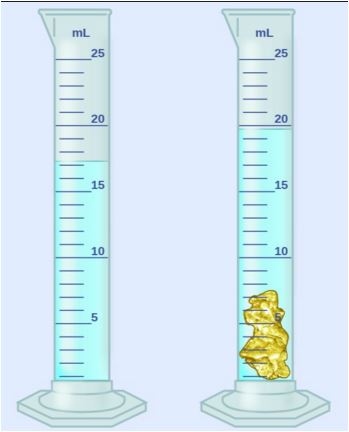
An irregularly shaped piece of gold was lowered into a graduated cylinder holding a volume of water equal to 17 ml. The height of the water rose to 20 ml. If the mass of the gold was 27 g, what was its density?
a)
9 g/mL
b)
10.5 g/mL
c)
6.5 g/mL
d)
8 g/mL
23.
What is the volume of Object X?
a)

10.0 ml

b)

15.0 ml

c)

20.0 ml

d)

25.0 ml

24.
How much water has been displaced in the image shown?
a)
40 mL
b)
65 mL
c)
20 mL
d)
25 mL
25.

Which object has the greatest density?

a)

Box with blue particles

b)

Box with red particles

c)

The density of both boxes are equal

26.

Using the picture, tell me which object is the least dense and why?

a)

The fish because he is in the middle

b)

The cork because it is floating at the top of the water

c)

The rock because it is at the bottom

d)

The cork and the rock because they have the same about of atoms.

27.
Describe the energy in this picture.
a)
Gravitational Potential
b)
Kinetic
c)
Elastic Potential
d)
No Energy
28.
Describe the energy in this picture.
a)
Gravitational Potential
b)
Kinetic
c)
Elastic Potential
d)
No Energy
29.
Describe the energy transformation in this picture.
a)
Potential to Kinetic
b)
Kinetic to Potential
c)
No transformation - it's all potential.
d)
No transformation - it's all kinetic.
30.
Describe the energy in the picture.
a)
Gravitational Potential
b)
Kinetic
c)
Elastic Potential
d)
No energy.
31.
What word best describes Kinetic Energy?
a)
Stored
b)
Motion
c)
Elastic
d)
Gravity
32.
What word best describes potential energy?
a)
Stored
b)
Motion
33.
Gravitational Potential energy increases as _________ increases.
a)
Speed
b)
Elasticity
c)
Height
d)
Movement
34.
Energy transformations occur when...
a)
energy is created through conduction
b)
energy changes from one form to another
c)
two forces slide together that are touching
d)
a chemical reaction takes place
35.
The energy transformation that takes place when a flashlight is turned on is...
a)
Chemical - electrical - light
b)
Chemical - light - electrical
c)
Electrical - thermal - light
d)
Nuclear - light - electrical
36.
The form of energy from the sun can be transformed into the energy needed for a tree to grow. What types of energy occur in this transformation?
a)
Electromagnetic - mechanical
b)
Potential - kinetic
c)
Light - chemical
d)
Nuclear - thermal
37.
What kind of energy does something have because of its height above the ground?
a)
gravitational potential
b)
elastic potential
c)
chemical
d)
radiant
38.
What kind of energy does something have because it is being stretched?
a)
gravitational potential
b)
elastic potential
c)
chemical
d)
radiant
39.
Which energy conversion is taking place when you put gasoline in a car?
a)
thermal -> electrical
b)
mechanical -> electrical
c)
chemical -> mechanical
d)
mechanical -> electromagnetic
40.
what type of energy is stored in a battery?
a)
electrical
b)
chemical
c)
thermal
d)
mechanical
41.
Gravitational potential energy depends on the ________ and ________ of the object. 
a)
Height and mass
b)
Friction and movement
c)
Mass and Movement
d)
Height and Friction 
42.
Which items would have this energy transformation: chemical energy -> electrical, light and thermal energy?
a)
turning on a flashlight
b)
nuclear power plant
c)
digesting an apple
d)
tanning bed
43.

At which position does the child on the swing have the most gravitational potential energy?

a)

W

b)

X

c)

Y

d)

Z

44.
When things are hot molecules are moving...
a)
Fast
b)
Slow
c)
They are not moving
d)
They are moving by not fast or slow
45.
When things are cold molecules are moving...
a)
Fast
b)
Slow
c)
They are not moving
d)
They are moving by not fast or slow
46.
What happens to the motion of the atoms of a cold spoon after it is placed in hot soup?
a)
They move faster
b)
They move slower
c)
They stay the same
d)
They melt
47.
What happens to the motion of the atoms of a hot soup after a cold spoon is placed in it?
a)
They move faster
b)
They move slower
c)
They stay the same
d)
They freeze
48.
When a substance is heated up, the molecules slow down.
a)
True
b)
False
49.
What are the states of matter?
a)
Solid, Liquid, Water
b)
Solid, Liquid, Gas
c)
Melting, Freezing, Condensing, Evaporating
d)
Water and Liquid
50.
What is the state of matter that has an infinite shape and definite volume?
a)
Solid
b)
Liquid
c)
Gas
d)
Plasma
51.
When the molecules are moving very fast, the substance is...
a)
Hot
b)
Cold
c)
Room Temperature
d)
Wet
52.

Match the type of matter to the correct diagram

a)

A. Liquid B. Gas. C. Solid

b)

A. Gas. B. Liquid. C. Solid

c)

A. Solid. B. Liquid. C. Gas

53.

When molecules move faster the temperature gets ____________________.

a)

Higher

b)

Lower

c)

Stays the same

54.

Lucky Charms

a)

Heterogeneous

b)

Homogeneous

55.

Freshly brewed black coffee

a)

Heterogeneous

b)

Homogeneous

56.

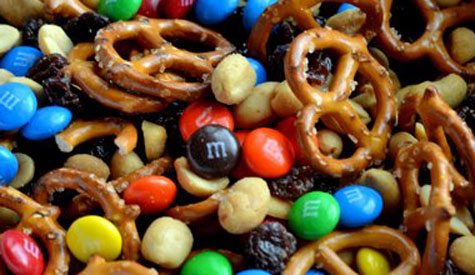
M&Ms

a)

Heterogeneous

b)

Homogeneous

57.
Sugar water
a)
Heterogeneous
b)
Homogeneous
58.
What is a homogeneous mixture?
a)
a mixture that is the same throughout.
b)
a mixture that is made up of one type of atom.
c)
a mixture that is made up of one type of compound
d)
a mixture that cannot be separated through physical changes
59.
A mixture that is NOT evenly distributed is called ....
a)
Compounded
b)

Homogeneous

c)

Heterogeneous

d)
Salty
60.
What type of mixture is this?
a)

homogeneous mixture

b)
chemical
c)
heterogeneous mixture 
d)
solid mix
61.

Heterogenous or Homogenous?

a)

Heterogeneous

b)

Homogeneous

62.

Which is a form of heterogeneous mixture?

a)

gravel and water

b)

sugar and water

c)

powdered milk and water

d)

powdered coffee and water

63.
Pizza
a)
Heterogeneous
b)
Homogeneous
64.
Air
a)
Heterogeneous
b)
Homogeneous
65.

Mixed nuts

a)

Homogeneous

b)

Heterogeneous

66.

a)

HETEROGENEOUS

b)

HOMOGENEOUS

67.

a)

HETEROGENEOUS

b)

HOMOGENEOUS

68.

a)

HETEROGENEOUS

b)

HOMOGENEOUS

69.
Which of the following is a sign that a chemical reaction has occurred?
a)
change in shape
b)
melting
c)
formation of a gas
d)
dissolving
70.
Fizzing, foaming, and burning are all examples of
a)
Chemical change
b)
Physical change
71.
Which of these is a result of a chemical change?
a)
A mixture
b)
A solution
c)
A new substance
d)
Melting or freezing
72.
Which of the following indicates a chemical change?
a)
Change in state of matter
b)
Temperature change
c)
Change in size 
d)
Change in shape
73.
Physical or Chemical Change?  Iron rusts
a)
Physical Change
b)
Chemical Change
74.

The formation of a solid when two liquids combine is called?

a)

Solidification

b)

Freezing

c)

Precipitate

d)

Solubility

75.

The following are examples of evidence of a chemical reaction....

a)

ice melting into a liquid

b)

condensation

c)

endothermic reaction

d)

change in color, production of gas bubbles

76.

Which is NOT evidence of a chemical change?

a)

Unexpected color change

b)

gas produced

c)

breaking

d)

light produced

77.

Which is NOT evidence of a chemical change?

a)

Unexpected color change

b)

gas produced

c)

melting

d)

temperature change

78.

Which of the following options provides evidence of a CHEMICAL change?

a)

Wood is burned releasing ash and smoke

b)

Rocks separate when soil is sifted

c)

Boiling water bubbles when heated

d)

Salt dissolves in water

79.

An object undergoes a chemical change when it changes:

a)

shape, form, state of matter

b)

melting, odor, size

c)

color, burning, rusting

80.

Bubbles quickly appear and continue forming for 20 seconds and there are small amounts of the solid at the bottom of the liquid in the final observation.

a)

physical change

b)

chemical reaction

81.

The temperature of the solution dropped 18 °C and there was no color change.

a)

physical change

b)

chemical reaction

82.
Physical or Chemical Change?  Logs burning in a campfire.
a)
Physical Change
b)
Chemical Change
83.
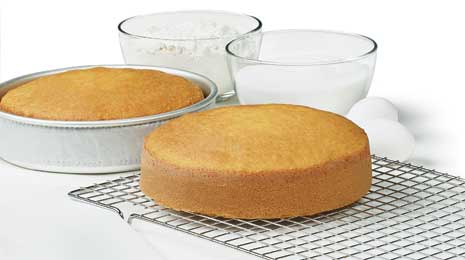
Physical or Chemical Change?  Baking a cake.
a)
Chemical Change
b)
Physical Change
84.
Bubbles form when two or more substances are combined ...
a)
Chemical Change
b)
Physical Change