wayground logo

Free Printable Worksheets

NEW

Font size

S
M
L
XL
Worksheets

Earth Science SSA Review 6th & 7th

Total questions: 80

Worksheet time: 3hrs 40mins

Name
Class
Date
1.
What does deposition mean?
a)
to settle in a new spot
b)
to break apart
c)
to sit still
d)
to move
2.
What does erosion mean?
a)
to break apart
b)
to settle in new spot
c)
to move
d)
to sit still
3.
What does weathering mean?
a)
to move
b)
to settle in a new spot
c)
to break apart
d)
to sit still
4.
Wind blowing sand from one location to another
a)
Weathering
b)
Erosion
c)
Deposition
5.
Water getting into cracks, freezing, and breaking the rocks or pavement apart
a)
Weathering
b)
Erosion
c)
Deposition
6.
Waves dropping sand on the beach
a)
Weathering 
b)
Erosion
c)
Deposition
7.
Layers of sediment forming at the bottom of the ocean floor
a)
Weathering
b)
Erosion
c)
Deposition
8.
Rain washing away soil from a hillside
a)
Weathering
b)
Erosion
c)
Deposition
9.

Define delta.

a)

a narrow stretch of land connecting two larger areas

b)

a point of land that extends into a river, lake or ocean

c)

a body of land jutting into a lake or ocean surrounded by water on three sides

d)

a flat, low-lying land built up from soil carried downstream by a river and deposited at its mouth

10.

Find the correct definition of the underlined word, glacier.

a)

a narrow stretch of land connecting two larger areas

b)

a large natural stream of water that runs through the land

c)

a large, thick body of slow moving ice

d)

a narrow stretch of water joining two larger bodies of water

11.

What is a plateau?

a)

an area of level land, usually at low elevation and often covered with grasses

b)

an area of land drained by a given river and its branches

c)

land usually level, at low elevation

d)

an area of flat or rolling land at high elevation

12.

Find the correct definition of the underlined word, valley.

a)

an area of level land, usually at low elevation and often covered with grasses

b)

an area of low land usually between hills or mountains

c)

land usually level, at low elevation

d)

an area of flat or rolling land at high elevation

13.
What landform is this?
a)
delta
b)
canyon
c)
valley
d)
sand dune
14.
What landform is this?
a)
mountain
b)
canyon
c)
valley
d)
sand dune
15.
What landform is this?
a)
delta
b)
mountain
c)
volcano
d)
sand dune
16.
The hydrosphere is predominately made of
a)
liquid water
b)
frozen water
c)
solid rock
d)
gaseous air
17.
The rock, dust, soil, and minerals of the Earth's solid crust and outer mantle make up the ____
a)
Biosphere
b)
Geosphere
c)
Cryosphere
d)
Atmosphere
18.

The prefix "bio" comes from a Greek word that means what?

a)

Life

b)

Water

c)

Earth

d)

Ground

19.
This is part of the....
a)
Geosphere
b)
Biosphere
c)
Hydrosphere
d)
Cryosphere
20.
All living things on earth are part of the....
a)
Biosphere
b)
Geosphere
c)
Hydrosphere
d)
Cryosphere
21.
All frozen water on Earth is...
a)
Hydrosphere
b)
Geosphere
c)
Cryosphere
d)
Atmosphere
22.
This is part of the....
a)
Geosphere
b)
Biosphere
c)
Cryosphere
d)
Atmosphere
23.
This is part of the....
a)
Geosphere
b)
Atmosphere
c)
Hydrosphere
d)
Cryosphere
24.
This is part of the....
a)
Geosphere
b)
Atmosphere
c)
Biosphere
d)
Hydrosphere
25.
What do we call the air and gasses that surround the earth?
a)
Atmosphere
b)
Troposphere
c)
Mesospherre
d)
Thermosphere
26.
What part of our atmosphere is where the ozone layer is?
a)
Stratosphere
b)
Troposphere
c)
Mesosphere
d)
Thermosphere
27.
What is the part of our atmosphere that protects us from comets because it acts like a shield.  It  is also very cold.  There are actually ice particles in the air.
a)
Atmosphere
b)
Stratosphere
c)
Mesosphere
d)
Thermosphere
28.
In which part of the atmosphere will we find a tree growing?
a)
Thermosphere
b)
Stratosphere
c)
Mesosphere
d)
Troposphere
29.
Daily temperature, daily rainfall, daily amount of sunshine
a)
Weather
b)
Climate
30.
The tropical rainforest has experienced 50 to 260 inches of rainfall annually for the last  few decades.
a)
Weather
b)
Climate
31.
The boundary between two air masses that meet is called?
a)
front
b)
back
c)
side
d)
air mass
32.

What is climate?

a)

A weather forecaster

b)

Day to day conditions of a particular place

c)

Rain, snow, and sleet

d)

Average weather conditions over a long period of time

33.

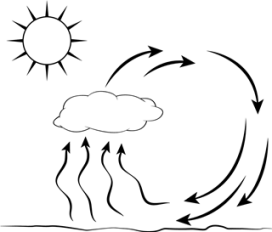
What energy source drives the water cycle?

a)

Clouds

b)

Oceans

c)

Sun

d)

Plants

34.
The main human activity that releases greenhouse gases is
a)
using bottled water
b)
burning fossil fuels
c)
texting on cellphones
d)
eating meat
35.
It was hot all week last week.  Is this a sign of climate change?
a)
Yes
b)
No
36.
Worldwide, temperatures have been increasing for more than 100 years.  Is this evidence of global warming?
a)
yes
b)
no
37.
Why is the increase of Greenhouse gasses a big issue?
a)
It causes climate change and increase in the global temerature 
b)
It can lead to a major increase in Greenhouses 
c)
It leads to more factories
d)
It causes a major decrease in people
38.
Which of the following is the most troubling greenhouse gas being produced by humans?
a)
Water Vapor
b)
Carbon Dioxide
c)
Methane
d)
Nitrous Oxide
39.
What causes the circulation of air in the atmosphere?
a)
Air in the atmosphere is heated by the sun and sinks to the ground.
b)
The ground is heated by the sun and then heats the air, causing the air to rise.
c)
Air loses heat to the ground and then rises upward to obtain more energy.
d)
The sun heats the clouds which forces the cooler air to move away and sink.
40.
What is the original source of most of the energy that people use?
a)
Energy that reaches Earth by radiation from the sun.
b)
Energy that reaches the earth by convection from the sun.
c)
Energy that reaches the earth by radiation from the core.
d)
Energy that reaches the earth by conduction from the core.
41.

The substance that is melted rock below the ground is called what?

a)

Magma

b)

Sediment

c)

Gas

d)

Water

42.

What are the particles of weathered rock called?

a)

Sediments

b)

Fossils

c)

Rocks

d)

Minerals

43.

This is the continuous process of rock changing from one type to another.

a)

Igneous rocks

b)

Sedimentary rocks

c)

Metamorphic rocks

d)

Rock Cycle

44.

This is the type of rock that forms when earth processes change the texture and heat and pressure are applied.

a)

Igneous rock

b)

Sedimentary rock

c)

Metamorphic rock

d)

Rock Cycle

45.

These are traces or remains of a once-living thing sometimes found in sedimentary rocks.

a)

Rocks

b)

Sediments

c)

Fossils

d)

Minerals

46.

This is the type of rock that forms from sediment that gets cemented or pressed together under pressure.

a)

Igneous rock

b)

Sedimentary rock

c)

Metamorphic rock

d)

Rock Cycle

47.

This is the type of rock that forms from magma or lava hardening.

a)

Igneous rock

b)

Sedimentary rock

c)

Metamorphic rock

d)

Rock Cycle

48.

Which missing rock type is the arrow pointing at?

a)

Igneous

b)

Sedimentary

c)

Metamorphic

49.

Which missing rock type is the arrow pointing at?

a)

Igneous

b)

Sedimentary

c)

Metamorphic

50.

Which missing rock type is the arrow pointing at?

a)

Igneous

b)

Sedimentary

c)

Metamorphic

51.

How does a metamorphic rock become an igneous rock?

a)

Heat and pressure

b)

Melting and cooling

c)

Weathering/Erosion and Cementation

d)

Cycle

52.

How does an igneous rock become a sedimentary rock?

a)

Heat and pressure

b)

Melting and cooling

c)

Weathering/Erosion and Cementation

d)

Cycling

53.

How does a sedimentary rock become a metamorphic rock?

a)

Heat and pressure

b)

Melting and cooling

c)

Weathering/Erosion and Cementation

d)

Cycling

54.

Which material is melting and cooling to become an igneous rock?

a)

Sediments

b)

Sedimentary rocks

c)

Magma

d)

Igneous rocks

55.

Which material is being broken down through weathering and erosion?

a)

Igneous

b)

Magma

c)

Sediments

d)

Sedimentary

56.

A geologist is studying three layers of sedimentary rock in an area. The layers have not shifted from their original positions. The geologist records the relative ages of the rocks. What did the geologist use to determine the relative ages of the rocks?

a)

Radioactive dating

b)

Mineral content

c)

Absolute dating

d)

The Law of Superposition

57.

Based on the law of superposition, what is the order of these rock layers, from oldest to youngest?

a)

1, 2, 3, 4

b)

2, 1, 4, 3

c)

3, 2, 1, 4

d)

4, 3, 2, 1

58.
The outermost solid layer of the Earth is called the
a)
mantle
b)
outer core
c)
inner core
d)
crust
59.
This layer of the Earth is found between the core and the crust.
a)
mantle
b)
outer core
c)
inner core
d)
crust
60.
The layer that lies beneath the mantle and surrounds the inner core. 
a)
mantle
b)
outer core
c)
inner core
d)
crust
61.
Identify the letter in the diagram.  Identify letter A
a)
Lithosphere
b)
Asthenosphere
c)
Mantle
d)
Outer Core
62.
Identify the letter in the diagram.  Identify letter F
a)
Lithosphere
b)
Asthenosphere
c)
Mantle
d)
Outer Core
63.
Identify the letter in the diagram.  Identify letter B
a)
Crust
b)
Convection Current
c)
Inner Core
d)
Outer Core 
64.
Identify the letter in the diagram.  Identify letter C
a)
Lithosphere
b)
Asthenosphere
c)
Mantle
d)
Inner Core
65.
Identify the letter in the diagram.  Identify letter C
a)
Lithosphere
b)
Asthenosphere
c)
Mantle
d)
Inner Core
66.
What is the theory that states that parts of the Earth's crust slowly drift atop a liquid core.
a)
Theory of Evolution
b)
Heliocentric Theory
c)
Geocentric Theory
d)
Continental Drift Theory
67.
What do you call the supercontinent landmass formed million years ago?
a)
Pangea
b)
Asia
c)
Pantallasa
d)
Eurasi
68.

Two plates come together or collide at what boundary?

a)

Convergent

b)

Divergent

c)

Transform

69.

Two plates spread or move apart at what boundary?

a)

Convergent

b)

Divergent

c)

Transform

70.

Two plates slide past each other at what boundary?

a)

Covergent

b)

Divergent

c)

Transform

71.

When two continental plates converge (collide) what type of crustal feature is formed?

a)

Mid Ocean Ridge

b)

Subduction Zone

c)

Rift Valley

d)

Folded Mountains

72.

A divergent boundary on land creates what feature?

a)

Mid Ocean Ridge

b)

Rift Valley

c)

Subduction Zone

d)

Deep Ocean Trench

73.
Analyze the seashell found in the white layer.  Which statement is true of the rock layer that contains this fossil?
a)
It could also contain a fossil from the bottom layer.
b)
It is older than the layers below it.
c)
It is younger than the layers above it.
d)
It is older than the layers above it.
74.
How do geologists use relative dating?
a)
Placing rocks in order from youngest to oldest
b)
Placing rocks in order by minerals they contain
c)
Classifying rocks by different textures
d)
Classifying rocks by different isotopes
75.
Which rock layer in the diagram seems to be the oldest?
a)
F
b)
E
c)
B
d)
A
76.

Absolute age is defined as:

a)

The age of rock determined by radioactive dating (carbon dating).

b)

The age of rock based on living animals.

c)

The age of rock based on its location/depth.

d)

The age of rock based on which fossils are found in it.

77.
How does absolute age differ from relative age?
a)
only absolute dating indicates which rock is older than another
b)
only absolute dating finds the age in years
c)
only relative dating finds the age in years
78.
Most earthquakes happen along the _________________. 
a)
coast
b)
faults
c)
desert
d)
directions
79.
Earthquakes under the water can cause _________________________________.
a)
tornadoes
b)
tsunamis
c)
lightening
d)
hailstorms
80.
Many earthquakes happen along the borders of...
a)
Countries
b)
Tetonic Plates
c)
Climate Zones
d)
None of the above.