wayground logo

Free Printable Worksheets

Font size

S
M
L
XL
Worksheets

All Things Matter Review

Total questions: 85

Worksheet time: 53mins

Name
Class
Date
1.
A solid is the only form of matter that has its own...
a)
shape
b)
properties
c)
mass
2.

What are all things made of?

a)

atoms

b)

gas

c)

liquid

3.
Beth blew up a balloon. What state of matter is inside the balloon?
a)
solid
b)
liquid
c)
gas
4.
Which can you usually NOT see?
a)
property
b)
liquid
c)
gas
5.
An ice cube melts. How is it changing?
a)
solid to gas
b)
solid to liquid
c)
gas to liquid
6.
What is it called when water vapor changes from a gas to liquid?
a)
condensation
b)
melting
c)
evaporation
7.
How can you change a liquid to a solid?
a)
freeze it
b)
mix it
c)
burn it
8.
What happens to water when it boils?
a)
melts
b)
freeze
c)
evaporates
9.

True or False:

Physical properties of matter can be observed without changing the makeup or identity of the matter.

a)

True

b)

False

10.

The ___________ of a substance is the temperature at which a solid begins to turn into a liquid

a)

boiling point

b)

heat of fusion

c)

melting point

d)

sublimation

11.

Which state of matter has atoms with the most motion?

a)

solid

b)

gas

c)

liquid

d)

jello

12.

When matter changes from a liquid to a solid it is called

a)

melting

b)

freezing

c)

sublimation

d)

condensation

13.

Dry Ice, which is compressed Carbon Dioxide , changes from a solid into a gas. This phase change is called

a)

vaporization

b)

freezing

c)

melting

d)

sublimation

14.

Which of the following IS NOT a characteristic of gas?

a)

has definite shape

b)

atoms move quickly

c)

does not have definite volume

d)

takes the shape of its container

15.
Which best represents the phases of water from 1 to 3?
a)
solid, gas, liquid
b)
gas, solid, liquid
c)
liquid, gas, solid
d)
gas, liquid, solid
16.
Which of the diagrams best shows the arrangement of molecules in a solid? 
a)
A
b)
B
c)
C
d)
D
17.
What Is Volume?
a)
How heavy something is.
b)

The amount of space taken up by an object.

c)
How a liquid flows.
d)
The international unit of measurement.
18.
A gas
a)
has a definite shape but no definite volume
b)
has a definite volume but no definite shape
c)
has fast-moving particles
19.
At higher temperatures
a)
particles in an object have less energy
b)
particles in an object move faster
c)
a gas contracts
20.
Boiling
a)
liquid to gas
b)
gas to solid
c)
gas to liquid
d)
solid to liquid
21.
The drops of water that appear on the outside of a glass of cold juice on a warm day are an example of?
a)
sublimation
b)
condensation
c)
evaporation
22.
The ability to move, work or cause a change in matter is...
a)
mass
b)
volume
c)
energy
d)
density
23.
What is the difference between mass and weight?
a)
Mass is the total matter in an object, and weight is the downward pull of an object.
b)
Mass is the downward pull of gravity on an object, and weight is the total matter making up an object.
c)

Mass is Batman, Weight is Spider-Cam

d)
I don't know 😭
24.
Physical or Chemical?  Water is nonflammable
a)
Physical
b)
Chemical
c)
Neither
25.
One hot summer, you remember you left a cup of water outside. A few weeks later, you saw that the cup was empty and you remember the cup having water. What happened to the water?
a)
It evaporated
b)
It underwent deposition
c)
It melted
26.
The molecules in the picture are tightly held together with little movement. They have shape and energy.  Therefore, the picture represents _________.
a)
solid
b)
liquid
c)
gas
d)
plasma
27.

When the temperature of matter decreases, the particles ...

a)
speed up and move farther apart
b)
speed up and move closer together
c)
slow down and move farther apart
d)
slow down and move closer together
28.

When the temperature of matter increases, the particles...

a)
speed up and move closer
b)
speed up and move farther apart
c)
slow down and move closer together
d)
slow down and move farther apart
29.

When air in a hot air balloon is heated the air inside the balloon...

a)
expands
b)
contracts
c)
evaporates
d)
condenses
30.
If an object has particles that are moving very slowly, the object's temperature is probably ______.
a)
hot
b)
small
c)
cold
d)
big
31.
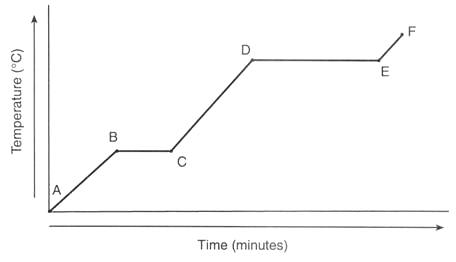
What phase change occurs between points B and C if heat is added?
a)
Freezing
b)
Melting
c)
Boiling
d)
Condensing
32.

A plasma can be made in a laboratory by

a)

cooling a gas to very low temperatures

b)

cooling a gas and reducing the pressure

c)

heating a gas to extremely hot temperatures

d)

heating a liquid to the point it turns into a gas

33.

In what way are liquids different from solids?

a)

Liquid molecules are lighter than solid molecules

b)

Liquids are made of atoms; solids are made of molecules

c)

Liquids don't have a fixed shape; solids do

d)

Liquids are always denser than solids

34.

What happens to the chemical structure of water when it changes state?

a)

Water molecules break apart to form individual atoms

b)

Water molecules harden into ice molecules

c)

Water molecules melt into gas molecules

d)

Nothing happens to the chemical structure

35.

What will happen if you keep increasing the temperature of a liquid?

a)

It will boil & become a gas

b)

It will transpire

c)

It will remain a liquid

d)

It will solidify

36.

What do lightning & stars have in common?

a)

Both have no electrical charge

b)

Both contain plasma

c)

Both have a fixed volume

d)

Both contain all three states of matter

37.

What is the basic shape of a liquid?

a)

A sphere

b)

The same shape as a gas, only rounder

c)

A cube

d)

Whatever shape its container is

38.

How can you remove energy from matter?

a)

By increasing its volume

b)

By lowering its temperature

c)

By increasing its pressure

d)

By boiling it

39.

Where would you find a Bose-Einstein condensate?

a)

Inside stars

b)

At the North Pole

c)

In a science lab

d)

Bose-Einstein condensates exist only in theory

40.

Burning of paper

a)

Physical Chang

b)

Chemical Change

41.

crumpled paper

a)

physical change

b)

chemical change

42.

melting ice cube

a)

physical change

b)

chemical change

43.

digested food inside the body

a)

physical change

b)

chemical change

44.

rusted nail

a)

physical change

b)

chemical change

45.

The amount of space an object occupies,

a)

mass

b)

volume

c)

matter

46.

The amount of matter an object contains.

a)

matter

b)

mass

c)

volume

47.

The state of matter that only exists at very low temperatures close to absolute zero.

a)

liquid

b)

plasma

c)

bose- einstein condensate

48.
A rock has a mass of 14g and a volume of 2cm3. What is the density of the rock?
a)
7 mL
b)
7 g/cm3
c)
28 g/cm3
d)
1/7 g/cm3
49.

What is the volume of the ring? (new volume - old volume)

a)

64 mL

b)

68 mL

c)

8 mL

d)

4 mL

50.
Calculate the Volume
a)
410 cm3
b)
420 cm3
c)
402 cm3
d)
401 cm3
51.
Find the Volume
a)
428.4 cm3
b)
412.8 cm3
c)
404.2 cm3
d)
400 cm3
52.
The mass of an object is 30 g.  The volume is 5 mL.  What is the density of this object?
a)
6 g/cm
b)
6 g/mL
c)
6
53.
The density of this material is 2 g/cm3.
There are 24 cm3  Find the total mass.
a)
12 grams
b)
48 grams
c)
12 g/cm3
d)
48 g/cm3
54.
Density: Chemical or Physical Property
a)
Chemical Property
b)
Physical Property
55.
Solubility (dissolves): Chemical or Physical Property
a)
Chemical Property
b)
Physical Property
56.
Sour Taste: Chemical or Physical Property
a)
Chemical Property
b)
Physical Property
57.
Luster: Chemical or Physical Property
a)
Chemical Property
b)
Physical Property
58.
Odor: Chemical or Physical Property
a)
Chemical Property
b)
Physical Property
59.
Reacts with Air: Chemical or Physical Property
a)
Chemical Property
b)
Physical Property
60.

1. Kinetic refers to _______________

a)

Force

b)

Energy

c)

Motion

d)

Acceleration

61.

All matter is made up of________

a)

space

b)

mass

c)

air

d)

atoms

62.

Atoms are in constant random __________

a)

molecules

b)

energy

c)

motion

d)

space

63.

Atoms in motion have kinetic energy and their motion __________ as they gain energy.

a)

increases

b)

decreases

c)

stays the same

64.

If you add heat, energy ____________, so atoms move faster.

a)

decreases

b)

increases

c)

stays the same

65.

If you remove heat, energy decreases so atoms move ______________

a)

faster

b)

slower

c)

stays the same

66.
What line segment represents only the solid state?
a)
A-B
b)
B-C
c)
C-D
d)
D-E
67.
Between which points is the temperature of the substance remaining constant?
a)
A-B only. 
b)
A-B, C-D, E-F
c)
B-C only. 
d)
B-C, D-E
68.
Between which points is the temperature of the substance increasing?
a)
A-B only. 
b)
A-B, C-D, E-F
c)
B-C only. 
d)
B-C, D-E
69.

Where on the graph are phase changes taking place?

a)

1

b)

2

c)

3

d)

4

e)

5

70.

Phase change going from a Gas to a Plasma...

a)

Melting

b)

Vaporization

c)

Ionization

d)

Freezing

71.

Phase change going from a Gas to a Solid...

a)

Deposition

b)

Sublimation

c)

Condensation

d)

Vaporization

72.

Convert 30°C into Kelvin.

a)

252K

b)

316°C

c)

303K

d)

-163°C

73.

Convert 589 Kelvin into °C.

a)

252K

b)

316°C

c)

303K

d)

-163°C

74.

Convert 45°F into °C.

a)

7°C

b)

32°C

c)

32°F

d)

212°F

75.

Convert 0°C into °F.

a)

7.2°C

b)

32°C

c)

32°F

d)

212°F

76.

Convert 100°C into °F.

a)

7.2°C

b)

32°C

c)

32°F

d)

212°F

77.

Convert 24°C into °F.

a)

7.2°C

b)

32°C

c)

75.2°F

d)

°68

78.
Melting Point of water is
a)
100 degrees Celsius
b)
0 degrees Celsius
c)
0 degrees Fahrenheit
79.
Freezing point of water is
a)
100 degrees Celsius
b)
0 degrees Celcius
c)
0 degrees Fahrenheit
80.
The freezing and melting points of water are the same.
a)
True
b)
False
81.

What is the boiling point of water?

a)

0 C

b)

100 F

c)

50 C

d)

100 C

82.

What is the boiling point of water on the Fahrenheit scale?

a)

0oF0^oF

b)

373oF373^oF

c)

100oF100^oF

d)

212oF212^oF

83.

What is the freezing/melting point of water of the Fahrenheit scale?

a)

273oF-273^oF

b)

0oF0^oF

c)

32oF32^oF

d)

273oF273^oF

84.

100 °C = _____ K

a)

173 K

b)

373K

c)

273 K

d)

0 K

85.

The absolute coldest anything can get.

In Celsius it's -273 degrees. Or 0 degrees Kelvin.

a)

Absolute cold

b)

Kelvin

c)

Absolute zero

d)

I don't know