wayground logo

Free Printable Worksheets

Font size

S
M
L
XL
Worksheets

Final Exam Prep

Total questions: 81

Worksheet time: 4hrs 3mins

Name
Class
Date
1.

What comparative anatomy structure has similar form/structure but different function?

a)

Analogous Structures

b)

Homologous Structures

c)

Vestigial Structures

2.

What comparative anatomy structure has a different form/structure but the same function?

a)

Analogous Structures

b)

Homologous Structures

c)

Vestigial Structures

3.

What comparative anatomy structure is a result from left over traits that are no longer needed for survival and no longer serve a purpose?

a)

Analogous Structures

b)

Homologous Structures

c)

Vestigial Structures

4.

Bone C: Shows the remnants of pelvic bones on a whale from when the whale used to be a land mammal. These bones no longer serve a function.

a)

Analogous Structure

b)

Homologous Structure

c)

Vestigial Structure

5.

What type of comparative structure is this an example of?

a)

Analogous Structures

b)

Homologous Structures

c)

Vestigial Structures

6.
Which statement is part of Darwin’s theory of evolution by natural selection? 
a)
More offspring are produced than can possibly survive.
b)
The organisms that are the fittest are always largest and strongest. 
c)
The number of offspring is not related to fitness.
d)
Acquired characteristics that are inherited are the cause of evolution.
7.

By looking at the genes of some animals we can determine which living species are most closely related to each other. This also reveals which species most recently diverged from their common ancestor.

Based on the partial gene segments shown, which pair of animals are genetically most closely related and therefore most recently diverged from their common ancestor?

a)

Chimpanzee and Mouse

b)

Rat and Mouse

c)

Rat and Chimpanzee

8.

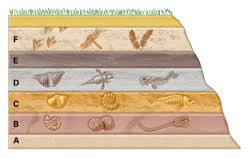
Which rock layer contains the newest fossils?

a)
F
b)
E
c)
B
d)
C
9.

Images of the embryo and adult stages of three different organisms are shown.


Which of the following is the best conclusion that can be drawn from this evidence?

a)

Having similar embryos indicates that these organisms eat the same types of food.

b)

Having similar embryos indicates that these organisms live in a similar environment.

c)

Having similar embryos indicates that these organisms share a recent common ancestor.

d)

Having similar embryos indicates that a certain protein controls how many legs the adult organisms will have.

10.

If a new trait DOES help an organism survive, what may happen to it?

a)

It dies and its DNA is not passed on

b)

It survives and its DNA is passed on

c)

It changes its traits to adapt and survive
11.
Common ancestry relates to evolution because
a)
evolution only happens when there are common ancestors.
b)
Common ancestors make evolution happen more quickly.
c)
evolution can never take place with common ancestors.
d)
the more two organisms have in common, the more recent is their common ancestor during their evolution.
12.
What is the term for a feature that allows an organism to survive in its environment?
a)
adaptation
b)
variation
c)
homologous structure
d)
vestigial structure
13.
Which of the following is a fossil?
a)
a plant that has recently died
b)
a group of organisms that can reproduce
c)
a structure or organ that no longer functions
d)
a trace of an organisms that existed in the past
14.
In natural selection, the selective agent is the
a)
humans
b)
mutations
c)
breeders
d)
environment
15.
Mutations are important because they bring about
a)
death of the organism in which they develop
b)
genetic variation needed for a population to evolve
c)
benefits for the individual, not for the population
d)
Hardey-Weinberg equilibrium within a population
16.
Which two processes are involved in protein synthesis?
a)
Replication and Transcription
b)
Replication and Translation
c)
Transcription and Translation
17.
Which of the following molecules is made during transcription?
a)
DNA
b)
tRNA
c)
protein
d)
mRNA
18.
Which of the following bases is found only in RNA?
a)
Adenine
b)
Guanine
c)
Thymine
d)
Uracil
19.
Which form of RNA carries amino acids from the cytoplasm to the ribosome?
a)
amino RNA
b)
ribosomal RNA
c)
transfer RNA
d)
messenger RNA
20.
What are the three base segments of mRNA called?
a)
anticodons
b)
codons
c)
triplets
21.
Transcribe the following sequence of DNA into RNA:
AAG   CTT   TGC
a)
TTC  GAA  ACG
b)
UUC  GAA ACG
c)
TTC  GUU  UCG
d)
UUC  GUU  UCG
22.
What would be the complementary DNA strand for the following nucleotide sequence?
TCG ATA CGA
a)
AGC ATA GCT
b)
AGC TAT GCT
c)
AGC UAU GCU
d)
UGC TUT GCT
23.
Which of the following terms means that in each molecule of DNA made during replication there is one original strand and one new strand?
a)
Antiparallel
b)
Semi-conservative
c)
Complementary base-pairing
24.
Cytosine always pairs with
a)
Adenine
b)
Thymine
c)
Uracil
d)
Guanine
25.
Which organelle is DNA usually found in?
a)
cell membrane
b)
vacuole
c)
ribosome
d)
nucleus
26.
In DNA, Adenine bonds with ______________.
a)
Guanine
b)
Thymine
c)
Cytosine
d)
Adenine
27.
What are the three components of a nucleotide?
a)
sugar, hydrogen, nitrogen base
b)
sugar, oxygen, nitrogen base
c)
sugar, phosphate, nitrogen base
d)
sugar, phosphate, protein
28.

Name this structure

a)

double helix

b)

nucelotide

c)

twisted ladder

d)

hydrogen bond

29.
Genetic info flows in one direction. Which best represents this flow?
a)
DNA-protein-RNA
b)
Protein-RNA-DNA
c)
RNA-protein-DNA
d)
DNA-RNA-protein
30.
The process to go from DNA to mRNA is _______
a)
translation
b)
transcription
c)
replication
31.
The process to go from mRNA to a protein is called ____
a)
transcription
b)
rRNA
c)
replication
d)
translation
32.
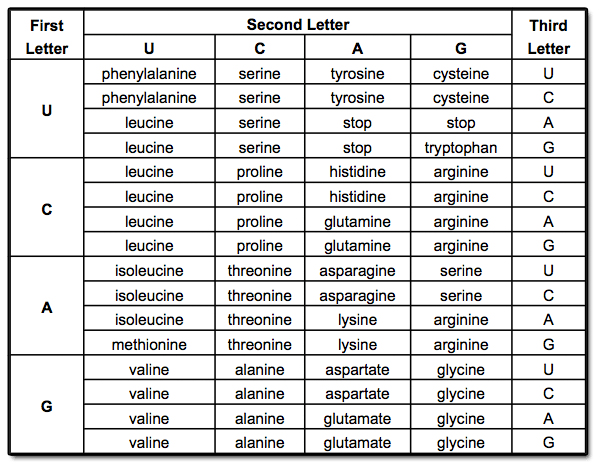
What amino acid is represented by the codon UUA?
a)
Phenylalanine
b)
Tyrosine
c)
Leucine
d)
Stop codon
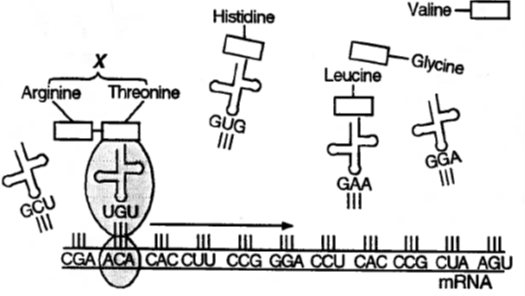
33.
What process is going on in this photo? 
a)
Transcription 
b)
Translation 
c)
Replication 
d)
All the above 
34.
What is the three base sequence of mRNA that codes for a single amino acid?
a)
Anticodon
b)
Codon
c)
Protein
35.
How many amino acids are coded for by this sequence of nucleotides:
ATG GGA ACT CCA
a)
4
b)
2
c)
6
d)
12
36.

What amino acid is represented by the codon AUG?

a)

Phenylalanine

b)

Methionine

c)

Leucine

d)

Stop codon

37.

If the DNA sequence of a gene is TAC CCC GGA GAG, what mRNA sequence will be produced in transcription?

a)

RNA Polymerase

b)

AUG GGG CCU CUC

c)

ATG GGG GGT GTG

d)

AUG GGG CCU CUG

e)

AUG CCG GCA CGG

38.

What amino acid would be added to the protein being formed during translation if the mRNA codon reads "CCU?"

a)

Isoleucine

b)

Stop

c)

Methionine

d)

Proline

39.

What is the correct amino acid sequence for the mRNA code AUG GCA AAC CGU

a)

Met-Ala-Asn-Ala

b)

Met-Ala (because the third codon codes for STOP)

c)

Ileu-Ala-Asn-Ala

d)

Met-Ala-Asn-Arg

e)

Ileu-Ala-Asn-Ala

40.
Which process and type of resulting cells are represented?
a)
mitosis, gametes
b)
mitosis, body cells
c)
meiosis, gametes
d)
meiosis, body cells
41.
The chromosomes that pair up during meiosis, are called __________ chromosomes.  
a)
homozygous 
b)
asexual
c)
homologous
d)
genes
42.
A male shark has 40 chromosomes in each of its sex cells. How many would be present in its body cells?
a)
20
b)
40
c)
80
d)
160
43.
Which letter(s) in the diagram correspond to cells that are haploid? 
a)
A
b)
B
c)
C
d)
A and B
44.
What causes genetic variation in meiosis?
a)
chromosomes lining up
b)
crossing over of chromosomes
c)
separation of chromosomes
d)
chromosomes pulling apart
45.
A human zygote should have _____ chromosomes inside.
a)
46
b)
23
c)
92
d)
64
46.
A human being has a somatic cell that has 46 chromosomes.  What is the haploid number found in a gamete?
a)
23
b)
46
c)
69
d)
92
47.
What is this?
a)
Trisomy 13
b)
Monosomy 21
c)
47, XXY
d)
Trisomy 21
48.
Diploid Cells are represented by
a)
2n
b)
n
c)
4n
d)
1/2 n
49.
Which statement best describes the importance of sexual reproduction?
a)
sexual reproduction produces variation in offspring
b)
sexual reprosuction provides regeneration of body parts
c)
sexual reproduction occurs between individuals of the same species
d)
sexual reproduction produces offspring that are identical
50.
Which of the following cell types is formed by meiosis?
a)
skin cells
b)
sperm cells
c)
blood cells
d)
muscle cells
51.
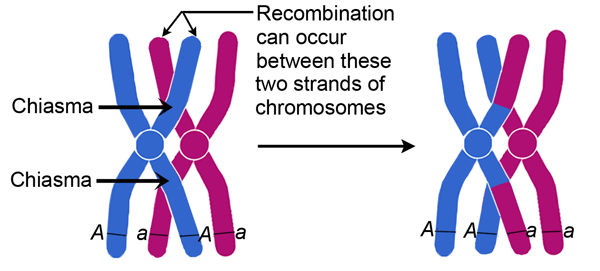
This image shows chromosomes during Prophase 1. Which of the following correctly describes the process shown?
a)
segregation of sister chromatids
b)
condensation and segregation of alleles
c)
mutationin which the DNA content of the gene is altered
d)
crossing - over in which alleles are exchanged
52.
Meiosis makes sperm and egg cells. In humans, sperm and egg cells each have _____ chromosomes. Therefore a fertilized human egg cell (sperm and egg cell combined) would create a cell with _____ chromosomes.
a)
23, 46
b)
46, 23
c)
2, 4
d)
50, 100
53.
Unlike mitosis, meiosis in male mammals results in the formation of
a)
one haploid gamete
b)
three diploid gametes
c)
four diploid gametes
d)
four haploid gametes
54.
What kind of cells are made in MEIOSIS?
a)
Haploid Gametes
b)
Diploid Somatic Cells
c)
Skin Cells
d)
Liver Cells
55.
Goes through P.M.A.T two rounds 
a)
Mitosis
b)
Meiosis
c)
Osmosis
d)
Transcription
56.

Who is considered the "father" of modern genetics?

a)

Einstein

b)

Mendel

c)

Disney

d)

Washington

57.
A single cross such as flower color.
a)
mono hybrid
b)
dihybrid
c)
crossing over
d)
homozygous
58.
What type of "square" helps us solve genetic problems?
a)
carpenter square
b)
Mendel square
c)
Punnett square
d)
genetic square
59.
TT,tt,PP,pp,SS,ss are examples of alleles that are?
a)
homozygous
b)
heterozygous
c)
different
d)
homologous 
60.
The exact genetic makeup of an organism, such as RR, Tt, PP is its?
a)
phenotype
b)
dominance
c)
genotype
d)
trait
61.
Y for yellow body is dominant over y for blue body.  What alleles would produce yellow bodies?
a)
YY,yy
b)
Yy,yy
c)
YY only
d)
YY,Yy
62.
"The Great White Shark was 20 feet in length.  Phenotype or Genotype?
a)
phenotype
b)
genotype
63.
Females-XX; MalesXY.  A couple has 4 girls.  What is the chance the next child will be a boy?
a)
75%
b)
100%
c)
25%
d)
50%
64.
If "T" is the allele for tall and "t" is the allele for short, then Tt would produce?
a)
tall
b)
short
c)
medium
d)
not enough info
65.
A physical characteristic that can be passed from parent to offspring.
a)
behavior
b)
trait
c)
strong muscles
d)
ability to fly a plane.
66.

Which of the following alleles is homozygous (purebred) recessive?

a)

TT

b)

Tt

c)

tt

d)

ts

67.

Red (R) is dominant over white (r). How can a flower be white?

a)

It can have RR and be white.

b)

It has to have rr.

c)

It has to have rR

d)

There is no way it can be white until the third generation.

68.

Alternant or different genes that code for the same trait are called?

a)

chromosomes

b)

segments

c)

alleles.

d)

homozygous.

69.
An offspring will receive how many alleles from each parent to determine a specific trait?
a)
one
b)
two
c)
three
d)
five
70.
Which of the following is a phenotype?
a)
BB
b)
Bb
c)
bb
d)
Blue eyes
71.
having two of the same genes for the trait (sometimes called purebred).
a)
homozygous
b)
hetrozygous
c)
protein
d)
chromosome
72.
Incomplete dominance means that the traits are
a)
expressed equally
b)
dominant
c)
recessive
d)
blended
73.
One form of a gene is called_______________
a)
a DNA
b)
a Phenotype
c)
a trait
d)
an allele
74.
A heterozygous long-tusked elephant is crossed with a homozygous recessive short-tusked elephant. What is the probability of the offspring having short tusks?
a)
0%
b)
25%
c)
50%
d)
75%
75.

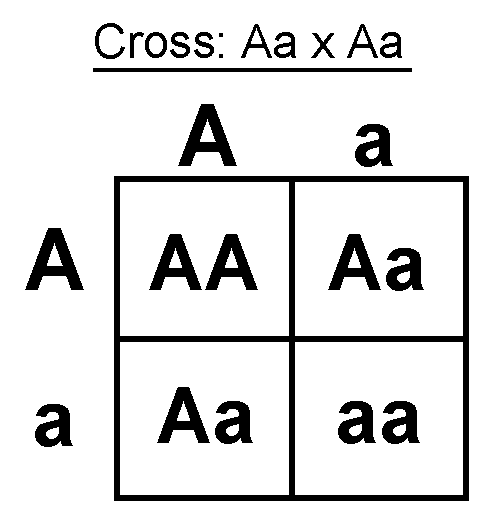
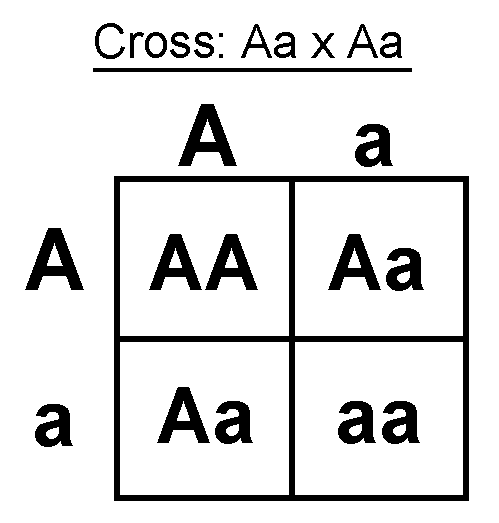
What is the genotypic ratio of the offspring?

a)

3:1

b)

1:3

c)

1:2:1

d)

2:2

76.

What are the phenotype percentages of the offspring?

(A-Brown fur color; a-white fur color)

a)

50 % Brown fur and 50% White fur

b)

25 % Brown fur and 75% White fur

c)

75 % Brown fur and 25% White fur

d)

0% Brown fur and 100% White fur

77.
What are the possible genotypes for this cross?
(Click the picture to see it without the text)
a)
TT = 25% Tt= 50% tt=25%
b)
all tall
c)
TT= 75% tt = 25%
d)
Tt = 100%
78.
If you cross a black guinea pig with a white guinea pig and the offspring are gray, what type of dominant trait would that be.
a)
incomplete dominance
b)
codominance
c)
codependant
d)
cooperative
79.

B=Brown fur

b=tan fur

What percent of the offspring would be tan when you cross BbxBb?

a)

75%

b)

25%

c)

50%

d)

100%

80.
This punnett square shows a cross between
a)
A hybrid Parent and a Homozygous parent
b)
A heterozygous parent and a heterozygous parent
c)
Two homozygous parents
d)
Two Hybrid Parents
81.
This is an example of
a)
Complete dominance
b)
Mendelian Genetics
c)
Codominance
d)
Incomplete Dominance