
 Worksheets
1 The Nature of Science
Total questions: 84
Worksheet time: 1hrs 21mins
A variable whose value changes as a result of changes to other variables is a(n) (a)
What is the standard unit for length?
Meter
Seconds
Mole
Feet
What is the standard unit for mass?
Kilogram
Gram
Slug
Pound
What do we call the amount of space something takes up?
Volume
Area
Surface
Density
What is the volume of a cube with a side of 2 cm?
2 cm^3
8 cm^3
4 cm^3
20 cm^3
What do we call anything that has mass and takes up space?
Matter
Weight
Volume
Density
What do we call the quantity of matter?
Mass
Weight
Volume
Density
What do we call the mass per volume? Example g/cm^3
Density
Volume
Weight
Matter
The SI base unit of length is the
kilometer
meter
liter
kilogram
How many meters in 1.2 km?
1200
.0012
12000
.012
The string is 3.2 cm. How many meters long is it?
.032
32
3200
.0032
What is the symbol for the prefix kilo-?
L
m
k
kg
Which of the following is equivalent to 4.5 m?
450 km
450 cm
0.45 km
45 cm
When converting between SI prefixes, what should you do if you are moving from smaller to larger units?
move the decimal to the left
move the decimal to the right
do not move the decimal
use dimensional analysis
How many significant figures (sig figs) are in the value 1204?
(a)
How many sig figs are in the value 1.20*10-3?
(a)
How many sig figs are in the value 0.00200?
(a)
Give the value of the following calculation to the proper number of sig figs. Don't forget to include units!
2.60 s4.1 m
(a)
Do the following calculation, giving the final answer to the proper number of sig figs. Don't forget your units!
0.076 − 0.0012
(a)
Solve the expression 3 cm ⋅ 4.0 cm . Give the answer to the proper number of sig figs.
12 cm2
10 cm2
12.0 cm2
10 cm
Which of the following conversion factors are needed to convert the value 65 mi/h to units of km/h? Select all that apply.
60 min1 h
60 s1 min
3600 s1 h
1 mi1.609 km
Conversions are methods of expressing a physical measurement or quantity via a different term (e.g. length in feet or inches). Which of the following can be multiplied by a given quantity without changing the physical meaning of the value? Select all that apply.
1 ft12 in
1 min60 s
1 km1000 m
2.54 cm1 in
Some conversions require multiple steps. Which of the following conversion factors would be used to convert 1.25 years to seconds? Select all that apply.
1 year365 days
1 day24 h
60 min1 h
60 s1 min
Convert 5.0 gal to mL. Show all steps (include picture with answer). Some useful conversion factors: 1 gal = 4 qt; 1.057 qt = 1 L. Remember to use proper sig figs and include units!
(a)
Match the correct SI base unit to the type of measurement.
Length or Distance
m
Volume
L
Time
s
Mass
g
Temperature
K
Why are graphs important?
They visually show information
The store data
They look colorful
They provide pictures for science books
Why would you use a line graph?
To show the relationship between the independent and dependent variable.
When the data forms a straight line.
When the data shows fractions of a whole.
When the data doesn't have any trends with it.
What variable is on the X axis in a line graph?
Independent
Dependent
Control
Constant
What must the total of the values add up to in a circle chart?
100
1000
1
.1
What graph shows a fix quantity broken down into parts?
Circle
Bar
Line
Total
What graphs are used to compare information collected by counting different groups?
Bar
Circle
Line
Pie
A visual display of data or information
model
graph
photograph
percentages
Information collected by counting can best be displayed on a
line graph
circle graph
bar graph
stem and plot graph
In a line graph, the dependent variable is plotted on the _____
x-axis
y-axis
A graph that shows information as parts of a circle is a _____
line graph
circle graph
bar graph
stem and plot graph
A type of graph that is useful for showing trends or continuous change is a _________________
line graph
bar graph
circle graph
stem and plot graph
Information in a circle graph is often shown as ___________
letters
highest to lowest
percentages
photos
In a line graph, the independent variable is plotted on the _________ axis.
horizontal
vertical
curved
changing

How many students take the bus to school?
35
20
10
15

How many more runs did Tracy have than Sarah and Patty combined?
6
8
2
1

How many more students liked Chocolate than Mint Chocolate Chip and Strawberry combined?
8
6
14
12
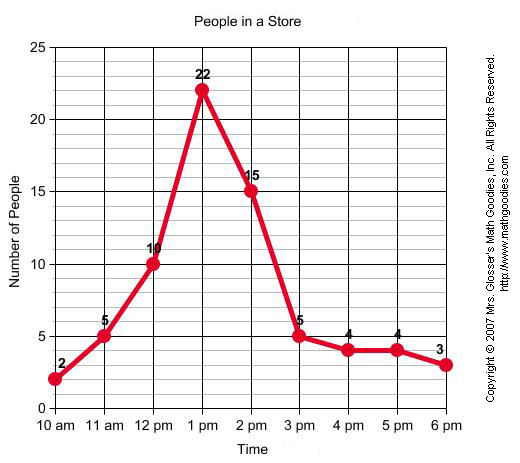
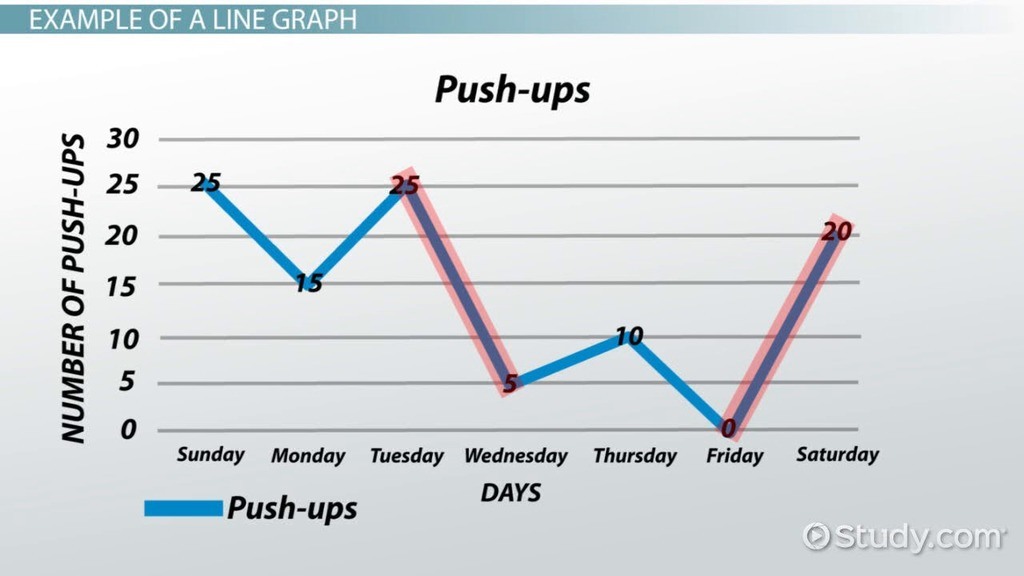
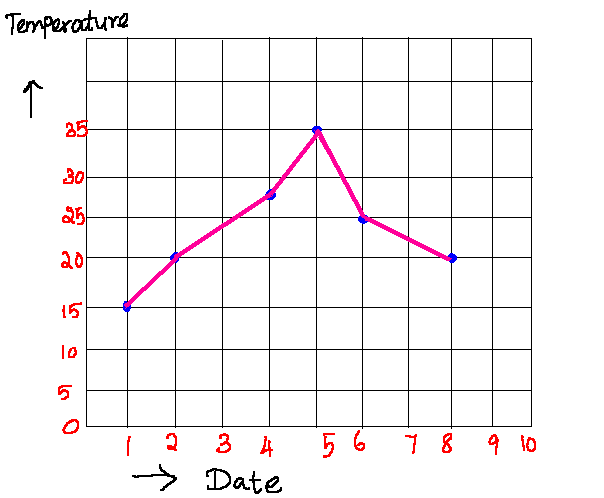
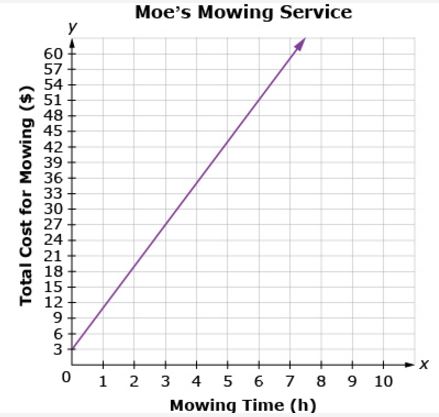

How many people voted altogether?
10
12
15
16
Which cereal received the least amount of votes?
Corn Flakes
Cheerios
Life
Kix

What kind of graph is this?
Color
Bar
Line
Pie
Which of the following is not technology?
Application of scientific knowledge
Skill or task a person performs
Changes over time
Is an exploration process to gain knowledge.
What do we call a network of people and objects that work together to perform a task?
Technological Systems
Internet
Networking System
Technology Group
What is a society?
A group of people that share similar values and beliefs
People who support technology only they agree with
All members in an area
Members of a country
Which of the following is not an economic force shaping technology?
Federal Government
Private Foundations
Private Industries
Society
What do we call the technical application of using living things or systems?
Biotechnology
Technology System
Private Industries
Ethical choices
What do ethics help scientist do?
Establish guidelines
Establish Laws
Limit what a scientist can do
Funds scientific research
Which two are examples of biotechnology?
Stem cell reseach
Genetically engineered crops
Solar charging batteries
Fast drying cement

