
 Worksheets
Honors-Test 1
Total questions: 83
Worksheet time: 42mins
Name
Class
Date
1.
A researcher is investigating the effects of temperature on the hatch time of grouper (fish) eggs. The eggs are exposed to different temperatures and the time that it takes the eggs to hatch is measured. What is the dependent variable?
a)
the hatch time
b)
the temperature
c)
the species of grouper
2.
Which of the following is NOT an example of researcher bias?
a)
A researcher selectively records data that supports their hypothesis while ignoring data that contradicts it.
b)
A researcher chooses observation sites that are easier to access but may not represent the overall study area.
c)
A researcher designs an experiment with clear, objective protocols to minimize personal influence on the results.
d)
A researcher unconsciously influences the outcome of an experiment due to their expectations about the results.
3.
Marine biologists are measuring the nitrogen levels at 10 random locations within a bay to determine which direction the most nutrient runoff is coming from. Which type of graph will they use to present their results?
a)
a line graph
b)
a bar graph
c)
a histogram
4.
If you categorize ocean organisms by "habitat" (e.g., reef, open ocean, estuary), what type of variable is this?
a)
Quantitative
b)
Continuous
c)
Categorical
5.
Systematic error in an experiment can result from:
a)
Using calibrated instruments
b)
Misreading random samples
c)
Faulty equipment consistently reading 2°C too high
d)
Unexpected variability in natural systems
6.
A study on fish populations only collects data near coastal areas. This could introduce:
a)
Measurement errors and bad results
b)
Sampling bias that reduces the strength of conclusions
c)
Observer error that can result in unreliable data
7.
Developed the Theory of Evolution.
a)
Charles Darwin
b)
James Cook
c)
Jacques Cousteau
8.
Who was the first person to circumnavigate the globe?
a)
Christopher Columbus
b)
Edward Forbes
c)
Charles Darwin
d)
Ferdinand Magellan
9.
_______ is the only underwater laboratory.
a)
Challenger
b)
Beagle
c)
Aquarius
d)
Atlantis
10.
Exploration of the ocean increased because of which of the following?
a)
Trade
b)
Discover new lands
c)
Food
d)
All the above
11.
Who established the first trade routes throughout the Mediterranean?
a)
Polynesians
b)
Vikings
c)
Arabs
d)
Phoenicians
12.
The _____ used mathematics principles to develop maps for seafaring.
a)
Greeks
b)
Romans
c)
Egyptians
d)
Chinese
13.
New technologies in marine science allow for scientists to do all the following except
a)
Track biological activity.
b)
Measure currents.
c)
Explore the entire ocean.
d)
Test water chemistry.
14.
The North American Plate and the Eurasian Plate meet in the middle of the Atlantic Ocean. They are
a)
colliding
b)
seperating
15.
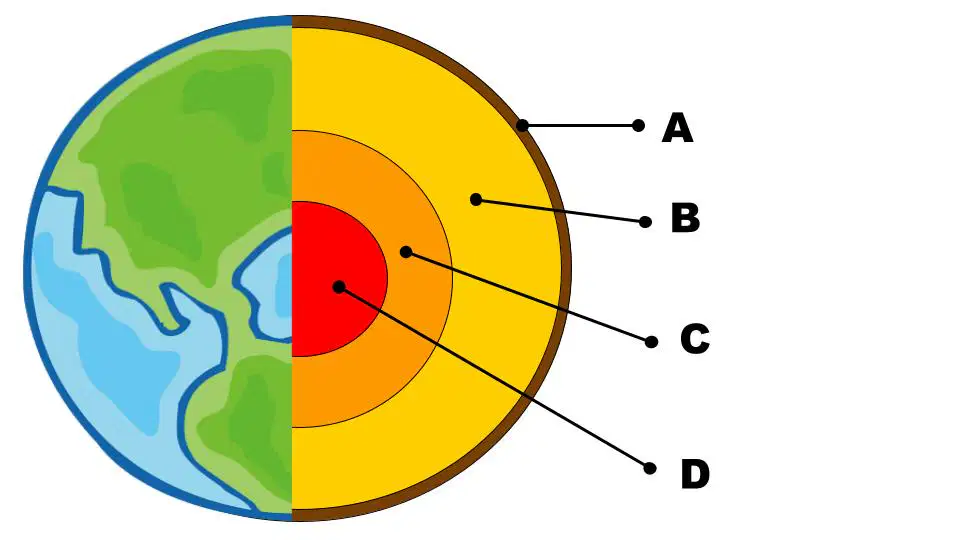
Identify the mantle.
a)
Layer A
b)
Layer B
c)
Layer C
d)
Layer D
16.
The Peru-Chile Trench runs along the coast of South America, where an oceanic plate is being subducted under a continental plate. Which of the following would you expect to find parallel to the trench?
a)
volcanoes
b)
another trench
c)
a mid-ocean ridge
d)
a hot spot
17.

In which of these locations would you expect the rocks of the seafloor to be the youngest?
a)
Location A
b)
Location B
c)
Location C
d)
Location D
18.
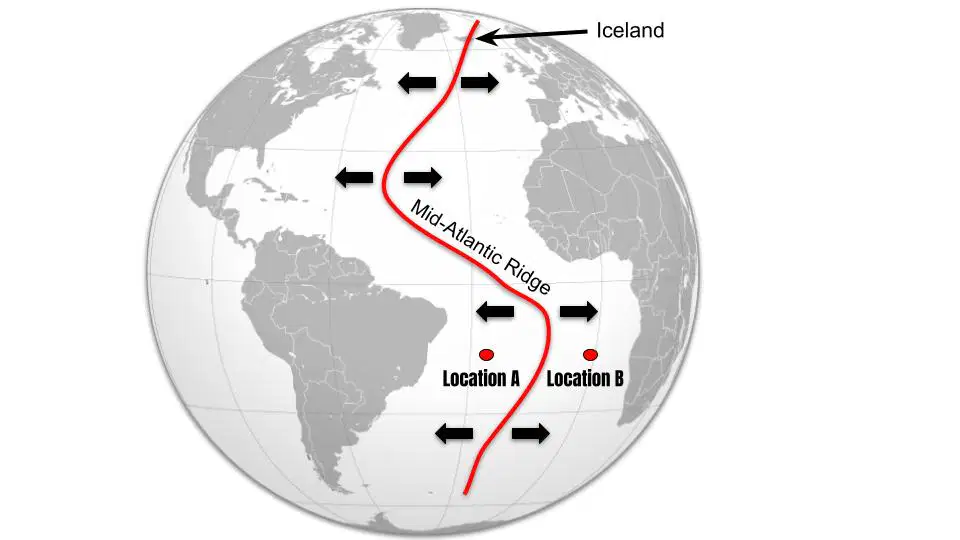
Which statement is NOT true about Iceland?
a)
The Mid-Ocean Ridge runs through it
b)
It is getting bigger every year
c)
It is located in the Pacific Ocean
d)
It is located at a divergent plate boundary
e)
In geological time, it is a relatively young island
19.
Which ocean is getting larger?
a)
Pacific
b)
Atlantic
20.
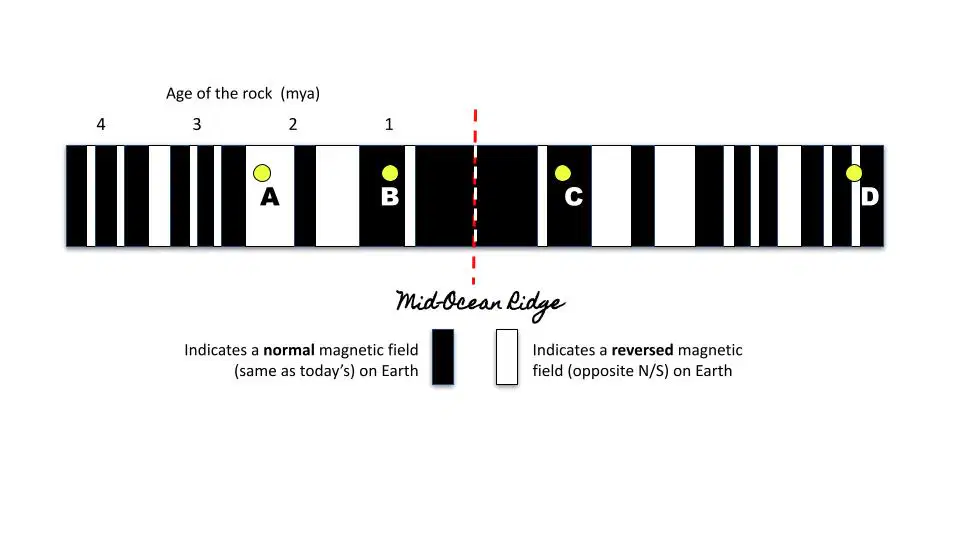
Which of the following is NOT correct?
a)
Rock A and rock D are not the same age
b)
Rock B and rock C are the same age
c)
Rock B and rock C would have the same magnetic history
d)
Rock A is older than rock D
21.
Which of the following is the correct statement?
a)
Earthquakes can cause tsunamis
b)
Tsunamis can cause earthquakes
22.
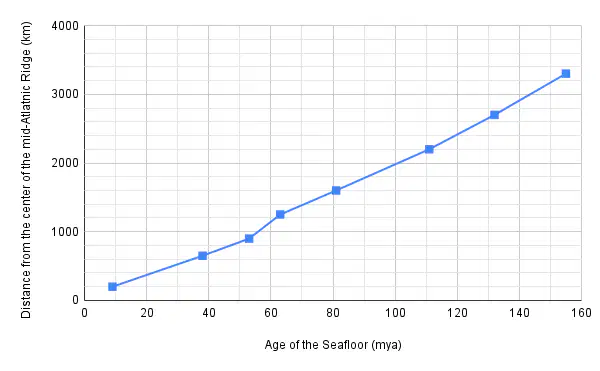
In the Atlantic Ocean, where does the newest rock on the seafloor occur?
a)
the closest to the mid-ocean ridge
b)
the furthest from the mid-ocean ridge
c)
between the ridge and the coastlines of the continents
23.
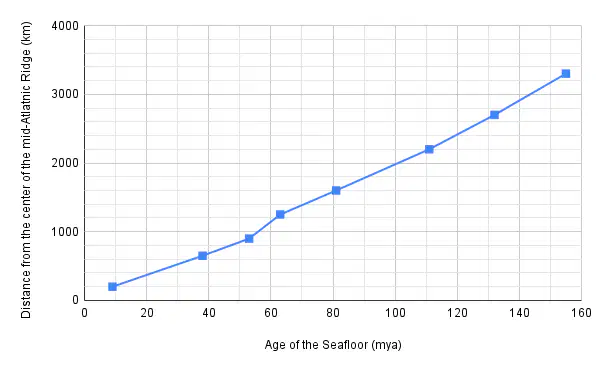
Approximately how old is the rock found on the seafloor 1400 km from the mid-Atlantic Ridge?
a)
70 years old
b)
70 million years old
c)
63 million years old
d)
63 years old
24.
What does the magnetic information stored in rocks tell us about the seafloor?
a)
the depth at the time the rocks formed
b)
the age of the rocks
c)
the direction of the magnetic north pole at the time the rocks formed
25.
The thermocline is
a)
an ocean layer where rapid change in temperature occurs
b)
an ocean layer where rapid change in salinity occurs
c)
an ocean layer where rapid change in density occurs
26.
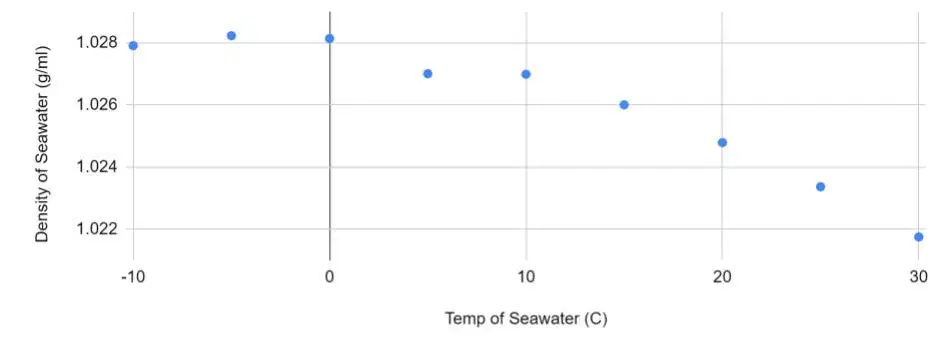
What can you conclude about the data shown on this graph?
a)
cold water is more dense
b)
warm water is more dense
27.
In which layer of the ocean do ALL of the following factors occur regarding the concentration of dissolved oxygen: a) no interaction with the atmosphere, b) very little respiration, c) no photosynthesis, d) very little decomposition, and e) increased solubility of gases due to very cold water and high pressure
a)
surface layer
b)
oxygen minimum layer
c)
deep layer
28.
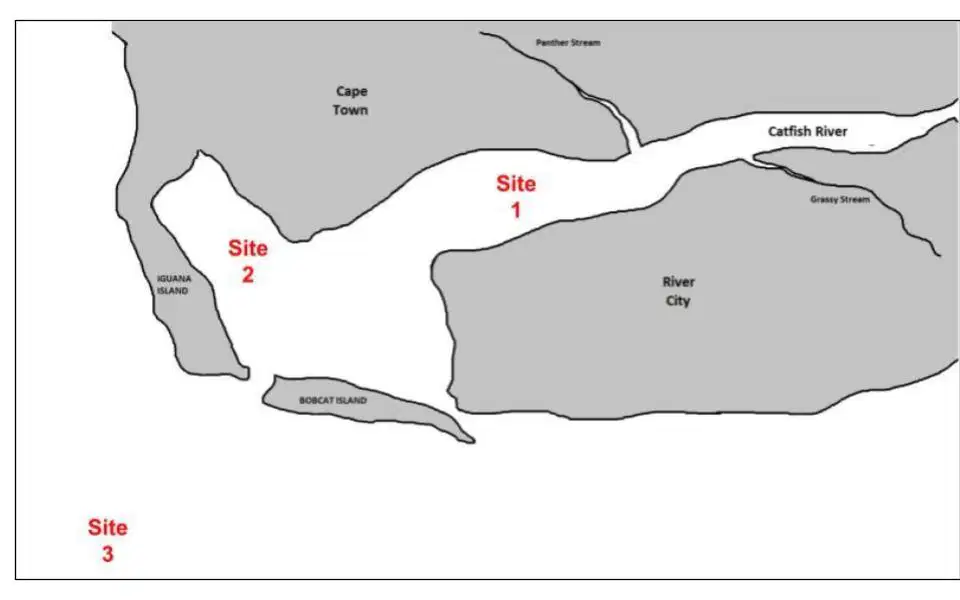
At which location would you expect to find the lowest salinity?
a)
site 1
b)
site 2
c)
site 3
29.
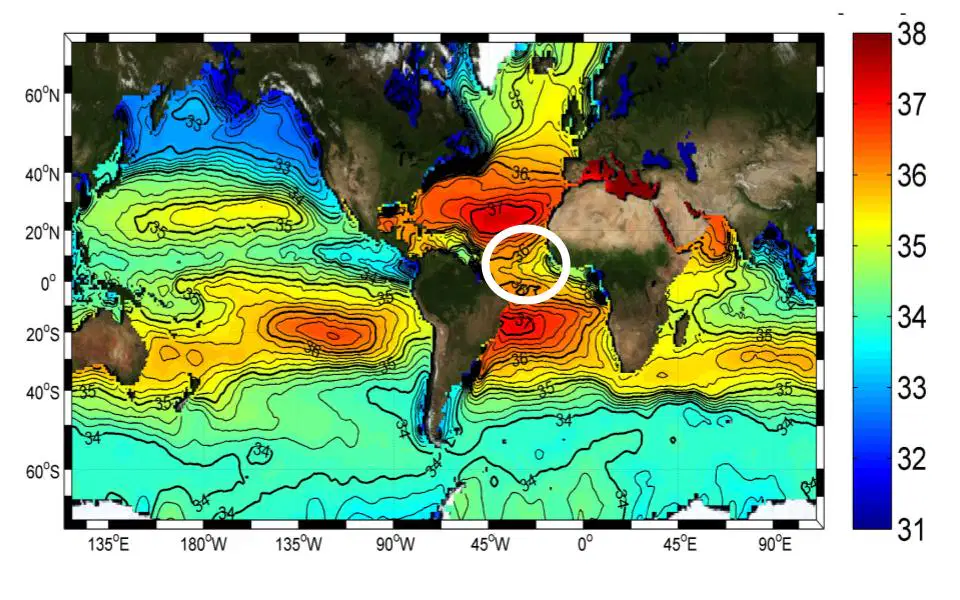
Which of the following best describes the location circled?
a)
There is a decreased salinity here due to large amounts of ice melting.
b)
There is a high rate of evaporation here, but there is also a high level of precipitation.
c)
The highest sea surface temperatures occur here due to the high rates of evaporation.
30.
Which of the following would INCREASE salinity in a location?
a)
runoff from land
b)
ice melting
c)
heavy rainfall
d)
evaporation
31.
Water is the only substance that naturally exists all three phases on Earth: gas, liquid, and solid.
a)
True
b)
False
32.
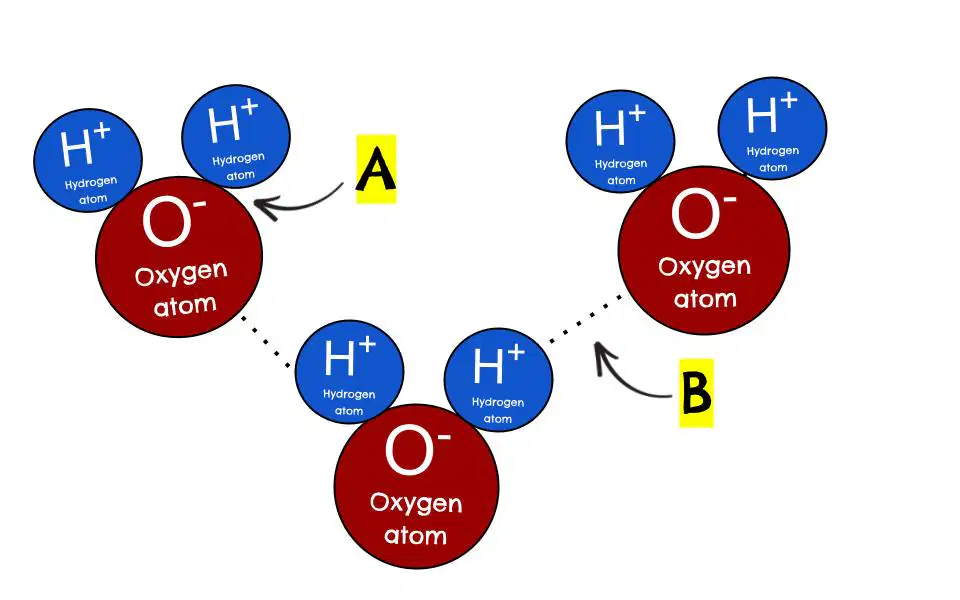
Which bond is a hydrogen bond?
a)
Bond A
b)
Bond B
33.
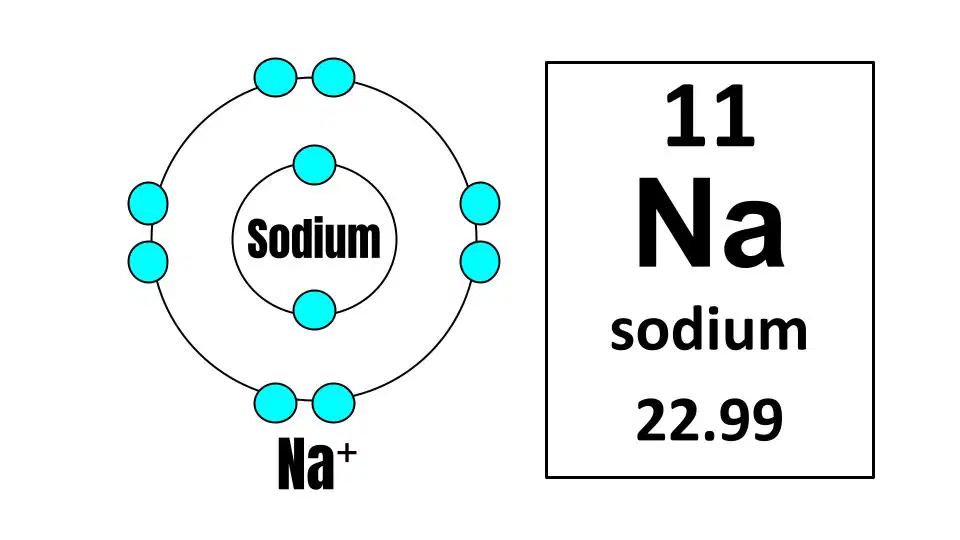
Why does this particular atom of sodium have a positive charge?
a)
because it lost an electron
b)
because it gained an electron
34.
Water is able to dissolve more substances than any other substance. Why?
a)
because of it's polarity
b)
because it is so abundant on earth
c)
because it is present in different phases on earth
d)
because it can be heated to high temperatures
35.
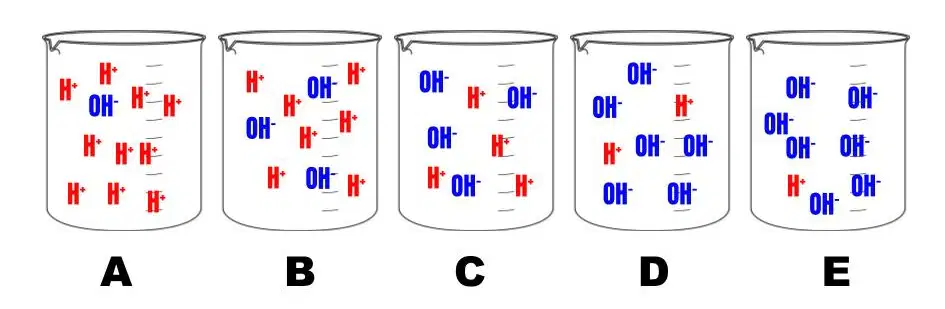
Which of the beakers represents the most acidic solution?
a)
Beaker A
b)
Beaker B
c)
Beaker C
d)
Beaker D
e)
Beaker E
36.
In which layer of the ocean do ALL of the following factors occur regarding the concentration of dissolved oxygen: a) no interaction with the atmosphere, b) very little respiration, c) no photosynthesis, d) very little decomposition, and e) increased solubility of gases due to very cold water and high pressure
a)
surface layer
b)
oxygen minimum layer
c)
deep layer
37.
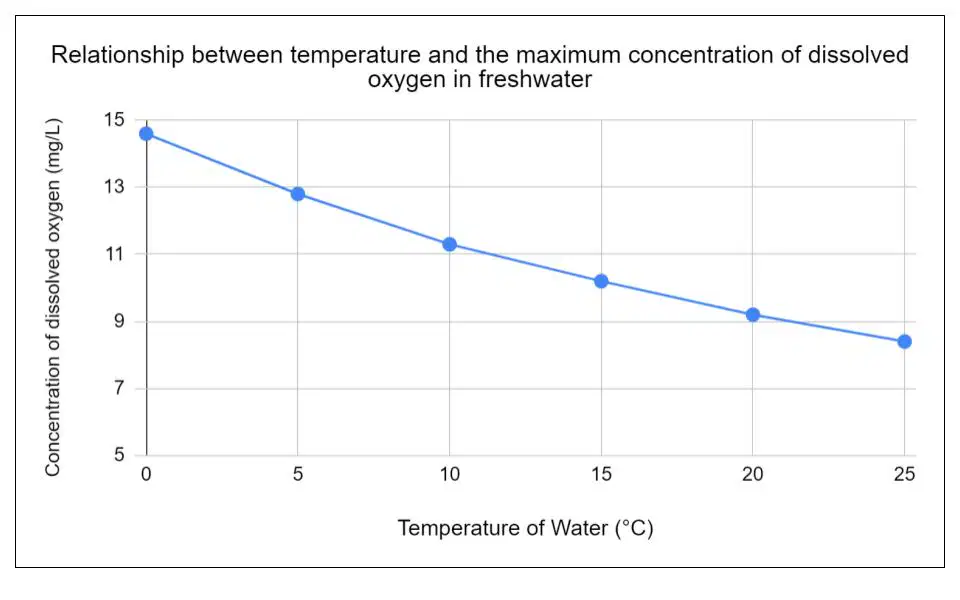
Which of the following statements best describes the data represented in this graph?
a)
Cold water can dissolve more gas than water at warmer temperatures
b)
Warm water can dissolve more gas than water at colder temperature
c)
Increased concentrations of dissolved oxygen can dramatically increase the temperature of water
38.
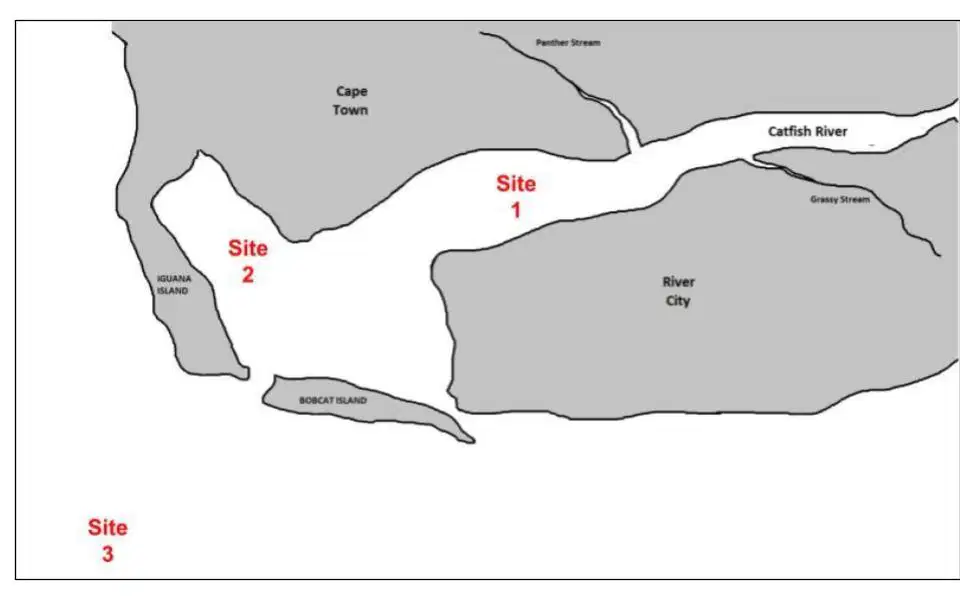
At which location would you expect to find the lowest salinity?
a)
site 1
b)
site 2
c)
site 3
39.
In the Don Juan Pond in Antarctica, the water does not freeze, even at a temperature of -50 degrees C. Why is that?
a)
The salinity of the pond is 350-400 ppt, and the salt content lowers the freezing point of the water
b)
The high concentration of dissolved oxygen in the water keeps the water from freezing to a solid
c)
The water is too cold to freeze
d)
There is no evaporation
40.
Which is the solute in a cup of lemonade?
a)
water
b)
sugar
c)
straw
41.
Which is more soluble in water?
a)
carbon dioxide - because it chemically combines with water molecules
b)
oxygen - because oxygen is an atom needed to form a water molecule
42.
Which can dissolve more gases?
a)
cold water
b)
warm water
43.
Which is NOT a source of of oxygen at the surface of the ocean?
a)
the atmosphere
b)
photosynthesis by plankton
c)
respiration of animals
44.
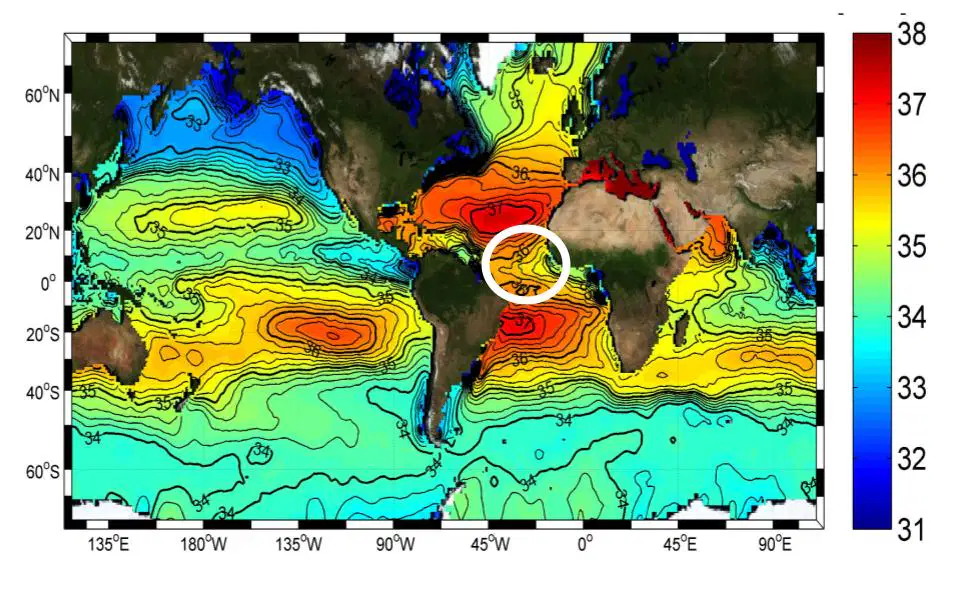
Which of the following best describes the location circled?
a)
There is a decreased salinity here due to large amounts of ice melting.
b)
There is a high rate of evaporation here, but there is also a high level of precipitation.
c)
The highest sea surface temperatures occur here due to the high rates of evaporation.
45.

Which of the following represents the ratio of hydroxide and hydrogen ions that you would find in distilled water?
a)
Beaker A
b)
Beaker B
c)
Beaker C
d)
Beaker D
e)
Beaker E
46.
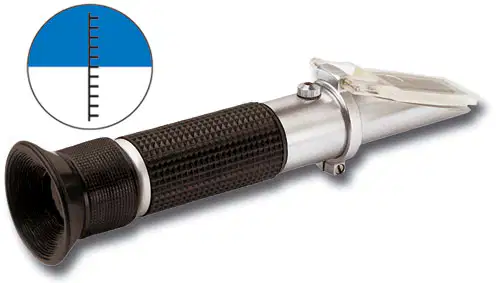
The instrument shown here is called a refractometer. You would use this to determine:
a)
The temperature of a water sample
b)
The turbidity of a water sample
c)
The salinity of a water sample
d)
The nutrient concentration of a water sample
47.
Which of the following would INCREASE salinity in a location?
a)
runoff from land
b)
ice melting
c)
heavy rainfall
d)
evaporation
48.
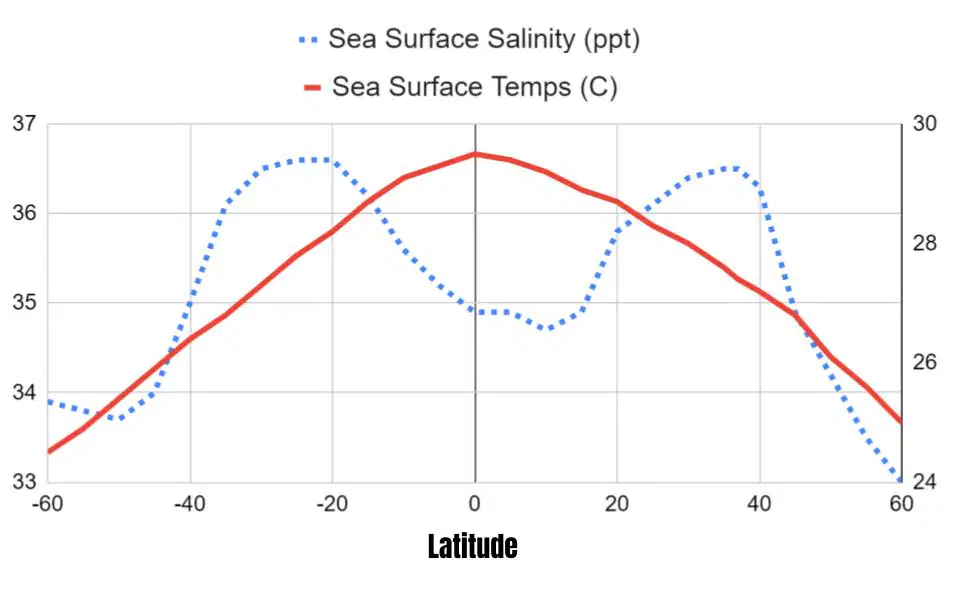
Which y-axis must be the one representing salinity? (look at the range of values - what do you know about ocean salinities?)
a)
the left vertical axis
b)
the right vertical axis
49.
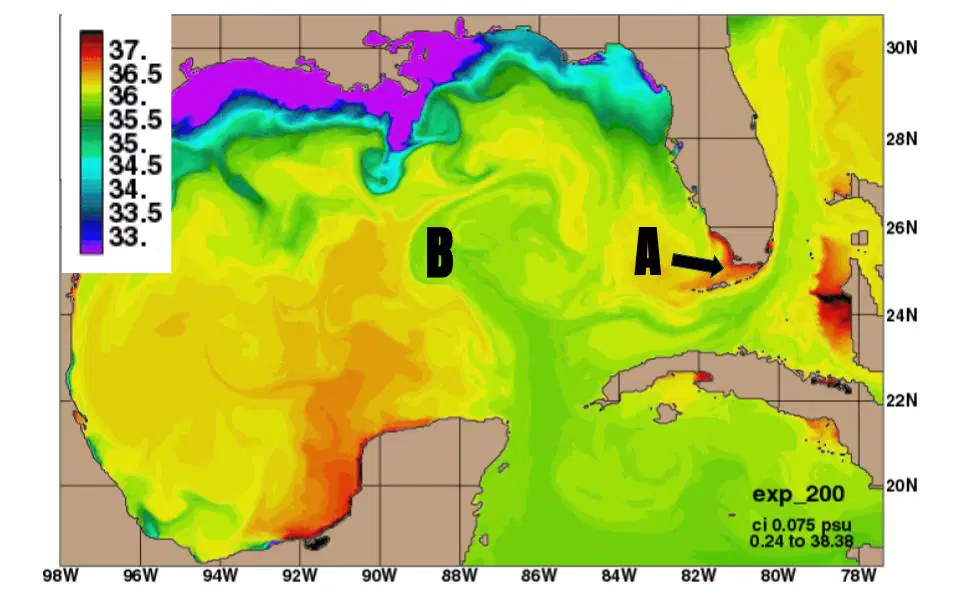
Location A is Florida Bay. Which of the following is the best explanation on why there are increased salinities in Florida Bay, in comparison to the surrounding waters of South Florida?
a)
There are large amounts of freshwater from the flow of the Everglades flowing into Florida Bay.
b)
Florida is a very shallow and warm body of water, with high rates of evaporation.
50.
What forms at the mouth of rivers that carry large amounts of silt and clay?
a)
tombolo
b)
delta
c)
sea stacks
d)
headlands
51.
Which is the largest particle size?
a)
sand
b)
clay
c)
silt
52.
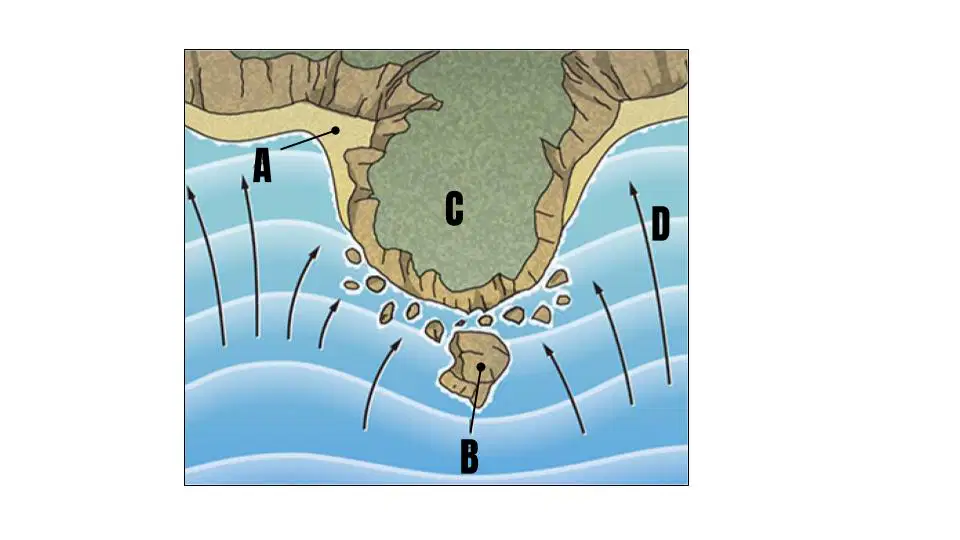
How was the formation represented by the letter B created?
a)
sedimentation built the sea stack
b)
surrounding erosion left the sea stack standing alone
53.
Which has overall higher levels of erosion than it does sedimentation?
a)
rocky coast
b)
sandy coast
54.
Choose the answer that provides examples of biological (or organic) weathering
a)
Frost wedging, in which ice in cracks of the rocks freezes
b)
Dissolving of calcite by carbonic acid
c)
Rock boring urchins biting chunks of rocks in the intertidal zone
55.
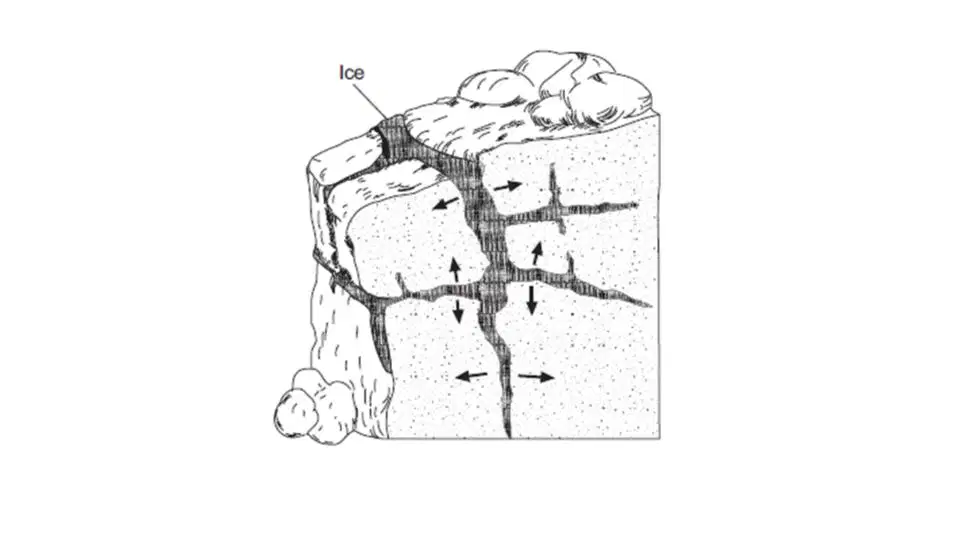
The diagram below shows a cliff along a coastline that has cracks. When water seeps into these cracks and then freezes, the cracks widen. Which type of weathering is this?
a)
chemical
b)
physical
c)
biological
56.
Which of the following is NOT true of depositional coasts?
a)
there is more sedimentation occurring than weathering
b)
they are constantly changing and shifting
c)
particles are only sand sized or larger
d)
all Florida beaches are depositional coastlines
57.
Along which type of coastline do you find estuaries, barrier islands, and sand bars?
a)
erosional
b)
depositional
58.
Why do estuaries often have high turbidity (water that is murky, non-clear)?
a)
the sediment contains a lot of large sand particles that sink quickly
b)
the sediment contains a lot of small, fine particles that are easily stirred up
59.
The thermocline is
a)
an ocean layer where rapid change in temperature occurs
b)
an ocean layer where rapid change in salinity occurs
c)
an ocean layer where rapid change in density occurs
60.
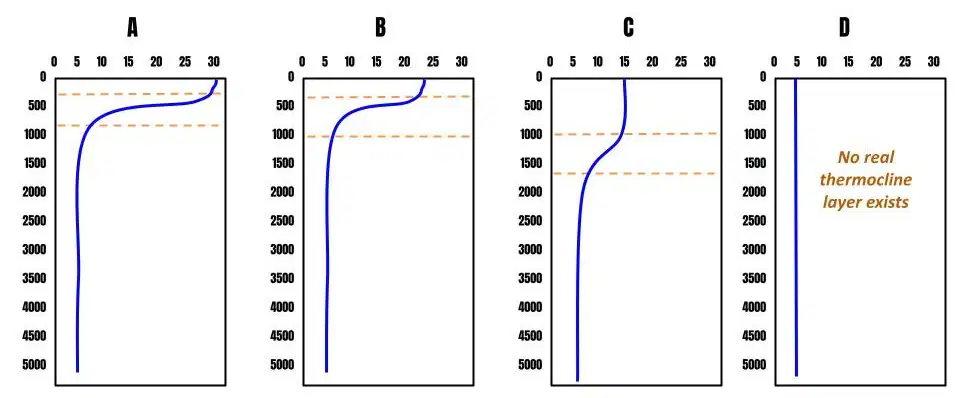
For these thermoclines, what unit is missing from the x-axis?
a)
temperature - in Celsius
b)
temperature - in Fahrenheit
c)
dissolved oxygen - in mg/L
d)
salinity - in ppt
61.
Which of the following is incorrect?
a)
the density of water is 1.0 g/ml
b)
the density of ice is 0.9 g/ml
c)
the density of seawater is 1.03 g/ml
d)
all of these are correct
62.

Which thermocline represents a polar ocean?
a)
thermocline A
b)
thermocline B
c)
thermocline C
d)
thermocline D
63.

Which is more dense?
a)
ice
b)
seawater
64.
Why does ice float?
a)
As water freezes, it expands and its density decreases.
b)
As water freezes, it takes up more hydrogen from the atmosphere, causing it to have a greater buoyancy.
c)
As water freezes, air becomes trapped between the hydrogen bonds of water molecules.
d)
As water freezes, it takes up more oxygen from the atmosphere, causing it to have a greater buoyancy.
65.
Which is more dense?
a)
saltwater
b)
freshwater
66.
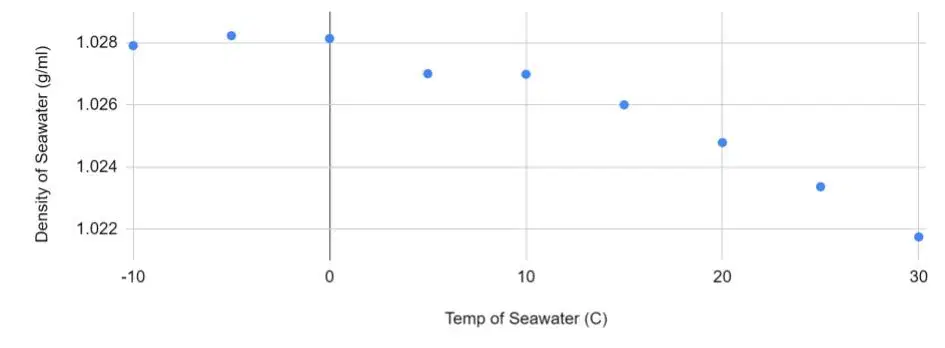
What can you conclude about the data shown on this graph?
a)
cold water is more dense
b)
warm water is more dense
67.
Upwelling currents bring water to the surface that is ..... (You must choose the TWO correct answers)
a)
warm
b)
cold
c)
rich in nutrients
d)
rich in oxygen
68.
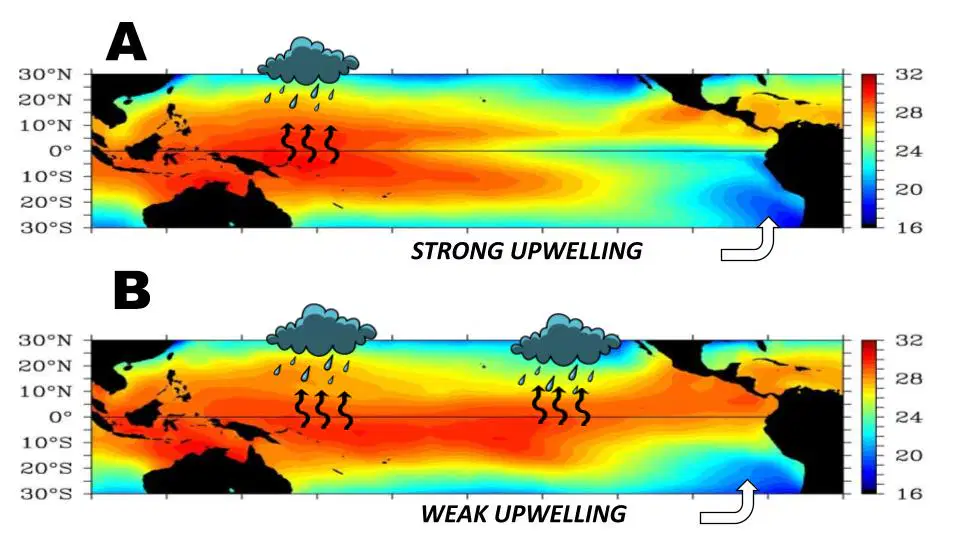
Which shows a normal year in the Pacific Ocean?
a)
Map A
b)
Map B
69.
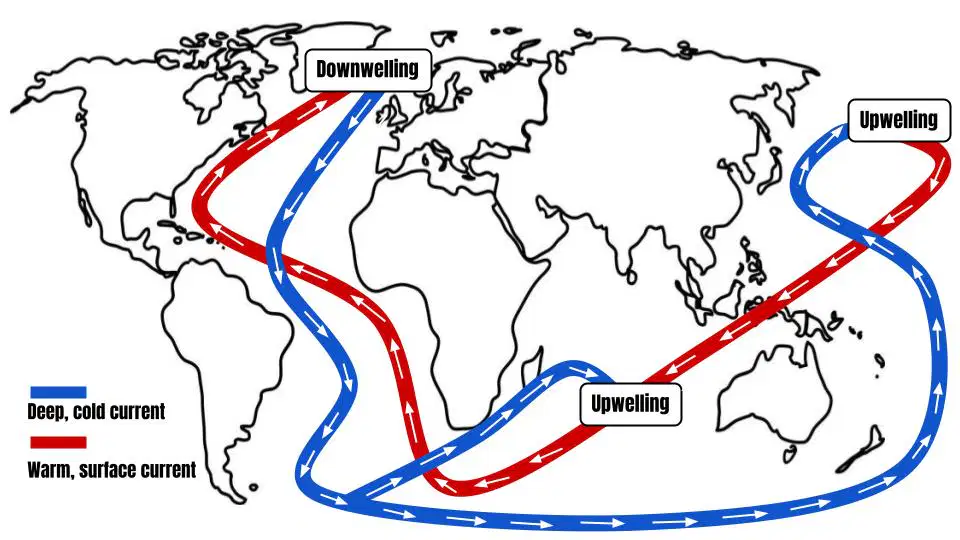
What causes the downwelling in the Northern Atlantic Ocean?
a)
strong winds from the Arctic Ocean
b)
salty water becoming very cold and dense in the Northern Atlantic
c)
extra strong tradewinds
d)
the delivery of warm water by the Gulf Stream
70.
During an El Nino year, the tradewinds
a)
are weaker
b)
are stronger
c)
don't change
71.
Which of the following is true?
a)
Currents traveling from the equator carry a lot of heat energy towards the poles.
b)
Currents traveling from the equator carry a lot of nutrients towards the poles.
c)
Currents traveling from the equator carry a lot of oxygen towards the poles.
72.
Coriolis Effect affects surface currents by
a)
making them warmer
b)
deflecting them left or right
c)
forcing them downwards
d)
making them faster
73.
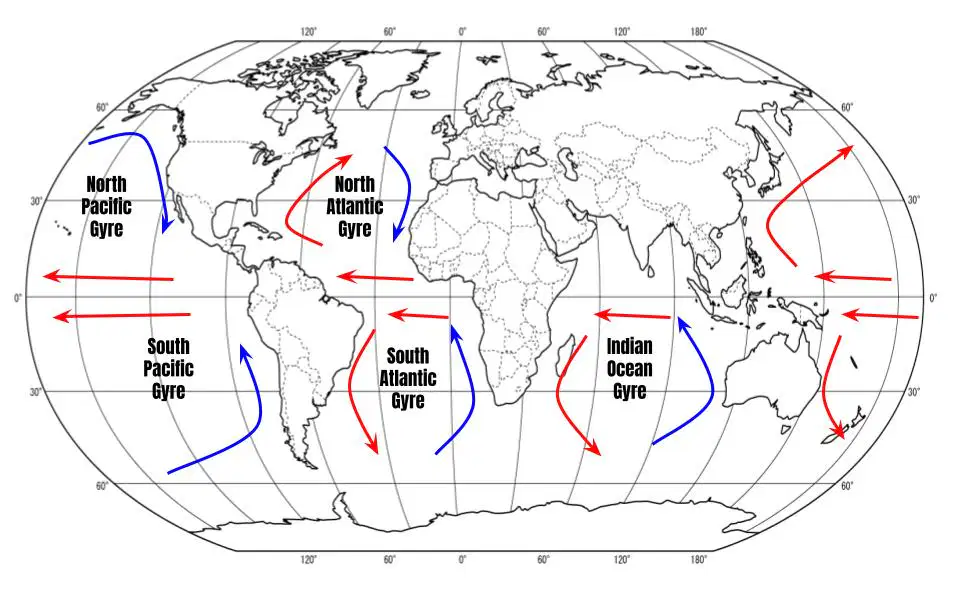
True or False: The westward directions of the tradewinds above and below the equator switch directions seasonally.
a)
False
b)
True
74.
During an El Nino year, the upwelling off of western South America
a)
is weaker
b)
is stronger
c)
is colder
d)
doesn't change
75.
When would you expect seabirds along the coast of Ecuador/Peru/Galapagos to have mass die-offs due to a lack of food (fish)?
a)
during a normal year
b)
during an El Nino year
c)
during a La Nina year
76.
During which year would you expect the strongest drought conditions in western Mexico?
a)
during a normal year
b)
during an El Nino year
c)
during a La Nina year
77.
Which of the following does NOT affect ocean currents?
a)
Coriolis Effect
b)
Winds
c)
Temperature and Density
d)
Gravitational pull of the moon
78.
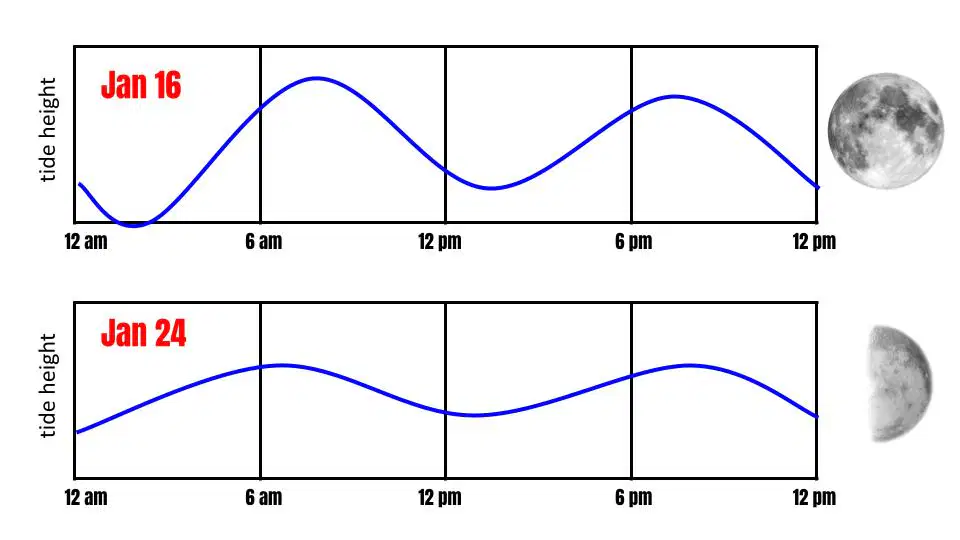
Which represents a spring tide?
a)
Jan 16
b)
Jan 24
79.
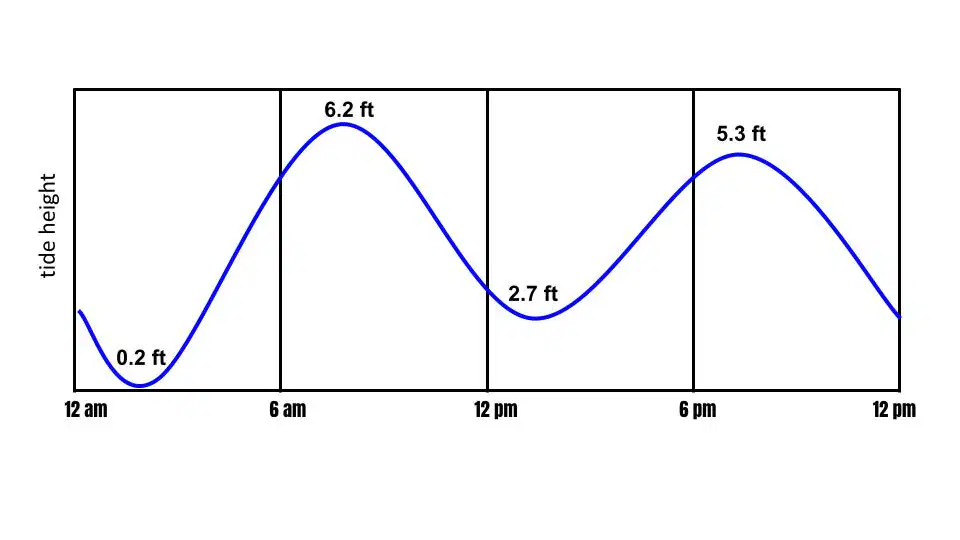
What is the tidal range on this day?
a)
6 ft
b)
6.2 ft
c)
0.9 ft
d)
2.5 ft
80.
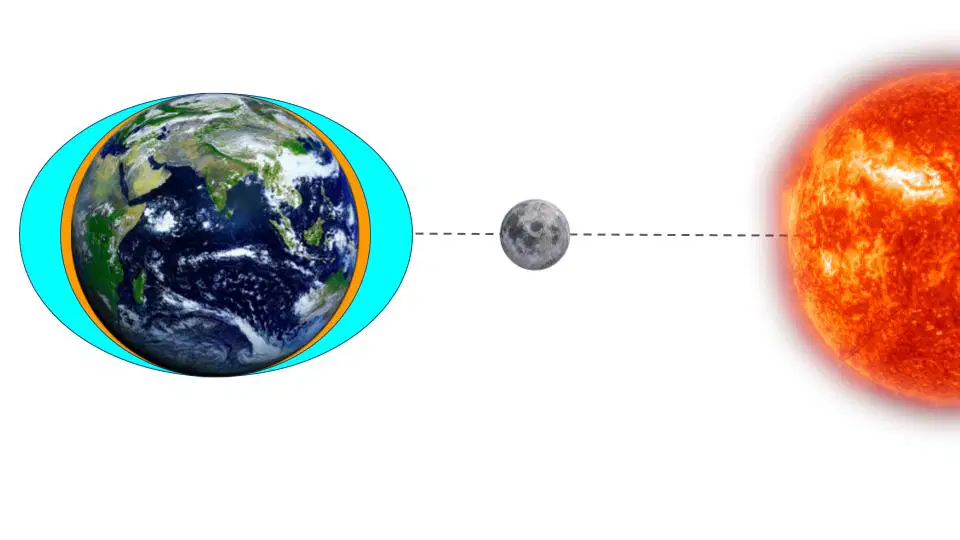
When the sun, moon, and earth are aligned as shown below, what type of tides will occur?
a)
spring tide
b)
neap tide
81.
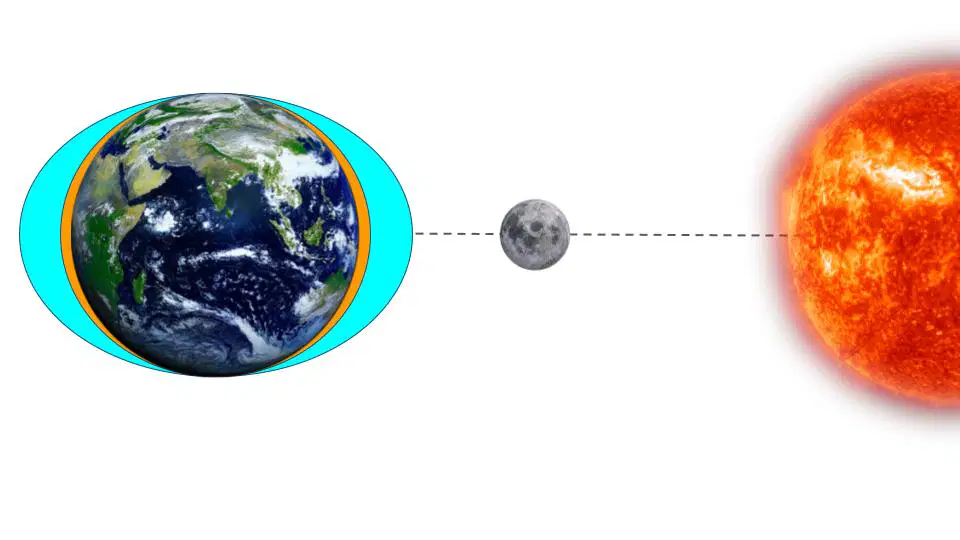
In the diagram below, the blue bulge indicates
a)
the bulge created by the pull of the moon
b)
the budge created by the pull of the sun
82.
About how much time passes between one spring tide and the next spring tide?
a)
about a week
b)
about 2 weeks
c)
about a month
d)
about 2 months
83.
During a full moon, the high tide will be
a)
one of the highest high tides of the month
b)
one of the lowest high tides of the month
100 %

