
 Worksheets
Year 7 ecology
Total questions: 79
Worksheet time: 2hrs 37mins

The original source of energy for a food web is...
plants
sun
producers
decomposers

Decomposers get energy from...
the sun
eating plants
eating animals
dead things and waste

Producers are ...
plants
able to do photosynthesis
also called autotrophs
all of these are true
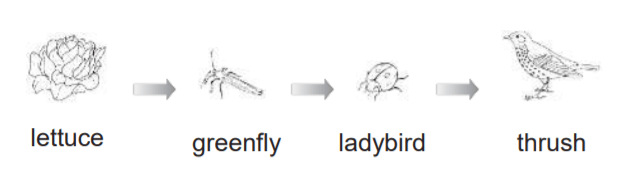
Who is the producer?
lettuce
greenfly
ladybird
thrush

What is a producer?
an organism that gets energy from eating other organisms
an organisms that uses sunlight to make its own food
an organism that gets energy from eating dead organisms, non-living material or waste

An animal that hunts other animals for food is a ___________
herbivore
predator
prey
omnivore

What is a herbivore?
an animal that gets energy from eating other animals
an organism that gets energy from eating only plants
an animal that gets energy by eating both plants and other animals

An organism that gets energy from eating other organisms is a ______________
producer
consumer
decomposer

A connection of food chains with many food energy paths in an ecosystem is a ____________
ecosystem
food web
environment

What is a carnivore?
an animal that gets energy by eating other animals
An animal that gets energy by eating only plants
an animal that gets energy by eating both plants and animals

The grasshopper has to eat the grass in order to get energy. This means the grasshopper is a(n) __________________________________________.
carnivore
producer
consumer
decomposer

In a different food chain, the mouse might eat the seeds of a plant. Because a mouse can eat plants and animals, it is classified as a(n) ________________________________________.
ominivore
hervivore
decomposer
carnivore

Which of the following are the producers in the food web?
Grasshoppers and crickets
Marsh grasses and cattails
Hawks and snakes
Shrews and Frogs

Which two animals does the hawk eat according to this food web?
Shrews and snakes
Shrews and frogs
Snakes and frogs
Shrews and Crickets

Select a sequence of one food chain represented in this food web, starting with a producer.
marsh grass, crickets, shrews, snakes
marsh grass, grosshoppers, frogs, hawks
cattails, crickets, frogs, hawks
cattails, crickets, shrews, hawks

Which of the following are considered a primary consumer? (can be more than one)
grasshopper
shrew
hawk
crickets

In this food chain, what will happen if the frogs become extinct?
The snakes will increase.
The grasshoppers will decrease.
The eagles will remain the same.
The grasshoppers will increase.

What is the driving source of energy for the food web?
Sun
Orca
Seal
Larvae

Which type of consumer is always a primary consumer?
Herbivore
Omnivore
Carnivore
Producer
Several food chains linked together make up
food web
food pyraid
ecosystem

Look carefully at the image. Which organism is tertiary consumer?
bird
lizard
grasshopper


Which animal is the top predator?
hawk
lizard
snake
grass
Which scenario describes a population?
a log providing shelter for beetles, spiders, and snakes
all of the sunfish, bass, and catfish living in a lake
all the mice living in a barn
a squirrel eating acorns
Deer and wolves share the same habitat. If the deer population decreased due to being hunted by man, how would this affect the wolf population?
More wolves would immigrate to the area.
The wolf population would increase.
The wolf population would decrease.
The would population would experience no change.

The graph shows the number of reindeer in a forest from 1970 to 2010. Which point on the graph indicates that the population had been affected by competition among reindeer for a limited food supply?
Point A
Point B
Point C
Point D
Why are there fewer organisms in each level as you go up the energy pyramid?
There is more energy available at higher levels.
Higher levels have more mean animals.
There is less energy availabe at higher levels.
Coyotes get hungrier.

According to the pond food web shown, which organism is a producer?
beetles
carp
diatoms
herons

If a disease killed all the mice in the food web shown here, how would that affect the owls and hawks?
Owls would be affected more because they are predators for fewer animals that the hawks.
Hawks would be affected more because they are predators for more animals than the owls.
Since they are both predators of mice, the hawks and the owls would be affected the same.
Since they are both predators of other animals, neither the hawks nor the owls would be affected.
A species that is NOT native to a particular region is called-
natural
invasive
endemic
extraordinary
An increase in population-
causes an increase in the need for natural resources.
causes a decrease in the need for natural resources.
causes no change in the need for natural resources.
has never occurred.

Which level of organization does the group pictured represent?
a community
a population
an organism
an ecosystem
What is the smallest level of organization within an ecosystem?
population
community
ecosystem
organism
What is an example of an ecosystem?
a deer
a group of deers, the sun, rabbits, the lake, the soil, a bird, a tree
a group of deers
a group of deers, rabbits, a bird, and a tree
Which of the following groups are abiotic?
bird, fish, tree, frog
shark, manatee, fly, lizard
water, shark, tree, soil
water, sun, 98 degrees, soil
Which of the following is a biotic factor?
a bird flying
a stream flowing
an airplane taking off
a thunderstorm
Biotic factors are...
living things
non-living things
undead things
Abiotic factors are...
living things
non-living things
undead things
Some examples of biotic factors would be
trees
insects
bacteria
all of the above
Which of these is NOT an abiotic factor?
water
temperature
grass
soil
Which of the following is an abiotic factor that plants depend on?
seed-eating birds
insect pollinators
ants building their nests in trees
nutrients in the soil
Which of the following is a biotic factor?
humans
bridges
roads
water


Identify the ecosystem
Forest
Tundra
Freshwater
Desert

Identify the ecosystem
Forest
Tundra
Freshwater
Grassland
A place where living and nonliving things interact
population
community
ecosystem
nutrient cycle
The number of species living in an ecosystem is referred to as...
succession
biodiversity
the food chain
productivity
Examples of elements that are recycled in an ecosystem include which of the following?
energy
water
carbon
ammonia

Biome with many different species of cacti and reptiles and very little rainfall.
Desert
Temperate Rainforest
Tropical Rainforest
Arctic Tundra

Air is a mixture of colorless gases. Air is an example of which type of factor?
BIOTIC
ABIOTIC

All living things or organisms in an ecosystem are
None
biotic factors
abiotic factors

Is temperature a biotic or abiotic factor?
biotic
abiotic

Are producers biotic or abiotic factors?
biotic
abiotic

Are decomposers biotic or abiotic factors?
biotic
abiotic

An angler fish has a fleshy growth on its head that gives off light. This part acts as a lure to help the angler fish catch its prey. An anglerfish is an example of which type of factor?
Biotic
Abiotic

Is soil a biotic or abiotic factor?
biotic
abiotic

Is wind a biotic or abiotic factor?
biotic
abiotic
Organisms and environment function as a unit in a(n) ________________.
ecosystem
species
community
population
____________________ is the struggle among organisms for resources such as food, water, and space.
crowding
predation
limitation
competition
Abiotic factors include all of the following except -
temperature.
pH.
availability of water.
competition.
Biotic factors include all of the following except -
parasitism.
feeding relationships.
predation.
climate.

If mice were removed from this ecosystem, which of the
following would also be expected to occur?
a decrease in the cricket population
a decrease in the corn population
a decrease in the hawk population
a decrease in the moth population

Which of the following would cause a decline in the lizard population?
a decrease in the cricket population
an increase in the corn population
a decrease in the mice population
an increase in the moth population

A decrease in which of the following populations would have the greatest effect on the rest of the organisms in this ecosystem?
hawks
corn
crickets
birds

Which of the following are the producers in this ecosystem?
Humpback whales
Sea turtles
Phytoplankton
Sharks

Overhunting of humpback whales would result in which of the following changes to this ecosystem?
a decrease in the puffin population
an increase in the population of krill
an increase in the phytoplankton population
increased competition between top predators

A decrease in the population of sharks due to poaching would cause which of the following factors to immediately increase for the puffins?
Predation
Competition
Parasitism
Adaptation

Insecticides are used by a farmer to decrease the grasshopper population in this area. This reduction in the grasshopper population would also cause which set of changes?
the grain population to decrease and the frog population to decrease
the grain population to decrease and the frog population to increase
the grain population to increase and the frog population to increase
the grain population to increase and the frog population to decrease

In this food chain, the spiders are -
Producers
Primary consumers
Competitors
Secondary Consumers

In this food pyramid, how much energy is available as the energy is passed from one trophic level to another?
1%
10%
25%
50%
True or False: Decreasing a population in an ecosystem will affect other populations in the ecosystem.
True
False
What happens when you remove a species from the beginning of a food web?
Every other population is affected
Only populations directly connected to the removed species are affected
Nothing - everything stays the same
Rising temperatures of ocean waters
disrupt marine ecosystems
Increases competition
Decrease temperatures
Decrease light



