wayground logo

Free Printable Worksheets

NEW

Font size

S
M
L
XL
Worksheets

Final Exam Review

Total questions: 76

Worksheet time: 54mins

Name
Class
Date
1.
If these boys are pulling with the same amount of force.  What will happen?
a)
The boy in blue will win.
b)
They will not move at all.
c)
The boy in red will win.
d)
Both will fall down.
2.
This is an example of what kind of force?
a)
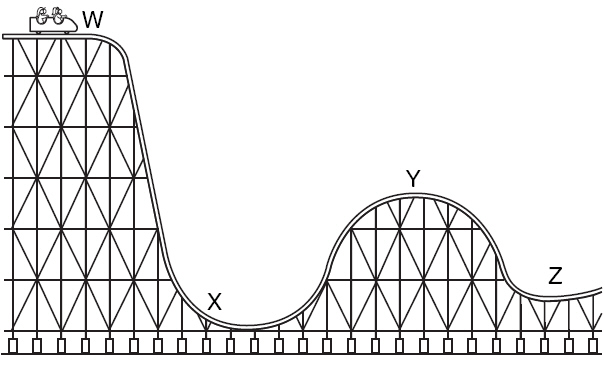
Balanced Force
b)
Pushing Force
c)
Gravity Force
d)
Unbalanced Force
3.
What is a PUSH or PULL of an object?
a)
Motion
b)
Force
c)
Friction
d)
Gravity
4.
How is gravity affected by mass?
a)
the larger the mass of the object, the greater the gravity
b)
small objects have no gravity
c)
gravity is not affected by mass of objects, whether large or small
5.
What is the standard unit force is measured in?
a)
Newtons
b)
pounds
c)
grams
d)
meters
6.
A greater applied force is required to move an object with a greater mass than one with a smaller mass.
a)
True
b)
False
7.

Mrs. Gibson creates an experiment with different heights of ramps to see which height makes a toy car travel farther. What is the variable?

a)

Size of the car

b)

Height of the ramp

c)

Distance the car travels

d)

Surface of the ramp

8.
Is this a balanced or unbalance force?
a)
Balanced
b)
Unbalanced
c)
Neither one
d)
Both
9.
Calculate the net force of the object in the image shown.
a)
20N
b)
35N
c)
5N
d)
25N
10.
Which direction will the object move?
a)
Up
b)
Down
c)
Right
d)
Left
11.
Is this a balanced or unbalanced force?
a)
Balanced
b)
Unbalanced
c)
Neither
d)
Both
12.
This model shows the forces applied to a box.  However, this model DOES NOT show ________________________.
a)
the forces acting in opposite directions
b)
that the forces are unequal
c)
that student B is pushing harder
d)
the actual amount of the forces
13.
Students are playing tug-of-war. If group B pulls the rope to the right with a force of 400 N and group A pulls the rope to the left with a force of 250 N, what will happen to the ribbon in the middle of the rope?
a)
The ribbon will move to the left and group A will win the tug-of-war.
b)
The ribbon will move to the left and group B will win the tug-of-war.
c)
The ribbon will move to the right and group B will win the tug-of-war.
d)
The ribbon will move to the right and group A will win the tug-of-war.
14.
A cyclist traveling at 25 km/hr turns sharply to the left while continuing to move 25 km/hr. This means the forces involved are_____________________.
a)
Balanced, because the cyclist's speed did not change.
b)
Balanced, because he was still moving forward.
c)
Unbalanced, because it's the same bicycle.
d)
Unbalanced, because his direction changed.
15.
The forces represented by the arrows in the diagrams are applied to the four objects that are at rest on a table. Which object is most likely to move to the right?
a)
Object W
b)
Object X
c)
Object Y
d)
Object Z
16.
An airplane is travelling North through the sky at a constant speed when turbulence causes it to take a different route, changing its direction. Explain the forces at work on this plane.
a)
Unbalanced, because the plane is moving forward, not backwards
b)
Unbalanced, because the speed is constant and there is a change in direction
c)
Balanced, because the plane is not falling to a lower altitude
d)
Unbalanced, because the plane is in motion
17.
The roller coaster car begins at point W.  At what point along the track will the car have the greatest amount of kinetic energy?
a)
W
b)
X
c)
Y
d)
Z
18.
Where is the force of attraction the strongest on a magnet?
a)
at the poles
b)
in the middle
c)
above the magnet
d)
below the magnet
19.
The picture is an example of an:
a)
Electric circuit
b)
Electromagnet
c)
Electric nail
d)
Electric power cell
20.

The entire region surrounding a magnet is known as the:

a)

Magnetic Domain

b)

Lodestone

c)

A Compass

d)

Magnetic Field

21.
What will happen when these magnets are brought close together?
a)
They will attract each other.
b)
They will repel each other.
c)
Both magnets will turn to the left
d)
Both magnets will turn to the right
22.
Earth's magnetic field and a bar magnet attract particles to the same locations. Where are they?
a)
The middle
b)
All around the outside
c)
The north and south poles
d)
First to the middle, then to the ends
23.

To make this electromagnet stronger you could:

a)

use less wire

b)

have fewer wire coils around the nail

c)

have more wire coils around the nail

d)

use a plastic core

24.
Energy of motion is which type of energy?
a)
Potential
b)
Kinetic
c)
Sound
d)
Gravitational
25.
The faster an object moves, the ________ kinetic energy it has. 
a)
more
b)
less
c)
none of the above
d)
all of the above 
26.
__________ is stored energy. 
a)
Potential
b)
Kinetic
c)
None of the above 
d)
All of the above 
27.
Gravitational potential energy depends on the ________ and ________ of the object. 
a)
Height and mass
b)
Friction and movement
c)
Mass and Movement
d)
Height and Friction 
28.
At which point is potential energy greatest?
a)
W
b)
X
c)
Y
d)
Z
29.
Energy can not be created or destroyed, only converted from one form to another.
a)
true
b)
false
30.
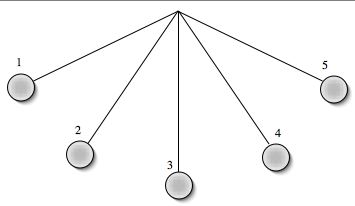
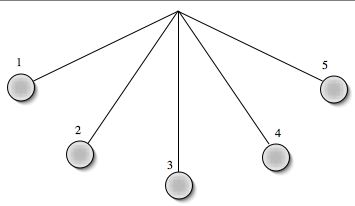
When a pendulum swings, at which point is kinetic energy highest?
a)
1
b)
2
c)
3
d)
4
31.
When a pendulum swings, at which point is potential energy at its greatest?
a)
1
b)
2
c)
3
d)
4
32.
What are the reasons for the season?
a)
Earth's tilt & rotation
b)
Earth's tilt & revolution
c)
Earth's rotation & rovolution
d)
Earth's tilt & resolution
33.
The hemisphere where you live 
a)
equator
b)
southern
c)
northern
d)
eastern
34.
What causes there to be longer number of hours of light during the summer
a)
Earth tilt's away from the sun in summer
b)
Earth's revolves slower in summer
c)
Earth tilts toward the sun in summer
d)
Earth is closer to the sun
35.
Why is it warmer in the summer?
a)
Closer to the sun
b)
More direct light from Earth's tilt
c)
Stronger light from the sun
d)
Earth spins slower
36.
Why is the Equator warmest?
a)
Because it is closest to the sun.
b)
Because it receives the most direct sunlight
c)
Because no clouds form here.
d)
Because it is far from the sun
37.
What moon phase is this picture?
a)
This is the full moon phase.
b)
This is the waxing gibbous moon phase.
c)
This is the waning gibbous moon phase.
d)
This is the first quarter moon phase.
38.
What moon phase is this picture?
a)
This is the waning crescent phase.
b)
This is the waxing gibbous phase.
c)
This is the waning gibbous phase.
d)
This is the new moon phase.
39.
What moon phase is this picture?
a)
This is the full moon phase.  
b)
This is the waxing crescent moon phase.
c)
This is the waning gibbous moon phase.
d)
This is the waning crescent moon phase.
40.
What is this moon phase?
a)
This is the waxing gibbous moon phase.
b)
This is the last quarter moon phase.
c)
This is the first quarter moon phase.
d)
This is the new moon phase.  
41.
What moon phase is this image?
a)
This is the full moon phase.
b)
This is the last quarter moon phase.
c)
This is the waxing gibbous moon.
d)
This is the new moon phase.
42.
What is the difference between a gibbous moon and a crescent moon?
a)
The gibbous shows more than half of the bright side of the moon.
b)
The crescent shows more than half of the bright side of the moon.
c)
The gibbous shows less than half of the bright side of the moon. 
43.
How many phases does the moon go through?
a)
4
b)
8
c)
10
d)
16
44.
What part of the moon do we see from Earth?
a)
all of it
b)
the same side
c)
none of it
d)
only one quarter
45.
The cycle of the moon lasts about a _.
a)
day
b)
year
c)
week
d)
month
46.

Species that existed on Earth for a short length of time, were abundant, and inhabited many locations

a)

unconformity

b)

correlation

c)

index fossil

d)

fossil

47.

The age of rocks and geologic features compared with other rocks and features nearby

a)

unconformity

b)

superposition

c)

absolute age

d)

relative age

48.
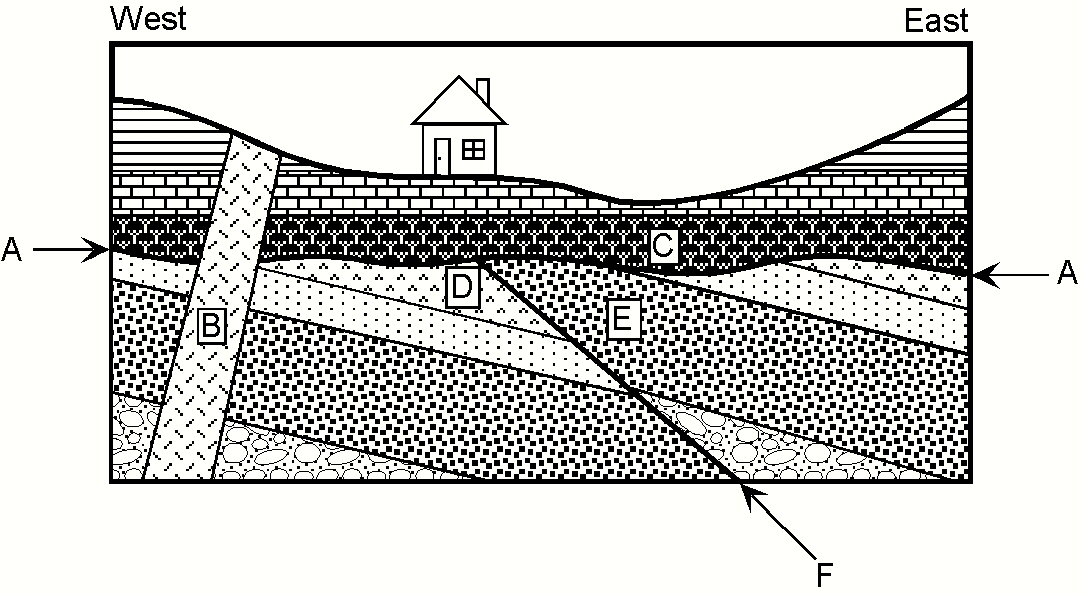
Which of the following correctly lists the layers in order from oldest to youngest?
a)
A, B, C, D, E
b)
E, B, C, D, A
c)
E, D, C, B, A
d)
C, B, A, D, E
49.
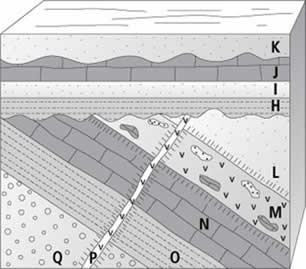
The rock formation labeled "P" is a(n)...
a)
fault
b)
intrusion
c)
inclusion
d)
unconformity
50.
Letter "F" is a....
a)
inclusion
b)
intrusion
c)
fault
d)
unconformity 
51.
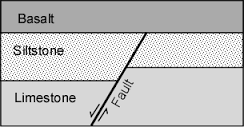
What are the relative ages of the features in order from oldest to youngest?
a)
Limestone, Basalt, Fault, Siltstone
b)
Siltstone, Fault, Basalt, Limestone
c)
Limestone, Fault, Basalt, Siltstone
d)
Limestone, Siltstone, Fault, Basalt
52.

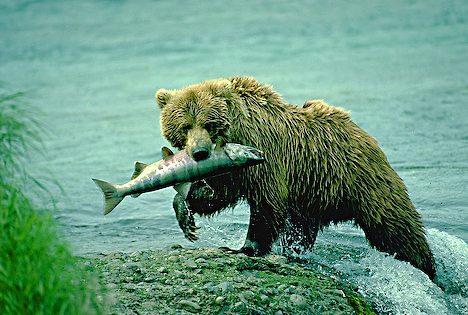
A grizzly bear survives because he is well-adapted to his environment. When he reproduces he passes on those traits to his offspring. this process is called

a)

Natural Selection

b)

Selective Breeding

c)

Random mutations

d)

Variations in a species

53.

The peppered moth's color camouflaged it on the light colored tree bark. It's color was an example of a/n

a)

Variation

b)

Dominant trait

c)

Recessive trait

d)

Adaptation

54.

Where are hereditary traits stored in all organisms?

a)

In the blood

b)

In the brain

c)

In the DNA

d)

In the heart

55.

Changes in inherited characteristics can cause a species to change into a new one. This change over time is called?

a)

Graduation

b)

Selective Breeding

c)

Revolution

d)

Evolution

56.
What is the definition of natural selection?
a)
Genes that are chosen by humans such as farmers and ranchers
b)
Organisms that are chosen by environmental pressures such as climate, available food, predators and habitat.
c)
Dogs and Wolves
d)
Genes that are chosen by scientist and academics. 
57.
The Aztecs and Maya Tribes of Mexico where some of the first humans to slowly change wild corn to the corn we know today. What process did these tribes use?
a)
Natural Selection
b)
Artificial Selection "Selective Breeding"
c)
Mitosis
d)
Cell Membrane
58.
Scientist have created larger and sweeter strawberries for humans to consume (eat). What process was used?
a)
Natural Selection 
b)
Artificial Selection 
c)
Cellular Respiration 
d)
Environmental Natural Selection 
59.
What happens to frequency when the energy increases?
a)
it increases
b)
it decreases
c)
it stays the same
60.
What part of the wave is shown at letter A?
a)
crest
b)
trough
c)
wavelength
d)
frequency
61.
Which part of the wave is shown at letter B?
a)
crest
b)
trough
c)
wavelength resting point
62.
Which part of the wave is shown at letter C?
a)
crest
b)
wavelength
c)
resting point
d)
amplitude
63.
Which part of the wave is shown at letter D?
a)
trough
b)
resting point
c)
wavelength
d)
frequency
64.
Which part of the wave is shown at letter E?
a)
trough
b)
crest
c)
resting point
d)
amplitude
65.
What does a wave carry?
a)
boats
b)
matter
c)
energy
d)
water
66.
When wavelength increases, what happens to the frequency?
a)
it increases
b)
it decreases
c)
it stays the same
67.
What is the speed of a wave that has a wavelength of 2 and a frequency of 2.5?
a)
2.5 m/s
b)
5 m/s
c)
4.5 m/s
d)
6 m/s
68.
Which wave has a greater frequency?
a)
wave B
b)
wave C
69.
Which wave has the most energy?
a)
top wave
b)
bottom wave
70.
Longitudinal waves are ______.
a)
Parallel
b)
Perpendicular
c)
Crazy
71.
Transverse waves are ___.
a)
Parallel
b)
Perpendicular
c)
Weird
72.
What is the wavelength?
a)
Length
b)
Height
c)
# of waves
73.
The loudness of the sound depends on
a)
wavelength
b)
amplitude
c)
frequency
74.
Which EM wave has the lowest frequency?
a)
radio
b)
xray
c)
gamma
d)
infrared
75.
A blue tshirt looks blue because of ___.
a)
reflection
b)
refraction
c)
diffraction
76.
Is refracting light bending or bouncing?
a)
bending
b)
bouncing