wayground logo

Free Printable Worksheets

Font size

S
M
L
XL
Worksheets

THE QUIZ OF SOUND AND LIGHT WAVE DESTINY!!!!!

Total questions: 81

Worksheet time: 1hrs 24mins

Name
Class
Date
1.

What is any spot on a wave where there is no amplitude called?

a)

node

b)

antinode

c)

trough

d)

crest

2.

Adjusting the amplitude of a wave changes....

a)

...the height of the peaks and the depths of the troughs.

b)

...the length of the waves.

c)

...the frequency of the waves.

d)

...the speed of the waves.

3.

What is a blue-shift?

a)

The apparent bunching-up of waves as they move toward you.

b)

The apparent spreading out of waves as they move away from you.

4.

What is a red-shift?

a)

The apparent bunching-up of waves as they move toward you.

b)

The apparent spreading out of waves as they move away from you.

5.

Longitudinal waves require a medium. What is an example of this?

a)

Sound waves.

b)

Electric waves.

c)

Light waves.

d)

None of these.

6.

What is the definition of Period?

a)

How long it takes to complete one wave.

b)

How often a wave goes by.

c)

How many waves can be completed in one second.

d)

None of these.

7.

A wave is traveling at a speed of 500 m/s. If the wave is as long as a soccer field, 100 m, what is the frequency of the wave?

a)

500,000 Hz

b)

5 Hz

c)

0.2 Hz

d)

1/5 Hz

8.
Transverse waves require no medium.  What is an example of this?
a)
Sound waves.
b)
Pressure waves.
c)
Light waves.
d)
Audio waves.
9.
Noise cancelling headphones work by means of...
a)
constructive interference
b)
destructive interference
c)
non-interference
d)
spatial interference
10.

The length of a wave is measured in meters. What is the symbol used for it?

a)

A

b)

f

c)

c

d)

λ

11.
Any point where any amplitude occurs on a standing wave is called...
a)
antinode
b)
node
c)
crest
d)
trough
12.

A wave that is 2 m long passes by with a frequency of 6 Hz. What is the speed at which this wave travels?

a)

12 m/s

b)

3 m/s

c)

0.5 m/s

d)

36 m/s

13.
The Doppler Effect is possible in...
a)
Only sound waves.
b)
Only light waves.
c)
All kinds of waves.
d)
Only pressure waves.
14.
A wave source that appears to move toward a viewer creates an apparent...
a)
red-shift
b)
blue-shift
c)
no shift
d)
the doppler effect
15.
As the fire truck approached Mary, the pitch of the siren got higher. Once the fire truck passed and moved away, the siren's pitch got lower. This change in pitch is because of a change in the sound wave's
a)
concussion. 
b)
amplitude. 
c)
reflection.
d)
frequency. 
16.
Which statement about sound waves is true? 
a)
Air travels with them
b)
They travel through a vacuum
c)
They exist only if heard
d)
They can be reflected. 
17.
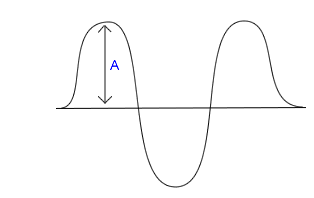
If the distance represented by the letter A were increased, how would it change the way the sound was heard?
a)
The sound would be higher. 
b)
The sound would be lower. 
c)
The sound would be softer. 
d)
The sound would be louder. 
18.
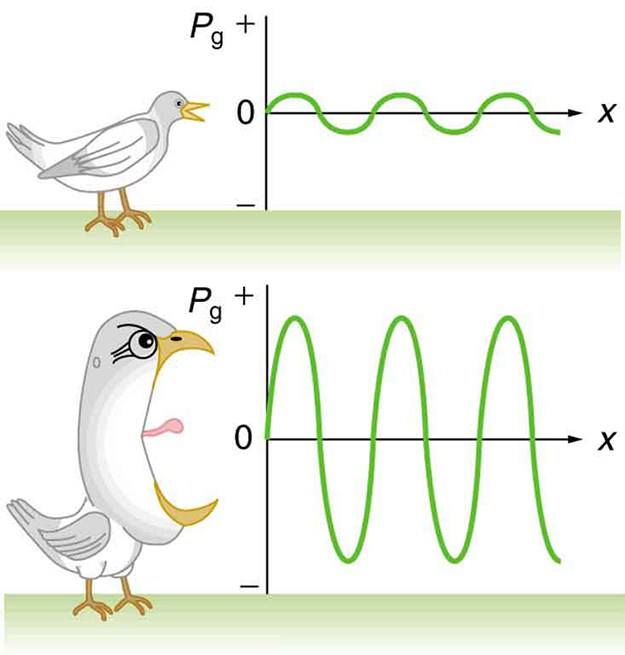
When comparing the two waves that are shown, how would Wave A (green wave) differ than Wave B (black wave)?
a)
Wave A and B have the same amplitude, but wave B (black) has a lower pitch.
b)
Wave A and B have the same amplitude, but Wave A has a lower pitch. 
c)
Wave A and B have the same pitch, but Wave A is a softer sound. 
d)
Wave A and B have the same pitch, but Wave B is a softer sound. 
19.
What does pitch depend on?
a)
amplitude 
b)
frequency
c)
intensity 
d)
volume of sound
20.
When a sound is louder what measurement gets bigger?
a)
Frequency 
b)
Amplitude 
c)
Wavelength 
d)
Crest
21.
A wave that requires a medium through which to travel
a)
mechanical wave
b)
chemical wave
c)
electromagnetic wave
d)
pitch
22.
Highest point of a wave
a)
crest
b)
trough
c)
wavelength
d)
frequency
23.
The number of wavelengths that pass a point each second
a)
crest
b)
amplitude
c)
frequency
d)
pitch
24.
The shorter the wavelength the 
a)
shorter the frequency
b)
higher the freuqnecy
c)
frequency stays the same
d)
less energy
25.
Sound is produced by
a)
music
b)
vibrations of molecules
c)
Electromagnetic Waves 
d)
Transverse Waves 
26.
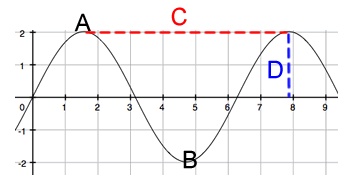
If distance C on the diagram increased, what would happen to the pitch? 
a)
The pitch would be louder. 
b)
The pitch would be softer. 
c)
The pitch would be higher. 
d)
The pitch would be lower. 
27.
Which feature of sound is determined by amplitude?
a)
Pitch
b)
Smoothness
c)
Loudness
d)
A Wave
28.
A disturbance that transfers energy from one place to another without transferring matter.
a)
wave
b)
trough
c)
pitch
d)
sound
29.
Material (matter) through which a wave travels
a)
medium
b)
Doppler Effect
c)
sound
d)
pitch
30.
Sound is a form of _________________ that travels as waves through a ________________.
a)
light/ transparency
b)
energy/ vibration
c)
energy/ medium
d)
frequency/ medium
31.
Which color of light is produced when all of the colors of visible light in the electromagnetic spectrum are combined?
a)
gray
b)
white
c)
black
32.
Which of the following statements BEST describes visible light?
a)
Light is an electromagnetic wave of a single frequency that makes up a small part of the electromagnetic spectrum.
b)
Light is an electromagnetic wave of a single frequency that makes up most of the electromagnetic spectrum.
c)
Light includes a range of electromagnetic waves that make up a small part of the electromagnetic spectrum.
d)
Light includes a range of electromagnetic waves that make up most of the electromagnetic spectrum.
33.
Visible light is which type of wave?
a)
seismic
b)
mechanical
c)
longitudinal
d)
electromagnetic
34.
Which of these describes a small range in the electromagnetic spectrum?
a)
gravity
b)
radiation
c)
electricity
d)
light
35.
Which statement BEST describes the relationship between visible light and the electromagnetic spectrum?
a)
Visible light and the electromagnetic spectrum are different names for the same phenomenon.
b)
Visible light occupies about half of the electromagnetic spectrum.
c)
Visible light is a narrow band in the electromagnetic spectrum.
d)
Visible light and the electromagnetic spectrum have a small area of overlap.
36.
Light waves are arranged in the electromagnetic spectrum by
a)
wavelength and brightness.
b)
speed and color.
c)
brightness and color.
d)
wavelength and frequency.
37.
Which of these colors of visible light has the shortest wavelength?
a)
red
b)
green
c)
violet
d)
yellow
38.
Scientists use large optical telescopes to obtain information about the planets in the solar system. What wavelengths of electromagnetic radiation provide this information?
a)
gamma radiation
b)
infrared radiation
c)
radio waves
d)
visible light
39.
As the loudness of a sound wave increases, which will also increase?
a)
amplitude
b)
frequency
c)
velocity
d)
wavelength
40.
Which of these illustrates that sound waves can travel through a liquid?
a)
Voices can be heard as people speak to one another.
b)
Whales and porpoises signal each other by making sounds.
c)
Astronauts can’t hear each other in space unless they use a radio.
d)
Footsteps can be heard through the ceiling as someone walks on the roof.
41.
An echo is a sound wave that has been
a)
absorbed.
b)
refracted.
c)
scattered.
d)
reflected
42.
The MOST likely reason sound travels faster in salt water than in fresh water is that salt water
a)
is more elastic.
b)
absorbs heat faster.
c)
has a higher density.
d)
reflects sound better.
43.
What is the MOST important property architects must consider when selecting materials for the walls, ceilings, and floors for a new concert hall?
a)
thermal properties
b)
chemical properties
c)
electrical properties
d)
acoustical properties
44.
Which is a source of sound?
a)
thermal energy
b)
potential energy
c)
a vibration
d)
a medium
45.
The distance between the line of origin to the top of the wave is called
a)
amplitude
b)
wavelength
c)
frequency
d)
speed
46.
Waves that travel at the same speed as light, but have different wavelengths and frequencies make up the
a)
energy fields
b)
electromagnetic spectrum
c)
polarized fields
d)
magnetic field
47.
True or false: The angle of incidence equals the angle of reflection.
a)
True
b)
false
48.
Concave or Convex?
a)
Concave
b)
Convex
49.
The bending of a wave as it travels from one medium to another and as a result changes speed is called
a)
reflection
b)
refraction
c)
diffraction
d)
interference
50.
Sound will usually travel the fastest in a ____________.
a)
vacuum
b)
solid
c)
liquid
d)
gas
51.
What word describes the number of waves that pass a certain point in a given amount of time?
a)
rarefactions
b)
amplitude
c)
resonance
d)
frequency
52.
The bending of a wave around the edge of a barrier is called
a)
reflection
b)
diffraction 
c)
interference
d)
refraction
53.
Two waves combining to form a wave with a larger amplitude results in
a)
constructive interference
b)
destructive interference
54.
The bouncing back of a wave when it hits a surface through which it can NOT pass is called —
a)
rarefaction
b)
reflection
c)
diffraction
d)
refraction
55.
lowest part of a wave
a)
crest
b)
trough
c)
wavelength
d)
amplitude
56.
top part of a wave
a)
crest
b)
trough
c)
wavelength
d)
amplitude
57.
Sound is a type of ____ energy
a)
chemical
b)
radiant
c)
electrical
d)
mechanical
58.
When a wave moves parallel to the direction that the wave travels, it is a
a)
longitudinal
b)
transverse
59.
The material through which a wave travels is called the —
a)
medium
b)
matter
c)
substance
d)
vacuum
60.
Which travels faster: sound or light?
a)
light
b)
sound
61.
As the wavelength of a sound wave increases, the frequency
a)
decreases
b)
increases
62.
The Tacoma Narrows Bridge was opened to traffic on July 1, 1940 and collapsed on November 7, 1940. One theory created for the bridge's failure is that the pressure of the wind caused the natural frequencies of the bridge to move. This condition is called —
a)
amplification
b)
reflection
c)
diffraction
d)
resonance
63.
How does light travel?
a)
longitudinal wave
b)
transverse wave
64.
This type of lens is thinner in the middle than on the edges. What type of lens does this describe?
a)
Concave
b)
Convex
65.
Which electromagnetic wave has the shortest wavelength?
a)
radio
b)
gamma
c)
visible
66.
Which of the following forms of electromagnetic radiation has the lowest frequency,longest wavelength, and carries the least amount of energy?
a)
radio
b)
gamma
c)
infrared
d)
visible
67.

If the wavelength of a sound wave is increased, what would happen to the sound made by this wave?

a)

It would have a lower pitch

b)

It would get softer

c)

It would get louder

d)

It would have a higher pitch

68.

If the wavelength of a sound wave is decreased, what would happen to the sound made by this wave?

a)

It would have a lower pitch

b)

It would get softer

c)

It would get louder

d)

It would have a higher pitch

69.

If the amplitude of a sound wave is decreased, what would happen to the sound made by this wave?

a)

It would have a lower pitch

b)

It would get softer

c)

It would get louder

d)

It would have a higher pitch

70.

If the amplitude of a sound wave is increased, what would happen to the sound made by this wave?

a)

It would have a lower pitch

b)

It would get softer

c)

It would get louder

d)

It would have a higher pitch

71.

As the wavelength of sound increases, the frequency ___.

a)

increases

b)

decreases

c)

stays the same

d)

is higher pitched

72.

How do the air molecules vibrate in a sound wave?

a)

in the same path as the wave

b)

the air molecules themselves do not move

c)

at right angles to the wave

d)

in all directions

73.

The number of waves that occur in a time interval is referred to as ___.

a)

frequency

b)

compression

c)

amplitude

d)

speed

74.

The spread apart regions of particles in a sound wave are called ____.

a)

rarefactions

b)

compressions

c)

frequencies

d)

wavelengths

75.

The pressed together regions of particles in a sound wave are called ____.

a)

rarefactions

b)

compressions

c)

frequencies

d)

wavelengths

76.

In the sound wave, what are the correct labels for areas X and Z?

a)

X = compression, Z = rarefaction

b)

X = trough, Z = crest

c)

X = crest, Z = trough

d)

X = rarefaction, Z = compression

77.

Sound waves can travel through all of the following EXCEPT

a)

a vacuum (empty space)

b)

air

c)

water

d)

steel

78.

What numbers should be labeled rarefaction in the longitudinal wave?

a)

1 and 3

b)

2 and 4

c)

1 and 2

d)

3 and 4

79.

As sound waves travel through air, they cause air molecules to ___.

a)

vibrate

b)

bend

c)

lose energy

d)

be absorbed

80.

Which labeled sound wave produced from the train whistle has the highest frequency?

a)

3

b)

2

c)

1

d)

4

81.

Which of the following is the unit for measuring loudness of sounds?

a)

decibel

b)

ampere

c)

coulomb

d)

joule