wayground logo

Free Printable Worksheets

Font size

S
M
L
XL
Worksheets

Common Assessment Study Guide

Total questions: 85

Worksheet time: 1hrs 16mins
Name
Class
Date
1.
What is the purpose of a dichotomous key?
a)
to find a common ancestor
b)
to show the evolution of organisms
c)
to show relationships between organisms
d)
to identify organisms
2.
When using a dichotomous key to identify organisms, what do we look at?
a)
physical features
b)
weather patterns
c)
environment
d)
diet
3.
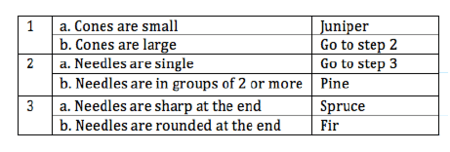
A dichotomous key for trees is provided. Hikers found a tree that has large brown cones and single sharp needles. What species of tree have the hikers found?
a)
Juniper
b)
Pine
c)
Spruce
d)
Fir
4.
A dichotomous key for insects is given. To what order does an insect with two pairs of scaly wings belong?
a)
Coleoptera
b)
Heteroptera
c)
Diptera
d)
Lepidoptera
5.
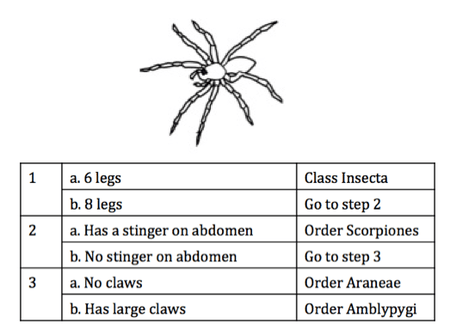
An illustration and a dichotomous key are given. What is the correct classification for this organism?
a)
Class Insecta
b)
Order Amblygygi
c)
Order Araneae
d)
Order Scorpiones
6.

What theory proposes that organisms with traits better suited to their environment are more likely to survive and reproduce?

a)

Acquired Characteristics

b)

Embryology

c)

Survival of the Smartest

d)

Natural Selection

7.

The fur of the snowshoe rabbit changes to a lighter color in the winter. This allows the rabbit to blend in with its surroundings. This change is an example of:

a)

Adaptation

b)

Extinction

c)

Competition

d)

Succession

8.

Due to genetic inheritance, members of a species can be slightly different from another in their traits. This is known as...

a)

Variation

b)

Overproduction

c)

Competition

d)

Evolution

9.

The finches on the Galapagos island were similar in form except for variations of their beaks. Darwin observed that these variations were useful for:

a)

Attracting a mate.

b)

Gathering food.

c)

Defending territory.

d)

Building nests.

10.
Where the better adapted organisms survive to pass traits along to offspring.
a)
Evolution
b)
Natural Selection
c)
Extinction
d)
Artifical Selection
11.

What word describes a trait that helps an organism survive in its environment?

a)

natural selection

b)

mutation

c)

camouflage

d)

adaptation

12.

Mutations are a change in what?

a)

DNA

b)

tRNA

c)

protein

d)

rRNA

13.
The differences among a species, like different bird beaks, are called
a)
genes.
b)
variations.
c)
traits.
d)
theories.
14.

All rabbits of the same species living in a particular area would be an example of a(n)

a)

population

b)

species

c)

community

d)

ecosystem

15.
Why do frogs and other organism reproduce so many eggs or offspring?
a)
so that their babies can have friends to play with
b)
the more offspring the more likely the offspring will survive
c)
the more offspring the less likely offspring will survive 
d)
the more offspring the less competition
16.
a)

Physiological

b)

Structural

c)

Behavioral

17.
a)

Physiological

b)

Structural

c)

Behavioral

18.
a)

Physiological

b)

Structural

c)

Behavioral

19.
Coloring or another physical characteristic that help an organism blend in with its environment
a)
mimicry
b)
camouflage
c)
hibernation
d)
migration
20.
When an organism copies a characteristic of something else in order to better its chances for survival and reproduction
a)
hibernation
b)
camouflage
c)
mimicry
d)
migration
21.
The seasonal movement of an organism from one place to another
a)
camouflage
b)
migration
c)
hibernation
d)
function
22.
All of these finches have different shaped beaks, they are an adaptation to gain access of 
a)
Water
b)
Food
c)
Shelter
23.

Hibernation is an example of _______________.

a)

Instinct Behavior

b)

Learned Behavior

c)

Physical Adaptation

d)

Camouflage

24.

Selective breeding is...

a)

a process to create an organism with desired traits from parents with those desired traits

b)

natural method of producing offspring with desired traits

c)

creating a new species

d)

making organisms reproduce during times of stress

25.
Which is another term for selective breeding?
a)
Artificial selection
b)
Natural Selection
c)
Intelligent selection
26.
Evidence shows that the wolf is the ancestor to all of the breeds of dogs shown below. How did this variation arise in a relatively short period of time?
a)
A.  Genetic manipulation
b)
Natural selection
c)
Random chance
d)
Selective breeding
27.

Problems with selective breeding include

a)

Better animals

b)

Increased meat production

c)

Animals can have bad health problems

d)

more diversity

28.

Which is NOT a result of selective breeding?

a)

Large seedless watermelons that consumer demand

b)

Bright oranges that are all about the same size

c)

An insect that matches the color of the environment

d)

A dog that has been bred to have short hair

29.

The purpose of selective breeding is to

a)

get bigger animals

b)

get smaller animals

c)

create animals with desirable traits

d)

create animals with bad traits

30.

group of ecosystems with similar climates and organisms

a)

biome

b)

climate

c)

tundra

d)

desert

31.

an area that receives less than 25cm of rain per year

a)

tundra

b)

taiga

c)

alpine

d)

desert

32.

area populated mostly by grasses and other nonwoody plants

a)

savanna

b)

grassland

c)

forest

d)

desert

33.

many trees in this type of forest biome shed their leaves and grow new ones each year

a)

coniferous

b)

fir

c)

deciduous

d)

tropical

34.

trees that produce their seeds in cones and have leaves shaped like needles

a)

coniferous

b)

deciduous

c)

tropical

d)

maple

35.

extremely cold and dry ecosystem

a)

desert

b)

tundra

c)

forest

d)

ocean

36.

Which of the following is an example of a desert biome plant?

a)

cactus

b)

sunflower

c)

pine tree

d)

fig tree

37.

Where do plants get the energy for photosynthesis to take place?

a)

nutrients in the soil

b)

the sun

c)

chlorophyll

d)

bee pollination

38.

What part of the plant soaks up water for photosynthesis?

a)

roots

b)

petals

c)

leaf

d)

stem

39.

What is the food manufacturing process in plants?

a)

respiration

b)

chlorophyll

c)

glucose

d)

photosynthesis

40.

Where do the leaves and stems of plants get their green color from?

a)

glucose

b)

oxygen

c)

carbon dioxide

d)

chlorophyll

41.

The process of photosynthesis takes place in the:

a)

Leaves of the Plant.

b)

Stem of the plant.

c)

Roots of the plant.

d)

All of the above.

42.
What gas  do plants give off after conducting photosynthesis that humans/animals need in order to live?
a)
Oxygen
b)
Carbon
c)
Nitrogen
d)
Hydrogen
43.
What are the 3 key ingredients needed for photosynthesis
a)
glucose, oxygen, carbon dioxide
b)
carbon dioxide, water, glucose
c)
water, soil, sunlight
d)
sunlight, water, carbon dioxide
44.
What is the name of the sugars a plant produces after photosynthesis
a)
Glucose
b)
Sugar
c)
ATP
d)
Oxygen
45.
What are the two products of photosynthesis?
a)
Oxygen and Carbon Dioxide
b)

Oxygen and Sugar

c)
Sunlight and Sugar
46.
Which of the following is the correct equation for PHOTOSYNTHESIS?
a)
CO+ light + H2O --> O+ Sugar
b)
CO+ sugar + H2O --> O+ light
c)
O2 + light + H2O --> CO+ Sugar
d)
CO+ O2 + H2O --> Light+ Sugar
47.

Which plant organelle transforms light into glucose to use as food?

a)

Mitochondria

b)

Vacuoles

c)

Chloroplasts

d)

Nucleus

48.
This is referred to as the energy currency of the cell
a)
ADP
b)
ATP
c)
Mitochondria
d)
Nucleus
49.
This process releases chemical energy from sugars and other carbon-based molecules to make ATP when oxygen is present.
a)
photosynthesis
b)
light-independent reaction
c)
cellular respiration
d)
light-dependent reaction
50.
Cellular respiration takes place in the
a)
nucleus
b)
cytoplasm
c)
ribosomes
d)
mitochondria
51.
What is the correct equation for cellular respiration?
a)
6O2 + C6H12O6 -> 6CO2 + 6H2O + Energy
b)
6O2 + C6H12O6 + Energy -> 6CO2 + 6H2O
c)
6CO2 + 6H2O -> 6O2 + C6H12O6 + Energy
d)
6CO2 + 6H2O + Energy -> 6O2 + C6H12O6
52.
What are the two reactants of cellular respiration?
a)
C6H12O6 & 6CO2
b)
6 CO2 & 6H2O
c)
C6H12O& 6O2
d)
6CO2 & 6O2
53.

Which type of cell uses cellular respiration?

a)

Plant cells

b)

Animal cells

c)

Both Animals and Plants

54.

The diagram shows changes to a pond ecosystem over time.

Through which of the following processes are plant communities taking over the ecosystem?

a)

biodiversity

b)

primary succession

c)

climate disturbance

d)

secondary succession

55.

The diagram below shows an example of ecological succession.

What does the presence of soil indicate about this process?

a)

It is unchanging.

b)

It is an example of primary succession.

c)

It is an example of secondary succession.

d)

It is an example of catastrophic change.

56.

Primary succession occurs when pioneer species move into an area that has no plants. Which organisms are common pioneer species?

a)

Conifer trees and tall grasses with roots that loosen the soil.

b)

Mosses and lichens that can grow on rocky surfaces.

c)

Grasses and weeds that arrive as seeds carried by the wind and then germinate in rich soil.

d)

Vines and shrubs that help prevent the erosion of shallow soil.

57.

Both primary and secondary succession begin with pioneer species that —

a)

change the area and make it safer from predatory organisms.

b)

invade the area so that new organisms cannot be established.

c)

modify the area and allow larger and more complex organisms to appear.

d)

use up all the existing resources and prevent establishment of non-native organisms.

58.

How do pioneer species make ecological succession possible on an island following a volcanic eruption?

a)

They use chemicals to produce food.

b)

They establish homes in which animals can live.

c)

They break down rock into soil in which plants can grow.

d)

They adjust the climate by altering the average temperature in a region.

59.

How is secondary succession different from primary succession?

a)

Secondary succession occurs after a disturbance in an area that was previously uninhabited.

b)

Secondary succession occurs after a disturbance in an area in which the soil has remained intact.

c)

Secondary succession occurs over a longer period of time than primary succession.

d)

Secondary succession occurs when animals are introduced to an area that had only plants.

60.

An ecosystem experiences a volcanic eruption that covers the area with lava. Which of the following organisms is most likely to be a pioneer species in this ecosystem?

a)

a tall tree

b)

a shrub

c)

moss

d)

a mouse

61.
Why is biodiversity so important?
a)
Because all species depend on each other to survive, so if one becomes extinct another species that relies on it could go extinct as well
b)
Because it’s better to have only one variation of each species.
c)
Because it better to only have a few species on Earth.
d)
Honestly, I have no idea what biodiversity is!
62.
What factor does NOT affect biodiversity?
a)
Urbanization
b)
Planting Native Plants
c)
Overfishing
d)
Pollution
63.
A plant nursery only grew one type of tomato. All of their tomatoes died from the same disease. What was most likely true of the tomato plant population?
a)
a. It had too little biodiversity
b)
b. It had a lot of resistance to disease
c)
c. It had a few plants that were resistant to disease
d)
d. It had too much genetic variation
64.
What does biodiversity mean?
a)
Only one species in an area.
b)
The different amount of species in an area
c)
All abiotic life
d)
Nitrogen fixation
65.
Which of the following is NOT related to biodiversity?
a)
species diversity 
b)
genetic diversity 
c)
climate diversity 
d)
ecosystem diversity 
66.
What are the 3 types of Biodiversity 
a)
sedimentary, metamorphic, and igneous
b)
genetic diversity, Ecosystem diversity, species diversity
c)
 ionic, covalent and metallic
d)
mRNA, tRNA, rRNA
67.
What is Species diversity?..?...
a)
the number or variety of species in the word or in a particular region 
b)
The range of genetic material present in a gene pool or population of a species.
c)
The variety of ecosystems that are present in the biosphere.
d)
A species whose numbers are so small that the species is at risk of extinction.
68.
What is ecosystem diversity...??..
a)
Number of different species in the biosphere.
b)
Regional extinction.
c)
A species whose numbers are so small that the species is at risk of extinction.
d)
The variety of ecosystems that are present in the biosphere.
69.

The original source of energy for a food web is...

a)

plants

b)

sun

c)

producers

d)

decomposers

70.

Decomposers get energy from...

a)

the sun

b)

eating plants

c)

eating animals

d)

dead things and waste

71.

Producers are ...

a)

plants

b)

able to do photosynthesis

c)

also called autotrophs

d)

all of these are true

72.

Arrows in a food web represent...

a)

eating

b)

sunlight

c)

energy

d)

matter

73.

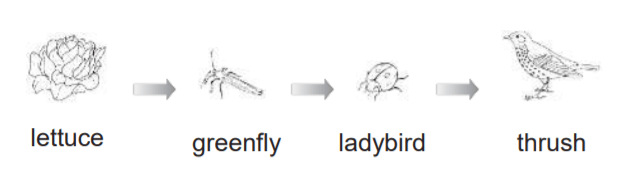
Who is the producer?

a)

lettuce

b)

greenfly

c)

ladybird

d)

thrush

74.

An animal that hunts other animals for food is a ___________

a)

herbivore

b)

predator

c)

prey

d)

omnivore

75.

What is a herbivore?

a)

an animal that gets energy from eating other animals

b)

an organism that gets energy from eating only plants

c)

an animal that gets energy by eating both plants and other animals

76.
what is the function of xylem tissue?
a)
transports water and minerals salt 
b)
control the opening and closing of stoma
c)
carry out photosynthesis
d)
provide support for young plant
77.

This vascular tissue moves food and nutrients throughout the plant.

a)

xylem

b)

arteries

c)

phloem

d)

veins

78.

The leaf's main function is

a)

to look pretty.

b)

transport nutrients throughout the plant.

c)

photosynthesis.

d)

transport water throughout the plant.

79.

The function of this structure is to transport nutrients throughout the plant body and provides support to the plant.

a)

stem

b)

leaf

c)

root

d)

flower

80.

Which form of tropism is shown in this video?

a)

Thigmotropism

b)

phototropism

c)

geotropism

81.

Geotropism is how a a plant responds to the external stimulus of _________ .

a)

touch

b)

light

c)

gravity

82.
What PART of the plant collects water?
a)
leaves
b)
flower
c)
roots
d)
stem
83.
The plant tissue that carries food DOWNWARD from the leaves to the rest of the pant is the ______.
a)
Phloem
b)
Stomata
c)
Chlorophyll
d)
Xylem
84.
Vascular tissue that transports water and minerals UPWARDS from a plant's roots is known as ______.
a)
Cuticle
b)
Phloem
c)
Stomata
d)
Xylem
85.
What is TISSUE that carries water and nutrients from the roots to every part of the plant?
a)
xylem
b)
pholem
c)
gymnosperm
d)
angiosperm