wayground logo

Free Printable Worksheets

Font size

S
M
L
XL
Worksheets

8.L.4 Review

Total questions: 76

Worksheet time: 1hrs 23mins

Name
Class
Date
1.

Some scientists think that all life evolved from a common ancestor. Which provides evidence that this may be true?

a)

analogous structures of organisms

b)

homologous structures of organisms

c)

extinction of many varieties of plant species

d)

existence of many varieties of bacteria species

2.

Which best explains the separate evolution of African and Asian elephants?

a)

overhunting

b)

volcanic activity

c)

splitting of Pangea

d)

extinction of dinosaurs

3.

Which best supports the idea of continental drift?

a)

Coastlines are constantly changing shape due to erosion.

b)

Earthquakes are frequently felt in many regions of the world.

c)

Glaciers currently exist in areas considered too warm for glaciers to form.

d)

Fossilized remains of the same plants and animals are found on different continents.

4.

Which best explains why species living in Australia are found nowhere else on Earth?

a)

Australia has an ecosystem different from any other area on Earth.

b)

Humans have genetically altered many Australian species in laboratories.

c)

Australian species were genetically altered after a comet hit the landmass.

d)

Australia separated from other continents and species there evolved independently.

5.

A new type of plant was discovered on a newly-formed volcanic island. The island is hundreds of miles away from the mainland. Which hypothesis best explains how the plant arrived?

a)

It spontaneously generated.

b)

It was carried there by humans.

c)

It was carried there by wind or waves.

d)

It was already present in volcanic materials.

6.

Two organisms have homologous structures. Which can most likely be concluded about the two organisms?

a)

They are unrelated.

b)

They are the same organism.

c)

They share a common ancestor.

d)

They evolved in a similar environment.

7.

Which would provide evidence of lithospheric plate movement over time?

a)

fossils of tropical plants found near the equator

b)

fossils of tropical fish found in a warm climate area

c)

fossils of tropical plants found in a cold climate area

d)

fossils of tropical fish found at the bottom of an ocean

8.

Based on the fossil record, which organisms were most likely to have existed first?

a)

plants

b)

insects

c)

jellyfish

d)

bacteria

9.

Which best describes the similar function of wings in birds and butterflies?

a)

embryological structures

b)

homologous structures

c)

analogous structures

d)

vestigial structures

10.

It is possible to hypothesize how a particular group of organisms evolved by arranging fossils in a chronological sequence. Where would the oldest fossils be found?

a)

the deepest rock layer

b)

the most shallow rock layer

c)

the rock layer with the greatest variety of fossils

d)

the rock layer containing fossils with the most complex structures

11.

Bird wings and insect wings are analogous structures. Which can most likely be concluded?

a)

Insects evolved from birds.

b)

Birds evolved from insects.

c)

Birds and insects have a close common ancestor.

d)

Birds and insects do not have a close common ancestor.

12.

What do scientists most often use to form the basis for biological classification?

a)

dietary habits

b)

population size

c)

geographic location

d)

comparative anatomy

13.

Which organisms are most closely related based on comparison of anatomical structures?

a)

jellyfish and clam

b)

snake and worm

c)

pig and human

d)

bid and bee

14.

Which best helps scientists explore the relationship between modern organisms and ancestral species to create a system of biological classification?

a)

volcanic ash

b)

fossils

c)

DNA evidence

d)

igneous rock layers

15.

Throughout fossil records, many species appearing in lower layers of rock disappear in higher layers of rock. Which best explains their disappearance?

a)

The species became extinct.

b)

The species moved to another geographic location.

c)

The fossil remains were disrupted by an earthquake.

d)

Environmental conditions were not suitable for fossil formation.

16.

Which evidence found in fossils supports that an ice age occurred during a particular time period?

a)

fern fossils

b)

glacial sediments

c)

high oxygen levels

17.

Which term refers to the classification of organisms in an ordered system that indicates natural relationships?

a)

taxonomy

b)

tectonics

c)

geology

d)

biology

18.

Organisms who are evolutionarily closer are most likely found at which taxonomic level?

a)

Kingdom

b)

Phylum

c)

Family

d)

Order

19.

Evolution can best be described as which type of change?

a)

absolute change

b)

extreme change

c)

gradual change

20.

Which is true about fossils?

a)

Fossils provide the evidence for the Law of Gravity.

b)

Fossils provide the evidence for the Laws of Motion.

c)

Fossils provide the evidence for the Theory of Evolution.

21.
the STUDY of how characteristics of living things are transmitted (passed) from one generation to the next.
a)
evolution
b)
natural selection
c)
genetics
d)
taxonomy
22.
how living things change over time
a)
evolution
b)
natural selection
c)
variation
d)
embryological
23.
branch of biology that deals with the formation, early growth and development of living organisms (offspring)
a)
taxonomy
b)
embryological
c)
homologous structures
d)
domain
24.
all organisms are grouped into 3 large groups using things they have in common (the groups are: bacteria, archaea, eukarya)
a)
class
b)
phyla 
c)
kingdom
d)
domain
25.
process where animals adapt to their environment in order to survive (survival of the fittest)
a)
adaptation
b)
natural selection
c)
analogous structures
d)
domains
26.
grouping of things by their common traits
a)
evolution
b)
natural selection
c)
analogous structures
d)
taxonomy
27.
2 organisms having similar body parts because they were needed since they lived similar lives (example: bee wings and bird wings because they need to fly)  It is not from an ancestor they have in common.
a)
analogous structures
b)
homologous structures
c)
domains
d)
taxonomy
28.
body parts on 2 completely different organisms that have similar structure and position on the body because of a common ancestor (example: arms of a person and front legs of a horse)
a)
adaptations
b)
variations
c)
analogous structures
d)
homologous structures
29.
something slightly different from others of the same type (species) (example: eye color)
a)
adaptation
b)
variation
c)
natural selection
d)
taxonomy
30.
evolutionary process where an organism becomes better suited to its habitat over time
a)
taxonomy
b)
genetics
c)
variation
d)
adaptation
31.

Evolution can best be described as which type of change?

a)

Absolute change

b)

Gradual change

c)

Extreme change

32.

Which of these would not be used by a scientist to determine the evolutionary relationship between two species?

a)

bone structure

b)

fossils

c)

population size

33.
the process in which populations change over time
a)
natural selection
b)
evolution
c)
mutation
34.
I formed the theory of evolution by natural selection after my research of various species of finches on the Galápagos Islands. Who am I?
a)
Charles Darwin
b)
Gregor Mendel
35.
Nature has a way of causing organisms that inherit advantageous traits to survive and reproduce more successfully than the ones that don't. This process is known as...
a)
natural selection
b)
genetic variation
c)
overproduction
36.
Populations of species which do not adapt to their environment can eventually become...
a)
stronger
b)
extinct
c)

larger in size

37.

Fossils provide clear evidence that evolution has occurred

a)

True

b)

False

38.

In a species that has multiple color variations which organisms would be more likely to survive and reproduce?

a)

The species that has a color variation that stands out from its surroundings

b)

The organism that has a color variation that matches its surroundings

39.

Which statement best describes the Law of Superposition?

a)

older on top younger on bottom

b)

younger on top older on bottom

c)

rocks are all the same age

40.

A student is visiting a local limestone quarry and finds fossils of seashells. The quarry is located hundreds of miles from the ocean. The fossils BESTindicate that

a)

area was once below sea level

b)

temperature changed

c)

global flooding

41.

Which best helps scientists explore the relationship between modern organisms and ancestral species to create a system of biological classification?

a)

fossils

b)

volcanic ash

c)

DNA Evidence

42.
A slight difference in an inherited trait between individual members of the same species.
a)
variations
b)
homologous structures
c)
analogous structures
43.

The key factor that impacted natural selection of the peppered moths is...

a)

predator prey

b)

environmental factors

c)

time

44.

If you place 50% light and 50% dark colored moths in a "Light Forest," you would expect the number of light colored moths to _____

a)

Increase

b)

Decrease

45.

A naming system where each living thing is given 2 names. These names are in Latin.

a)

Binomial nomenclature

b)

Hierarchical

c)

Nomenclature

46.

A scientific name consists of

a)

Genus and Order

b)

Genus and Species

c)

Kingdom and Phylum

47.

Humans, birds, whales, and lizards all have similar arm bones. This tells scientists that

a)

The function of these bones is the same in all animals

b)

They live in similar environments

c)

They have a common ancestor

48.

Which of the following organisms are LEAST closely related?

a)

organisms that share a Kingdom

b)

organisms that share a Species

49.
Some organisms that share a common ancestor have features that have different functions, but similar structures.  These are known as
a)
analogous structures
b)
homologous structures
c)
fossil structures
50.

Whales have pelvic bones. What type of structure does this best represent?

a)

Homologous structure

b)

Analogous structure

c)

Vestigial structure

51.
Which of the following pieces of evolution evidence contain both homologous and vestigial structures?
a)
fossil record
b)
comparing anatomy
52.
Which of the following pieces of evolution evidence deals with structures common in embryos that form differently or for different purposes in adult form?
a)
fossil record
b)
comparing embryology
c)
comparing anatomy
53.
The scientific name for an organism is made from the:
a)
class and family name
b)
genus and species name
c)
domain and kingdom name
d)
kingdom and phylum name
54.
Which kingdom contains members who are prokaryotic?
a)
Archaebacteria and Eubacteria
b)
Archaebacteria and Protista
c)
Eubacteria and Animalia
d)
Eubacteria  and Fungi
55.
The 8 levels of classification, most broad to most specific.
a)
Domain, Genus, Family, Order, Class, Phylum, Kingdom, Species
b)
Domain, Species, Kingdom, Genus, Phylum, Family, Class, Order
c)
Domain, Kingdom, Phylum, Class, Order, Family, Genus, Species
d)
Order, Kingdom, Species, Domain, Phylum, Family, Class, Genus
56.
What do protists, plants, fungi, and animals ALWAYS have in common? They are all...
a)
Multicellular
b)
Eukaryotic
c)
Prokaryotic
d)
Consumers
57.
Who first proposed binomial nomenclature as a way of classifying organisms?
a)
Carl Linnaeus
b)
Carl's Jr.
c)
Charles Darwin
d)
Henry Groseclose
58.
Tool used by a taxonomist to identify an unknown organism is a:
a)
dichotomous key
b)
binomial nmenclature
c)
scientific name
d)
binomial key
59.
Which of the following means sorting living things into groups based on similarities?
a)
Taxonomy
b)
Scientific Sortation
c)
Classification
d)
Taxidermy
60.
Giving living things a two part name is called
a)
Taxonomy
b)
Binomial Nomenclature
c)
Classification
d)
Kingdom Phylum
61.
Which of the following is the least closely related animal:
Gray Wolf: Canis lupus
Aardwolf: Proteles cristatus
Coyote: Canis latrans
a)
Coyote
b)
Aardwolf
c)
Gray Wolf
d)
Need more information on body characteristics
62.
What type of animal has fur and feeds its young with milk?
a)
birds
b)
reptiles
c)
amphibians
d)
mammals
63.
A dichotomous key for trees is provided. Hikers found a tree that has large brown cones and single sharp needles. What species of tree have the hikers found?
a)
Juniper
b)
Pine
c)
Spruce
d)
Fir
64.
What is the name of bird W?
a)
Certhidea
b)
Geospiza
c)
Camarhynchus
d)
Platyspiza
65.
Cells that have a true nucleus are called....
a)
eukaryotes
b)
prokaryotes
c)
unicellular
d)
multicellular
66.
Using this dichotomous key, identity the name of the circled fish.
a)
band-tail puffer
b)
spotted goat fish
c)
peacock flounder
d)
trumpet fish
67.
From the table, which two animals are MOST CLOSELY related
a)
House Cate and Red Fox
b)
Red Fox and Dog
c)
Dog and Wolf
d)
Wolf and Gopher
68.

Which of the following is NOT a domain?

a)

Bacteria

b)

Chordata

c)

Archaea

d)

Eukarya

69.

Which of the following are levels of classification?

a)

Species

b)

Binary

c)

Phylum

d)

Tripod

70.

What kingdom do mushrooms and many molds belong to?

a)

Animalia

b)

Protista

c)

Archaea

d)

Fungi

71.

Using the dichotomous key, what is the name of Bird W?

a)

Cirthidea

b)

Geospiza

c)

Camarhynchus

d)

Platyspiza

72.
The scientific name for an organism is made from the:
a)
class and family name
b)
genus and species name
c)
domain and kingdom name
d)
kingdom and phylum name
73.
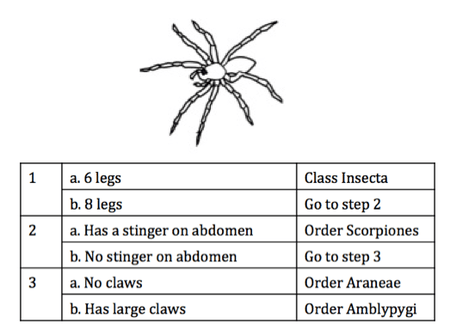
An illustration and a dichotomous key are given. What is the correct classification for this organism?
a)
Class Insecta
b)
Order Amblygygi
c)
Order Araneae
d)
Order Scorpiones
74.
What statement would NOT be good for a dichotomous key?
a)
The organism has 1 dorsal fin
b)
The organism is ugly
c)
The organism has leaves in groups of three
d)
The organism has 6 legs
75.
In what kingdom would you find trees and flowers?
a)
Plantae
b)
Fungi
c)
Eubacteria
d)
Animalia
76.
All of the following have a nucleus except...
a)
Bacteria
b)
Animalia
c)
Plantae
d)
Protista