wayground logo

Free Printable Worksheets

Font size

S
M
L
XL
Worksheets

Exploring Sound and Light Waves

Total questions: 73

Worksheet time: 1hrs 28mins

Name
Class
Date
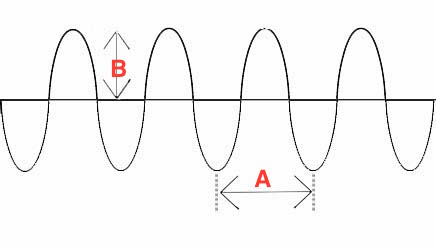
1.

#1 refers to the

a)

wavelength

b)

amplitude

c)

crest

d)

trough

2.

#3 refers to the

a)

wavelength

b)

amplitude

c)

crest

d)

trough

3.

When you yell in a canyon, you hear an echo of your voice. Why is this?

a)

The sound waves are absorbed by the walls of the mountains.

b)

The sound waves are reflected by the walls of the mountains.

c)

The sound waves are transmitted through the walls of the mountains.

4.

The picture shows a duck that appears to have its body detached when viewed underwater. Why does the duck's body look detached?

a)

because the bottom of the pond scatters the light, making the duck's body underwater appear different than the rest of the duck

b)

because the atmosphere absorbs the sunlight, so it reaches the duck's body underwater slower than the rest of the duck

c)

because the pond is a different material than the air, and sunlight gets refracted as it travels in and out of the water

d)

because the duck reflects the light toward its abdomen, making it look different than the rest of the duck

5.

A beam of light is directed towards a tank filled with water.

What causes the beam of light to change direction?

a)

change in media

b)

change in altitude

c)

increase in pressure

d)

increase in temperature

6.

The distance from the beginning of one compression to the beginning of the next compression is called a -----

a)

Rarefaction

b)

Frequency

c)

Wavelength

d)

Compression

7.

The measure of the amount of energy in a wave is ----

a)

Wavelength

b)

Hertz

c)

Frequency

d)

Amplitude

8.

What type of wave is a sound wave?

a)

Transverse wave

b)

Longitudinal wave

c)

Electromagnetic wave

d)

Surface wave

9.

Which of the following is true about light waves?

a)

They require a medium to travel.

b)

They are longitudinal waves.

c)

They can travel through a vacuum.

d)

They are slower than sound waves.

10.

What is the speed of light in a vacuum?

a)

3×10⁸m/s3 \times 10^8 \, \text{m/s}

b)

3×10⁶m/s3 \times 10^6 \, \text{m/s}

c)

3×10⁵m/s3 \times 10^5 \, \text{m/s}

d)

3×10⁴m/s3 \times 10^4 \, \text{m/s}

11.

Which of the following is a property of sound waves?

a)

They can travel through a vacuum.

b)

They are faster than light waves.

c)

They are electromagnetic waves.

d)

They require a medium to travel.

12.

What is the phenomenon called when light bends as it passes from one medium to another?

a)

Reflection

b)

Refraction

c)

Diffraction

d)

Absorption

13.

Which of the following colors of light has the shortest wavelength?

a)

Red

b)

Green

c)

Blue

d)

Violet

14.

What is the unit of frequency for sound waves?

a)

Hertz (Hz)

b)

Decibel (dB)

c)

Meter (m)

d)

Second (s)

15.

Which of the following best describes the amplitude of a sound wave?

a)

The distance between two consecutive crests

b)

The height of the wave from the rest position

c)

The number of waves passing a point per second

d)

The speed at which the wave travels

16.

What is sound?

a)

Vibrations caused in the vacuum of space

b)

Vibrations of matter

c)

A transverse wave

d)

A type of electromagnetic wave

17.

Sound waves travel the fastest in ​ (a)   .

Choose from the below words
a solid
a liquid
a gas
empty space
18.

The pitch of a sound wave relates to the wave's (a)   .
Choose from the below words
Amplitude
Frequency
Wavelength
Period
19.

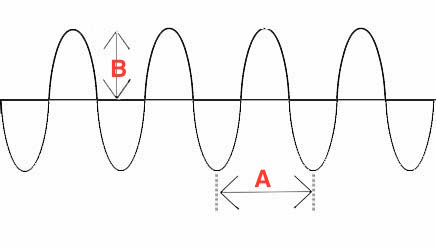
What property of this wave is represented by the letter "A"

a)

amplitude

b)

crest

c)

trough

d)

wavelength

20.
A wave that moves the medium parallel to the direction of the energy is a:
a)
electromagnetic
b)
standing
c)
transverse
d)
longitudinal
21.
When the particles of a medium are vibrating perpendicular to the direction of the wave,  this is a __________wave.
a)
sound
b)
water
c)
transverse
d)
longitudinal
22.
The distance between the crest of a wave and the crest of the next wave is:
a)
3mm
b)
frequency
c)
amplitude
d)
wavelength
23.
The number of complete waves that pass a point in a certain amount of time is:
a)
speed
b)
frequency
c)
amplitude
d)
wavelength
24.
when the particles of a wave are spread out
a)
rarefaction
b)
compression
c)
node
d)
antinode
25.
the highest point of a transverse wave
a)
crest
b)
trough
c)
compression
d)
rarefaction
26.
the lowest point of a transverse wave
a)
crest
b)
trough
c)
compression
d)
rarefaction
27.
when the particles of a wave are bunched up
a)
rarefaction
b)
compression
c)
node
d)
antinode
28.

What property of this wave is represented by the letter "A"

a)

amplitude

b)

crest

c)

trough

d)

wavelength

29.
What property of the wave is represented by the letter "B"?
a)
amplitude
b)
crest
c)
trough
d)
wavelength
30.
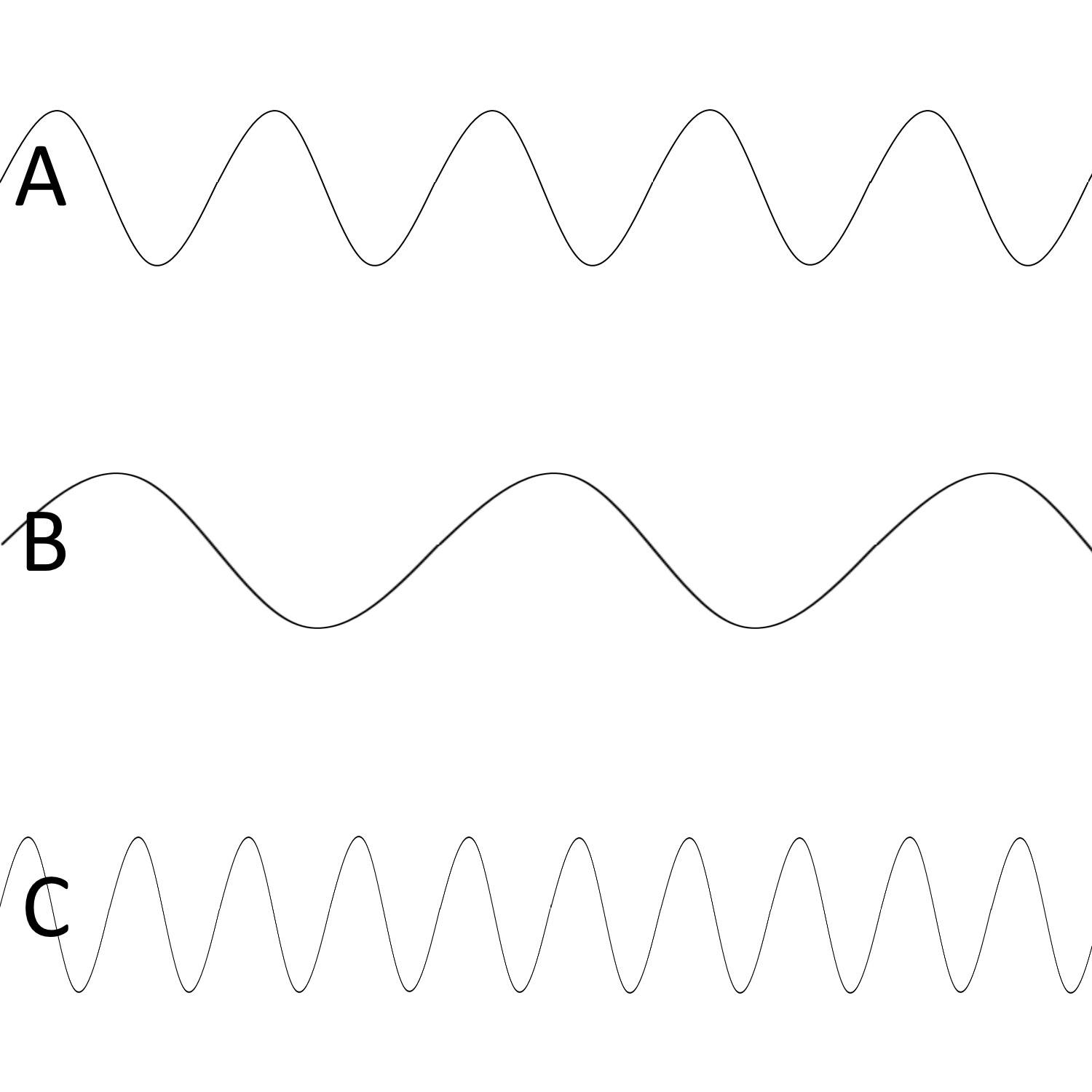
Which wave has the largest wavelength?
a)
A
b)
B
c)
C
d)
None (same wavelength)
31.
Which vocabulary term is used to identify the distance between points C & G?
a)
Amplitude
b)
Crest
c)
Frequency
d)
Wavelength
32.

Which image represents a longitudinal wave?

a)

A

b)

B

33.
Which letter represents the wave trough?
a)
A
b)
B
c)
C
d)
D
34.
Which letter represents the wave crest?
a)
A
b)
B
c)
C
d)
D
35.
What is another name for wave height?
a)
Frequency
b)
Amplitude
c)
Wavelength
d)
Origin
36.
What is measured from crest to crest or trough to trough?
a)
Frequency
b)
Amplitude
c)
Wavelength
d)
Origin
37.
If a wave has a greater frequency, what happens to the wavelength?
a)
increases
b)
decreases
c)
stays the same
38.

Shaking a rope up and down produces which type of wave?

a)

transverse

b)

amplitude

c)

longitudinal

d)

period

39.

Which is an example of a longitudinal wave?

a)

x ray

b)

microwave

c)

sound wave

d)

water wave

40.

Which letter represents the trough?

a)

A

b)

B

c)

C

d)

D

41.

The distance from one crest to the next crest in a wave is

a)

wavelength

b)

crest

c)

trough

d)

amplitude

42.
In longitudinal waves, the parts where the coils are spread apart are called what?
a)
rarefactions
b)
compressions
c)
mechanicals
d)
longitudes
43.
In a longitudinal wave, the parts where the coils are close together are called what?
a)
longitudes
b)
rarefactions
c)
compressions
d)
contractions
44.
What kind of wave is pictured?
a)
Transverse
b)
Longitudinal
c)
surface
d)
none of the above
45.

What does a wave carry from place to place?

a)

energy

b)

matter

c)

people

46.

Sound waves travel as _________ waves.

a)

transverse

b)

electromagnetic

c)

longitudinal

d)

surface

47.

A rarefaction is generated when particles move ______.

a)

together

b)

closer

c)

under

d)

apart

48.
The highest point on a wave is:
a)
the crest
b)
the trough
c)
the top
d)
the coast 
49.
Which wave is pictured?
a)
Transverse
b)
Longitudinal
c)
Both
d)
Neither
50.
A wave in which the particles of the medium move perpendicularly to the direction the wave is traveling
a)
A. surface wave
b)
B. transverse wave
c)
C. electromagnetic  wave
d)
D. longitudinal wave
51.
A wave in which the particles of the medium vibrate parallel to the direction of the wave motion
a)
A. mechanical wave
b)
B. surface wave
c)
C. longitudinal wave
d)
D. wave
52.

A wave in which the movement of the wave’s medium is perpendicular to the movement of the wave traveling through the medium

a)

Transverse waves

b)

Compression waves

c)

Nodular Waves

d)

Ocean Waves

53.

Water waves are __________ waves because the wave moves up and down.

a)

transverse

b)

inverse

c)

longitudinal

d)

flat

54.

Travels the fastest through air

a)

Light

b)

Sound

c)

Both

55.

This is a transverse wave

a)

Light

b)

Sound

c)

Both

56.

This is a longitudinal wave

a)

Light

b)

Sound

c)

Both

57.

This wave requires a medium.

a)

Light

b)

Sound

c)

Both

58.

This wave is caused by the vibration of particles

a)

Light

b)

Sound

c)

Both

59.

This wave can travel through empty space

a)

Light

b)

Sound

c)

Both

60.

If lightning strikes you see it before you hear the thunder because...

a)

Sound travels faster than light

b)

Light travels faster than sound

61.

In these waves as frequency increases, wavelength decreases.

a)

Light

b)

Sound

c)

Both

62.

These waves travel faster through empty space than through solid, liquid, or gas.

a)

Light

b)

Sound

c)

Both

d)

Neither

63.

Where do sound waves travel the FASTEST?

a)

solids

b)

liquids

c)

gasses

d)

a vacuum

64.
What is a medium?
a)
something between a small and a large?
b)
the substance through which a wave can travel
c)
a pattern of vibration that simulates when a wave is standing still
d)
the distance from any point on a wave to an identical point on the next wave
65.

What type of wave is this?

a)

Electromagnetic

b)

Mechanical

c)

Both Electromagnetic and Mechanical

66.
Sound waves move faster than light waves.
a)
True
b)
False
67.
The high points on waves are called...
a)
troughs
b)
crests
c)
zeniths
d)
wavelengths
68.
What is the lowest part of a wave?
a)
trough
b)
crest
c)
point of origin
d)
compression point
69.
Which wave has a greater frequency?
a)
A
b)
B
70.

 A wave has frequency of 50 Hz and a wavelength of 10 m. What is the speed of the wave? (a)  

Choose from the below words
500 m/s
50 m/s
5 m/s
0.5 m/s
71.
7. Which of the following occurs as the frequency of a wave decreases?
a)
A. The wavelength increases
b)
B. The wavelength decreases
c)
C. The wavelength increases and then decreases
d)
D. The wavelength remains the same
72.

9. The frequency of a wave is measured in (a)   .
Choose from the below words
Hertz
Crest
Trough
Compression
Rarefaction
73.
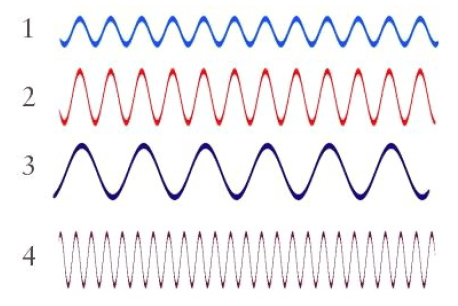
Which wave in the diagram has the greatest frequency?