wayground logo

Free Printable Worksheets

NEW

Font size

S
M
L
XL
Worksheets

Characteristics of the Universe Review!

Total questions: 71

Worksheet time: 53mins

Name
Class
Date
1.
At 10,000 degrees Celsius, hydrogen begins to change into helium and energy is released in a process called
a)
supernova
b)
pulsar
c)
nuclear fusion
d)
nuclear fission
2.
All stars begin their life in a
a)
Main Sequence
b)
Nebula
c)
Protostar
d)
Black Dwarf
3.
What are the final two stages of a medium mass star?
a)
white dwarf - black dwarf
b)
neutron star - black hole
c)
supernova - neutron star
d)
pulsar - neutron star
4.
The life cycles of stars are determined by their:
a)
mass (size)
b)
color
c)
distance from Earth
d)
luminosity
5.
Our sun is currently in what star stage?
a)
Protostar
b)
Nebula
c)
Main Sequence
d)
Red Giant
6.
______ is a force that causes dust particles to stick together in a nebula.
a)
nuclear fusion
b)
gravity
c)
hydrogen
d)
friction
7.
A gigantic explosion that causes the death of a large star is called
a)
pulsar
b)
red giant 
c)
supernova
d)
black hole
8.
A ________ is an object so dense with so much gravity that even light cannot escape.
a)
neutron star
b)
white dwarf
c)
blackhole
d)
black dwarf
9.
The star that appears brightest to us on Earth is
a)
the Sun
b)
Sirius
c)
Polaris
10.
The hottest stars are
a)
red
b)
yellow
c)
blue
d)
white
11.
When a massive star dies it may explode in a supernova.
a)
True
b)
False
12.
A diagram or graph that shows the relationship between luminosity and temperature in a star.
a)
HR (Hertzsprung - Russell) Diagram
b)
Color vs. Brightness chart
c)
Temperature vs. Luminosity chart
d)
Stellar life cycle chart
13.
Any star that is fusing hydrogen in its core and has a stable balance of outward pressure from core nuclear fusion and gravitational forces pulling inward.
a)
Red giant star
b)
White dwarf star
c)
Supergiant star
d)
Main sequence star
14.
A main sequence star that has stopped fusing hydrogen and begun fusing helium. It has grown in size and changed color as a result. (this is the fate of our sun)
a)
Black hole
b)
Red giant star
c)
White dwarf star
d)
Super red giant star
15.
A small, hot, dim star that is the leftover center of an old star
a)
Yellow dwarf star
b)
Black dwarf star
c)
White dwarf star
d)
Red dwarf star
16.
In the diagram given, what happens as we move to the left?
a)
Stars Get Larger
b)
Stars get Colder
c)
Stars get hotter
17.
Compared to the rest of the stars, our sun is considered...
a)
Extremely Large and Cold
b)
Small with a medium temperature
c)
Medium size with medium temperature
18.
Which category is our Sun located in?
a)
White Dwarfs
b)
Supergiants
c)
Main Sequence
d)
Giants
19.
Look at the H-R diagram. Which star is
sort of cool, dim (not too much light), and red?
a)
Betelguse
b)
Sirius B
c)
Procyon B
d)
Barnard's star
20.
Which star has the lowest temperature?
a)
A
b)
B
c)
C
d)
D
21.
The HR Diagram shows a relationship of a star's surface temperature and its
a)
color
b)
size
c)
apparent magnitude
d)
absolute magnitude
22.
The effective temperature of a star is related to its...
a)
solar system
b)
luminosity
c)
absolute magnitude
d)
color
23.
Use the diagram to answer the question.Using the figure, Aldebaran, Mira, and Pollux are all _____ stars.
a)
giant
b)
supergiant
c)
main-sequence
d)
white dwarf
24.
Use the Hertzsprung-Russell Diagram to answer the following question.  Betelgeuse is a _____
a)
Hot and Bright Star
b)
Cool and Bright Star
c)
Hot and Dim Star
d)
Cool and Dim Star
25.

Use the Hertzsprung-Russell Diagram to answer the following question. Spica is a _____

a)

Hot and Bright Star

b)

Cool and Bright Star

c)

Hot and Dim Star

d)

Cool and Dim Star

26.

Use the Hertzsprung-Russell Diagram to answer the following question. Sirius B is a _____

a)

Hot and Bright Star

b)

Cool and Bright Star

c)

Hot and Dim Star

d)

Cool and Dim Star

27.

Use the Hertzsprung-Russell Diagram to answer the following question. Epsilon Eridani is a _____

a)

Hot and Bright Star

b)

Cool and Bright Star

c)

Hot and Dim Star

d)

Cool and Dim Star

28.
John observes three different colored stars.  What can John infer about the three stars
a)
The three stars have different temperatures
b)
The three stars have the same temperatures
c)
The three stars have the same luminosity
d)
The three stars have different luminosity
29.

Use the Hertzsprung-Russell Diagram to answer the following question. Main sequence stars ______

a)

increase in size while they decrease in temperature.

b)

increase in brightness while they decrease in temperature.

c)

decrease in brightness while they decrease in temperature.

d)

decrease in brightness while they increase in temperature.

30.

Use the Hertzsprung-Russell Diagram to answer the following question. What is Barnard's Star classified as?

a)

Dim Main Sequence Star

b)

Bright white dwarf star

c)

Bright Supergiant Star

d)

Dim white dwarf star

31.

Use the Hertzsprung-Russell Diagram to answer the following question. What is Canopus classified as?

a)

Dim Main Sequence Star

b)

Bright white dwarf star

c)

Bright Supergiant Star

d)

Dim white dwarf star

32.
The color index of a star provides information about that star’s
a)
age
b)
luminosity
c)
absolute magnitude
d)
temperature
33.
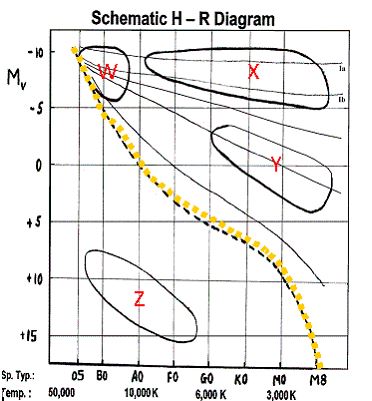
In which region of the H-R Diagram would you be likely to find stars fusing hydrogen to make helium in their cores?
a)
W
b)
X
c)
Y
d)
The orange dashed line
34.
In which region of the H-R Diagram would you be likely to find the brightest, reddest stars?
a)
W
b)
X
c)
Y
d)
The orange dashed line
35.
What is the primary difference between a star of spectral class K0 in the Y region, compared to a star of spectral class K0 in the X region?
a)
temperature
b)
color
c)
brightness
d)
color index
36.
About 90 percent of stars on the H-R diagram are ____ stars.
a)
red giant
b)
main sequence
c)
luminosity
d)
supergiants
37.
Use the diagram to answer the question.Using the figure, which is a main-sequence star?
a)
Zeta Eridani
b)
Deneb
c)
Mira
d)
Sirius B
38.

What is this section of stars known as?

a)

Main Sequence

b)

Red Giants

c)

White dwarfs

d)

Blue/Red Supergiants

39.

Which stage is this?

a)

Red/Blue Supergiants

b)

Main sequence

c)

White dwarfs

d)

Red Giants

40.

Which stage is represented by this picture?

a)

Red Giants

b)

Main Sequence

c)

White Dwarfs

d)

Blue Giants

41.

Which star type is represented by this section of the H-R diagram?

a)

Main Sequence Star

b)

Blue/Red Supergiants

c)

White Dwarfs

d)

Red Dwarfs

42.

Compared to a red giant star, a blue supergiant is...

a)

Hotter and brighter

b)

Hotter and not as bright

c)

Colder and brighter

d)

Colder and not as bright

43.

Compared to a white dwarf, a red supergiant is...

a)

Hotter and brighter

b)

Hotter and not as bright

c)

Colder and brighter

d)

Colder and not as bright

44.

What kind of star has the longest lifespan?

a)

A very massive star, like a blue giant

b)

An average sized star, like our Sun

c)

A star with low mass, like a red dwarf

45.

A galaxy which is either spherical (ball like) or a flattened disk is a ___ galaxy.

a)

elliptical

b)

humanoid

c)

irregular

d)

spiral

46.

A galaxy which has a nucleus of bright stars and two or more arms in circular formation is called a ___ galaxy.

a)

elliptical

b)

humanoid

c)

irregular

d)

spiral

47.

A Group of stars, and or star systems, star clusters, dust and gas held together by gravity is known as:

a)

Universe

b)

Galaxy

c)

Solar System

d)

Planet

48.

A galaxy that does not have a regular shape?

a)

Spiral

b)

Elliptical

c)

Irregular

d)

Quasar

49.

In what Galaxy is Earth located?

a)

Andromeda

b)

Milky Way

c)

Sagittarius

d)

Snickers

50.

How many main sequence stars is in our solar system?

a)

2

b)

8

c)

1

d)

None

51.
What kind of galaxy is this?
a)
Ring
b)
Irregular
c)
Spiral
d)
Elliptical 
52.
What type of galaxy do we live in?
a)
Spiral
b)
Elliptical
c)
Irregular
d)
Coaxial
53.
What type of galaxy is this?
a)
Spiral
b)
Elliptical
c)
Irregular
d)
Irrational
54.
Place these objects in order from smallest to largest.
a)
Planets, solar system, universe, galaxy
b)
Solar system, planets, galaxy, universe
c)
Planets, solar system, galaxy, universe
d)
Galaxy, solar system, planets, universe
55.
Which of the following is the largest?
a)
The Milky Way Galaxy
b)
A red giant star
c)
The moon
d)
Jupiter
56.
Our sun is located on one of the Spiral Galaxy arms.  
a)
True
b)
False
57.

which galaxy has mainly old stars present ?

a)

spiral galaxies

b)

Elliptical galaxies

c)

irregular galaxies

d)

barred spiral galaxies

58.

which wavelength is the shortest?

a)

x-ray

b)

invisible

c)

gamma ray

d)

radio

59.
Low-mass stars eventually collapse into what final star remnant?
a)
Black holes
b)
Neutron stars
c)
White dwarfs
d)
Nebulae
60.

Our sun is in what stage?

a)

planetary nebula

b)

protostar

c)

main sequence

d)

red giant

61.

What the shape of the milky way? Choose the best shape

a)
b)
c)
d)
62.

Why do other stars appear so much smaller than the sun?

a)

They are really close.

b)

They are so far away.

c)

They are tiny stars.

63.
Most of the sun’s energy is a result of
a)
nuclear fusion  
b)
nuclear fission
c)
atomic reactions
d)
coronal mass ejection
64.

When Hydrogen atoms fuse together and form atoms of Helium, which of the following happens next?

a)

the nuclei die.

b)

energy is released.

c)

particles collide

d)

particles neutralize.

65.

Which of the following has the longest wavelength?

a)

microwaves

b)

UV rays

c)

Infrared

d)

Gamma rays

66.

Which of the following has the most energy?

a)

Red

b)

Blue

c)

Green

d)

Yellow

67.

Which of the following has the most energy?

a)

X-rays

b)

The color green

c)

Microwaves

d)

Infrared

68.

Which of the following would have the highest frequency?

a)

Gamma rays

b)

The color red

c)

X-rays

d)

UV rays

69.
True or false: as you move along the spectrum, radio to gamma waves, the wavelengths decrease in size (get smaller)
a)
true
b)
false
70.
A wave with a large wavelength will have a ______ frequency and _____ energy
a)
high, low
b)
high, high
c)
low, high
d)
low, low
71.
Which section of the spectrum is the ONLY one we can see?
a)
X-rays
b)
Visible Light
c)
Gamma Rays
d)
Ultraviolet Rays