wayground logo

Free Printable Worksheets

NEW

Font size

S
M
L
XL
Worksheets

Plate Tectonics

Total questions: 67

Worksheet time: 38mins
Name
Class
Date
1.
The type of plate boundary where two plates come together is a .....
a)
Convergent Boundary
b)
Divergent Boundary
c)
Transform Boundary
d)
Plate Boundary
2.
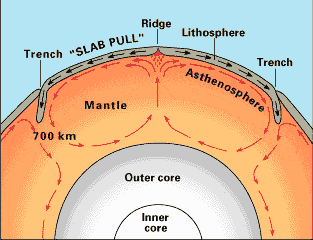
Which of the following causes Earth's tectonic plates to move?
a)
Energy from the Sun
b)
Magnetic Pole Reversal
c)
Convection currents in the mantle
d)
Faults in Mountain Ranges
3.
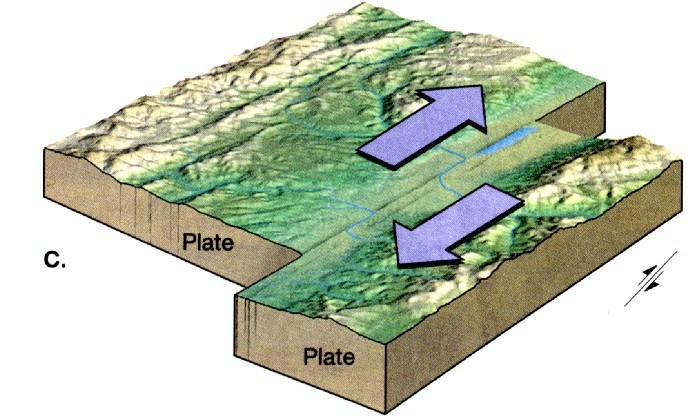
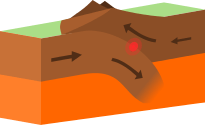
What type of plate boundary is this?
a)
Plate
b)
Divergent
c)
Convergent
d)
Transform
4.
What type of event will occur at this boundary?
a)
Earthquake
b)
Volcano Eruption
c)
Tornado
d)
Mountain Building
5.
A divergent boundary occurs when plates ....
a)
Pull apart
b)
Come together
c)
Slide past each other
d)
subducting
6.
What type of plate boundary is this?
a)
Transform
b)
Convergent
c)
Divergent
d)
Plate
7.

Oceanic Ridges are formed by _______ plate boundaries

a)

Convergent

b)

Transform

c)

Plate

d)

Divergent

8.
Islands can from from magma which is pushed up at a __________ plate boundary
a)
Divergent
b)
Convergent
c)
Transform
9.
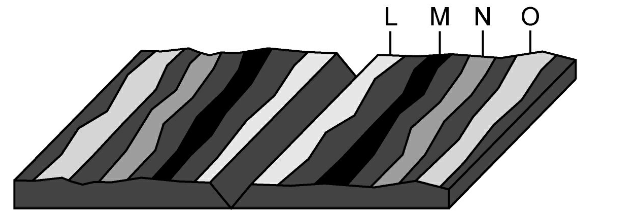
Where would the oldest rock be found?
a)
L
b)
M
c)
N
d)
O
10.
How is it possible for new crust to be formed without increasing the surface area of the Earth?
a)
Crust is destroyed at the same time it is created
b)
New crust is underwater where it sinks
c)
New crust breaks more easily than old crust
11.
Mountains are created when....
a)
Two continental plates collide
b)
Two oceanic plates pull apart
c)
An Oceanic plate subducts under a Continental Plate
d)
Two continental plates pull apart
12.
The Great Rift Valley in Africa and the Mid-Ocean Ridge were all created by this boundary
a)
Divergent
b)
Convergent
c)
Reform
d)
Transform
13.
What are the two types of crust
a)
continental and oceanic
b)
ocean and upper
c)
lower and upper
d)
pizza and subway
14.
When an oceanic plate and a continental plate collide, which one will subduct?
a)
oceanic
b)
continental
c)
neither
15.
The area where two tectonic plates meet.
a)
mantle
b)
focus
c)
plate boundary
d)
convection
16.
A subduction zone is formed...
a)
when one tectonic plate sinks below another
b)
at every type of convergent plate boundary
c)
at every type of divergent plate boundary
d)
at transform boundaries
17.

What does the hypothesis of Continental Drift explain?

a)

Ocean currents move continents around the planet

b)

Convection works deep within the asthenosphere

c)

Mid-ocean ridges force tectonic plates to move

d)

Continents were once together and slowly drifted to where they are today

18.

Who was the scientist who proposed the theory of continental drift?

a)

Alfred Powell

b)

Harry Hess

c)

Alfred Wegener

d)

Ernest Rutherford

19.

How far do tectonic plates move each year?

a)

Meters per year

b)

Centimeters per year

c)

Kilometers per year

d)

Feet per year

20.

Where does seafloor spreading take place?

a)

Convergent boundaries

b)

The continentals shelves

c)

Transform boundary

d)

Mid-ocean ridges

21.

What is the driving force behind the movement of the tectonic plates?

a)

Gravity

b)

Convection

c)

Wave motion

d)

Seismic activity

22.

The super continent that existed when all continents were together was named

a)

Gondwana

b)

Laurasia

c)

Eurasia

d)

Pangea

23.

What is the process of convection?

a)

The process of hot material rising and cooler material sinking in circular patterns

b)

The process of hot rock solidifying and forming new crust

c)

The process of explaining what goes up must come down

d)

Strong ocean currents moving tremendous amounts of material

24.

Mountains are created along

a)

Transform boundaries

b)

Continental-Continental Convergent

c)

Divergent

d)

Oceanic-Continental Convergent

25.

Volcanoes are created along

a)

Divergent and Convergent boundaries

b)

Transform and Convergent boundaries
c)

Divergent and Transform boundaries

d)

The boundary between Illionois and Wisconsin

26.

Earthquakes can happen along

a)

All boundaries

b)

Divergent and transform boundaries

c)

Convergent and divergent boundaries

d)

Transform and Convergent boundaries

27.
What type of boundary is in this image?
a)
convergent plate boundary
b)
divergent plate boundary
c)
transform plate boundary
d)
subduction
28.
Wegener’s proposal of a supercontinent was supported by:
a)
earthquake data
b)
seafloor magnetism
c)
rock, fossil, and climate data.
d)
convection currents in the mantle.
29.
Which type of crust is more dense?
a)
oceanic
b)
continental
c)
divergent
d)
pizza
30.
A rift valley occurs at a ____________ boundary.
a)
divergent
b)
convergent
c)
transform
d)
horizontal
31.
A trench forms at a _________ boundary.
a)
convergent
b)
divergent
c)
transform
d)
vertical
32.
What type of boundary is shown at A?
a)
transform
b)
convergent
c)
divergent
d)
subduction
33.
Trenches, deep underwater canyons on the sea floor are created at this type of boundary 
a)
Divergent
b)
Convergent, Subduction Zone
c)
Transform 
34.
New crust is created at this type of  boundary.
a)
Divergent
b)
Convergent, Subduction Zone
c)
Transform 
35.

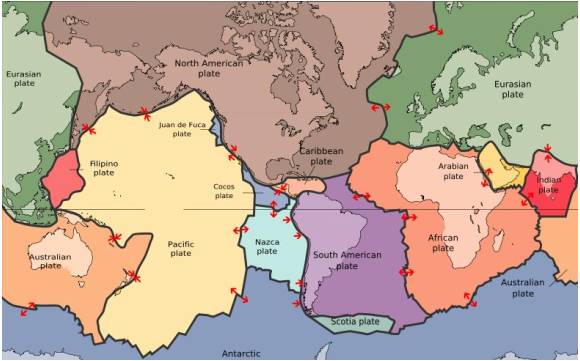
The map in the picture shows tectonic plate boundaries. This map would be useful in predicting the location of future

a)

droughts

b)

hurricanes

c)

earthquakes

d)

tornadoes

36.
The Earth’s surface is not a solid surface but is divided into
a)
several oceanic plates.
b)
continental and crustal plates.
c)
seven continental plates.
d)
continental and oceanic plates.
37.

What is the source of energy that drives plate movement?

a)

the subducton of the sea floor

b)

the different densities of the oceanic and crustal plates

c)

convection currents in the asthenosphere

d)

the friction force between the plates that move past each other

38.

What is the correct order (starting from the surface) of Earth’s layers?

a)

crust, outer core, inner core, mantle

b)

mantle, outer core, inner core, crust

c)

crust, mantle, outer core, inner core

d)

outer core, inner core, crust, mantle

39.

The geological theory of _______ states that pieces of Earth’s lithosphere are in constant, slow motion.

a)

subduction

b)

plate tectonics

c)

deep-ocean trenches

d)

sea-floor spreading

40.

Scientists think that convection currents flow in Earth’s

a)

continents.

b)

mantle.

c)

lithosphere.

d)

inner core.

41.
The Himalayas in Asia are an example of what type of plate boundary?
a)
divergent
b)
continent-to-continent convergent
c)
ocean-to-continent convergent
d)
transform
42.
What is Pangaea?
a)
the name of a German scientist
b)
the name of the super-continent that existed millions of years ago
c)
another name for continental drift
d)
the name of an ancient fossil
43.

Breaks in the crust called __________ form where plates meet.

a)

mountains

b)

rift valleys

c)

faults

d)

trenches

44.
The east coast of South America seems to fit into the wet coast of Africa, this evidence for Continental Drift is called...
a)
fit/shape of continents
b)
fossil evidence
c)
geologic evidence
d)
climate evidence
45.
India, Australia, South America, and Africa all have deep grooves or scratches in rocks which is climate evidence of ....
a)
erosion
b)
dinosaurs
c)
glaciers
d)
aliens
46.
Glossopteris grew in warm, swampy areas proving Antarctica used to have a ________________climate.
a)
warm and wet
b)
hot and dry
c)
cold and icy
d)
temperate
47.
Scientists did not believe Wegner's theory because Continental Drift is a slow process and there is no explanation for...
a)
how to measure the continents.
b)
how the continents move.
c)
Wegener being a silly man.
d)
Antarctica having fern fossils.
48.

Which layer is solid and made of iron and nickle?

a)

crust

b)

mantle

c)

outer core

d)

inner core

49.

Which layer is the thinnest?

a)

crust

b)

mantle

c)

outer core

d)

inner core

50.

Harry Hess discovered....

a)

Submarines

b)

Deserts at the bottom of the ocean

c)

A new fish species

d)

The Mid-Atlantic Ridge

51.

Geologist and Navy Admiral who mapped the seafloor in WWII discovering the Mid Atlantic Ridge and ocean trenches which led to his theory of 'seafloor spreading'

a)

Alfred Wegener

b)

Harry Hess

52.
Is a layer of week of soft mantle that is made of rock that flows slowly.  Tectonic plates move on top of this layer. 
a)
Inner Core
b)
Asthensophere
c)
Lithosphere
d)
Outer Core
53.

Which layer is made (mostly) of LIQUID iron and nickel?

a)

crust

b)

mantle

c)

outer core

d)

inner core

54.

Which crust is thicker

a)

oceanic

b)

continental

c)

bread

d)

pizza

55.

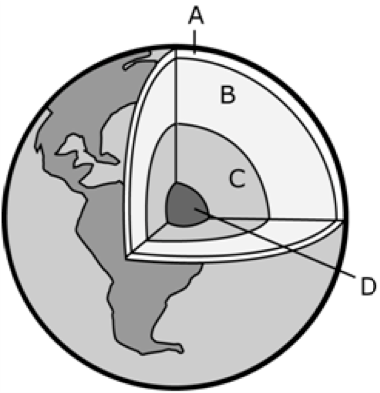
What letter in the diagram identifies the layer that is composed of moving continental and oceanic plates?

a)

layer A

b)

layer B

c)

layer C

d)

layer D

56.
What happens to pressure as we move from the crust to the inner core?
a)
Pressure Decreases
b)
Pressure Increases
c)
Nothing
57.
What happens to temperature as we move from the crust to the inner core?
a)
Decreases
b)
Increases
c)
Nothing
58.
Less dense materials rise to the top.
a)
True
b)
False
59.

Which diagram best represents the type of plate movement that results in FOLDED mountains?

a)
b)
c)
d)
60.

As you move northwest through the Hawaiian Islands, the age of the islands increases. The older islands are northwest of the new islands because they

a)

age faster than those to the east

b)

formed from old, recycled, silica-rich magma

c)

were made of less lava than the southwestern islands

d)

formed first and were moved away from the hot spot

61.
Which layer is plastic and has the consistency of silly putty allowing movement?
a)
asthenosphere
b)
lithosphere
c)
mesosphere
d)
crust
62.

How do scientists know the Earth has layers?

a)

Drilling into the mantle

b)

Volcanoes

c)

Seismic waves data

d)

ocean waves

63.
What creates the Earth's Magnetic Field?
a)
The spinning of the mantle around the crust
b)
The spinning of the outer core around the inner core
c)
The spinning of the inner core around the outer core
d)
The spinning of the oceanic crust around the mantle
64.
Identify C
a)
Crust
b)
Mantle
c)
Outer Core
d)
Inner Core
65.
Identify A
a)
Crust
b)
Mantle
c)
Outer Core
d)
Inner Core
66.
Identify D
a)
Crust
b)
Mantle
c)
Outer Core
d)
Inner Core
67.
Identify B
a)
Crust
b)
Mantle
c)
Outer Core
d)
Inner Core