
 Worksheets
OLD Unit 1 Test Review - Water/Ocean Currents
Total questions: 76
Worksheet time: 3575secs
Water has an unusually high ____________, which makes it take a lot of energy to heat up.
heat capacity
Water below Earth's surface and the spaces between rocks and soil
Groundwater
Aquifer
Surface water
Withdrawl
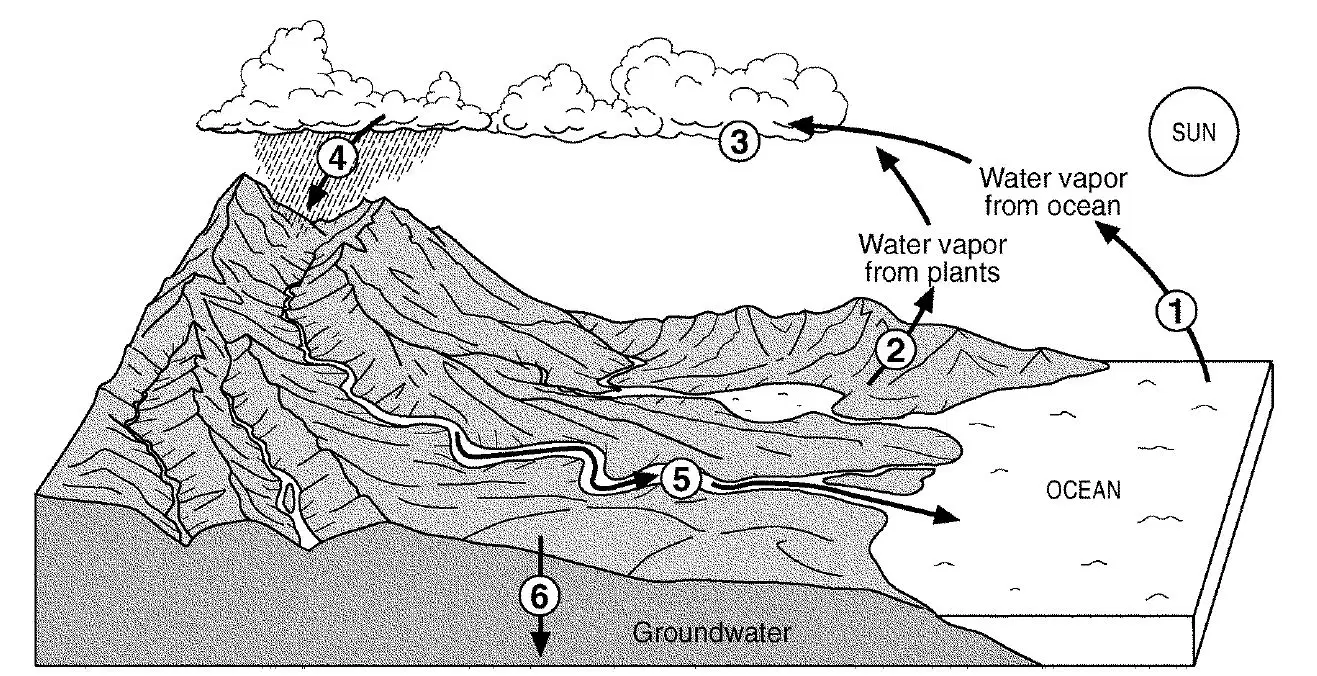
Process #6 in the image:
Drawdown
Withdrawl
Infiltration
Aquifer
Which of the following implies the same thing as the word "aquifer"?
Saturated zone
zone of aeration
zone of soil moisture
zone of twilight

Entire land area that drains to a given stream, lake, or wetland.

This is the top of an aquifer/saturated zone, below which water fills all open spaces between the rock...
Groundwater
Reservoir
Water Table
Well
Layers of rock that hold a lot of water and allow it to circulate.
Groundwater
Artesian wells
Transpiration
Aquifers
Groundwater that flows naturally to the surface due to pressure of rock layers pressing on an aquifer from above and below.
Aquifers
Runoff
Artesian wells
Transpiration
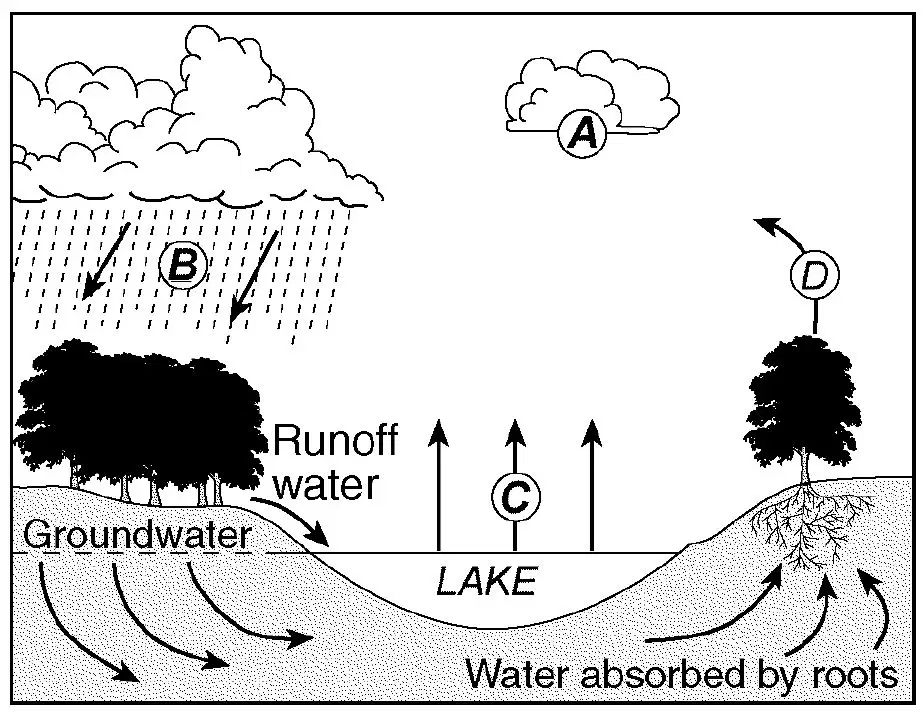
Plants giving off moisture and releasing water into the air (D in the image).
Precipitation
Evaporation
Transpiration
Runoff

What is D?
Horizontal motion of air, water, or heat.
advection
precipitation
condensation
locomotion

This Image represents...
Downwelling
Upwelling
Thermohaline circulation
Rip Current
The __________ is a surface current that flows along the eastern US and brings warm water to Europe.
California Current
Gulf Stream
North American Gyre
Arctic Current

The red arrows indicate ___
Eastern boundary currents
Western boundary currents
Thermohaline circulation
Trade winds
These surface currents are cooler, shallow, slower, and move less water
Eastern boundary currents
Western boundary currents
Westerlies
Coriolis effect
In convection, COOL air or water
In convection, WARM air or water

Winds occur because hot air rises and cool air sinks in a process called...
conduction
convection
radiation
magnetism
A prevailing wind...
blows from one direction more frequently than others
blows north to south
blows east to west
is unpredictable
______ and the Coriolis force cause deep ocean currents
heat capacity
gravity
wind
density differences
A microscopic organism found in the ocean that uses photosynthesis:
Amoeba
Paramecium
Which are related to El Niño?
Warmer than normal temperatures in the eastern Pacific
Causes warmer and drier weather in USA
Colder than normal temperatures in the eastern Pacific
Causes colder and wetter weather in USA
Occurs in a cycle every 2 to 7 years
Which are related to la Niña?
Warmer than normal temperatures in the eastern Pacific
Causes warmer and drier weather in USA
Colder than normal temperatures in the eastern Pacific
Causes colder and wetter weather in USA
Occurs in a cycle every 2 to 7 years
Hurricanes hit the _________ side of the United States because winds blow warm ocean currents off the coast of Africa and across the Atlantic Ocean.
east
west
north
south
______ combined with the Coriolis Effect causes surface currents.
salinity
gravity
density differences
wind
Strong El Niños typically create _________winters in Minnesota.
longer
colder
warmer
darker
The salt content of a substance
density
temperature
convection
salinity
Temperature and salinity affect deep ocean water's ___________.
wave height
clarity
density
depth
These deep-ocean currents are driven by differences in the water’s density, caused by temperature and salinity differences.
Surface winds
Moon tides
Thermohaline circulation
Coriolis force
The ___________ acts as the primary driving force of ocean currents, causing winds and temperature differences to create current flow.
Earth's core
Earth's revolution
moon
Sun
Ocean currents regulate ____________, helping to counteract the uneven distribution of solar radiation reaching Earth's surface by circulating the water.
tide lengths
global climate
earth's rotation
clouds
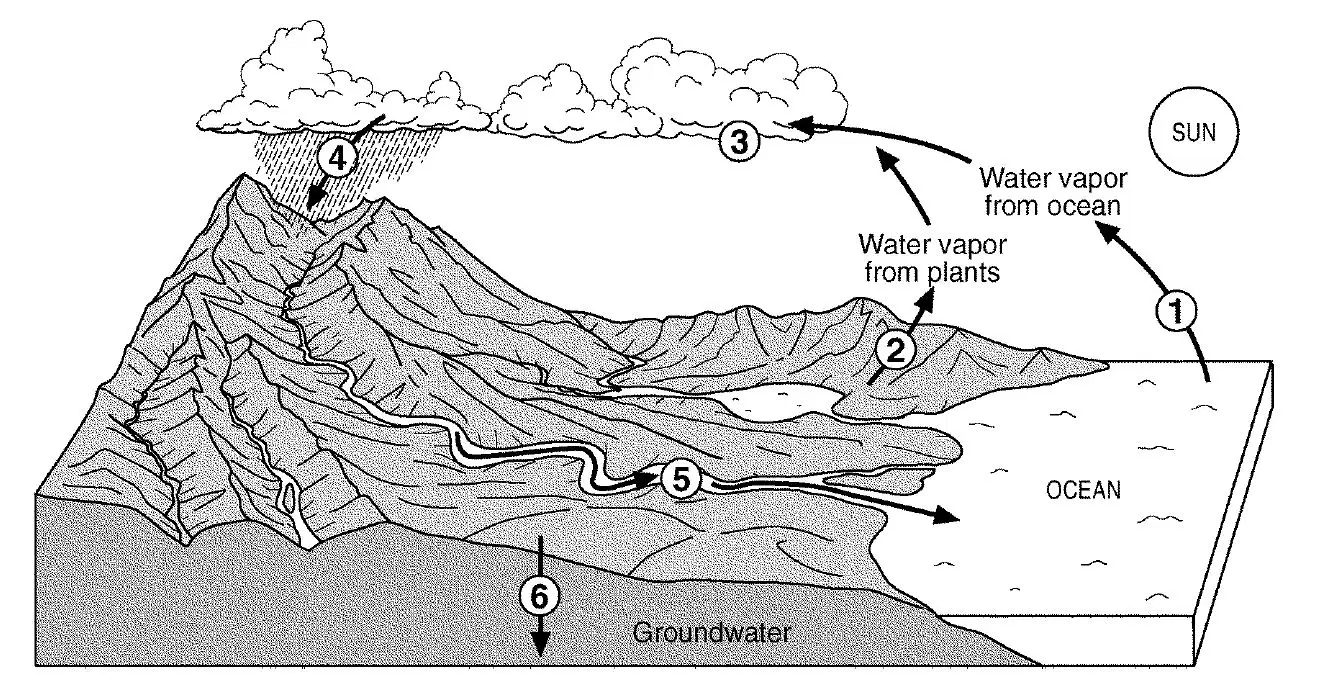
What phase of the water cycle is #1?
Evaporation
condensation
precipitation
runoff
Which word best completes the water cycle below:
Precipitation --> Runoff --> Ocean --> ________ --> Water Vapor
Transpiration
Evaporation
Advection
Infiltration
Which word best completes the water cycle below:
Sublimation --> ___________ --> Cloud --> Advection --> Precipitation
Transpiration
Evaporation
Condensation
Infiltration
Turns frozen water into water vapors - skipping the melting stage
Sublimation
Percolation
Transpiration
Evaporation
As a part of the water cycle, water from Earth's surface enters the clouds and finally falls back to the ground in the form of rain. What is the correct sequence of processes water undergoes?
Evaporation, Condensation, Precipitation
Precipitation, Condensation, Evaporation
Condensation, Evaporation, Precipitation
Evaporation, Precipitation, Condensation
Process by which animals eliminate waste liquids from their body.
excretion
respiration
absorption
transpiration
Processes by which animals and plants take in water.
excretion and osmosis
advection and condensation
consumption and absorption
transpiration and respiration
The movement of water underground is called:
Release of water vapor by animals when they breathe is called:
A place in the water cycle where water can exist for a given amount of time.
Formed when gaseous (evaporated) water condenses in the atmosphere.
Rivers
Aquitards
Glaciers
Major bodies of saline (salty) water on earth's surface.
Oceans
Groundwater
Glaciers
A __________ is formed when water accumulates in a low spot on the landscape as a result of surface-water runoff and groundwater seepage. They can be both freshwater and salt water.
aquifer
ocean
glacier
A natural body of water that flows from higher to lower elevations as a result of gravity. Also called streams, or creeks, depending on their size.
Ocean
Lake
Cloud
River
Water stored in ice or snow near the earth's poles.
Ocean
Mass of ice that forms in mountain slopes and valleys.
mountain glacier
A river or stream flowing into a larger river or lake.
The portion of the subsurface above the groundwater table. The soil and rock in this zone contains mostly air and little water.
Unsaturated zone
Saturated zone
Created by compacted layers of clay, silt or rock that block water flow underground. They act as a barrier for groundwater. They separate aquifers and partially disconnect the flow of water underground.
Aquitard/Confining Layer
Aquifer
Vadose zone
What is the main source of freshwater accessible for human consumption?
Ice
Groundwater aquifers
Transpiration
Surface water bodies
How are surface-water bodies replenished?
Evaporation and transpiration
Precipitation, infiltration, and groundwater flow
Advection and condensation
Runoff and evaporation
What is the most productive type of aquifer for groundwater extraction?
Permeable aquifers
Low porosity aquifers
Fractured bedrock aquifers
Impermeable aquifers
What factors determine the amount of surface water and groundwater available in a given area?
Population density and industrialization
Elevation and wind patterns
Climate, watershed size, and water usage rate
Geological age and soil composition
What can prolonged drought do to surface water bodies?
Increase infiltration and groundwater flow
Decrease evaporation rates
Lower the water table and increase runoff
Decrease the amount of water flowing into the water body
What can overuse of surface water and groundwater cause?
Increase in precipitation rates
Depletion of water resources
Increase in water quality
Increase in water table levels
What can cause water to become unsafe for use as a community water supply?
High levels of sedimentation
Low levels of dissolved oxygen
Natural mineral deposits
Agricultural and industrial contamination
What is the main purpose of land protection in watershed areas?
To prevent contamination of surface water and groundwater
To reduce water consumption
To increase water usage
To decrease water quality
What is the main purpose of dams in relation to water resources?
To decrease water quality
To increase water usage
To store surface water for use during dry periods
To increase water contamination
What is the main purpose of wells drilled into the ground in relation to water resources?
To extract groundwater from aquifers
To increase water contamination
To decrease water quality
To increase water usage

Gyre #2 is called _________ and rotates _______.
North Atlantic, Clockwise
South Atlantic, Counterclockwise
Indian, Counterclockwise
South Pacific, Clockwise

Which best describes the Gulf Stream?
an ocean current which originates in the Gulf of Mexico and causes warm water to travel up the east coast of the United States
an ocean current which originates in the Gulf of Mexico and causes cool water to travel up the east coast of the United States
an ocean current which originates in the Gulf of Mexico and causes warm water to travel down the east coast of Mexico
an ocean current which originates in the Gulf of Mexico and causes cool water to travel down the east coast of Mexico

B has the largest porosity

Which container has the lowest permeability?

