wayground logo

Free Printable Worksheets

Font size

S
M
L
XL
Worksheets

Ecology

Total questions: 82

Worksheet time: 2hrs 39mins

Name
Class
Date
1.

What would be a good example of a primary consumer?

a)

carnivore

b)

detrivore

c)

decomposer

d)

herbivore

2.

The monkey would be a

a)

decomposer

b)

producer

c)

primary consumer

d)

secondary consumer

3.

A lion that eats a zebra that eats grass is a

a)

primary consumer

b)

secondary consumer

c)

tertiary consumer

d)

quaternary consumer

4.
Members of a species in a defined area
a)
Ecosystem
b)
community
c)
biodiversity
d)
population
5.
Study of interactions between organisms and their environment 
a)
niche
b)
community 
c)
ecology
d)
ecosystem
6.
Non-living factor that affects an ecosystem
a)
biotic factor
b)
abiotic factor
c)
food chain 
d)
biome
7.
A collection of organisms that belong to different populations but all live in the same area and interact with one another.
a)
Population
b)
Ecosystem
c)
Community
d)
Ecosphere
8.
All of the living and nonliving things in an area that interact with each other are called a/an ______.
a)
community
b)
habitat
c)
population
d)
ecosystem
9.
An individual belonging to a specific species
a)
Biotic
b)
Community
c)
Organism
d)
Reptile
10.
An area where an organism finds food, shelter and water in a specific arrangement
a)
niche
b)
biosphere
c)
biome
d)
habitat
11.
The living part of an ecosystem
a)
Biotic
b)
Abiotic
c)
Mother Earth
d)
Flowers
12.

An organism's place in the biotic environment and its role in an ecosystem is

a)

Habitat

b)

Habit

c)

Niche

d)

Community

13.

What type of relationship is this?

a)

parasitism

b)

mutualism

c)

commensalism

d)

competition

14.
Green plants are
a)
producers
b)
consumers
c)
herbivores
d)
omnivores
15.

symbiotic relationship in which both organisms benefit

a)

competition

b)

mutualism

c)

predation

d)

commensalism

16.
What does a food web represent?
a)
All connections of energy flow throughout all organisms in a habitat.
b)
The specific ways that mutualism is carried out.
c)
A single pathway or energy flow between organisms. 
d)
How carnivores get their food. 
17.
Organisms that breaks down and absorbs nutrients from dead organisms 
a)
consumer
b)
trophic level
c)
decomposer
d)
species
18.
Consumer that eats plants
a)
heterotroph
b)
herbivore
c)
producer
d)
community
19.
Which one is NOT an example of a decomposer?
a)
mushroom
b)
leaves
c)
mold
d)
worm
20.
In the energy pyramid here, how much of the energy in the producers gets passed to the herbivores?
a)
10%
b)
20%
c)
80%
d)
90%
21.

What is a species?

a)

Different animals that compete for the same resources

b)

A group of similar organisms that can reproduce with each other

c)

A group of organisms that live together

d)

A group of organisms that are physically and functionally very different from each other

22.
Which organism recieves the least amount of energy from the producer?
a)
Owl
b)
Grasshopper
c)
Lilypad
d)
Mouse
23.

Rabbits introduced into Australia over 100 years ago have become a serious pest to farmers. Rabbit populations increases so much that they displaced many native species of plant eaters. What is the most logical explanation for their increased numbers?

a)

Rabbits have a high death rate.

b)

There are few effective predators.

c)

Additional rabbit species have been introduced.

d)

There is an increase in rabbit competitors.

24.
Barnacles grow on whales.  Whales give the barnacles a place to live but the barnacles do not help or harm the whale.  Which type of relationship is this?
a)
commensalism
b)
mutualism
c)
parasitiesm
25.
What does every food chain start with? (Even if it's not drawn or written there!)
a)
producers
b)
sun
c)
consumer
d)
decomposers
26.
What is the term for each step in the transfer of energy and matter within a biological community?
a)
energy path
b)
food web
c)
trophic level
d)
food pyramid
27.
As you move upward, from level to level, in an energy pyramid, energy _____.
a)
increases
b)
decreases
c)
stays the same
d)
increases exponentially
28.

If the amount of food or resources available increases, the carrying capacity for an animal.....

a)

Stays the same

b)

Increases

c)

Decreases

d)

Fluctuates

29.

Predator population lags behind prey population because......

a)

Increase in predators leads to decrease in prey

b)

Increase in predators leads to increase in prey

c)

Increase in predators leads to decrease in producers

d)

Increase in producers leads to increase in prey

30.

All ecosystems combined...

a)

biosphere

b)

community

c)

habitat

d)

population

31.

Which of the following could be a density-independent limiting factor in the desert?

a)

number of prey

b)

food supply

c)

parasitism

d)

rainfall

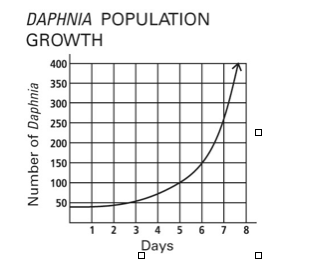
32.
What type of population growth is shown in the graph?  
a)
logistic growth
b)
logical growth
c)
exponential growth
d)
density-dependent growth
33.

What type of population growth is shown in this graph?

a)

logistic growth

b)

exponential growth

c)

logical growth

d)

density-independent growth

34.

Which point on the graph best represents the carrying capacity?

a)

Letter A

b)

Letter B

c)

Letter C

d)

Letter D

e)

Letter E

35.

Which of the following is density-independent limiting factor?

a)

disease

b)

competition

c)

earthquake

d)

predation

36.

In which month(s) did the Cottontail Rabbits reach their carrying capacity?

a)

January and February

b)

March and May

c)

April and January

d)

April and May

37.
Diseases may spread more rapidly when an area is crowded, so disease is considered to be a
a)
type I survivorship curve
b)
population crasher
c)
density-dependent limiting factor
d)
population enhancer
38.
What pattern of growth will a population with limited resources show?
a)
density-dependent
b)
exponential 
c)
logistic
d)
logical 
39.

The number of organisms per acre is an example of:

a)

population growth

b)

population size

c)

population density

40.

(birth + immigration) - (death + emigration) = ?

a)

population density

b)

population change

c)

population decline

d)

population growth

41.

An organism's movement INTO an ecosystem is

a)

emigration

b)

stability

c)

decline

d)

immigration

42.

A(n) ____________________-shaped curve describes the tendency of a population to grow without limit to its size.

a)

L

b)

J

c)

S

d)

T

43.

A population that grows until it reaches its carrying capacity usually has the shape of an ____.

a)

I

b)

J

c)

S

d)

M

44.

When a jellyfish paralyzes a tiny fish with its poisonous tentacles, the fish is the

a)

predator.

b)

prey.

c)

host.

d)

parasite.

45.
When a population grows past the ecosystem's carrying capacity, what happens to the population?
a)
Continues to grow
b)
The population starts to die off to return to carrying capcity
c)
The population will go extinct due to lack of resources
d)
The population grows then finds a new carrying capacity
46.
What is the order of succession shown in this figure?
a)
A, B, C, D
b)
B, A, D, C
c)
C, D, A, B
d)
D, A, B, C
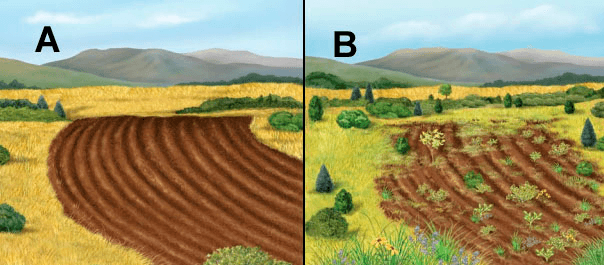
47.
What type of succession is shown going from figure A to figure B?
a)
primary succession
b)
ecological succession
c)
secondary succession
d)
intermediate
48.
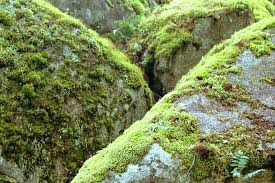
The picture shows what type of succession?
a)
primary
b)
secondary
c)
tertiary
d)
quadanary
49.
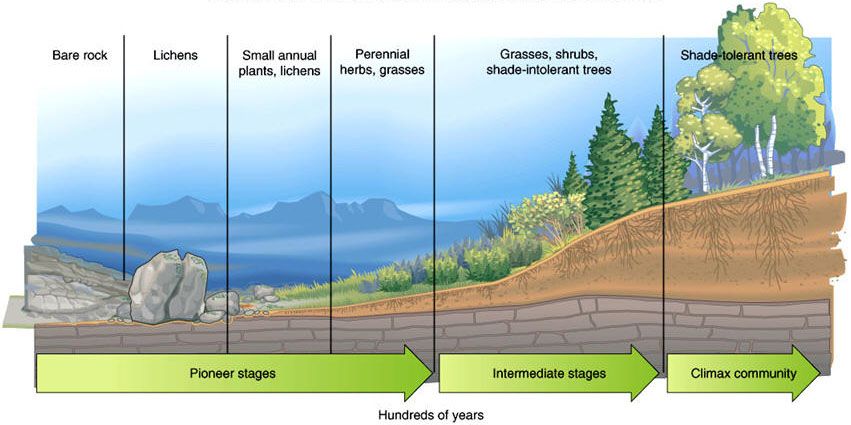
What are examples of pioneer species in a primary succession?
a)
Bushes and Shrubs
b)
Oak trees
c)
Mossess and Lichens 
d)
A rose Bush
50.
Final illustration (#8) shows
a)
pioneer species
b)
climax community
c)
only biotic factors
d)
only abiotic factors
51.
Succession type?
a)
primary succession
b)
secondary succession
c)
tertiary succession
d)
variable succession
52.
What is the most important function of pioneer species?
a)
To create rocks
b)
To create soil and add nutrients to the environment 
c)
To look nice
d)
Food for animals 
53.

Which of the following best describes primary succession?

a)

Volcano wipes out ecosystem that gradually grows back from ash covered soil

b)

Volcano creates a new island of rock that must break down to form an ecosystem

c)

Forest fire burns down forest that must bounce back over time

d)

Tornado destroys a crop that must slowly grow back over time.

54.

Why does biodiversity increase during the course of succession?

a)

Biodiversity refers to the difference in ages of organisms, so some organisms arrive earlier than others.

b)

Over time, the same trees begin to reproduce and take over an area.

c)

Many populations of organisms gradually begin to occupy the same area to create a climax community.

d)

Many organisms move in to the area for a short amount of time, then leave to find a better habitat.

55.

What is an example of an area that is likely to undergo primary succession?

a)

Glaciers melt and leave exposed rock

b)

Plants die from drought and decompose

c)

Land is bulldozed and soil remains

56.

What is the main difference between primary and secondary ecological succession?

a)

Primary begins WITHOUT soil; Secondary begins WITH soil

b)

Primary is the first state and secondary is the second stage

c)

Primary builds plant community; secondary builds animal community

d)

Primary begins WITH soil; Secondary begins WITHOUT soil

57.

Which is faster: Primary or Secondary Succession?

a)

Primary Succession

b)

Secondary Succession

c)

Both Take The Same Amount of Time

58.
When humans burn fossil fuels, most of the carbon quickly enters the                       as carbon dioxide.
a)
Water
b)
Atmosphere
c)
Sun
d)
Air
59.
How do living organisms return carbon to the atmosphere in the carbon cycle?
a)
respiration and photosynthesis
b)
 decomposition and respiration
60.
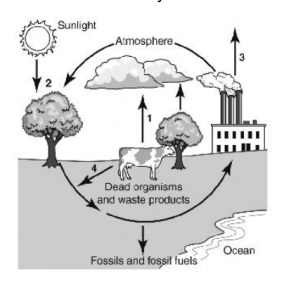
What is happening at 1?
a)
respiration: releasing CO2
b)
decomposing COin the soil
c)
photosynthesis: absorbing CO2
d)
turning CO2 from the atmosphere into organic molecules
61.
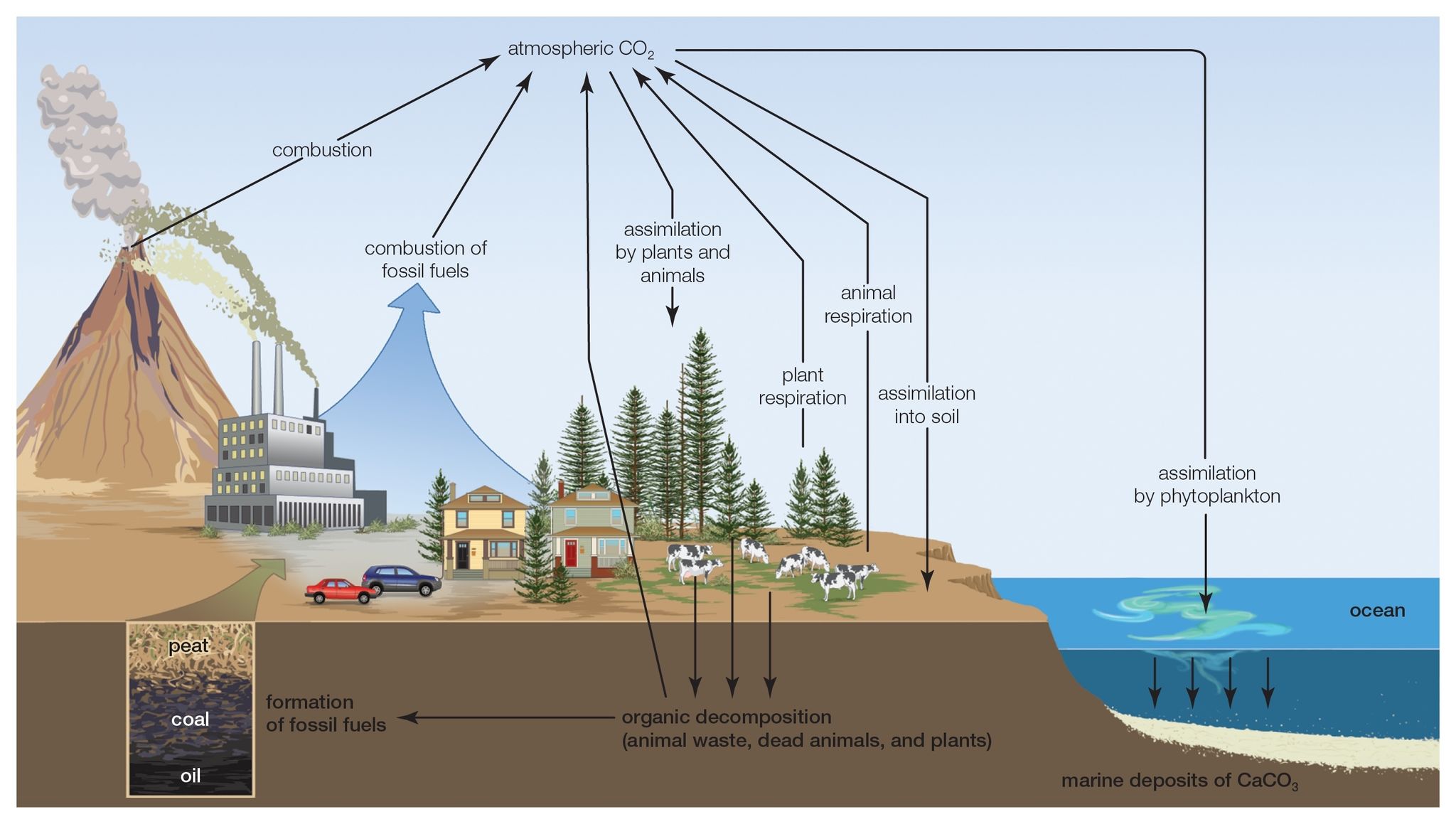
Identify the cycle pictured.
a)
The Water cycle
b)
The Carbon cycle
c)
The Nitrogen cycle
d)
The Phosphorus cycle
62.
Which of the following add carbon dioxide to the atmosphere?
a)
volcanoes
b)
combustion of fossil fuels
c)
animal and plant respiration
d)
all of these
63.
Organisms that do not decompose can be buried and become what?
a)
water
b)
nutrients
c)
air
d)
fossil fuels
64.

Organisms release carbon dioxide gas through a process called

a)

filtration

b)

respiration

c)

photosynthesis

d)

nitrogen cycle

65.

________________________ is part of the air, rocks, soil, and all living things.

a)

Nitrogen

b)

Carbon

c)

Water

d)

Silver

66.

When water vapor is cooled and forms droplets of liquid water

a)

Condensation

b)

Evaporation

c)

Transpiration

d)

Runoff

67.
Precipitation occurs because 
a)
the droplets evaporate in the air
b)
the droplets are too light for the air to hold
c)
the droplets are too heavy for the air to hold
68.
When water turns into a gas
a)
condensation 
b)
evaporation
c)
precipitation
69.
What is condensation?
a)
The part of the water cycle when the sun heats up water, turning it from a liquid into water vapor or steam. It rises from the ground into the air.
b)
The part of the water cycle when the water vapor in the air gets cold. The water turns back into a liquid and forms clouds.
c)
The part of the water cycle when clouds get heavy and can no longer hold the liquid water. This causes the water to fall from the sky to the earth as rain, snow, sleet, or hail.
70.
What is evaporation?
a)
The part of the water cycle when the sun heats up water, turning it from a liquid into water vapor or steam. It rises from the ground into the air.
b)
The part of the water cycle when the water vapor in the air gets cold. The water turns back into a liquid and forms clouds.
c)
The part of the water cycle when clouds get heavy and can no longer hold the liquid water. This causes the water to fall from the sky to the earth as rain, snow, sleet, or hail.
71.
On which kind of day would you expect the most evaporation from the surface of a pond?
a)
cold, rainy
b)
cold, sunny
c)
warm, rainy
d)
warm, sunny
72.
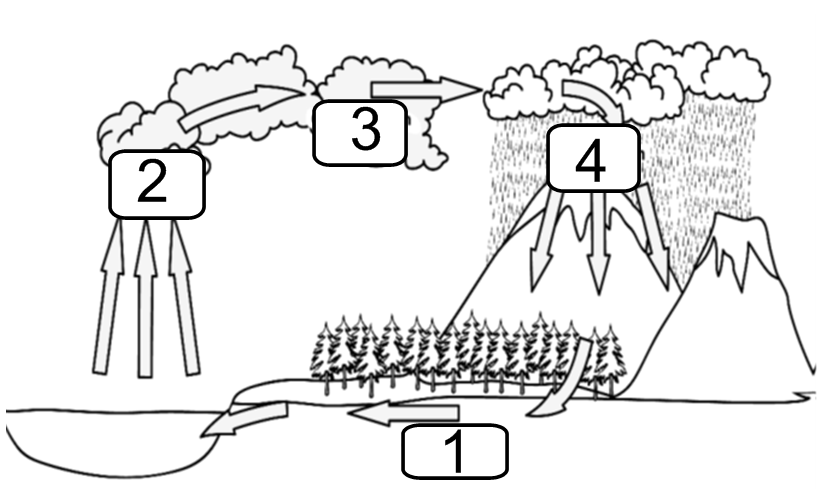
Which stage does the #2 show in the diagram?
a)
condensation
b)
evaporation
c)
precipitation
d)
run off
73.
Which stage does the #3 show in the diagram?
a)
condensation
b)

evapotranspiration

c)
precipitation
d)
run off
74.
what does the #4 show in the diagram?
a)
condensation
b)
evaporation
c)
precipitation
d)
run off
75.

TRees breathe out water vapor, driving this process:

a)

Transpiration

b)

Precipitation

c)

Evaporation

d)

Condensation

76.

Which of these nitrogen cycle processes converts atmospheric nitrogen to a soil form of nitrogen that is usable by plants?

a)

nitrogen fixation

b)

nitrification

c)

denitrification

d)

ammonification

e)

assimilation

77.
How much of the atmosphere is composed of nitrogen gas?
a)
87%
b)
38%
c)
78%
d)
21%
78.
Organisms that break down dead plants & animals and release nitrogen back into atmosphere...
a)
bacteria
b)
plants
c)
animals
d)
producers
79.
Organisms that need nitrogen to survive
a)
only plants
b)
only animals
c)
only bacteria
d)
all living organisms
80.
If the atmosphere is 78% N2, why can't we just get our nitrogen by breathing?
a)
We have no mechanism to break the triple bond of nitrogen between the atoms.
b)
Our lungs would be damaged by the N2.
c)
We need Oxygen for cellular respiration.
d)
The legumes take it up first.
81.
Plants and animals cannot use nitrogen directly from the air.
a)
True
b)
False
82.
After plants and animals contain nitrogen, what puts it back into atmosphere and soil?
a)
decomposition
b)
precipitation
c)
condensation
d)
bacteria