wayground logo

Free Printable Worksheets

NEW

Font size

S
M
L
XL
Worksheets

Meiosis/Genetics Review

Total questions: 80

Worksheet time: 1hrs 3mins

Name
Class
Date
1.

What kind of cells are made in MEIOSIS?

a)

Haploid Gametes

b)

Diploid Somatic Cells

c)

Skin Cells

d)

Liver Cells

2.

A human body (somatic) cell usually has how many chromosomes?

a)

6

b)

22

c)

4

d)

46

3.
When an area of a chromatid is exchanged with the matching area on a chromatid of its homologous chromosome, _________________ occurs
a)
crossing over
b)
mutagenesis
c)
hybridization
d)
fertilization
4.
If the Diploid number of Carrots is 18, the haploid number is
a)
18
b)
9
c)
27
d)
36
5.

The cells produced via meiosis are called:

a)

Gametes

b)

somatic cells

c)

body cells

d)

skin cells

6.
Why do we need meiosis?
a)
To double the number of chromosomes going into sex cells
b)
To halve the number of chromosomes going into sex cells
c)
To triple the number of chromosomes going into sex cells
d)
To not change the number of chromosomes going into sex cells
7.
If a somatic (body) cell in a butterfly contains 24 chromosomes, a butterfly egg would contain
a)
3
b)
6
c)
12
d)
24
8.
The result of meiosis is:
a)
two diploid cells
b)
two haploid cells
c)
four diploid cells
d)
four haploid cells
9.
What causes genetic variation in meiosis?
a)
chromosomes lining up
b)
crossing over of chromosomes
c)
separation of chromosomes
d)
chromosomes pulling apart
10.

The chromosomes that pair up during meiosis, are called __________ chromosomes.

a)

heterozygous

b)

asexual

c)

homologous pairs

d)

genes

11.
How many daughter cells are produced at the end of meiosis?
a)
1
b)
2
c)
3
d)
4
12.
What phase is represented?
a)
metaphase 1
b)
metaphase 2
c)
anaphase 1
d)
anaphase 2
13.
What phase is represented?
a)
metaphase 1
b)
metaphase 2
c)
anaphase 1
d)
anaphase 2
14.
What process, and which type of resulting cells are represented?
a)
mitosis, gametes
b)
mitosis, body cells
c)
meiosis, gametes
d)
meiosis, body cells
15.
Meiosis makes sperm and egg cells. In humans, sperm and egg cells each have _____ chromosomes. Therefore a fertilized human egg cell (sperm and egg cell combined) would create a cell with _____ chromosomes.
a)
23, 46
b)
46, 23
c)
2, 4
d)
50, 100
16.
Identify the phase.
a)
Metaphase I
b)
Metaphase II
c)
Prophase I
d)
Anaphase II
17.
A human zygote should have _____ chromosomes inside.
a)
46
b)
23
c)
92
d)
64
18.

What are homologous chromosomes?

a)

single chromosomes

b)

they are the same size and have the same genes

c)

sister chromatids

d)

centromeres

19.

What phase must happen before meiosis occurs to replicate the DNA?

a)

prophase

b)

metaphase

c)

anaphase

d)

interphase

20.

How many cells are at the the beginning of meiosis?

a)

1

b)

2

c)

3

d)

4

21.

How many cells are there after meiosis I?

a)

1

b)

2

c)

3

d)

4

22.

How many cells are there after meiosis II?

a)

1

b)

2

c)

3

d)

4

23.
The passing of traits from parent to offspring 
a)
Heredity 
b)
Genetics 
c)
Hybrid 
d)
Probability 
24.
Who was the father of genetics 
a)
Sagan 
b)
Issac Newton 
c)
Gregor Mendel 
d)
C.jenkins 
25.
 which is heterozygous ?  
a)
Tt
b)
TT
26.
Which is homozygous ?
a)
Zz
b)
SS
27.
the genetic makeup of an organism
a)
heterozygous
b)
punnet square
c)
genotype
28.
A homozygous dominant dog with brown fur is crossed with a heterozygous dog with brown fur. What are the percentages of the possible genotypes?
a)
100% BB
b)
75% BB and 25%Bb
c)
50 % BB and 50% Bb
d)
50% Bb and 50% bb
29.
An offspring will receive how many alleles from each parent to determine a specific trait?
a)
one
b)
two
c)
three
d)
five
30.
having two of the same genes for the trait (sometimes called purebred).
a)
homozygous
b)
hetrozygous
c)
protein
d)
chromosome
31.
Two heterozygous (Tt) tall pea plants are crossed. Which describes their offspring?
a)
50% tall and 50% short
b)
75%tall and 25% short
c)
100%short
32.
B=brown eyes
b= blue eyes
What is true about two brothers that have brown eyes?
One has genotype BB the other Bb.
a)
they have same phenotype and genotype
b)
they have different genotypes and phenotypes
c)
they have same phenotype but different genotypes
d)
they have same genotype but different phenotypes
33.
A dog gives birth to 5 puppies. What percentage of the chromosomes does each puppy share with the mother?
a)
25%
b)
50%
c)
75%
d)
100%
34.
This is an example of what?
a)
Complete dominance
b)
Incomplete dominance
c)
Codominance
d)
None of the above
35.
If T=Tall & t=short, what is the genotypic ratio?
a)
1:3
b)
3:1
c)
1:2:1
d)
2:2
36.
The sex of an offspring is determined by ______________________.
a)
the mother
b)
the father
c)
the mother and the father
d)
by the environment
37.
Incomplete dominance means that the traits are
a)
expressed equally
b)
dominant
c)
recessive
d)
blended
38.
Term for homozygous organisms that display two dominant phenotypes at the same time
a)
codominance
b)
incomplete dominance
c)
multiple alleles
d)
linked genes
39.

The pedigree represents red-green color blindness in four generations of a family. Which best describes individual II-4?

a)

female with normal color vision who is a carrier of the allele

b)

female with normal color vision who is not a carrier of the allele

c)

male with normal color vision who is a carrier of the allele

d)

male with normal color vision who is not a carrier of the allele

40.
In the second generation-how many people are carriers of the trait?
a)
2
b)
3
c)
5
d)
6
41.
Examine the pedigree. The allele for the presence of a widow’s peak is dominant. Therefore, we can tell from the chart that in the couple labeled 2:
a)
the male is heterozygous and the female is homozygous.
b)
the male is homozygous and the female is heterozygous.
c)
the male is homozygous and the female is homozygous.
d)
the male is heterozygous and the female is heterozygous.
42.
How are individuals III-2 and II-4 related?
a)
Cousins
b)
Dad and Daughter
c)
Uncle and Niece
d)
Grandpa and Granddaughter
43.
Which of the following sequences of processes correctly reflects the central dogma?
a)
protein synthesis, transcription, translation
b)
protein synthesis, translation, transcription
c)
transcription, translation, protein synthesis
d)
translation, transcription, protein synthesis
44.
A molecule of DNA is made up of _________.
a)
amino acids and proteins
b)
ATP and enzymes
c)
paired nucleotides
d)
receptor enzymes
45.
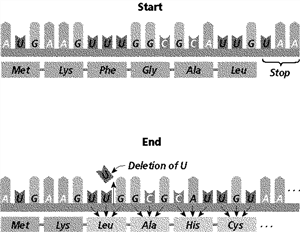
What type of mutation has occurred in Figure 12-3?
a)
substitution
b)
frameshift
c)
lethal
d)
insertion
46.
What is the complimentary mRNA sequence to the DNA sequence A-T-T-G-C-A.
a)
T-A-A-C-G-T
b)
U-A-A-C-G-T
c)
U-A-A-C-G-U
d)
T-A-A-G-C-U
47.
Which defines a codon in DNA or mRNA?
a)
pair of nucleic acid and sugar
b)
pair of phosphate and sugar
c)
three-base code
d)
two-base code
48.
What mutation has occurred here? 
T-G-A-C-C-A
T-G-A-G-C-A
a)
Substitution
b)
Deletion
c)
Insertion
d)
Frameshift 
49.
Any change in the sequence of DNA is...
a)
transgenic shift
b)
Single Genotype
c)
Monohybrid Trait
d)
Mutation
50.
Which organelle is DNA usually found in?
a)
cell membrane
b)
vacuole
c)
chloroplast
d)
nucleus
51.
What are the building blocks of proteins called?
a)
DNA
b)
RNA
c)
Ribosomes
d)
Amino Acids
52.
DNA has a ______ strand; RNA has a ______ strand.
a)
double/double
b)
double/triple
c)
double/single
d)
single/single
53.
In RNA, the nitrogen base____ replaces ____ that was present in DNA. 
a)
A, U (adenine, uracil)
b)
C, G (cytosine, guanine)
c)
U, T (uracil, thymine)
d)
U, A (uracil, adenine)
54.
The "central dogma" states that genetic information flows from 
a)
Protein-->mRNA-->DNA
b)
Protein-->DNA-->mRNA
c)
mRNA-->DNA-->Protein
d)
DNA-->mRNA-->Protein
55.
Transcription takes place in the 
a)
cytoplasm
b)
ribosome
c)
mitochondrion
d)
nucleus
56.
Translation occurs in the
a)
nucleus
b)
mitochondria
c)
cytoplasm
d)
golgi apparatus
57.

Which Nucleotide matches to Cytosine?

a)

Guanine

b)

Adenine

c)

Uracil

d)

Thymine

58.

This is the process by which double stranded DNA produces single stranded RNA:

a)

Photosynthesis

b)

Translation

c)

Pollination

d)

Transcription

59.

This organelle is crucial for the translation process:

a)

Mitochondria

b)

Ribosome

c)

Gogli Apparatus

d)

Vacuole

60.

The DNA sequence UAGCGAUUACGU is part of a gene. How many amino acids are coded for by this sequence?

a)

20

b)

4

c)

8

d)

12

61.
What is the sugar in RNA?
a)
glucose
b)
ribose
c)
fructose
d)
lactose
62.
Which of the following is a function of DNA?
a)
speeds up body functions
b)
provides structural support
c)
stores energy
d)
stores genetic information
63.
If there is 10% Adenine in a given DNA molecule, what percent of the DNA will be Thymine?
a)
40%
b)
90%
c)
80%
d)
10%
64.
What kind of cells are made in MEIOSIS?
a)
Haploid cells
b)
Diploid Cells
c)
Skin Cells
d)
Liver Cells
65.
Diploid Cells are represented by
a)
2n
b)
n
c)
4n
d)
1/2 n
66.
The chromosomes that pair up during meiosis, are called __________ chromosomes.  
a)
homozygous 
b)
asexual
c)
homologous
d)
genes
67.
Which of the following best describes meiosis?
a)
It is carried out in all tissues theat require cell replacement
b)
It occurs only in cells in the reproductive structures of an organism
c)
It happens in all of the tissues except the brain and spinal cord
d)
It is the first stage of mitosis
68.
A human zygote should have _____ chromosomes inside.
a)
46
b)
23
c)
92
d)
64
69.
Which of the following cells is a gamete?
a)
egg
b)
bone
c)
heart
d)
muscle
70.
The fertilized egg is termed a/an _____.
a)
gamete
b)
allele
c)
homolog
d)
zygote
71.

Is the following cell diploid or haploid?

a)

Diploid

b)

Haploid

72.

Is this a normal human karyotype?

a)

YES

b)

NO

73.

Is this karyotype for a male or female?

a)

MALE

b)

FEMALE

74.

Mitosis makes sure that all daughter cells are _____.

a)

genetically identical, diploid

b)

genetically identical, haploid

c)

genetically diverse, diploid

d)

genetically diverse, haploid

75.
What is one advantage of sexual reproduction?
a)
The offspring are identical to the parents
b)
the offspring are resistant to viruses
c)
the offspring are born live, instead of from eggs
d)
The offspring inherit a wider variety of genetic information
76.
If an intestinal cell in a butterfly contains 24 chromosomes, a butterfly egg would contain
a)
3
b)
6
c)
12
d)
24
77.

A mutation is defined as:

a)

A change in the cell's structure

b)

Anything that changes in an embryo

c)

Any change in the physical features of a human

d)

A change in the DNA sequence

78.
What causes mutations?
a)
Mistakes in replication or environmental substances
b)
The amino acids
c)
Passed down by genetics
d)
It's how your born
79.

A mutation in which only one nucleotide is altered is called a:

a)

Frameshift Mutation

b)

Deletion Mutation

c)

Point Mutation

d)

Insertion Mutation

80.
Why are insertion and deletion mutations so harmful?
a)
They change all of the codons from the mutation on down the line, which changes the amino acid sequence
b)
They insert things that an organism doesn't need.
c)
They often delete things that organisms need.
d)
Insertion and deletions are not any more harmful than substitution mutations.