wayground logo

Free Printable Worksheets

NEW

Font size

S
M
L
XL
Worksheets

H Evolution Quizizz

Total questions: 80

Worksheet time: 1hrs 21mins

Name
Class
Date
1.

Geologist, said the earth was very old.

a)

Lyell

b)

Darwin

c)

Shakespeare

d)

Hutton

2.

Vertebrate embryos:

a)

Have similar stages of development, due to a common ancestor

b)

Have different stages of development, due to a common ancestor

3.

Tetrapods (4 limbs) have very similar bone structures. This leads biologists to believe:

a)

They all had a common ancestor

b)

Their common ancestor was probably a lamprey

c)

Their limbs are convergent evolution

4.

Which is artificial selection?

a)

Breeding dogs for specific traits.

b)

Coyote species diverging from the wolves.

5.

Natural selection would select for:

a)

Better camouflage for hiding

b)

Bigger, redder, neck sack to attract females.

c)

Bigger antlers to beat up other deer.

d)

Loss of alleles.

6.

An animal has several inherited characteristics that makes it much fitter than its rivals. According to Natural Selection it should:

a)

Help the others that are less fortunate

b)

Survive longer, have more and better babies.

c)

Be equals with its kin

7.

A species of spider is an average of 5 cm long. Any longer and it has trouble hiding from birds. Any smaller and it has trouble catching prey. What type of selection is this?

a)

Stabilizing

b)

Directional

c)

Disruptive.

8.

Genetic variation in a population can be increased with:

a)

Mutations

b)

Genetic drift

c)

Founders effect

d)

Genetic bottleneck.

9.

High fitness individuals in a population:

a)

Live longer and have more offspring

b)

Live longer but have less offspring

c)

Neither live longer nor have more offspring

10.

Individuals who enter or leave a population, taking their alleles with them are contributing to:

a)

Gene flow

b)

Genetic Bottleneck

c)

Founder effect

11.
Who was the first naturalist to study evolution?
a)
Charles Darwin
b)
Gregor Mendal
c)
Carolus Linneaus
d)
Thomas Edison
12.
This is a process by which organisms inherited advantageous traits that tend to reproduce more successfully than the other organisms do. 
a)
Artificial selection
b)
Natural selection
c)
Populations
d)
Environment
13.
This is a group of organisms of the same species that live in a specific geographical area.
a)
Environment
b)
Evolution
c)
Biological diversity
d)
Populations
14.
This is an inherited trait that helps an organism survive and reproduce in its environment.
a)
Evolution
b)
Population
c)
Environment
d)
Adaptation
15.
This is an ecological relationship in which two or more organisms depend on the same limited resource.
a)
Adaptation
b)
Competition
c)
Evolution
d)
Natural selection
16.
The death of every member of a species.
a)
Competition
b)
Population
c)
Extinction
d)
Evidence
17.
This is the trace or remains of an organism that lived long ago, most commonly preserved in sedimentary rock.
a)
Competiton
b)
Extinction
c)
Evidence
d)
Fossil
18.
The law of superposition states
a)
the oldest rock layer is on the top, the younger rock layer is on the bottom
b)
rock layers are always in sequence from oldest to youngest
c)
the youngest rock layer is on the bottom and the oldest is on the top
d)
the oldest layer is on the bottom and the youngest is on the top when it is undisturbed
19.
Dolphins have the same arm structure as wolfs, what type of evidence for evolution does this represent?
a)
DNA
b)
vestigial structures
c)
homologous structures
d)
embryology
20.
What is embryology?
a)
the age of organisms
b)
the oldest stage of development
c)
the life span of an organism
d)
the earliest growth stage of development
21.
Change over time is
a)
evolution
b)
generation
c)
growth
d)
biogenesis
22.
What animal is Darwin known for studying?
a)
dinosaurs
b)
tunicates
c)
finches
d)
horses
23.

The picture shown is an example of

a)

Vestigial structures

b)

Homologous structures

c)

Analogous structures

d)

Fossils

24.

Which process of evolution is demonstrated below?

a)

Comparative anatomy

b)

Homologous structures

c)

Comparative embryology

d)

Vestigial structures

25.

Which evidence for evolution is shown below?

a)

Comparative embryology

b)

Homologous structures

c)

Biochemical evidence

d)

Vestigial structures

26.

See picture for question

a)

Live in the same type of ecosystem

b)

Have slowly evolved to become herbivores

c)

Have a common ancestor

d)

Exchanged DNA at some point in the past
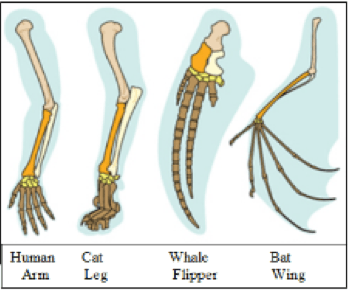
27.

The bones in the figure above are-

a)

Evidence of a common ancestor

b)

Evidence that animals can walk

c)

Evidence that fossils are old

d)

Evidence of nothing

28.

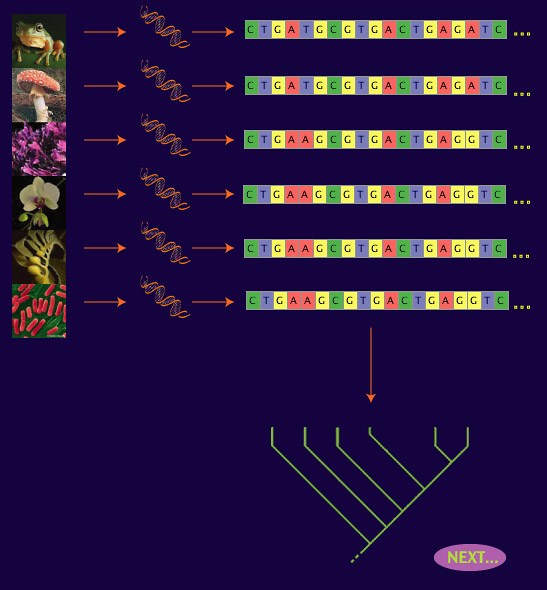
Genome maps provide the DNA sequences of chromosomes. Some scientists have compared the genome maps of a hedgehog and a sloth. What do these genome maps allow the scientists to determine?

a)

The color patterns of the offspring of each species

b)

How much the size ranges of the two species differ

c)

The methods of protein synthesis that each species uses

d)

How closely related the two species are to each other.

29.

What conclusion can you draw from the fact that many modern whale species have vestigial pelvic and leg bones?

a)

The ancestors of whales may have been land mammals

b)

Whales could walk if they wanted to

c)

Whales are preparing to evolve into land animals

d)

Someday whales will be able to walk and will have legs

30.

Scientists discover that cells from two species of organisms are made up of similar proteins, suggesting a close evolutionary relationship. If the scientists do further biochemical analyses, which additional finding would support this conclusion?

a)

The fossils of both organisms are found relatively close to each other in the fossil record.

b)

The anatomical structure of both organisms is similar.

c)

The DNA nucleotide sequence of both organisms is similar.

d)

Both populations of organisms have undergone natural selection over time.

31.

The fact that both these mammals incubate their immature offspring in a pouch provides evidence that they-

a)

Belong to the same species

b)

Must range great distances to eat

c)

Have very similar skeletal structures

d)

Are descended from a common ancestor

32.

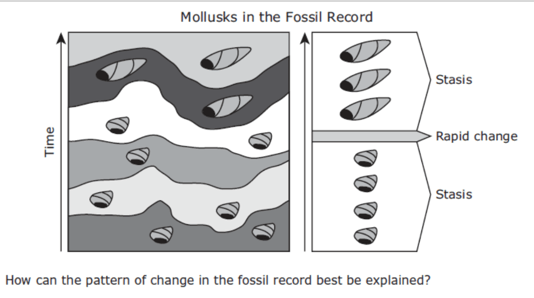
How can the pattern of change in the fossil record best be explained?

a)

The mollusks were well adapted to their stable environment. A large, sudden change occurred in their environment. After the change the mollusks with the bigger shells were better adapted for the new environment.

b)

The mollusks were well adapted to their stable environment. The mollusks hybridized with a smaller species of mollusk. A new species of mollusk with a bigger shell resulted.

c)

The mollusks were not well adapted to their environment. The length of the mollusks' shells changed gradually over time. The mollusks in the original population that had small shells died over a period of many years.

33.
Which layer is the oldest?
a)
1
b)
2
c)
3
d)
4
34.
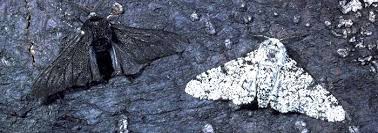
Predict which moth would increase in population
a)
light 
b)
dark
35.
Two organisms that are closely related would have
a)
very similar DNA sequence
b)
exactly the same DNA sequences
c)
no proteins in common
d)
completely different DNA sequence
36.
The white feathers of a snowy owl allow it to blend in with its environment during the winter months (snow). This is an example of ________________
a)
Species
b)
Environmental Change
c)
Adaptation
d)
Variation
37.
A prey population consists of individuals with a variety of running speeds.
The adaptation that allows some of these animals to run fast would be an example of natural selection if it helps them —
a)
survive and undergo mutations in their DNA
b)
produce offspring that run at average speeds
c)
reproduce and increase the frequency of their genes in the population
d)
lower the mortality rates of the population
38.
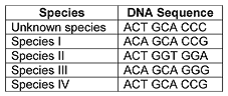
According to this data, the unknown bacterial species is most closely related to: 
a)
Species I
b)
Species II
c)
Species III
d)
Species IV
39.
The similarities of organisms in which two areas numbered in the picture provide the best evidence for common ancestry?
a)
1 and 2
b)
3 and 4
c)
5 and 6
d)
7 and 8
40.
Certain insects resemble (look like) the bark of the trees on which they live. Which statement provides the best explanation  for this resemblance? (Peppered Moths)
a)
The trees caused mutations in the insects
b)
Natural selection played a role in this protective coloration
c)
The insect camouflage so they developed this coloration
41.
A few deer wander out of their native woods into a completely new park where no deer had ever been before. They go on to create an entirely new population.
a)
Genetic Drift
b)
Natural Selection
c)
Non-random mating
d)
Mutation
42.
Yellow toucan birds seek out one another to make babies together and tend to avoid the green toucan birds.
a)
Genetic Drift
b)
Non-random mating
c)
Gene flow
d)
Mutation
43.
During gestation (pregnancy), a developing male pig had a change in his genetic code. The result was that he was able to walk and do karate.
a)
Genetic Drift
b)
Non-random mating
c)
Mutation
d)
Natural Selection
44.
Five hundred years after the deer had established a flourishing population in the park, a few of them venture back to their original woods and have babies with the deer there.
a)
Genetic Drift
b)
Mutations
c)
Non-random mating
d)
Gene flow
45.
Bats are common in Texas, especially in rocky regions. Bats with longer hang claws have demonstrated higher fitness because of their ability to cling to rock while resting.
a)
Adaptation
b)
Non-random mating
c)
Gene Flow
d)
Mutation
46.
Wolves from the Arizona mesa were transferred to the Colorado Rockies after a forest fire destroyed their habitat. They quickly became part of the local pack and had offspring.
a)
Mutation
b)
Natural Selection
c)
Genetic Drift
d)
Gene Flow
47.
7 Wild Mustangs were taken from the prairies of Iowa after a Texan Rancher purchased them and provided them with their own pasture. Those 7 Mustangs eventually became 122.
a)
Genetic Drift (small popultaion)
b)
Non-random mating
c)
Gene flow
d)
Mutations
48.
Logan was born with unique abilities for quick healing and awesome claws that stick out of his fingers.
a)
Gene flow
b)
Natural Selection
c)
Mutation
d)
Genetic Drift
49.
Two track stars fell in love and after marriage had 5 children that became record-setting athletes.
a)
Non-random mating
b)
Gene flow
c)
Genetic drift
d)
Mutation
50.
The chimpanzees have developed an ability to use simple tools, thanks to their opposable thumb. This has allowed them to thrive in their habitat.
a)
Thumbs up 
b)
Middle finger
c)
Pointer finger
d)
PInky finger
51.
What does the image represent?
a)
Gene flow
b)
Gene drift
c)
Mutation
d)
Adaptation
52.
The hypothesis that evolution of a species occurs gradually over time as a slow and constant process is known as
a)
speciation
b)
punctuated equilibrium
c)
gradualism
d)
microevolution
53.
The hypothesis that evolution of a species occurs in periods of rapid change separated by periods of little or no change is called
a)
divergence
b)
gradualism
c)
punctuated equilibrium
d)
isolation
54.
What type of selection is depicted in the picture? 
a)
stabilizing 
b)
directional 
c)
disruptive 
d)
the answer is not here
55.
Robins typically lay fours eggs. If more then four eggs are produced then the baby chicks are malnourished while smaller egg numbers result in no viable (able to live) baby chicks. This is an example of
a)
stabalizing
b)
disruptive
c)
direction
d)
none of the above
56.
What type of selection?
a)
Directional 
b)
Stabilizing
c)
Disruptive
57.
Only populations can evolve.
Individuals can not evolve.
a)
True
b)
False
58.
Which of the three graphs shows stabilizing selection?
a)
A
b)
B
c)
C
59.
Which of the three graphs shows disruptive selection?
a)
A
b)
B
c)
C
60.
If finches with large beaks and finches with small beaks increase in a population while finches with average sized beaks decreases, which pattern of natural selection has occurred?
a)
Directional selection
b)
Disruptive selection 
c)
Stabilizing selection
61.
What type of natural selection is this?
a)
Disruptive Selection
b)
Directional Selection
c)
Stabilizing Selection
d)
Sexy Selection
62.
What is the correct explanation for what is happening in this graph?
a)
There are a lot of average-sized beaks
b)
There are no beaks
c)
There are a lot of small beaks only
d)
There are a lot of small and large beaks, but not average-sized ones
63.
Scientists find that most feral cats in a neighborhood have whiskers about 12 cm long. After about 15 generations of stabilizing selection, what would you expect to see?
a)
even more cats with 12 cm long whiskers
b)
most cats with less than 12 cm long whiskers
c)
most cats with more than 12 cm long whiskers
d)
most cats with whiskers either less than or more than 12 cm long, very few with whiskers 12 cms 
64.
Human babies don't do well if they are born too small. If they are too big complications can occur during birth. Baby size should then be selected for by which method?
a)
stabilizing
b)
directional
c)
disruptive
d)
Beyonce is having twins
65.
In recent years "SuperBugs" (bacteria that aren't effected by antibiotics) are becoming more and more common. How could natural selection explain this?
a)
Superbugs survive antibiotics and reproduce
b)
Antibiotics cause bacteria to become superbugs
c)
We have always had the same amount of superbugs; modern media just discusses them more.
d)
There is no reliable data on the origin of super bugs.
66.
Why do peppered moths tend to be the same color as the trees on which they live?
a)
The coloring goes along with tasting like the tree. 
b)
It keeps the moth the same temperature as the tree. 
c)
It makes the moths faster than the birds
d)
It makes the moths harder to see.
67.
Comparing human hemoglobin of chimpanzees, horses, kangaroos, and chickens, reveal that humans have the fewest amino acid differences with 
a)
Kangaroos
b)
Horses
c)
chickens
d)
chimpanzees
68.

Darwin's Finches became separate species due to

a)

Geographic isolation

b)

Temporal Isolation

c)

Behavioral Isolation

d)

Postzygotic Isolation

69.

The term for the formation of new and distinct species over the course of evolution is...

a)

speciation

b)

biological species concept

c)

reproductive barrier

d)

natural selection

70.
What is genetic drift?
a)
The movement of genes in/out of a population
b)
A small, random change in the DNA
c)
Any change in the allelic frequencies in a population that is due to chance
d)
›The process in which humans select for or against particular features in organisms
71.
When has speciation occurred?
a)
When populations no longer look the same
b)
When populations no longer have the same frequency of alleles
c)
When populations are living in different environments
d)
When populations can no longer interbreed
72.
Which is a mechanism for change in allele frequency?
a)
gene flow
b)
genetic drift
c)
natural selection
d)
all answers are correct
73.
What is a species? 
a)
A group of organisms that can mate with each other and produce fertile offspring. 
b)
A group of organisms that can mate and produce offspring even if those offspring are infertile.
c)
A group of organisms that genetically are very different from each other. 
d)
Indivual organisms that live in the same environment. 
74.
Mutations, crossing-over, genetic recombination, and random fertilization are all sources of
a)
genetic variation
b)
stabilizing selection
c)
genetic equilibrium
d)
genetic drift
75.
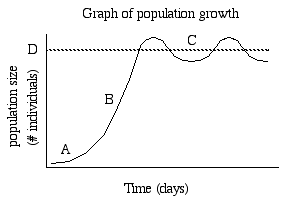
As a population grows, it will most likely stop growing at what size?
a)
Growth limit
b)
Exponential limit
c)
Carrying Capacity
d)
It won't stop growing
76.
The carrying capacity of an environment for a particular species at a particular time is determined by the
a)
number of individuals in the species.
b)
distribution of the population.
c)
reproductive potential of the species.
d)
supply of the most limited resources
77.
Which kind of growth does the human population follow? It is described as a J-shaped curve.
a)
Exponential Growth
b)
Logistic Growth
c)
Outstanding Growth
d)
Minimal Growth
78.
What is the carrying capacity of the following graph?
a)
1000
b)
8000
c)
800
d)
600
79.
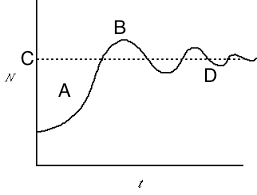
Which point on the graph represents carrying capacity?
a)
A
b)
B
c)
C
d)
D
80.
Which letter shows the the exponential growth of a population?
a)
A
b)
B
c)
C
d)
D