
 Worksheets
Astronomy Test Review
Total questions: 54
Worksheet time: 31mins
Name
Class
Date
1.
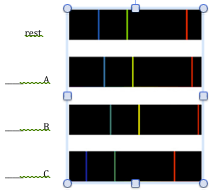
Are any of the galaxies moving towards Earth? Explain.
a)
A. It is redshifted
b)
B. It is redshifted.
c)
C. It is blue shifted.
d)
A. It is blueshifted.
2.
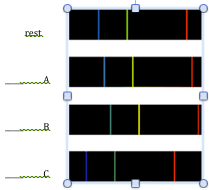
Based on
Hubble’s Law, which of the galaxies is farthest from Earth?
a)
A
b)
B
c)
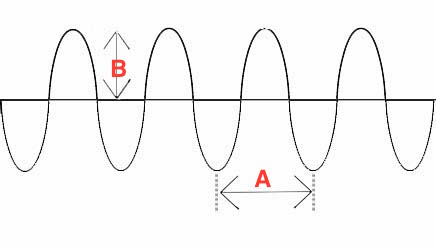
C
3.

Based on the spectrums in the figure, rank the galaxies in order of the speed with which they are moving away from Earth, from slowest (1) to fastest (3).
a)
C, A, B
b)
A, B, C
c)
B, A, C
d)
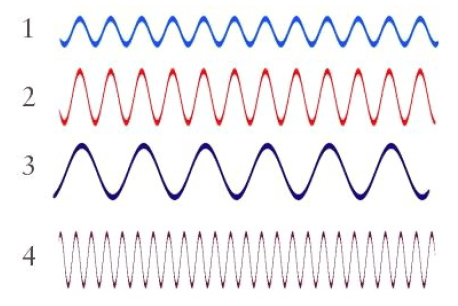
A, C, B
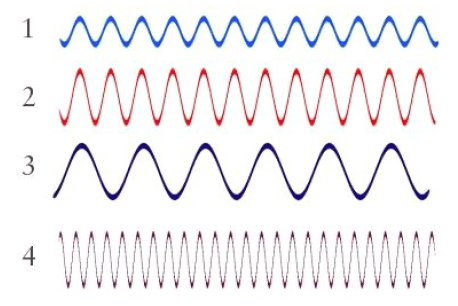
4.
Evidence suggests that the whole Universe is expanding and that it might have started billions of years ago from one place with the big bang.
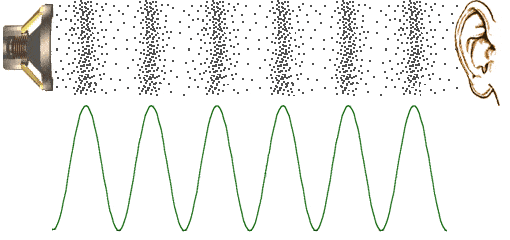
a)
True
b)
False
5.
The existence of the cosmic background radiation
implies that
a)
the big bang model is wrong.
b)
the universe began in a hot, dense state.
c)
the universe did not have a moment of creation.
d)
the universe began in a cold, low-density state.
6.
If an
object is moving toward us, its spectrum will experience
a)
no shift
b)
red shift
c)
black spectrum
d)
blue shift
7.
Hubble observed that galaxies are
a)
expanding
b)
moving away from us
c)
moving towards us
d)
standing still
8.
Which piece of evidence supports the Big Bang
theory?
a)
The more distant galaxies are moving the slowest
b)
The more distant galaxies are moving the
quickest
c)
The more distant galaxies are moving towards us
d)
Galaxies and space is not changing
9.
Why is the CMB so cool now?
a)
The expansion of the Universe has cooled the
radiation and stretched its wavelengths
b)
Dense clouds of dust have blocked most of it.
c)
The cosmological constant has
"squashed" its wavelengths and cooled it.
d)
Hydrogen atoms have condensed on it and chilled
it.
10.
In red shift, the wavelengths of light become
a)
Bluer
b)
shorter
c)
longer
11.
What can a scientist learn about a star from its spectrum
a)
its color
b)
its size
c)
its composition and temperature
d)
its age
12.

Which star is considered a Main Sequence Star?
a)
A
b)
B
c)
C
d)
D
13.

Stars are formed in a large cloud of gas and dust called a
a)
cumulonimbus cloud
b)
nebula
c)
neutron star
d)
black hole
14.

What does the Big Bang theory suggest?
a)
The universe was just there
b)
The Milky Way is the only solar system
c)
The universe is continually expanding
d)
The universe is collapsing in toward a single point
15.
What is the nebular hypothesis?
a)
Prediction about how the universe was formed
b)
Prediction of how the moon was formed
c)
Prediction of how comets were formed
d)
Prediction of how the Solar System was formed
16.
The stable period of a star’s life cycle is called...
a)
The birth of a star
b)
Nebula
c)
Neutron star
d)
Main Sequence
17.
Gravity pulls gases and dust particles in space toward one another, squeezing them into a smaller and smaller space. The temperature at the center rises high enough for nuclear fusion of hydrogen to begin.
What stage in a stars life cycle is this describing?
What stage in a stars life cycle is this describing?
a)
The birth of a star
b)
The death of a star
c)
Black Hole
d)
Stellar Nebula
18.
What determines the color of a star?
a)
It's size
b)
It's temperature
c)
It's composition
d)
They are all the same color
19.
A star at the stage in its life cycle when it stops burning hydrogen, begins burning helium, and expands to a large, low-density star.
What stage in the life cycle does this describe?
What stage in the life cycle does this describe?
a)
Supernova
b)
Black Hole
c)
Main Sequence
d)
Red Giant or Red Supergiant
20.
What fuel do stars use?
a)
Oxygen
b)
Hydrogen
c)
Carbon
d)
Iron
21.
Larger stars (stars with more mass) have a longer life cycle.
a)
True
b)
False
22.
The remains from its supernova will form a rapidly spinning, highly magnetic star called a...
a)
Neutron star
b)
Black Hole
c)
White Dwarf
d)
Supernova
23.
A low mass star ends its life as a
a)
Supernova
b)
Black hole
c)
Black dwarf
d)
Nebula
24.
Something that takes up space and has mass.
a)
volume
b)
matter
c)
mass
d)
density
25.
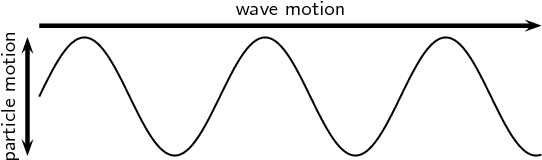
What kind of wave is pictured below?
a)
compressional wave
b)
transverse wave
c)
sound wave
d)
mechanical wave
26.
Amplitude reflects the amount of ____________________ in a wave.
a)
energy
b)
compression
c)
rarefaction
d)
speed
27.
The ___________________ of waves can change when the waves move from one medium to another.
a)
altitude
b)
amplitude
c)
speed
d)
compression
28.
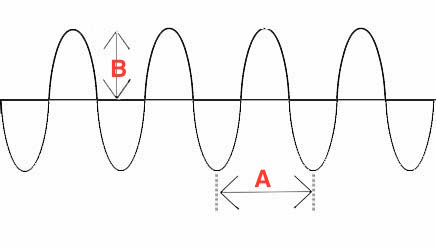
What property of this wave is represented by the letter "A"
a)
amplitude
b)
crest
c)
trough
d)
wavelength
29.
What property of the wave is represented by the letter "B"?
a)
amplitude
b)
crest
c)
trough
d)
wavelength
30.
The highest point on a wave is:
a)
the crest
b)
the trough
c)
the top
d)
the coast
31.
The lowest point on a wave is the:
a)
Amplitude
b)
Crest
c)
Trough
d)
Wavelength
32.
The number of wavelengths that pass a point each per second is:
a)
frequency
b)
period
c)
longitudinal
d)
transverse wave
33.
The type of waves that require medium to pass:
a)
Mechanical Waves
b)
Electromagnetic Waves
34.
When the frequency of a wave increases, what happens to the wavelength?
a)
The wavelength is not directly affected by the frequency of a wave.
b)
The wavelength increases.
c)
The wavelength decreases.
d)
More specific information is needed to form a conclusion about the wavelength.
35.
Which wave in the diagram has the greatest frequency?
a)
1
b)
2
c)
3
d)
4
36.
Which wave in the diagram has the greatest wavelength?
a)
1
b)
2
c)
3
d)
4
37.
Which of the following can sound travel through?
a)
solid
b)
liquid
c)
gas
d)
all of the above
38.
What is the speed of a sound wave that has a frequency of 250 hertz and a wavelength of 8 meters?
a)
31 m/s
b)
250 m/s
c)
2000 m/s
d)
5280 m/s
39.

What are the spaced out sections of this wave called?
a)
Reflections
b)
Rarefactions
c)
Compressions
d)
Wavelengths
40.

What is the wavelength of the sound wave that has a frequency of 340 hertz as it travels through the air at 680 m/s?
a)
0.01 m
b)
0.5 m
c)
2.0 m
d)
200 m
41.
which of the following does NOT belong in the electromagnetic spectrum:
a)
X-ray
b)
sound wave
c)
ultra violet rays
d)
microwaves
42.
Which waves are used to show heat loss with heat sensitive cameras?
a)
Infrared radiation
b)
ultraviolet radiation
c)
microwaves
d)
gamma rays
43.
Which waves are the type that can give us suntans and sunburns?
a)
Infrared radiation
b)
Ultraviolet radiation
c)
Radio waves
d)
X-rays
44.
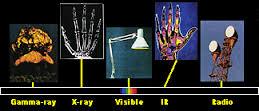
Cancer can be treated with_______________waves.
a)
Penicillin
b)
Radio
c)
Infrared
d)
Gamma
45.

Electromagnetic waves________________travel through space.
a)
Never
b)
Cannot
c)
Can
d)
Wish they could
46.

The acronym (letters) used to remember visible light is____________
a)
KTPERRY
b)
ROYGBIV
c)
DOGPOUND
d)
ROMERO
47.

This type of Electromagnetic wave shows a break in bones.
a)
gamma ray
b)
x-ray
c)
brokenometer
d)
radio wave
48.
Select the correct order of waves on the Electromagnetic Spectrum
a)
Radio, Micro, Infra, Visible, Ultra, X-ray, Gamma
b)
Gamma, X-ray, Ultra, Vis, Infra, Micro, Radio
c)
Vis, Micro, Infra, Ultra, X-ray, Gamma, Radio
d)
Micro, Radio, Vis, Infra, Ultra, X-ray, Gamma
49.

These are the secondary, or second waves to be released. They cannot travel through the liquid outer core
a)
S waves
b)
Surface Waves
c)
P waves
50.
We use this tool to measure seismic waves during earthquakes
a)
Seismographs
b)
magnitude
c)
actual magnitude
d)
sonograph
51.
This is the name of the single digit number that means how powerful an earthquake is. It is measured on the Richter scale
a)
Force
b)
Stress
c)
Magnitude
d)
Plate Boundary
52.

These are the first waves released during an earthquake
a)
S waves
b)
Surface Waves
c)
P waves
53.
How does the Earth's magnetic field help make life possible?
a)
It gives the Earth its gravity
b)
It makes the Earth rotate at the right speed
c)
It protects us from harmful UV rays from the Sun
d)
It blocks electrically-charged particles in solar winds
54.

Which of the following represents refraction?
a)
A
b)
B
c)
C
d)
D
100 %

