
NEW
Font size
S
M
L
XL
 Worksheets
The Periodic Table
Total questions: 46
Worksheet time: 38mins
Name
Class
Date
1.
In the modern periodic table elements are arranged by:
a)
atomic mass
b)
atomic number
c)
valence electrons
d)
number of isotopes
2.
Each column in the periodic table is called a
a)
period
b)
group
c)
cluster
d)
unit
3.
The atomic number tells you what?
a)
number of electrons
b)
number of protons
c)
number of neutrons
d)
both electrons and protons in an atom.
4.
Which group of the periodic table is composed of inert (not reactive) gases?
a)
alkali metals
b)
alkaline earth metals
c)
halogens
d)
noble gases
5.
Elements which are shiny, conduct electricity and heat are called
a)
metal
b)
nonmetal
c)
metalloid
d)
nonexistent
6.
Which element is not a metal?
a)
H
b)
Re
c)
Al
d)
B
7.

The atoms along the staircase are called
a)
metals
b)
nonmetals
c)
metalloids
d)
noble gases
8.
Which is a halogen?
a)
Helium
b)
Chlorine
c)
Oxygen
d)
Neptune
9.
Which is an alkali metal?
a)
Magnesium
b)
Iron
c)
Sodium
d)
Europium
10.
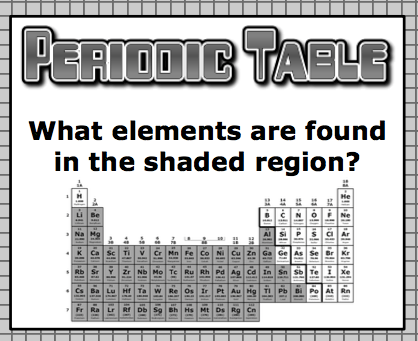
a)
Metals
b)
Nonmetals
c)
Metalloids
11.
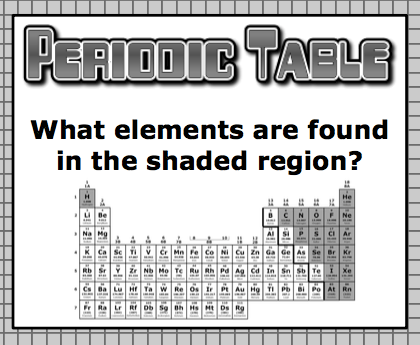
a)
Metals
b)
Nonmetals
c)
Metalloids
12.
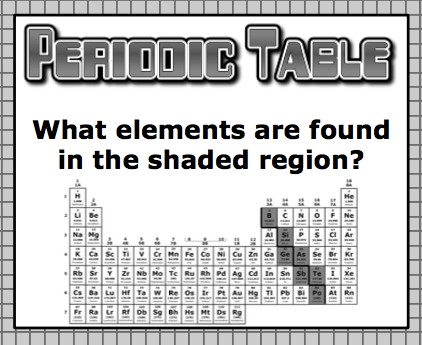
a)
Metals
b)
Nonmetals
c)
Metalloids
13.
Calcium is most like which of the following?
a)
Barium
b)
Potassium
c)
Cesium
d)
Nitrogen
14.
Elements which are considered semiconductors are
a)
metal
b)
nonmetal
c)
metalloid
d)
nonexistent
15.
Which of the following is not a property of metals?
a)
brittle
b)
malleable
c)
lustrous
d)
conductive
16.
If a material can easily be drawn into the shape of a wire, it is
a)
Ductile
b)
Magnetic
c)
Malleable
d)
Reactive
17.
Which element is not in the Alkali metal family?
a)
Li
b)
H
c)
Fr
d)
Cs
18.

Beryllium is in group number______.
a)
Group 2
b)
Group 3
c)
Group 4
d)
Group 7
19.

The period for Bromine is ___________.
a)
3
b)
2
c)
4
20.
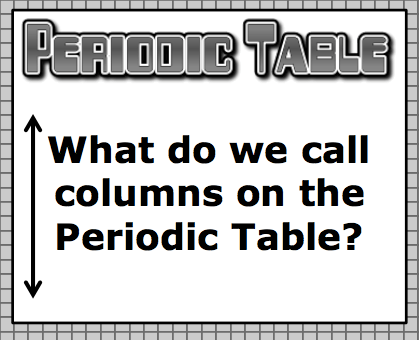
a)
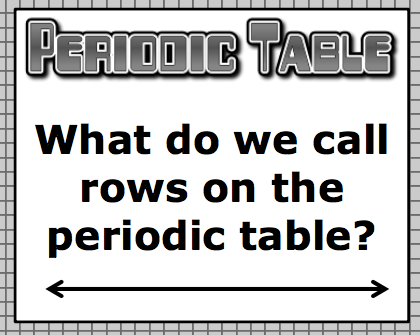
Periods
b)
Groups
21.
a)
Periods
b)
Groups
22.

a)
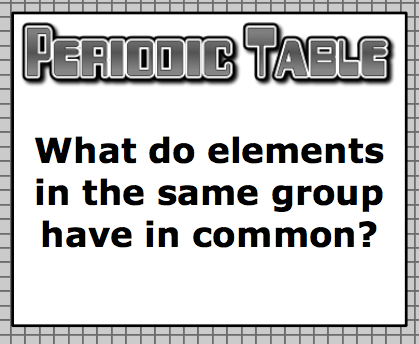
energy levels
b)
valence electrons
c)
protons
d)
neutrons
23.
a)
energy levels
b)
valence electrons
c)
protons
d)
neutrons
24.
The subatomic particle that determines the identity of an element.
a)
neutron
b)
proton
c)
electron
d)
outer shell
25.
What part of the atom determines the chemical properties?
a)
neutrons
b)
protons
c)
outer energy level electrons
d)
core electrons
26.
Which element has the greater ionization energy?
a)
Magnesium
b)
Phosphorus
27.
Which element has the greater ionization energy?
a)
Cesium
b)
Chlorine
28.
Which element has the greater ionization energy?
a)
Gallium
b)
Germanium
29.
Energy is required to remove an electron from the atom.
a)
True
b)
False
c)
Not sure
30.
Which atom is larger?
a)
Mg
b)
Sr
31.
Which atom is larger?
a)
Sr
b)
Sn
32.
Which atom is larger?
a)
Ge
b)
Sn
33.
Which atom is larger?
a)
Cr
b)
W
34.
Which has the greater Electronegativity:
N or C?
N or C?
a)
C
b)
N
35.
Which is the most reactive alkaline earth element?
a)
Ca
b)
Ba
c)
Be
36.
Which of the following is the most reactive non-metal?
a)
Cl
b)
F
37.
Which has the greater Electronegativity:
H or F?
H or F?
a)
H
b)
F
38.
Electronegativity is...
a)
how good an atom is at attracting electrons
b)
the ability of an atom to lose electrons
c)
the energy required to remove an electron from a specific atom
d)
how easy it is to make friends.
39.
The element with the largest electronegativity in the halogens is -
a)
At
b)
F
c)
Cl
d)
Br
40.
The element with the lowest electronegativity in Period 3 is -
a)
Na
b)
Cl
c)
Ar
d)
Mg
41.
Which of the following generally applies to the noble gases?
a)
high ionization energy, low electronegativity, high reactivity
b)
high ionization energy, high electronegativity, high reactivity
c)
low ionization energy, low electronegativity, low reactivity
d)
high ionization energy, low electronegativity, low reactivity
42.
How did Mosely set up the modern periodic table?
a)
increasing atomic mass only
b)
increasing atomic number only
c)
increasing atomic mass with periods and groups
d)
increasing atomic number with periods and groups
43.
As you move left to right across a period, the atomic radius will ....
a)
decrease
b)
increase
c)
stay the same
44.
As you move down a group, the atomic radius will ....
a)
decrease
b)
increase
c)
stay the same
45.
How did Mendeleev organize the elements in his periodic table?
a)
increasing mass only
b)
increasing atomic number only
c)
increasing atomic mass with periods and groups
d)
increasing atomic number with periods and groups
46.
Why did Mendeleev leave blanks in his periodic table?
a)
forgot elements
b)
left room for elements not yet discovered
c)
placed elements in wrong positions leaving gaps
Reset

