wayground logo

Free Printable Worksheets

Font size

S
M
L
XL
Worksheets

covalent review

Total questions: 42

Worksheet time: 31mins

Name
Class
Date
1.
Phosphorous trichloride
a)
PCl3
b)
P3Cl
c)
P3Cl3
d)
PCL
2.

Which of the following is NOT formed by a covalent bond?

a)

K2S

b)

H2O

c)

I2

d)

CO2

3.
Covalent compounds
a)
Share electrons
b)
transfer electrons
c)
contain a sea of electrons
d)
conduct electricity
4.
What is a cation
a)
a metal with a negative (-) charge
b)
a non-metal with a negative (-) charge 
c)
a metal with a positive (+) charge 
d)
a non-metal with a positive (+) charge
5.
The octet rule means that all valence shells want to have the number...... 
a)
1
b)
9
c)
8
d)
16
6.

Which of the following is a characteristic of a covalent bonding?

a)

Crystalline solids

b)

High melting point

c)

Transfer electrons

d)

Low electrical conductor

7.
All atoms obey the octet rule except...
a)
H
b)
P
c)
F
d)
Ne
8.
How many electrons are shared in a double bond?
a)
1
b)
2
c)
4
d)
6
9.
What is the VSEPR shape of H2S?
a)
linear
b)
trigonal planar
c)
bent
d)
tetrahedral
10.
Which of the following is the correct Lewis dot structure for the molecule fluorine (F2)?
a)
A
b)
B
c)
C
d)
D
11.
How many unshared pairs of electrons will a pyramidal molecule have? 
a)
1
b)
2
c)
3
d)
4
12.
How many unshared pairs of electrons will a bent molecule have? 
a)
1
b)
2
c)
3
d)
4
13.
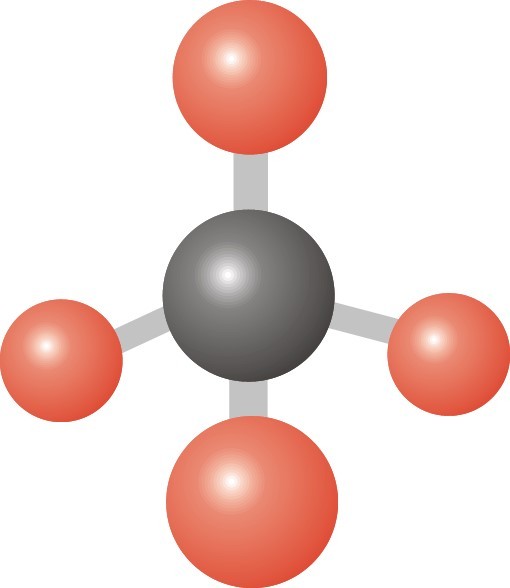
Who could this molecule be?
a)
CH4
b)
CO2
c)
PCl5
d)
BF3
14.
What shape would PHhave?
a)
Trigonal Planar
b)
Trigonal Bipyramidal
c)
Bent
d)
Linear
15.

Which is the correct molecular structure for carbon dioxide?

a)
b)
c)
d)
16.

What 3-D VSEPR shape does this molecule exhibit?

a)

linear

b)

tetrahedral

c)

trigonal pyramidal

d)

trigonal planar

17.
Which of the following is the correct Lewis structure for the compound PBr3?
a)
structure A
b)
structure B
c)
structure C
d)
structure D
18.
What's a valence electron?
a)
electrons in the second energy level
b)
electrons in the outermost energy level
c)
the atomic number
d)
electrons in the first level
19.

A bond where two atoms SHARE electrons

a)

Ionic

b)

covalent

20.

Which Lewis Dot Model drawing correctly shows an O2 molecule?

a)
b)
c)
d)
21.
How many valence electrons does N have?
a)
1
b)
3
c)
5
d)
8
22.
What is the correct name for P2O5?
a)
phosphorus oxide
b)
phosphorus dioxide
c)
phosphate oxide
d)
diphosphorus pentoxide
23.
What is the basis of a metallic bond?
a)
the attraction of neutral metal atoms.
b)
the attraction between protons and neutrons.
c)
the attraction between positive metal ions and interlocking electrons.
d)
the attraction between positive metal ions and free floating electrons.
24.
Electrons that are free to move in metals
a)
delocalized electrons
b)
oxidation number
c)
chemical bond
d)
salts
25.

Which of these are considered properties of metals? (choose ALL that apply)

a)

brittleness

b)

low melting point

c)

luster (shininess)

d)

malleability

e)

ductility

26.
In general, what can be said of the melting points of metals?
a)
They are low.
b)
They are high.
c)
They are lower than nonmetals.
d)
They do not have melting points.
27.

Determine the molecular geometry of the given structure.

a)

Trigonal Pyramidal

b)

Trigonal Bipyramidal

c)

Trigonal Planar

d)

Tetrahedral

28.
Bonds that form between two metals are called ______________ bonds.
a)
ionic 
b)
covalent
c)
metallic
d)
pervasive
29.
Which of the following is a characteristic property of ionic compounds?
a)
They form hard, brittle crystals with characteristic shapes
b)
They have low melting points
c)
They have low boiling points
d)
They contain no charged particles
30.

Which the of the following are properties of covalent compounds?

a)

exist as gases usually

b)

low melting point

c)

high melting point

d)

soft

e)

brittle

31.
 A lone pair is defined as
a)
A pair of bonding electrons
b)
One non-bonding electron
c)
A pair of non-bonding electrons
d)
A pair of electrons on the central atom
32.
What is the VSEPR theory used to predict?
a)
Bond Strength
b)
Polarity
c)
Molecular Shape
d)
Electronegativity
33.

Intermolecular forces are attractions between ______.

a)

Cations and anions

b)

Atoms within a molecule

c)

Neighboring molecules

d)

Protons and electrons

34.
According to VSEPR, molecules adjust their shapes to keep which of the following as far away as possible?
a)
Pairs of valence electrons
b)
Inner shell electrons
c)
Mobile Electrons
d)
Electrons closest to the nucleus
35.
VSEPR stands for ________ theory.
a)
Valence Structure of Electron Pyramids and Regression
b)
Varied Structures of Electrons Paired and Replaced
c)
Varied Shell Energy of Protons and Radiation
d)
Valence Shell Electron Pair Repulsion
36.

Which sample has hydrogen bonding?

a)

H2S

b)

CH4

c)

NH3

d)

HI

37.

Water has an unusually high boiling point for a molecular compound because it has

a)

hydrogen bonding

b)

ion-ion attractions

c)

a high density

d)

a large gram formula mass

38.

Which substance has the weakest intermolecular forces?

a)

Substance A, boiling point of 75 °C

b)

Substance B, boiling point of 105 °C

c)

Substance C, boiling point of 25 °C

d)

Substance d, boiling point of 45 °C

39.

________________________ have the strongest intermolecular forces of attraction.

a)

Dipole- Dipole

b)

Dispersion

c)

Hydrogen Bonds

40.

Can NEVER conduct electricity

a)

ionic

b)

covalent

c)

metallic

41.

CAN conduct electricity when dissolved in water

a)

ionic

b)

covalent

c)

metallic

42.

are a "sea" of electrons

a)

ionic

b)

covalent

c)

metallic