
 Worksheets
DA 3 Review
Total questions: 42
Worksheet time: 42mins
How many electrons are present in a Pb4+ ion?
4
78
82
86
[TEST QUESTION: DRAG-and-DROP: Bonding and intermolecular forces directly impact the physical properties of materials. What type of solid is described in each statement? Move ONE answer to each box]
Which one is typically soft and has low melting points?
Ionic
Metallic
Molecular
Covalent network
[TEST QUESTION: DRAG-and-DROP: Bonding and intermolecular forces directly impact the physical properties of materials. What type of solid is described in each statement? Move ONE answer to each box]
Which type has charges present and high melting points?
Metallic
Ionic
Molecular
Covalent network
[TEST QUESTION: DRAG-and-DROP: Bonding and intermolecular forces directly impact the physical properties of materials. What type of solid is described in each statement? Move ONE answer to each box]
What type is described as a network of atoms, strong, and typically has the highest of all melting points?
Metallic
Ionic
Molecular
Covalent network
[TEST QUESTION: DRAG-and-DROP: Bonding and intermolecular forces directly impact the physical properties of materials. What type of solid is described in each statement? Move ONE answer to each box]
Which type has properties that vary widely and tends to be conductive and malleable?
Metallic
Ionic
Molecular
Covalent network
Calculate the molar mass of (NH₄)₂C₂O₄.
100.00 g/mol
124.10 g/mol
240.78 g/mol
316.20 g/mol
What is the total number of atoms of all the elements in 2.50 moles of Al₂(SO₄)₃?
1.02 x 10²⁴ atoms
1.51 x 10²⁴ atoms
2.56 x 10²⁵ atoms
5.20 x 10²⁵ atoms
Ca₃(PO₄)₂ has a molar mass of 310.174 g/mol. Determine the percent composition of phosphorus in Ca₃(PO₄)₂ to the hundredth place. [TEXT ENTRY on DA]
19.97%
15.23%
25.50%
10.75%
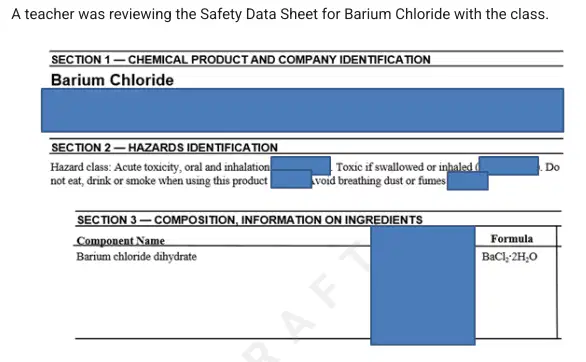
How many molecules are there in one mole of Barium chloride?
1.50 x 10^23
6.02 x 10^23
1.20 x 10^24
2.40 x 10^24
What is the percentage by mass of sodium (Na) in a formula unit of sodium hydrogen carbonate (NaHCO₃)?
44.2%
37.7%
27.4%
16.7%
For each scenario, determine the impact on the solubility of the substance by indicating whether it will increase, decrease, or have no effect. Select the correct answer in each row. [Match Table Grid]
Stirring a solute slowly - Increase
Breaking a solute into smaller pieces - Decrease
Raising the temperature of a solvent - No Effect
Stirring a solute slowly - Decrease
What is the empirical formula for glucose, C₆H₁₂O₆?
CH₂O
C₂H₄O₂
C₃H₆O₃
C₆H₁₂O₆
Which characteristics make water a polar molecule? Select TWO correct answers.
Water is polar because oxygen has a partial negative charge.
Water is polar because hydrogen atoms have a partial negative charge.
Water is polar because the protons create an overall positive charge.
Water is polar because of its bent shape with oppositely charged ends.
Non-electrolytes do not conduct electricity because-
no atoms are formed in solution
no molecules are formed in solution
no ions are formed in solution
too many ions are formed in solution
In a supersaturated solution, what happens when sugar is added to a cup of coffee?
The sugar dissolves completely
The sugar settles on the bottom
The sugar floats on top
The sugar evaporates
In a saturated solution, what occurs when sugar is stirred into hot coffee?
The sugar keeps dissolving
The sugar settles on the bottom
The sugar soon stops dissolving
The sugar evaporates
In an unsaturated solution, what happens when sugar is stirred into coffee?
The sugar keeps dissolving
The sugar settles on the bottom
The sugar floats on top
The sugar evaporates
Which coefficients are required to correctly balance the equation, C₂H₂ + O₂ → CO₂ + H₂O?
1, 2, 3, 2
2, 5, 4, 2
2, 4, 5, 2
2, 3, 5, 2
Any two atoms with the same _____ represent the same element. Select TWO correct answers.
number of protons
number of neutrons
number of electrons
atomic number
Consider aqueous solutions of the following four compounds:
MgCl₂ Na₂O C₁₂H₂₂O₁₁ C₂H₅OH
Which two compounds will conduct electricity when dissolved in water? Explain your choices in the box provided. [Constructed Response on DA] ***Use your own language***
MgCl₂ and Na₂O
Compounds are ionic compounds and/or electrolytes.
C₁₂H₂₂O₁₁ and C₂H₅OH
Na₂O and C₁₂H₂₂O₁₁
In aqueous solutions they dissociate into ions and carry electric charge.
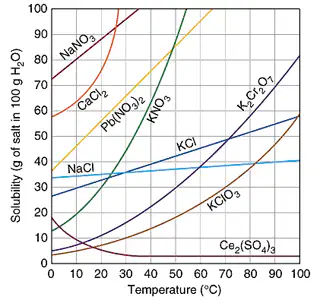
Refer to the solubility curve. In order to have a saturated solution, how many grams of potassium nitrate, KNO₃, need to be dissolved in 100 grams of water at 20°C?
20
30
60
100
Of an 8 M solution of HCl, 1 L is diluted to 2 M. What is the volume of the diluted solution?
0.25 L
4 L
6 L
16 L
A student is conducting a lab on an unknown white substance. The substance is a white crystal and does not melt when placed over a heat source for an extended period of time. What properties should the white substance have to indicate that it is an ionic compound? Select TWO correct answers.
It should have a low melting point.
It should be conductive as a solution.
As a solid, it should be able to dissolve in water.
As a solid, the ions should move when voltage is applied.
Which of the following would result in being able to dissolve a greater amount of gas in a solution?
Cool the gas and solution
Make the gas an electrolyte
Heat the gas and solution
Decrease the pressure of the solution
What are the respective coefficients needed to balance the equation below? __N₂ (g) + __H₂ (g) --> __NH₃ (g)
1, 1, 1
1, 2, 3
1, 3, 2
3, 3, 2
[DRAG-and-DROP]
What type of reaction is represented by the equation X(s) + Y(s) → Z(g) + heat
**heat is being released/EXITING**
Endothermic
Exothermic
Cold energy
Neutral
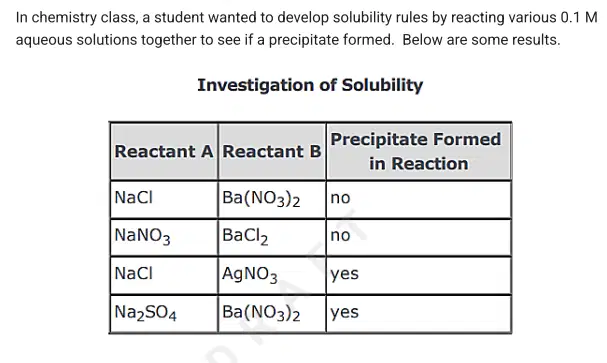
Which of the following conclusions can be made based on the results shown above?
NaNO₃ is insoluble in water.
Ba(NO₃)₂ is insoluble in water.
AgNO₃ is insoluble in water.
AgCl is insoluble in water.
A student is making a solution of sodium carbonate (Na₂CO₃). They mix 0.79 grams of sodium carbonate into 0.05 L of water. What is the molarity of the sodium carbonate solution?
0.15 M Na₂CO₃
1.5 x 10⁻⁴ M Na₂CO₃
6.7 M Na₂CO₃
15.8 M Na₂CO₃

[CONSTRUCTED RESPONSE QUESTION: use your own words]
A student wants to do the following reaction in a lab setting: aluminum + copper (II) chloride → aluminum chloride + copper.
Based on the locations of the metals on the activity series, will the reaction occur? Provide your answer and explanation in the box provided.
Compared to copper, aluminum is higher on the activity series chart, and it can, therefore, bind with chloride and displace copper.
Try not to write word for word as this is a Constructed Response Question.
The reaction will occur because aluminum is more reactive than copper and can displace the reactant in a single replacement reaction.
Use the information from the chart, and think about chemical reactions (single replacements)
In a reaction between aluminum and copper (II) chloride, what is the expected outcome based on the reactivity series?
No reaction occurs
Aluminum chloride and copper are formed
Copper chloride and aluminum are formed
Copper and aluminum chloride are formed
Which of the following metals is the least reactive according to the activity series?
Zinc
Lead
Gold
Iron
Which metal is higher on the activity series chart and can displace copper in a single replacement reaction?
Copper
Aluminum
Iron
Zinc
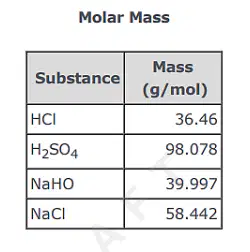
What volume of 2.5M NaHO solution contains 3.25 mol of NaHO?
0.098 L
0.575 L
1.30 L
1.45 L
To make 2000 mL of 0.300 M sulfuric acid, how many mL of a 1.00 M stock solution should be used?
150 mL
600 mL
667 mL
1500 mL
A student has a 5.00 gram sample of calcium chloride (CaCl₂) solid. How many moles of calcium chloride are contained in this sample?
378 moles of CaCl₂
0.0662 moles of CaCl₂
555 moles of CaCl₂
0.0451 moles of CaCl₂
[DRAG-and-DROP] A student was differentiating between the different types of chemical reactions. They created the table below based on what they had learned in science class. Move the correct titles to the chart.
*Things to remember: any product ending with CO2 and H20 [COMBUSTION]
*Think in terms of couples- Person 1 + Person 2 --> couple; A + B --> AB [Synthesis]
*When a couple gets divorced AB --> A + B [Decomposition]
*Lastly, Single Replacement - swapping out with your friend :) A + BC --> AC + B
Which one is an example of single replacement?
CaCO3 ( s ) → CaO(s) + CO2 (g)
Zn( s ) + 2 HCl( aq ) → ZnCl2 ( aq ) + H2 ( g )
4Al(s) + 3O2 (g) → 2Al2O3 ( s )
2C4H10 (g) + 13O2 (g) → 8CO2 ( g ) + 10H2O(g)
For each scenario, determine the impact on the solubility of the substance by indicating whether it will increase, decrease, or have no effect. Select the correct answer in each row. [Match Table Grid]
breaking a solute into smaller pieces - Increase
breaking a solute into smaller pieces - no change
stirring slowly - increase
stirring slowing - no change
For each scenario, determine the impact on the solubility of the substance by indicating whether it will increase, decrease, or have no effect. Select the correct answer in each row. [Match Table Grid]
raising the temperature of a solvent - decrease
raising the temperature of a solvent - Increase
raising the temperature of a solvent - no change
stirring a solute slowly - Increase
[DRAG-and-DROP] A student was differentiating between the different types of chemical reactions. They created the table below based on what they had learned in science class. Move the correct titles to the chart.
*Things to remember: any product ending with CO2 and H20 [COMBUSTION]
*Think in terms of couples- Person 1 + Person 2 --> couple; A + B --> AB [Synthesis]
*When a couple gets divorced AB --> A + B [Decomposition]
*Lastly, Single Replacement - swapping out with your friend :) A + BC --> AC + B
Which one is an example of Combustion?
CaCO3 ( s ) → CaO(s) + CO2 (g)
4Al(s) + 3O2 (g) → 2Al2O3 ( s )
Zn( s ) + 2 HCl( aq ) → ZnCl2 ( aq ) + H2 ( g )
2C4H10 (g) + 13O2 (g) → 8CO2 ( g ) + 10H2O(g)
[DRAG-and-DROP] A student was differentiating between the different types of chemical reactions. They created the table below based on what they had learned in science class. Move the correct titles to the chart.
*Things to remember: any product ending with CO2 and H20 [COMBUSTION]
*Think in terms of couples- Person 1 + Person 2 --> couple; A + B --> AB [Synthesis]
*When a couple gets divorced AB --> A + B [Decomposition]
*Lastly, Single Replacement - swapping out with your friend :) A + BC --> AC + B
Which one is an example of Decomposition?
CaCO3 ( s ) → CaO(s) + CO2 (g)
4Al(s) + 3O2 (g) → 2Al2O3 ( s )
2C4H10 (g) + 13O2 (g) → 8CO2 ( g ) + 10H2O(g)
Zn( s ) + 2 HCl( aq ) → ZnCl2 ( aq ) + H2 ( g )
[DRAG-and-DROP] A student was differentiating between the different types of chemical reactions. They created the table below based on what they had learned in science class. Move the correct titles to the chart.
*Things to remember: any product ending with CO2 and H20 [COMBUSTION]
*Think in terms of couples- Person 1 + Person 2 --> couple; A + B --> AB [Synthesis]
*When a couple gets divorced AB --> A + B [Decomposition]
*Lastly, Single Replacement - swapping out with your friend :) A + BC --> AC + B
Which one is an example of Synthesis?
CaCO3 ( s ) → CaO(s) + CO2 (g)
4Al(s) + 3O2 (g) → 2Al2O3 ( s )
Zn( s ) + 2 HCl( aq ) → ZnCl2 ( aq ) + H2 ( g )
2C4H10 (g) + 13O2 (g) → 8CO2 ( g ) + 10H2O(g)
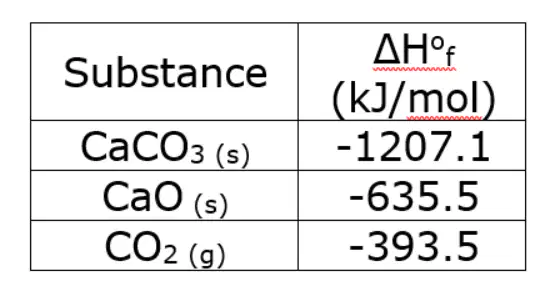
When Calcium Carbonate is heated, the following reaction occurs:
CaCO3 --> CaO (s) + CO2 (g)
The standard enthalpy of reaction of reaction for each substance is shown in the provided table.
What statements correctly classifies the decomposition of calcium carbonate reaction?
The reaction is endothermic because energy is released during the reaction.
The reaction is endothermic because energy is absorbed during the reaction.
The reaction is exothermic because energy is released during the reaction.
The reaction is exothermic because energy is absorbed during the reaction.

